A New Jersey Tenant's Guide to NJPDES Permits, Drains, Outdoor Storage, and Lease Language Before You Sign
Signing a lease on an industrial building in New Jersey can feel like the finish line, but stormwater is one of the few compliance issues that moves into the building with you. The landlord may say the property is covered, a broker may mention an old permit, and the previous tenant's name may still be on file with NJDEP. If you're the one who will be running operations there, you're the one an inspector will ask about runoff, drains, and plans.
This article walks through the questions to ask before you sign: whether an NJPDES authorization already exists and whose name it's in, which permit category applies, what's exposed outdoors, where the drains go, and what the lease says. Coverage usually follows the operator, so tenants may need their own, and we explain why. A checklist at the end pulls it together, and if you'd like a second opinion on a specific building, you can reach out to RMA and we'll tell you plainly what you'll need, including when the answer is nothing.
Table of Contents
TL;DR
Before you sign an industrial lease in New Jersey, find out whether an NJPDES stormwater authorization exists for the building and whose name it's in, because coverage usually follows the operator and you may need your own. Confirm which permit category fits your business, what you'll keep outdoors, and whether the drains lead to a storm sewer or a combined sewer. Then make sure the lease says who handles the permit, the plan, inspections, and the site's pre-existing conditions. Many warehouse and similar tenants don't need a permit, but you want to know that before you move in.
Why Should Tenants Ask About NJPDES Stormwater Permits Before Signing an Industrial Lease?
In New Jersey, rain that touches industrial materials and then runs off a property is regulated by NJDEP under the New Jersey Pollutant Discharge Elimination System (NJPDES), the state's version of the federal NPDES program. Plenty of first-time industrial tenants have never heard of it. Facilities with stormwater associated with industrial activity have to request authorization from NJDEP, and the agency looks to whoever is running the operation, not whoever holds the deed.
Lease negotiations rarely touch any of this. Broker tours focus on dock doors, power, ceiling height, and rent. Then six months after move-in, an inspector or a customer's auditor asks for your stormwater permit, and you learn the building has none, or that the one on file belongs to a company that left years ago. Fixing it at that point means doing the work on a landlord's property, sometimes under a lease that already says it's your problem.
Plenty of tenants don't need a permit at all. Warehouses, data centers, body shops, dealerships, and quick-lube shops are often in that group, depending on the SIC code, what sits outside, and where the water goes. The point of the questions below is to find out which situation you're in before you sign, while you can still negotiate. For a broader look at who needs a stormwater permit, we've covered it separately.
Does NJPDES Stormwater Permit Coverage Follow the Operator or the Property?
Coverage usually follows the operator, meaning the company actually running the industrial activity at the site. Authorization is issued to a named permittee for a specific facility, so a new company moving into a building generally can't borrow the last tenant's coverage. A tenant may need to obtain its own authorization, or have the existing one formally transferred, before it starts operating.
New Jersey's rules spell out how a transfer works. Under N.J.A.C. 7:14A-16.2, the current permittee has to give NJDEP written notice at least 30 days before the proposed transfer date. That notice includes the new owner's and operator's names and addresses, the permit number, the responsible officers, and a written agreement between the two parties that sets a specific date for the handoff. The general permits also carry their own provisions for a change of owner or operating entity. If the prior tenant moved out without any of that happening, there's nothing for you to inherit.
Multi-tenant buildings add a wrinkle. If the landlord holds one authorization for the whole property, what it covers depends on who controls the activities and the drainage, and on the terms of that permit category. Don't assume the landlord's coverage reaches your operation. Ask, get the answer in writing, and confirm it against the current permit before you rely on it.
Is There an Existing NJPDES Authorization at the Property, and Whose Name Is It In?
Start by asking the landlord for the permit number, the permit category, the permittee's name, and the effective date of authorization. Then check the name. It might be the previous tenant's LLC, the landlord, or a company that no longer exists. If the permittee isn't you, plan on treating the building as uncovered for your purposes until a transfer or new authorization is in place. NJDEP's online systems can show what's on file, so verify instead of taking a broker's word for it.
Ask for the paperwork behind the permit as well. That means the facility's stormwater pollution prevention plan, which New Jersey's permits call an SPPP and which is sometimes called an SP3 or just a stormwater plan (we'll call it a SWPPP here), plus the most recent annual inspection and certification records and any NJDEP correspondence or notices of violation. A permit with no current plan behind it, or a plan nobody has touched in years, tells you the property has been out of compliance and that you'd be inheriting the cleanup. If you want a refresher on what a SWPPP is, we've written it up in plain language.
Ask about the property's history too. Stained soil, old spill reports, or past enforcement can follow a site from tenant to tenant, and a Phase I environmental site assessment is a normal way to look at that before you commit.
Which NJPDES Permit Category Applies to the Site?
New Jersey doesn't run on one stormwater permit. The Basic Industrial Stormwater General Permit (5G2) is the broad one that isn't tied to a single industry. NJDEP also issues industry-specific general permits: Concrete Products Manufacturing (CPM), Hot Mix Asphalt (R4), Mining and Quarrying (R13), Sand and Gravel (RSG), Scrap Metal (SM and SM2), Vehicle Recycling (RVR), and Wood Waste Recycling and Leaf Composting (WRC). Some facilities need an individual permit, and facilities that keep every industrial material and activity protected from rain may qualify for an exclusion instead of a permit. Our posts on the 5G2 Basic Industrial Stormwater General Permit and the individual NJPDES industrial permit go deeper on those two.
The category on file for a building reflects the last tenant's business, not yours. A unit that housed a machine shop under 5G2 won't automatically fit your operation, and a change in use can push you into a different category or out of permitting altogether. Which one applies turns on your SIC code, your activities, and where your water goes, so we don't recommend assuming. For a walkthrough of general, individual, and no exposure permits, start there.
Ask the landlord whether the lease restricts your use to the prior tenant's type of operation. If your business sits in a different category, the existing paperwork may be useful background but it won't be your coverage.
What Is Exposed Outdoors at the Property and at Your Operation?
Exposure is what drives most of the permit decision, so walk the site with a short list of questions. What's sitting outside right now? Look at dumpsters without lids, pallets of material, scrap, drums, outdoor equipment, areas where vehicles are washed or fueled, loading docks where product gets handled in the rain, and any staining on pavement or around the drains. Then ask what you plan to put outside. A tenant who keeps everything indoors is in a very different position from one who stores material in the yard.
Leftover conditions count. Residue from the previous tenant's operations can end up in runoff that leaves the property under your name once you're the operator. Photograph what you find before move-in, and put it in the lease file.
If your operation could be moved indoors or under cover, ask whether the lease lets you build a canopy, an enclosure, or covered storage. For some tenants, covering materials so they qualify for the no exposure exclusion is worth weighing against carrying a permit year after year. NJDEP has its own process and current requirements for that exclusion, so confirm those before you plan around it. Our article explains what no exposure means, and the lines between stormwater and process water are worth understanding if your process creates wastewater.
Where Do the Drains Go: Storm Sewer, Groundwater, or Combined Sewer?
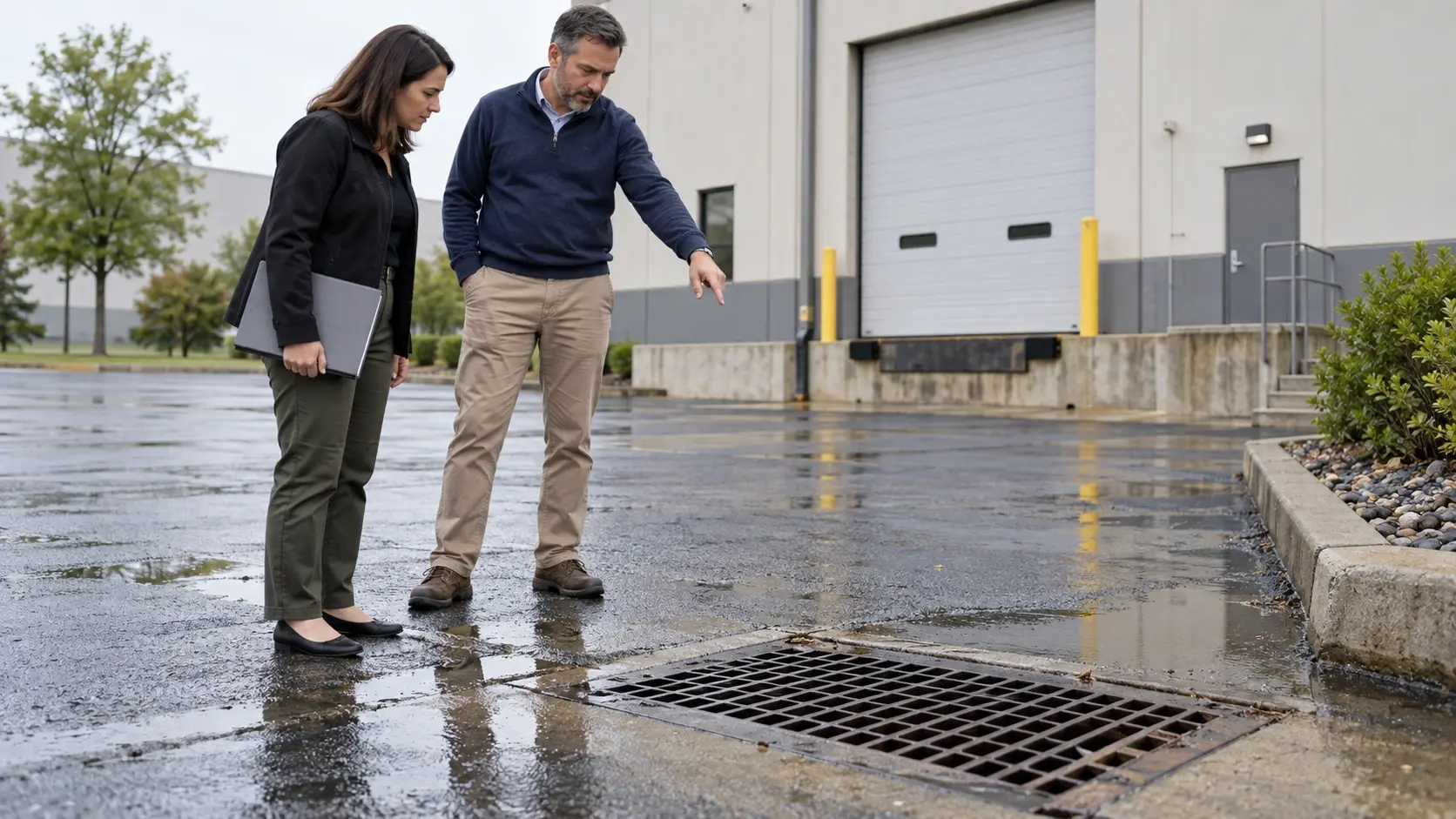
Where the drains lead changes which rules apply. Water might flow to a stream, ditch, or municipal storm sewer, soak into the ground through dry wells or infiltration areas, or enter a sanitary or combined sewer that ends at a sewerage authority's treatment plant. New Jersey's permits cover discharges to surface water and groundwater, so a site with no obvious outfall isn't automatically free of obligations.
A combined sewer carries rainwater and sewage in the same pipe. Several older New Jersey cities have them, and NJDEP has issued individual permits covering combined sewer overflow outfalls in 21 municipalities, including places like Newark, Jersey City, Paterson, Camden, and Elizabeth. Where your runoff goes into a sewer system run by a sewerage authority, that authority's rules may apply instead of, or alongside, an NJPDES stormwater permit. We never tell a tenant flatly that a facility in a particular city does or doesn't need a stormwater permit, because cities like Newark have both separated and combined sections. The connections at your specific property decide it.
To find out, ask the landlord for the site plan or as-built drainage drawings. Then call the municipal engineer and the local sewerage authority and ask where that parcel's catch basins and roof leaders connect. If the drawings are missing or the answers don't agree, an on-site inspection or dye test can sort it out before you sign.
What Should an Industrial Lease Say About Stormwater Responsibility?
Standard industrial leases usually push compliance with environmental laws onto the tenant in one general clause and say nothing more specific. For stormwater, it's worth asking for more detail. At minimum, ask your attorney to look at who holds and maintains the NJPDES authorization, who prepares and updates the SWPPP, and who pays for inspections and any sampling the permit requires. Sampling requirements vary by permit category, and some permits require none, so the answer depends on which one applies to you.
Also look at who maintains the drainage structures, such as catch basins, pavement, and oil and water separators, and whether you can alter site drainage. Check that NJDEP inspectors can get access when needed. Document the baseline condition of the site at move-in, with photos and a written walk-through, and ask for an indemnity covering conditions that existed before you arrived. At the other end of the lease, spell out what happens to the permit: whether it's terminated or transferred, and who handles any cleanup.
If you'll be storing oil, fuel, or other petroleum products on site, that falls under a separate plan. We explain the difference between an SPCC plan and a SWPPP in a separate post. And because lease terms carry legal weight, treat this section as a list of questions for your attorney, not legal advice from us.
Stormwater Checklist for Leasing Industrial Space in New Jersey
Here's the full list in one place. Print it, take it on the site tour, and send the open items to the landlord before you negotiate.
| Question to ask |
What to look for |
Who can answer |
| Is there an existing NJPDES authorization? |
Get the permit number, category, and effective date of authorization, then verify with NJDEP. |
Landlord, then NJDEP records |
| Whose name is on it? |
If it belongs to a prior tenant or a defunct company, plan on starting from scratch or arranging a formal transfer. |
Landlord, prior tenant, NJDEP records |
| Which permit category fits your operation? |
5G2, an industry-specific permit, an individual permit, or no exposure. It turns on SIC code and activities. |
Your consultant or NJDEP |
| Is there a current SWPPP, and was it followed? |
Ask for the plan, annual inspection and certification records, and any NJDEP notices. |
Landlord or prior tenant |
| What is outside now, and what will you store outside? |
Exposure decides whether you need a permit or may qualify for an exclusion. |
Site walk and your operations team |
| Is there any history of spills or contamination? |
Stained soil and old reports can follow the site. Consider a Phase I environmental site assessment. |
Landlord, site walk, environmental consultant |
| Where do the drains go? |
Storm sewer, groundwater, sanitary sewer, or combined sewer. Sewerage authority rules may apply. |
Site plans, municipal engineer, sewerage authority |
| Is the building multi-tenant with shared drainage? |
Other tenants' activities can affect shared drains, and the landlord's coverage may not reach you. |
Landlord and property manager |
| What does the lease say about stormwater? |
Responsibility for the permit, plan, inspections, sampling, drainage upkeep, and lease-end handling. |
Your attorney |
| Will you do construction or build-out? |
Construction-phase approvals are a separate track from operational permits. |
Your engineer and contractor |
If most of these come back as "we don't know," that's useful information in itself. It tells you the property's stormwater paperwork needs work, and it gives you grounds to ask for a rent concession, a longer fit-out period, or landlord cooperation on getting things in order.
What About Construction or Build-Out Before You Move In?
Building a new facility or doing major site work triggers a separate set of requirements from the operational permits above. At a high level, those can include NJPDES construction stormwater coverage (the 5G3 general permit), soil erosion and sediment control certification through the local Soil Conservation District, the stormwater management rules for major development under N.J.A.C. 7:8, and municipal site plan approvals. Whether a tenant fit-out triggers any of them depends on how much ground gets disturbed and what the town requires, and your engineer, contractor, or the landlord's site team is the right source for that answer.
We don't prepare construction-phase permits or approvals, and we don't want you to think we do. Where we help is the operational side once the doors open. A new or expanded facility almost always needs the right NJPDES industrial permit or a no exposure exclusion, a SWPPP, inspections and annual certification, sampling where the permit requires it, and often an SPCC plan and Community Right to Know reporting. We're also glad to help you work out what the construction phase involves and point you toward the right construction professionals. Allow time for the operational side as well, and we cover how long a New Jersey stormwater permit takes in a separate article.
How Can RMA Help With NJPDES Stormwater Before You Sign an Industrial Lease?
We're a family-run firm based in New Jersey, and we've worked with NJDEP and the state's permit categories since 1992. If you're weighing a specific building, we'll look at the property and your operation, tell you which NJPDES permit category fits or whether you probably don't need one, review whatever authorization and SWPPP the landlord can produce, and flag the lease points to raise with your attorney. Senior people do the work, and if a simpler route exists, we'll say so.
There's no pressure and no obligation. You can call us at 888-RMA-0230, email, or fill out the form on our website, and we'll let you know whether we're the right fit. If you're ready to talk through a building, contact RMA and we'll take it from there. Once you're in, our online training library can help your team handle any stormwater training your permit calls for.