How to Find NJDEP's SPPP Forms, Pick the Ones That Fit Your Permit, and Fill Them In With Verified, Site-Specific Information
If your facility needs a stormwater plan in New Jersey, you've probably searched for a template and landed on a pile of results that look right and mostly aren't. Some are for construction sites, some are for towns, and some come from other states with different permits and different vocabulary. A stormwater pollution prevention plan is what we call a SWPPP, though NJDEP (the New Jersey Department of Environmental Protection) calls it an SPPP, and you'll also hear SP3 or just "the stormwater plan." The short answer to your search is yes: NJDEP publishes free SPPP forms for one specific permit, the Basic Industrial Stormwater General Permit, known as the 5G2. Whether those forms are the right ones for your facility depends on which permit you're under, and filling them in well depends on information only you can supply.
In this article we'll show you how to tell which template applies, where to download NJDEP's forms and guidance, and how to fill in each form with verified, site-specific information instead of guesses. We'll also be straight about the situations where a template won't get you there. If you'd rather talk it through, you can reach out to RMA at any point, and if the forms are all you need, you won't need us.
Table of Contents
TL;DR
Yes, NJDEP publishes a free set of SPPP forms and a guidance document for its Basic Industrial Stormwater General Permit (the 5G2), and you'll find them on the 5G2 page of NJDEP's stormwater website. They only fit facilities that keep their industrial materials and activities out of the rain. If you're under an industry-specific permit, an individual permit, or one of the municipal programs, the plan requirements are different. The forms are easy to download, but the answers have to come from walking your site and pulling your own paperwork.
Does New Jersey Offer an Official SWPPP Template?
Yes, with a catch. NJDEP's page for the Basic Industrial Stormwater Permit (5G2) lists a set of SPPP forms under its guidance documents. Right beside them you'll find the 5G2 certification form and a guidance document NJDEP last revised in February 2013. The forms are blank, fill-in pages, and the guidance walks through what each one asks for.
The catch is what the 5G2 covers. NJDEP describes it as available to regulated industrial facilities that have eliminated, or can eliminate within six months of authorization, all exposure of industrial materials and activities to stormwater, meaning rainfall and snowmelt. You do that by putting things under cover or moving them indoors. So the NJDEP template is a plan for keeping materials and activities away from stormwater, not a plan for managing runoff you can't avoid. A facility with open stockpiles, outdoor processing, or equipment that has to live in the weather often can't use the 5G2 at all. Our guide to the 5G2 basic industrial stormwater permit in New Jersey covers who qualifies, and our article on the individual NJPDES industrial permit covers what comes next when you don't. NJPDES is the New Jersey Pollutant Discharge Elimination System, the state's version of the federal NPDES permit program.
Which New Jersey SPPP Template Fits Your Stormwater Permit?
Search results for "New Jersey SWPPP template" mix several different documents, and they aren't interchangeable. Your NJDEP authorization paperwork names the permit you're covered under, and that tells you which row of this table is yours. If you're not sure, our article on which NPDES permit you need can help you sort it out.
| If you're covered by |
The plan template you'll find |
Where to check |
| The Basic Industrial Stormwater General Permit (5G2) |
NJDEP's industrial SPPP form set and guidance document |
NJDEP's 5G2 page and your permit |
| An industry-specific general permit (concrete products, hot mix asphalt, mining and quarrying, sand and gravel, scrap metal, vehicle recycling, or wood waste recycling and leaf composting) |
Plan requirements written into that permit. We wouldn't assume the 5G2 forms satisfy them. |
The plan section of your specific permit |
| An individual NJPDES stormwater permit |
No standard form set. The plan requirements are in your permit conditions. |
Your permit itself |
| A municipal, county, or highway agency stormwater permit |
A separate SPPP form set numbered 1 through 15, built for local governments |
Not a fit for an industrial facility |
| Nothing yet, and you're comparing templates from EPA or other states |
Plans built around a different permit, usually called a SWPPP |
Skip these for a New Jersey industrial facility |
Construction sites sit outside this table on purpose. They have their own permit and their own plan under 5G3 construction stormwater coverage, plus soil erosion and sediment control approvals through the local Soil Conservation District. That's construction-phase work RMA doesn't prepare, so if you're building or expanding, your engineer or contractor is the right call for that piece. Once the facility is running, though, it'll need one of the operational permits in the table, and that's the plan we're covering here.
Start on NJDEP's Basic Industrial Stormwater Permit (5G2) page, which sits under the industrial stormwater section of the department's stormwater website. The page groups what you need into a few blocks. Permit documents hold the current master general permit and its fact sheet. Guidance documents hold the 5G2 certification form, the general guidance document, the SPPP forms, and a marina edition of the guidance. The application forms and checklists, including the Request for Authorization (RFA) checklist and the supplemental application form, are listed on NJDEP's permit forms page for stormwater permits.
Even if you're not a marina, the marina edition of the guidance is worth a look. NJDEP has included worked examples of filled-in forms in it, and seeing a completed Form 2 or a completed site map is the quickest way to learn what level of detail the department expects.
Download the current set directly from NJDEP rather than grabbing a copy from somewhere else. Copies of the forms get posted on consultant sites, trade association pages, and document-sharing sites, and some are years old. Form numbering has changed over time. The 2007 marina guidance describes ten forms, including an initial facility assessment, while the set we're working from today has nine. Use whatever numbering and wording your downloaded set has, and read the plan section of the permit itself, since the forms are NJDEP's convenient way to document what the permit requires.
NJDEP's 5G2 certification form says not to submit the plan with it. The plan stays at your facility, and you hand it over when NJDEP asks to see it. Since nobody reviews it up front, keeping it accurate is up to you.
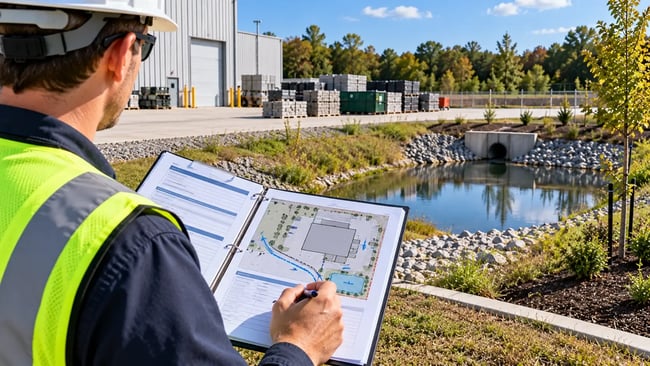
Every form in the 5G2 set opens with the same facility information block, so it pays to get it right once and copy it. The block asks for the facility name, the county, the NJPDES number (which starts with NJG for general permits), the Program Interest (PI) ID number, the name and title of the team member completing the form, the effective date of permit authorization, the date of completion, and the date of the most recent update.
NJDEP's guidance points you to the Authorization to Discharge page of your permit paperwork for the facility name, NJPDES number, PI ID, and effective date. Copy them exactly as printed there. The facility name should match what's on your authorization, even if the business has since rebranded, and the date of most recent update should change every time your operations or your team change. If you can't find your authorization paperwork, track it down before you draft anything, since every number on these forms depends on it.
The nine forms in the set we're looking at follow a logical order: who's responsible, what's on site, where water goes, how you'll keep materials out of it, and how you'll prove you did. The table below shows what each form asks for and where the real answer comes from, because "verified" means it came from somewhere other than memory.
| Form |
What it asks for |
Where the verified answer comes from |
| 1: Team Members |
Facility contact, plus each team member's title, office and emergency phone numbers, and responsibilities |
Ask each person, and confirm they know they're on the list |
| 2: Inventory Requirements |
Industrial activities, source materials (use, storage, handling, quantity), non-stormwater discharges, other NJDEP permits |
A site walk, purchasing records, your chemical inventory, and your permit list |
| 3: Developing a Site Map |
A map of buildings, paving, drainage, discharge points, and every spot where materials or activities sit outdoors |
Engineered site drawings if you have them, then a walk to confirm |
| 4: Best Management Practices |
For each source material or activity, the corrective action or BMP and a scheduled completion date |
Decisions your management has made and funded |
| 5: Maintenance Plan |
How structural BMPs get maintained and repaired, how non-structural ones get updated, and any problem areas |
Whoever maintains the buildings, covers, and equipment |
| 6: Inspection Schedule |
A log of monthly inspections: date, whether BMPs are in place, problems found, and fixes with dates |
Real inspections, recorded when they happen |
| 7: Coordination With Other Plans |
Where your TRI forms, SPCC plan, N.J.A.C. 7:1E discharge prevention plans, and other plans (such as a PPC plan or OSHA emergency action plan) are kept |
Wherever those documents live, or a plain note that none apply |
| 8: Employee Training |
An annual training log: date, topic, and who attended |
Sign-in sheets and training records |
| 9: Annual Inspection Schedule |
The date of each annual inspection and whether you were in or out of compliance |
A full walk-through by a designated team member |
How Do You Build an Accurate Source Material Inventory and Site Map?
Forms 2 and 3 do most of the work, and they're where plans go wrong. NJDEP's term "source material" covers anything tied to your industrial activity that could pollute stormwater: raw materials, fuels, lubricants, solvents, waste, machinery fluids, and containers like drums and dumpsters that hold industrial waste. NJDEP's guidance has used a simple screen. Is the material a liquid that rain can carry? Is it eroding or easy to erode? Does it dissolve? Does it break down or corrode and add pollutants? Does it add color or odor to water? A yes to any of those makes it a source material. Walk the yard with someone from operations and someone from purchasing, and if you can, do it during or right after a rain, because puddles and flow paths show you where water goes better than a drawing does.
The site map is a scaled drawing, and NJDEP's guidance accepts existing engineered drawings or a hand-drawn map as long as every feature is clearly labeled. It should show buildings, paved areas, how water moves across the site (storm sewers, sheet flow, rooftop drainage, swales, ditches), where water leaves the site, and every location where source materials are stored or industrial activities happen outdoors. Loading and unloading areas, dust-generating processes, and hazardous waste storage areas all belong on it.
Form 2 also asks you to list non-stormwater discharges and any permit that covers them. The 5G2 covers stormwater, and NJDEP's guidance has been plain that process wastewater, non-contact cooling water, and domestic sewage aren't authorized by it. If your inventory turns one up, the fix is stopping it, routing it somewhere that's permitted, or getting the right permit. A plan form can't paper over it.
How Do You Write BMPs You Can Carry Out?
Form 4 pairs every source material or activity from Form 2 with a best management practice (BMP) and a completion date. Under the 5G2 the goal is elimination of exposure, so the entries look like covering the material, moving it indoors, relocating equipment under a roof, tarping, recycling a waste stream, or ending the activity. Write only what you'll do, and date it realistically. NJDEP describes the annual inspection as a check that your plan is current, in place, and working, which means every line in Form 4 is something you'll be measured against. Our overview of stormwater BMPs shows what the options look like in practice.
Forms 5, 6, 8, and 9 keep the plan alive after the first draft. Someone has to maintain the covers and containment, log monthly inspections, run annual training, and complete the annual inspection, and a form that's filled in once and never touched again is the most common way these plans fall out of date. Our guide to doing a stormwater visual inspection the right way helps with the monthly walk, and our online environmental training library is one option for the training log. For Form 7, our article on the difference between an SPCC plan and a SWPPP explains how the two plans fit together.
When Is a New Jersey SWPPP Template Not Enough?
For a small, tidy facility that's genuinely covered by the 5G2, filling in NJDEP's forms yourself is a reasonable plan. Nothing about them requires a consultant, and our article on writing your own SWPPP goes through what that takes. If your site is simple and your team has an afternoon to walk it, you may not need us at all.
A template stops being enough when the facts don't fit the form. If you can't cover or move every exposed material and activity, the 5G2 probably isn't your permit, and no amount of careful form-filling changes that. If you're under an industry-specific or individual permit, your plan has to meet requirements written into that permit, and a form set built for a different one can leave gaps you won't see until an inspection. If your inventory turns up process water, you have a discharge question that's bigger than a plan. And if you're not sure which permit applies, settle that first, because everything else flows from it. Our overview of NJPDES stormwater permit requirements is a good place to start.
Existing plans need attention too. A plan written years ago for a different layout, different materials, or a different team is out of date, and Form 1 and Form 2 will say so the moment you compare them to what's on site. Our quick guide to navigating your stormwater plan is a useful read for whoever inherits one.
How Does RMA Help With a New Jersey SWPPP?
We're a New Jersey firm, and we work with NJDEP's stormwater permits and forms regularly. Depending on where you're starting, we can review a plan you've drafted, tell you whether the 5G2 truly fits your site, write or update the plan with you, or train your team to keep it current. If your facility doesn't need us, we'll say so. And if the answer turns out to involve engineered controls or construction-phase permits, we'll point you toward the right people for that piece and stay focused on the operational permits and plans your facility needs once it's running.
There's no pressure and no obligation. You can call, email, or fill out the form on our website, and we'll look at your situation and tell you plainly what makes sense. To get started, contact RMA whenever you're ready.