Comparing Pennsylvania's No Exposure Certification and the PAG-03 Industrial Stormwater Permit, and How to Tell Which One Fits Your Site
If your facility falls into one of the industrial categories Pennsylvania regulates for stormwater, you've got a choice to make. Either you get covered under PAG-03, the state's general permit for industrial stormwater, or you show PA DEP that rain and snow never touch your industrial materials or activities and file a No Exposure Certification. If everything industrial at your site is indoors, under a roof, or sealed tight, No Exposure is usually the better fit. If anything industrial sits out in the weather, you're looking at PAG-03, along with the plan, inspections, sampling, and reporting that come with it.
The tricky part is that most facilities aren't purely one or the other. A plant that runs almost entirely indoors might still have an open dumpster or a few drums of used oil on the loading dock. Below, we compare the two paths, walk through what each requires, give you questions to ask about your own site, and look at when modest changes can move a facility from PAG-03 to No Exposure. If you'd rather talk it through, feel free to reach out to RMA.
Table of Contents
TL;DR
If no industrial materials or activities anywhere on your site are exposed to rain, snow, or runoff, a No Exposure Certification is usually the better fit, since it skips PAG-03's ongoing sampling, inspections, and reporting. If anything industrial is exposed, you need PAG-03 coverage with a PPC Plan, semiannual sampling, inspections, and annual reporting. Some sites can qualify for No Exposure by covering outdoor storage or moving work inside, and DEP makes the final call on borderline cases.
No Exposure vs. PAG-03 in Pennsylvania: A Side-by-Side Comparison
Both paths start the same way: your SIC code or activities put you in a category DEP regulates under the federal NPDES program (the Clean Water Act permit system for discharges to waterways) and Pennsylvania's Clean Streams Law. If you aren't sure you're in a covered category, our guide to stormwater associated with industrial activity is a good starting point. Here's how the two paths compare.
| Factor |
No Exposure Certification |
PAG-03 General Permit |
| Who it fits |
Sites where every industrial material and activity is sheltered from precipitation and runoff |
Covered sites with any exposed industrial activity or material |
| Paperwork to get started |
No Exposure application filed together with a PAG-03 Notice of Intent (NOI) and filing fee |
NOI, site plan, topographic map, PPC Plan, and filing fee |
| Written plan |
PPC Plan only if your answers about material storage and handling call for one |
PPC Plan required and kept current |
| Stormwater sampling |
One grab sample with the application (existing facilities); no routine sampling after |
Semiannual sampling for the parameters in your industry's appendix, including total nitrogen and total phosphorus |
| Ongoing tasks |
Keep the no exposure condition in place facility-wide; allow DEP inspections |
Inspections, BMP upkeep, training, recordkeeping, corrective action |
| Reporting |
No eDMRs or PAG-03 annual reports |
Sampling results through eDMR, plus an annual report and $500 annual fee installment due March 23 |
| Renewal |
Every five years, by the date in DEP's approval letter |
New NOI when DEP reissues PAG-03 (current permit runs through March 23, 2028) |
| Typical effort |
Mostly upfront, then light maintenance |
Steady work every year of coverage |
There's also a third path. A facility that isn't eligible for PAG-03, often because it discharges to High Quality or Exceptional Value waters, may need an individual NPDES permit, and No Exposure isn't available for those waters either. We cover all three in our guide to general, individual, and No Exposure permits, but most facilities are choosing between the two in the table.
What Counts as Exposure Under Pennsylvania's No Exposure Rules?
Pennsylvania's No Exposure Certification comes from a federal rule (40 CFR 122.26(g)) adopted through 25 Pa. Code Chapter 92a. "No exposure" means every industrial material and activity is protected by a storm resistant shelter. That covers raw materials, byproducts, waste, machinery, and material handling like loading and storage.
DEP's application lists the usual suspects, like outdoor processing, loading areas, storage piles, dumpsters, outdoor fueling or washing, spill residue, and particulates from roof vents, and asks whether each is exposed now or will be within five years. A single "yes" makes the site ineligible, so if you're planning an outdoor staging area next year, you can't certify no exposure today.
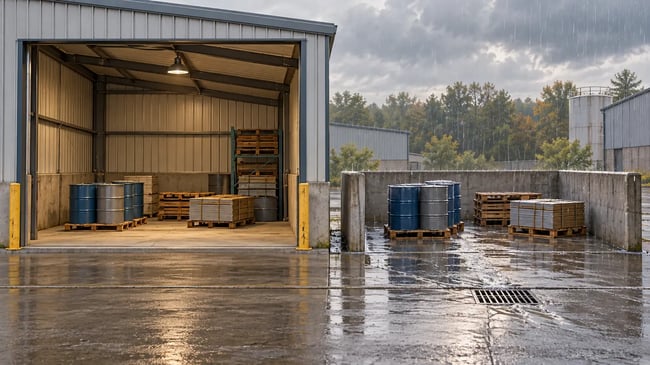
A few things don't need a roof. Drums, barrels, and tanks can stay outside if they're tightly sealed (no working taps or valves), in good condition, and not leaking. Adequately maintained vehicles used in material handling can be outside, and so can final products that won't wash off into stormwater. Rock salt is DEP's example of a final product that doesn't get this break.
No Exposure is also all or nothing. DEP won't approve it for one corner of your property while the rest stays under PAG-03. For the federal background, our article on what non-exposure means under an NPDES stormwater permit covers it from a national angle.
What PAG-03 Coverage Requires Year After Year
DEP reissued PAG-03 effective March 24, 2023, and the current version runs through March 23, 2028. Getting covered starts with an NOI package that includes a site plan, a topographic map, and a Preparedness, Prevention and Contingency (PPC) Plan, Pennsylvania's counterpart to the SWPPP other states use. Our comparison of SWPPPs and PPC Plans for PAG-03 explains how the two line up.
Once you're covered, you sample your outfalls twice a year for the parameters in your industry's appendix. Since 2023, every appendix includes total nitrogen and total phosphorus on top of sector parameters like pH, suspended solids, and metals. Results get reported electronically through DEP's eDMR system, which we walk through in our guide to Pennsylvania eDMR reporting. You also inspect the site, maintain your best management practices, train staff, and keep records.
By March 23 each year, you file an annual report and pay a $500 fee installment. If the same pollutant exceeds its benchmark in two consecutive monitoring periods, you need a corrective action plan. Benchmarks aren't effluent limits, so an exceedance isn't automatically a violation, but it does trigger work. Our article on benchmark values vs. effluent limits explains the difference. None of it is hard for a well-run facility, but it doesn't stop while you hold the permit.
What a Pennsylvania No Exposure Certification Requires
No Exposure runs through the same front door as PAG-03. You file DEP's No Exposure Certification application with a PAG-03 NOI and the filing fee, answer the exposure questions, sign a certification under penalty of law, and agree to let DEP inspect the site. If you drain to a municipal separate storm sewer system, that system's operator can ask for a copy and inspect too.
Existing facilities also submit at least one grab sample from a representative outfall, collected early in a qualifying storm and analyzed for common parameters like oil and grease, suspended solids, nutrients, pH, and iron. DEP compares the results to values it considers typical of a no exposure site. A high result doesn't automatically disqualify you, but it raises questions. Our tips on taking a good stormwater sample apply here too. New facilities that haven't started operating skip this step.
Depending on how you answer the storage and handling questions, you may need to attach a PPC Plan even for No Exposure. The site also can't have non-stormwater discharges beyond the short list PAG-03 allows, so process water or washwater going to a storm drain rules you out. Our explanation of the difference between stormwater and process water helps sort that out.
An approved certification lasts up to five years. The approval letter sets a renewal due date well before expiration, so calendar it right away.
Questions to Ask About Your Site Before Choosing No Exposure or PAG-03
Walk your property on a rainy day and look at it the way an inspector would, including the back lot, the area behind the maintenance shop, and wherever pallets pile up. These questions will tell you a lot.
| Question About Your Site |
If the Answer Is Yes |
| Is any raw material, scrap, or waste stored outside without a roof or cover? |
Points to PAG-03 unless you can cover it or move it inside |
| Do you load or unload materials in an uncovered area? |
Exposure, though a canopy over the dock may fix it |
| Do you fuel, wash, or maintain vehicles or equipment outdoors? |
Exposure in most cases |
| Are dumpsters or roll-offs left open to the rain? |
Exposure, often solved with lids or covers kept closed |
| Are there drums or totes outside with open bungs, taps, or signs of leaking? |
Exposure, since only sealed, sound containers get a pass |
| Do roof vents or stacks leave visible residue on the roof or pavement? |
Potential exposure that DEP will look at closely |
| Is there staining, spilled material, or residue in your storm inlets? |
Exposure until it's cleaned up and the source is fixed |
| Will any of this change in the next five years? |
Plan for the site you'll have, not just the one you have today |
If you answered no to every question, No Exposure is probably a realistic option. If you answered yes to one or two, keep reading, because those are often the facilities that can switch with some targeted changes. If you answered yes to most, PAG-03 is almost certainly your path, and your energy is better spent on a solid PPC Plan than chasing a certification your site can't support.
Can Small Site Changes Qualify You for No Exposure Instead of PAG-03?
Often, yes. A lot of Pennsylvania facilities end up under PAG-03 because of a handful of exposure points rather than anything about their core operations. A manufacturer that does all its production indoors might be exposed only because of a scrap bin by the back door and a used oil drum on the dock. Fixing those two things could move that site from a permit with semiannual sampling to a certification that needs attention once every five years.
Common fixes include moving outdoor storage into an existing building, keeping dumpster lids closed, swapping open containers for sealed ones, adding a canopy over a dock or fueling area, bringing maintenance inside, and cleaning out stained storm inlets. Sometimes it's just changing where the crew stages materials at the end of a shift.
Bigger fixes can make sense too, but think them through. Building a new roof structure or enclosure may need local building permits or township approvals, and DEP's certification doesn't authorize any construction. We don't handle building permits or other construction-phase approvals, so that part usually goes through your contractor or engineer. What we can do is help you figure out which changes would get your site to no exposure before anyone spends money on steel.
The change has to stick. A dumpster lid propped open every afternoon isn't no exposure. If the fix depends on daily discipline, ask whether your crew will keep it up through a busy season with turnover.
Comparing the Cost of No Exposure and PAG-03 Over Time
The cost difference between the two paths shows up over years, not on the first invoice. Both start with an application and the same filing fee, and both need someone to evaluate the site carefully. After that, they split. PAG-03 adds a $500 annual fee installment, two rounds of lab analysis every year, staff time for inspections and recordkeeping, eDMR and annual report filings, PPC Plan updates, and the possibility of corrective action if results run high. Over a five-year permit term, that adds up.
For professional help, a relatively straightforward PAG-03 application typically runs about $5,000 to $10,000, and ongoing compliance support often runs another $3,000 to $6,000 per year, depending on the site and how much your own staff handles. Our article on what a PAG-03 permit costs in Pennsylvania breaks those numbers down. A No Exposure Certification usually means a smaller upfront project and very little recurring cost, which is why spending a few thousand dollars on covers, lids, or relocated storage can pay for itself within a couple of years.
That math only works if the site can truly hold the no exposure condition. If you'll be fighting to keep it, or if your business is likely to add outdoor operations soon, the savings disappear fast. If you want a quick estimate of what our help would cost for your situation, whichever path you're on, use the free calculator below. There's no email required and no sales call.
Borderline No Exposure Cases and Why PA DEP Makes the Final Call
Plenty of facilities don't fit neatly into either box. A warehouse with a covered dock where wind-driven rain still reaches the edge of the pad. A plant whose roof vent leaves a little dust behind. Finished steel products stored outside, which may or may not count as final products that don't wash off, depending on coatings and residue. These are judgment calls.
In the end, DEP decides. Filing a No Exposure Certification doesn't guarantee approval, and if DEP concludes that stormwater from your site contributes or is likely to contribute pollutants to surface waters, it can require permit coverage instead. DEP's regional offices may also want to see the site before approving, and the inspection rights you agree to on the application don't expire once you're approved. Our article on what happens during a PA DEP stormwater inspection gives you a sense of what they look at.
For borderline sites, document your reasoning with photos, a description of how each exposure point is controlled, and a clean sample result. Local rules matter too. If your site drains to a municipal storm sewer or a combined sewer, your municipality or sewer authority may have its own requirements, so check with them about your specific situation.
What Happens If Exposure Returns After Your No Exposure Certification?
A No Exposure Certification isn't a permanent exemption. It's a conditional exclusion that lasts only as long as the conditions do. If operations change and industrial materials or activities become exposed, you can no longer certify no exposure, and you need to notify DEP and get PAG-03 coverage or an individual permit before stormwater from the exposed activity is discharged. That means submitting an NOI, preparing a PPC Plan, and starting the sampling and reporting cycle.
This is where facilities tend to get caught. A new product line needs outdoor storage, a busy season pushes materials onto the lot, or a new owner doesn't know the certification exists or that it has to be formally transferred. The site ends up discharging industrial stormwater without coverage, which can turn into enforcement if DEP finds it first.
Treat No Exposure as something you manage. Build a quick check into existing walkthroughs, make sure whoever approves new outdoor storage knows about the certification, and revisit it before any expansion, lease change, or sale. Training helps here too. Our online environmental training library is one way to keep supervisors aware of what they can and can't do outdoors.
How RMA Helps Pennsylvania Facilities Choose Between No Exposure and PAG-03
We're a family-run environmental consulting firm based in New Jersey, and we work with facilities across Pennsylvania on exactly this question. We'll look at your operations and drainage, tell you straight whether No Exposure is realistic, point out the exposure points that are holding you back, and help you weigh what it would take to fix them. If No Exposure fits, we prepare the certification package and help you collect a sample you can rely on. If PAG-03 fits, we handle the NOI, maps, and PPC Plan, and we can stay involved for sampling, eDMRs, annual reports, and renewals. And if your site is simple enough that you can handle it yourself, we'll tell you that too.
There's no pressure and no obligation. You can call us, email us, or fill out the form on our website, and a senior member of our team will talk through your site with you. When you're ready, get in touch with RMA and tell us a little about your facility.


