When Pennsylvania Facilities Can Use a Contingency Plan and a Written Commitment of Resources Instead of Containment for Transformers, Hydraulic Systems, and Other Oil-Filled Equipment
Walk through a manufacturing plant, a quarry, or a data center and you'll find oil in places nobody thinks of as storage: a hydraulic press, a pump skid, a gearbox, a pad-mounted transformer. If your facility stores more than 1,320 gallons of oil aboveground, counting only containers of 55 gallons or more and including oil-filled equipment, the federal oil spill rule applies and you need an SPCC Plan. That's the written oil spill prevention plan EPA requires under 40 CFR Part 112. The plan has to explain how a leak from each piece of oil-filled equipment would be stopped before it reaches a creek, a ditch, or a storm drain, and when building a dike around a transformer or a hydraulic unit isn't realistic, the rule offers alternatives built around a contingency plan.
This article explains when those alternatives are available, what each one requires, and why neither one is a shortcut. We'll cover the qualified oil-filled equipment option in 112.7(k), the impracticability option in 112.7(d), what a contingency plan and a written commitment of resources have to contain, and what to expect from EPA Region 3 inspectors in Pennsylvania. If you aren't sure whether your facility needs a plan or how your equipment fits, you can reach out to RMA and we'll talk it through with you.
Table of Contents
TL;DR
Yes, in two situations. If your facility hasn't had certain reportable oil discharges from its oil-filled equipment in the last three years, you can use documented inspections or monitoring, a contingency plan, and a written commitment of people, equipment, and materials instead of building containment for that equipment. If containment can't practicably be built for other equipment or areas, a Professional Engineer has to certify a Plan that explains why and includes the same contingency plan and commitment. Either way, you're trading physical containment for work you have to do and document year after year, so it's rarely the easier path.
What Counts as Oil-Filled Operational Equipment Under the SPCC Rule?
The rule defines oil-filled operational equipment as equipment with an oil container (or several) where the oil is there only to make the device work. The examples in the regulation are hydraulic systems, lubricating systems for pumps and compressors and other rotating equipment, gear boxes, machining coolant systems, heat transfer systems, transformers, circuit breakers, and electrical switches. If the oil is just a means of operating the machine, it's operational equipment. If oil flows through the equipment as part of making a product, that's oil-filled manufacturing equipment (flow-through process), which the rule treats differently and which isn't eligible for the options in this article.
Oil-filled operational equipment isn't a bulk storage container, so the tank-specific requirements in the rule don't apply to it. The general requirements in 112.7 still do, and that includes secondary containment. The oil in your equipment also counts toward your facility's total capacity, which is how a plant with only small tanks can still cross the 1,320 gallon line. Ownership matters too. A transformer your facility owns belongs in your plan, so confirm who owns each unit on your site before you decide how to handle it.
How Does SPCC Secondary Containment Apply to Oil-Filled Equipment?
Section 112.7(c) requires appropriate containment or diversionary structures or equipment to keep a discharge from reaching navigable waters or adjoining shorelines. The list of acceptable methods is broad: dikes, berms, or retaining walls; curbing or drip pans; sumps and collection systems; culverting, gutters, or other drainage systems; weirs, booms, or other barriers; spill diversion ponds; retention ponds; and sorbent materials. You only have to design for the typical failure mode and the most likely quantity of oil that would be discharged, and the containment can be passive (a wall) or active (something you deploy).
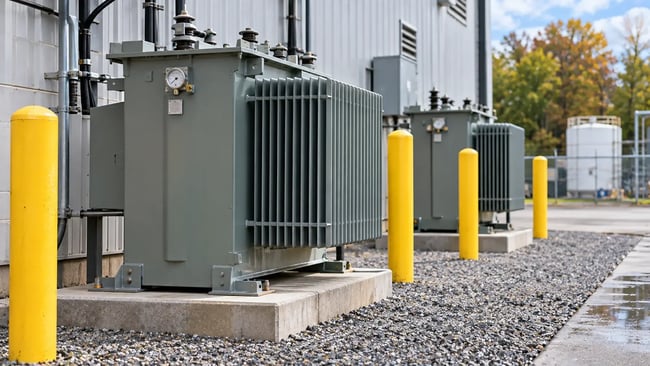
Before you pursue an alternative, check whether you already have containment you haven't counted. EPA has pointed out that a gravel bed under electrical equipment can qualify if the drainage doesn't act as a pipe to surface water, and that equipment inside a building with limited drainage may already meet the requirement. For electrical equipment where a permanent dike isn't feasible, EPA also recognizes active measures such as sorbent material, spill kits, and covers for drain openings, as long as they prevent a discharge to water. Many facilities end up with a simple answer here and never need the contingency plan option at all. If you'd like a refresher on the containment side, our guide on how big SPCC oil spill containment needs to be walks through the sizing rules.
How Does the SPCC Contingency Plan Option for Qualified Oil-Filled Equipment Work?
Section 112.7(k) lets you skip general secondary containment for qualified oil-filled operational equipment if you meet two sets of conditions. It's optional. You can still choose to provide containment for every piece of equipment, and many facilities do.
The first condition is a clean discharge history. Looking back three years from the date your Plan is certified (or since you became subject to the rule, if that's been less than three years), your facility can't have had a single discharge over 1,000 gallons from any oil-filled operational equipment, and it can't have had two discharges over 42 gallons each within any twelve-month period. The discharges that count are the ones described in 112.1(b), meaning oil that reaches navigable waters or adjoining shorelines, which can include oil that gets to a stream through a ditch or storm drain. Discharges caused by natural disasters, acts of war, or terrorism are left out of the count.
The second condition is the work. You have to establish and document procedures for inspections or a monitoring program that will detect equipment failure or a discharge. Then, unless you've submitted a Facility Response Plan, your SPCC Plan has to include an oil spill contingency plan that follows 40 CFR Part 109, along with a written commitment of manpower, equipment, and materials to expeditiously control and remove any quantity of oil discharged that may be harmful. The option has no separate impracticability determination attached to it, which is the main reason it's the more common route for transformers and similar units. EPA also treats qualified oil-filled equipment and qualified facilities as separate ideas that can overlap, so a small facility can use this option and still self-certify its Plan if it meets the qualified facility criteria.
What Goes Into an SPCC Contingency Plan and Written Commitment of Resources?
Part 109 was written as criteria for state, local, and regional oil removal plans, so facilities adapt it to a single site. The elements translate cleanly, though. Part 109 calls for defined responsibilities for everyone involved, notification procedures with a current list of names, phone numbers, and alternates, a reliable way to communicate, and a prearranged way to get help when a spill is bigger than you can handle. It also calls for an inventory of the equipment, materials, and supplies you have available, an estimate of what it would take to remove the largest discharge you'd reasonably anticipate, and advance arrangements to get whatever you don't have on site.
The response side needs to be specific as well. Part 109 asks for a trained response team, a designated response coordinator with the authority to direct the work, a planned location to run the response from, and varying levels of response depending on how severe the discharge is. For a plant with a hydraulic press or a transformer pad, that usually means named people, a spill kit and sorbents staged at the equipment, a drain cover or boom that can be deployed in minutes, and a cleanup contractor you've lined up in advance.
The written commitment of manpower, equipment, and materials is where plans most often get thin. It has to say who will respond, what they'll use, and where it's kept, with enough detail that someone reading it can tell it would work at 2 a.m. on a Sunday. If you're relying on a contractor, have a real agreement in place rather than a name in a phone list. Documented inspections or monitoring tie it all together, since the response only works if someone notices the leak early. Our article on what to check during monthly SPCC inspections covers the inspection side, and the SPCC training guide explains what your oil-handling staff need to know to carry out the response.
When Is SPCC Secondary Containment Impracticable Under 112.7(d)?
The second route is 112.7(d), and it works differently. It applies when you determine that installing the containment structures or equipment the rule calls for isn't practicable, whether that's at a loading rack, around a piece of equipment, or elsewhere on the site. Your Plan has to be certified by a licensed Professional Engineer (or, for a qualified facility, the relevant sections of the Plan do), and the Plan has to clearly explain why containment isn't practicable. For bulk storage containers, you also have to conduct periodic integrity testing of the containers and periodic integrity and leak testing of valves and piping. Then, unless you've submitted a Facility Response Plan, the same two items from 112.7(k) apply: a Part 109 contingency plan and a written commitment of manpower, equipment, and materials.
The explanation is the part to take seriously. A line that says containment is "not feasible" won't hold up when someone reviews the Plan. The explanation should state the physical or operational reason for the specific location, what you considered, and what you're doing in its place. When a Professional Engineer is needed, we work with an outside engineer, and our guide to Professional Engineers and SPCC Plan requirements explains where PE certification fits. The table below shows how the three approaches compare.
| Approach |
Rule |
Who can use it |
What you have to document |
| General secondary containment |
112.7(c) |
Any facility |
Containment or diversion that stops a typical failure from reaching water |
| Qualified oil-filled equipment alternative |
112.7(k) |
Facilities with the required three-year discharge history |
Inspection or monitoring procedures, a Part 109 contingency plan, and a written commitment of resources |
| Impracticability determination |
112.7(d) |
Facilities with a PE-certified Plan that explains why containment isn't practicable |
Written explanation, integrity and leak testing for bulk containers, valves, and piping, a contingency plan, and a written commitment of resources |
Why Isn't the SPCC Contingency Plan Option a Shortcut for Pennsylvania Facilities?
On paper, skipping a concrete dike looks like the cheaper and faster choice. In practice the option moves the burden from hardware to people and paperwork, and that's work you repeat every year. Inspections have to follow written procedures and the signed records stay with the Plan for three years. Oil-handling staff need training and an annual discharge prevention briefing. Spill kits have to be stocked, contacts have to be current, and contractor agreements have to stay in force. A contingency plan that was accurate when the Plan was written and hasn't been touched since is one of the easier things for an inspector to poke holes in.
Eligibility under 112.7(k) isn't permanent either. The discharge history is measured back from the date your Plan is certified, so a release that crosses the thresholds can knock equipment out of the option at your next review or amendment, and your five-year SPCC Plan review is a natural time to check. If you've had a significant discharge, it's reasonable to talk with an environmental attorney about how it should be documented, and our article on when you have to report an oil spill covers the reporting side.
In Pennsylvania, EPA Region 3 enforces the federal SPCC rule, and the rule's 112.7(j) requires your Plan to discuss conformance with any more stringent state rules, regulations, and guidelines. Pennsylvania has its own layer through DEP, including its storage tank program, and some DEP permits and programs call for a Preparedness, Prevention and Contingency (PPC) Plan. A contingency plan you write for SPCC purposes can overlap with a PPC Plan, but they're separate documents with separate requirements, so check what your own permits ask for. For a look at the penalty side, see our breakdown of top SPCC Plan violations and fines.
There's also an honest case for just building the containment. A drip pan, a curb, or a small berm under a hydraulic unit can be cheaper than the documentation, training, and inspection work that the alternative adds, and it removes a whole category of questions in an inspection. The contingency plan option makes the most sense where containment really can't be built, such as for pad-mounted electrical equipment or equipment spread over a large site. It's also worth knowing that if you're under the 1,320 gallon threshold, you may not need a plan at all.
How Does RMA Help With SPCC Plans and Oil-Filled Equipment in Pennsylvania?
We help facilities figure out which of these paths fits their equipment, then write the Plan so the documentation matches what's happening on site. That includes inventorying oil-filled equipment, checking what containment you already have, writing the contingency plan and commitment of resources, and setting up inspection procedures your staff can follow. When your Plan needs a Professional Engineer, we work with an outside engineer, and our own staff typically handle the site visit and Plan development. Our team can also train your oil-handling staff, and our online training library is available if you want something self-paced.
There's no pressure and no obligation. If you'd rather talk through your equipment before deciding anything, you can call us, email us, or fill out the form on our website, and you can contact RMA whenever you're ready. If we think you don't need a plan, or that simple containment will do, we'll tell you.


