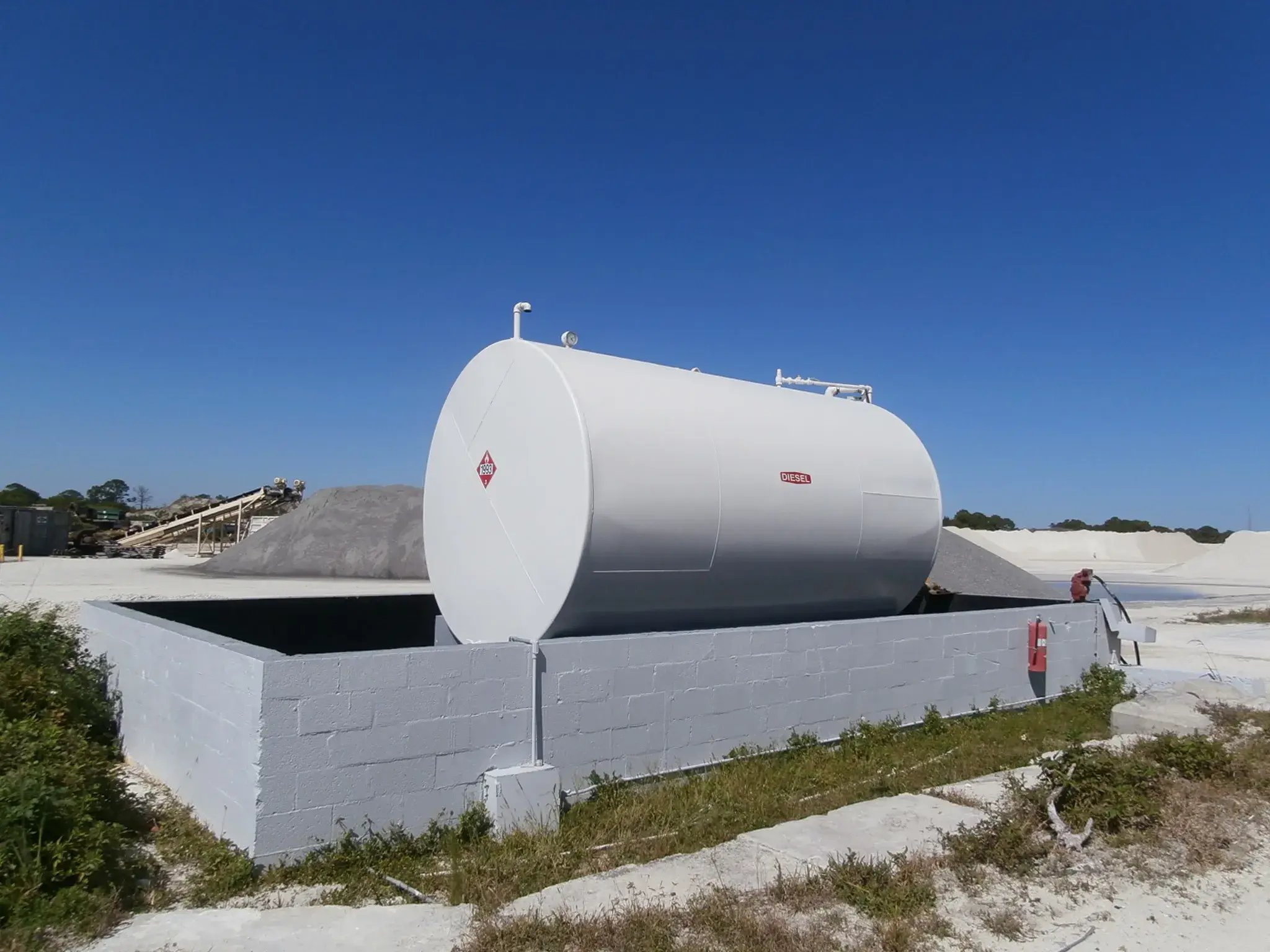
Oil Storage Rules Most Small Pennsylvania Businesses Have Never Heard Of, and How to Tell Which Ones Are Yours
Most small business owners don't think of themselves as running an oil storage operation. You've got a diesel tank for the trucks, a couple of hydraulic oil drums behind the shop, a backup generator with its own fuel tank, maybe a few totes of lubricant or a container of used cooking oil out back. Then a fire marshal, an insurance underwriter, or a lender asks about your oil spill plan, and you find out there's a stack of rules sitting behind what you've always treated as ordinary supplies.
This article lays out the five sets of rules that can apply to oil storage at a Pennsylvania business: the federal oil spill plan known as an SPCC Plan, Pennsylvania's storage tank registration, a DEP Preparedness, Prevention and Contingency (PPC) Plan, local fire code, and Tier II chemical reporting. The short answer is that most small businesses land under one or two of them, not all five. If you'd rather have someone look at your tanks and tell you which ones are yours, you can reach out to RMA at any point.
Table of Contents
TL;DR
Five sets of rules can touch oil storage at a Pennsylvania business: the federal SPCC Plan from EPA, DEP storage tank registration, a DEP PPC Plan when another DEP program calls for one, local fire code, and Tier II chemical reporting. Each has its own trigger, and most small businesses only meet one or two of them. Total oil capacity, the size of each tank, and how much diesel or other chemicals sit on site at one time decide which ones are yours.
Why Do Oil Storage Rules Surprise Small Pennsylvania Businesses?
There isn't one oil storage law. There are several, written by different agencies for different reasons, and each has its own trigger. EPA cares about oil reaching streams and storm drains. Pennsylvania's Department of Environmental Protection (DEP) cares about tanks leaking into soil and groundwater. Your local fire marshal cares about fire and explosion. The state and local emergency planners care about what's stored near a neighborhood. A single 500-gallon diesel tank can set off a different answer under each of those programs.
These rules also get talked about as if they're only for gas stations, refineries, and big industrial plants. They're not. Body shops, landscapers, contractors, farms, restaurants, small manufacturers, auto repair shops, and property owners with a backup generator all store enough oil to run into at least one of them. We cover the wider picture in our guide to the top environmental requirements for small businesses, and the split between agencies in how federal, state, and local environmental laws split up.
One more thing trips people up. Oil here means more than gasoline and diesel. Hydraulic oil, lubricating oil, transformer oil, used oil, and even vegetable oil and animal fats can count, depending on the rule. The kinds of oil each program counts aren't identical, so it pays to check them one program at a time.
Which Oil Storage Rules Can Apply to Your Business?
Here's the whole picture in one place. Each row is a separate set of rules with its own trigger, and meeting one doesn't mean you meet the others. The sections below walk through each one in plain terms.
| Rule |
Trigger |
Agency |
What It Means for You |
| Federal SPCC Plan |
More than 1,320 gallons of total aboveground oil capacity (counting containers of 55 gallons or more), or more than 42,000 gallons buried, plus a reasonable chance of oil reaching waterways |
EPA (Region 3 covers Pennsylvania) |
A written oil spill prevention plan, secondary containment, inspections, and training |
| Pennsylvania storage tank registration |
A stationary aboveground tank over 250 gallons (or a buried tank over 110 gallons) holding a regulated substance, unless an exemption applies |
DEP Storage Tanks Program |
Registration, certified installers and inspectors, fees, and technical standards for the tank |
| DEP PPC Plan |
Another DEP program or permit that calls for one, not oil storage by itself |
DEP |
A plan for preventing and responding to pollution incidents at the site |
| Local fire code |
Storing flammable or combustible liquids above locally set quantities |
Municipal fire marshal or code office |
Possible permits, storage limits, separation distances, and containment or venting requirements |
| Tier II reporting |
10,000 pounds or more of a hazardous chemical on site at one time (roughly 1,400 gallons of diesel), or 500 pounds or the planning quantity for extremely hazardous substances |
State emergency agency, local emergency planning committee, and local fire department |
An annual chemical inventory report due March 1 |
Notice that the triggers measure different things. SPCC adds up the total capacity of your oil containers. Pennsylvania's tank program looks at individual stationary tanks. Tier II looks at how much of a chemical is on site at one time. Fire code looks at the type of liquid and the quantity per building or area. A facility can be well under one threshold and well over another, which is why guessing from a neighbor's situation doesn't work.
When Does a Federal SPCC Plan Apply to Your Oil Storage?
SPCC stands for Spill Prevention, Control, and Countermeasure. It's a federal rule, found in 40 CFR Part 112, that requires a written oil spill prevention plan at facilities that store enough oil and could reasonably send a spill to a stream, storm drain, ditch, or other waterway. EPA enforces it, and in Pennsylvania that's EPA Region 3. If you want the basics first, we explain what an SPCC Plan is and cover everything you need to know about SPCC Plans in separate articles.
The threshold has two parts. You're covered when your total aboveground oil capacity is more than 1,320 gallons, or your completely buried oil capacity is more than 42,000 gallons, and a spill from your site could reasonably reach navigable waters or adjoining shorelines. For most small businesses, the aboveground number is the one that matters.
How Do You Count Gallons Toward the SPCC Threshold?
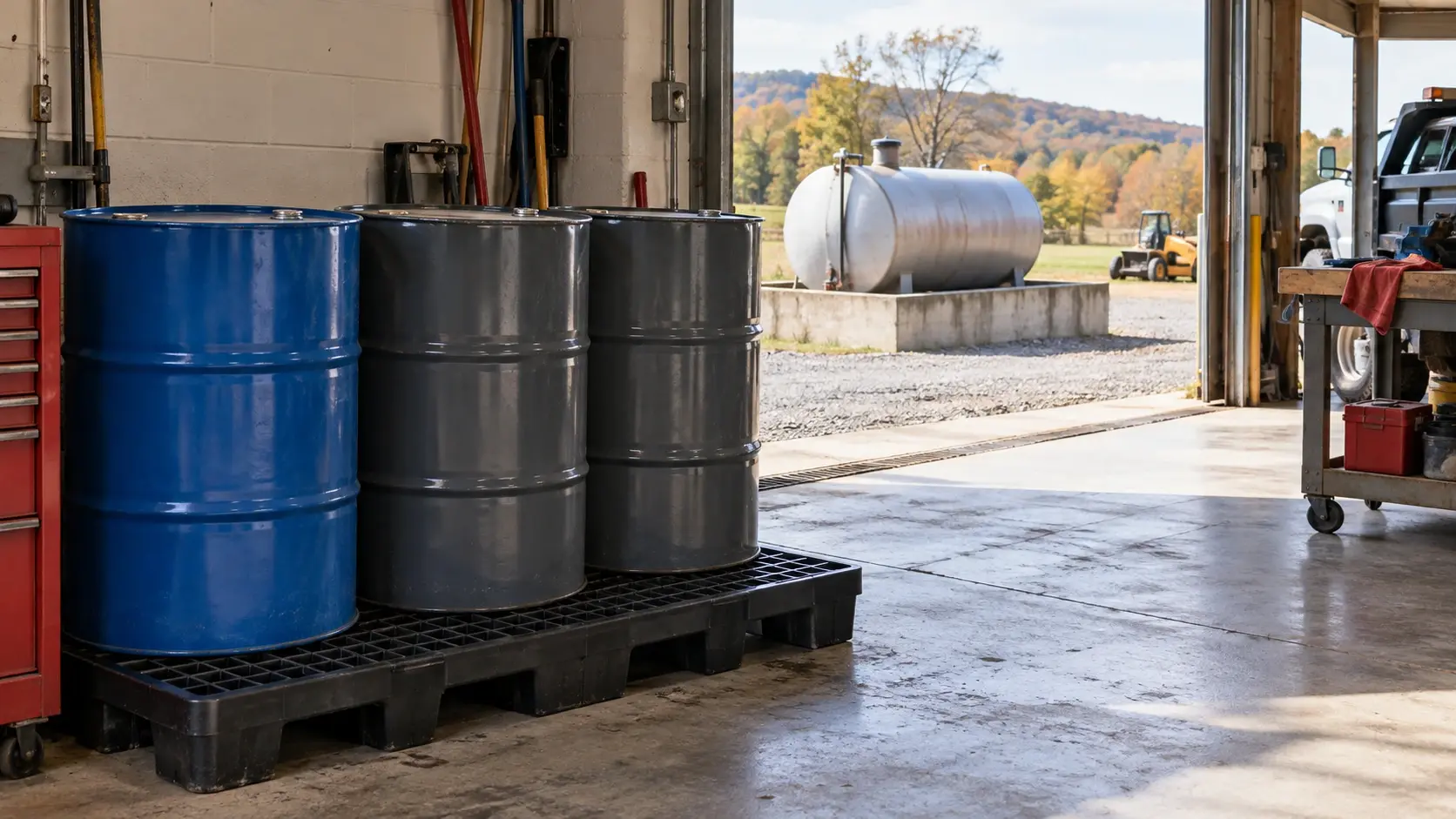
Capacity counts, not what's in the tank today, so an empty 1,000-gallon tank still counts at 1,000. Only containers of 55 gallons or more go into the total, so a shelf of quart bottles doesn't. Oil-filled equipment such as transformers and hydraulic reservoirs counts, and so do animal fats and vegetable oils, which is why restaurants and grease collectors get caught (we cover that in our article on cooking oil and used cooking oil). Propane isn't oil. Add up everything that qualifies across the whole site, and our article on whether 55-gallon drums count toward an SPCC Plan shows how quickly drums add up.
If you're covered, the plan itself comes in a few forms. Smaller facilities with no significant spill history may qualify to self-certify a simpler plan, while others need a Professional Engineer to certify it, and we break those down in different types of SPCC Plans. Either way, plans get a five-year review, and you'll be expected to handle inspections, secondary containment, and employee training. If you want a simple way to walk through the threshold, try four simple steps for figuring out if you need an SPCC Plan.
If you've got a spill happening right now, put safety and the emergency call first. Call 911 for any fire or injury risk, and the National Response Center at 800-424-8802 reports spills that reach water. Our article on the sheen rule for reporting an oil spill covers when a reportable spill occurs.
Does Pennsylvania Require Storage Tank Registration?
Often, yes, and this is the one small businesses miss most. Pennsylvania runs its own storage tank program through DEP under the Storage Tank and Spill Prevention Act, with the details in 25 Pa. Code Chapter 245. In general, a stationary aboveground tank with a capacity over 250 gallons that holds a regulated substance has to be registered with DEP, and so does an underground tank over 110 gallons, unless an exemption applies. The rules list a long set of exemptions, so what the tank holds and how it's used both matter.
Owners register each tank on a DEP form within 30 days after installing it or acquiring an ownership interest in it. DEP also certifies the people who install and inspect tanks, so the contractor putting in a new tank and the inspector looking at an existing one generally need DEP certification. The Pennsylvania program has its own fees, inspection schedules, and technical standards, which depend on the type of tank, so check yours against DEP's storage tank program before assuming what applies.
Here's where the two programs split. A single 500-gallon diesel tank sits far below the federal SPCC threshold of 1,320 gallons, yet it's larger than Pennsylvania's 250-gallon registration size, so it may need DEP registration even when it needs no SPCC Plan. The reverse happens too. A site with twenty 55-gallon drums can cross the SPCC threshold, while none of the drums is large enough to register as a tank. Both programs ask about oil storage, and each uses a different yardstick.
When Does a DEP PPC Plan Apply to Oil Storage?
A PPC Plan, short for Preparedness, Prevention and Contingency Plan, is a DEP-required document that describes how a facility prevents pollution incidents and what it does if one happens. The thing to know is that storing oil doesn't trigger it on its own. A PPC Plan comes into play when another DEP program, permit, or approval at your site calls for one. Facilities with certain waste, water quality, or similar DEP permits are the usual examples, and the permit conditions say whether you need one.
So if you've never held a DEP permit for anything beyond your tanks, a PPC Plan probably isn't on your list. If you do hold one, read the conditions or ask your DEP regional office, because Pennsylvania has six of them and the one covering your county handles your file. When a PPC Plan is required and you already have an SPCC Plan, the existing plan can often serve as a starting point instead of a separate project, though your permit and DEP's guidance control what's acceptable.
What Do Local Fire Codes Require for Flammable and Combustible Liquids?
Fire code is the rule set that's easiest to overlook, because it isn't an environmental program at all. It's enforced locally, usually by a municipal fire marshal or code office, and it varies from one municipality to the next. Gasoline and many solvents are flammable liquids, while diesel and most lubricating oils are combustible liquids, and codes treat the two differently. Many local codes build on national standards, and what applies to you depends on how your municipality has adopted them.
Depending on where you are, fire code can set limits on how much of a liquid you can keep in a building or outdoor area, call for a permit above certain quantities, and spell out requirements for tank placement, distance from buildings and property lines, containment, venting, and signage. Large cities, including Philadelphia and Pittsburgh, administer their own codes, and the details can differ from the surrounding county.
We keep our advice here general on purpose, because we can't tell you what your township requires without looking at its adopted code. Call your local fire marshal or code office, tell them what you store and where, and ask what applies. It's a quick call, and fire officials usually appreciate being asked before a tank goes in rather than after.
When Does Tier II Reporting Apply to Diesel and Other Chemicals?
Tier II is a chemical inventory report under the Emergency Planning and Community Right-to-Know Act (EPCRA). It tells emergency responders and your community what hazardous chemicals you keep on site. The federal threshold for most hazardous chemicals is 10,000 pounds present at any one time during the year. Extremely hazardous substances trigger reporting much lower, at 500 pounds or their threshold planning quantity, whichever is less. Fuel is covered by the 10,000-pound rule, and since diesel weighs roughly 7 pounds a gallon, that works out to somewhere around 1,300 to 1,450 gallons depending on the product.
Two details catch people. First, Tier II counts the most you had on site at one time, not the size of the tank, so a 3,000-gallon tank you keep a third full may stay under the line. Second, the chemicals are added up product by product across the whole facility. Diesel in a tank, lubricants, antifreeze, batteries, and cleaning products each get tallied against their own threshold, so a facility with little oil can still trigger Tier II because of something else on the shelf.
Reports are due March 1 each year and cover the prior calendar year. They go to the state emergency response agency, the local emergency planning committee, and the local fire department, and Pennsylvania collects them through an electronic system run under the Department of Labor and Industry. We walk through the details in everything you need to know about Tier II reporting, including who needs to file Tier II and who receives the report.
How Many of These Oil Storage Rules Will Your Business Face?
Most small businesses meet one or two. A small repair shop with a single 275-gallon waste oil tank and a few drums, for example, might face Pennsylvania tank registration and a fire code conversation, while sitting under both the SPCC and Tier II thresholds. A contractor with one 500-gallon diesel tank and a small oil storage shed is in a similar spot. A landscaper with a few small containers may be under every threshold and need nothing beyond sensible housekeeping.
The picture changes with scale. A fleet yard with 2,000 gallons of aboveground diesel, a hydraulic oil tote, and an on-site generator can land in SPCC, Pennsylvania tank registration, fire code, and possibly Tier II all at once. A facility with a DEP permit for another activity may add a PPC Plan on top. The table earlier in this article is the quickest way to run your own numbers, and we'd rather tell you that you're under the line than sell you a plan you don't need.
Once you know which rules are yours, the day-to-day work is smaller than it sounds: monthly walk-arounds, keeping containment in good shape, knowing who to call after a spill, and training the employees who handle the oil. Our online training library covers the training side for teams that want a simple starting point.
What Happens When You Build or Add an Oil Tank?
Putting in a new tank, or expanding a site that has one, brings a separate set of construction-phase requirements. In Pennsylvania those can include DEP-certified installers for tank work, building and fire permits, and, if the work disturbs enough ground, erosion and sediment control or construction stormwater approvals. We'll be direct about this: RMA doesn't prepare construction permits or approvals, and we don't install tanks. Most owners work with their engineer, contractor, or a soil erosion specialist on that piece, and we're glad to help you figure out which construction-phase professionals you'll need.
Where we do help is with what the facility needs once it's running. A new or larger tank often means a new SPCC Plan or an amendment to an existing one, DEP tank registration, inspections and integrity testing, employee training, and sometimes Tier II. It also helps to size the project against the thresholds early. Adding one more tank can move you from under the SPCC line to over it, and it's far cheaper to know that before the concrete is poured. Temporary fuel storage at a construction site can fall under SPCC as well, and that's a plan we can help with, even though the construction permits themselves aren't ours.
How Does RMA Help With Oil Storage Rules for Small Businesses?
We're a family-run environmental consulting firm based in New Jersey, and we've worked with small businesses across Pennsylvania and the rest of the country since 1992. For oil storage, that usually starts with a simple conversation about what you've got on site. We help you work out which of these rules apply, tell you plainly when you're under the thresholds, and then, if you want help, take on the pieces that are ours: SPCC Plans, plan updates, Tier II reporting, inspection and training programs, and questions about DEP tank registration. You can read more about how we work with small businesses if you'd like to see how we think about the budget.
For rough numbers, SPCC Plans typically run from $2,500 to $15,000 depending on the facility, and Tier II reporting from $1,500 to $7,500, with the cost driven by how many containers you have, whether a Professional Engineer certification is needed, and how complex the site is. We break that down in what an SPCC Plan costs. If you're dealing with a violation notice or an enforcement action, an environmental attorney may also be worth bringing in alongside us.
There's no obligation and no sales pressure. You can call us at 888-RMA-0230, email us, or fill out the form on our website, and a member of our team will help you sort out where you stand. If you'd like to talk it through, contact RMA today and tell us what's in your yard.