When a Rainbow Sheen in Stormwater at Your Pennsylvania Facility Is a Housekeeping Problem, and When It Means Calling PA DEP and the National Response Center
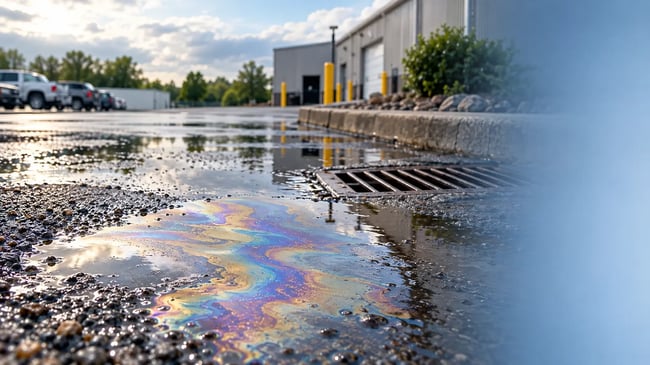
It rains, and the next morning someone notices a rainbow swirl on the puddles by the loading dock or where the forklifts park. Is this a spill? Do we have to report it? The short answer is that a small sheen sitting in a puddle on pavement usually isn't a reportable spill on its own. It's almost always vehicle and equipment drips, and the fix is cleanup and housekeeping. But once oil reaches a storm drain, a ditch, or a stream and puts a sheen on that water, Pennsylvania and federal reporting rules can kick in, and some of those calls have to happen immediately.
Below, we'll cover how to tell an oil sheen from a natural one, where a puddle problem becomes a reportable discharge, who you call and when, what to do in the first hour, and how PAG-03 inspections and your PPC Plan should catch these problems early. If you're dealing with a sheen right now and aren't sure what your facility needs to do next, reach out to RMA and we'll help you sort it out.
Table of Contents
TL;DR
A small sheen in a puddle on your pavement usually comes from vehicle drips and isn't a reportable spill by itself, but it's a sign oil is getting into your stormwater, so find the source and clean it up. If oil reaches a storm drain, ditch, or stream and causes a sheen on the water, Pennsylvania's spill rule requires an immediate call to DEP (1-800-541-2050), and the federal sheen rule requires an immediate call to the National Response Center (1-800-424-8802). Document what you found and what you did either way. At a permitted facility, your PAG-03 inspections and PPC Plan should be catching these problems before they ever reach the drain.
What Causes an Oily Sheen in Parking Lot Puddles?
Oil spreads into an incredibly thin film on water, so it takes very little to make a visible rainbow. A few drips from a truck's oil pan, a weeping hydraulic fitting on a forklift, or a little residue washed off a fueling pad can light up a whole puddle after a storm.
At an industrial facility, the usual suspects are a little more specific. Parked trucks and loaders, equipment maintenance areas, fuel islands, drum and tote storage, used oil collection points, compactors and dumpsters, and leaking hydraulic lines on outdoor machinery all produce sheens when rain hits them. These are the same activities that make runoff count as stormwater associated with industrial activity, which is why a sheen at a permitted site tells you something about how well your controls are working.
Not every sheen is oil, though. Decaying leaves and iron bacteria in wet, low spots can produce a natural film that looks oily from a few feet away. Here's a quick way to tell the difference that anyone doing your stormwater inspections should know.
| Check |
Oil Sheen |
Natural (Bacterial) Sheen |
| Poke it with a stick |
Swirls and flows back together |
Breaks into flat plates or flakes that stay apart |
| Color |
Rainbow colors that shift as it moves |
Often dull, silvery, or bluish |
| Smell |
Petroleum or fuel odor, sometimes |
Musty or swampy, if anything |
| Where you see it |
Near vehicles, equipment, fueling, or storage areas |
Standing water with leaves, rust staining, or orange slime |
If the stick test leaves you unsure, treat it as oil until you know otherwise.
Is an Oil Sheen in a Parking Lot Puddle a Reportable Spill in Pennsylvania?
Usually, no. The federal reporting rule is about oil on the surface of the water, meaning streams, rivers, lakes, and their shorelines. A puddle sitting on asphalt isn't that. Pennsylvania's spill notification rule, found at 25 Pa. Code § 91.33, is about incidents that cause or threaten pollution of "waters of the Commonwealth." A few drips in a puddle that stays on your pavement and gets cleaned up generally doesn't reach that bar.
The catch is where that puddle goes next. Pennsylvania's Clean Streams Law defines waters of the Commonwealth very broadly. The definition doesn't stop at rivers and streams. It specifically includes ditches, watercourses, and storm sewers. So oil draining into a storm inlet or down a swale may already be in regulated water.
So the useful question isn't "how big is the sheen?" It's "where is this water headed?" A sheen in a puddle with no path to a drain is a cleanup task. The same sheen streaming toward a storm grate during a rainstorm is a potential reportable discharge.
Even when it isn't reportable, a puddle sheen at a permitted facility is evidence that oil is coming into contact with rain. If it keeps happening, a DEP inspector will notice, and it means your controls have a gap somewhere upstream of that puddle.
When Does an Oil Sheen Have to Be Reported to PA DEP and the National Response Center?
Two separate reporting rules can apply when oil reaches water, one state and one federal. They work independently, so plan on making both calls when both apply.
Pennsylvania's Spill Notification Rule (25 Pa. Code § 91.33)
Under § 91.33, if an accident or other incident causes pollution or creates a danger of pollution of waters of the Commonwealth, the person responsible has to notify DEP immediately by telephone, describing the location and nature of the problem. If it's reasonably possible, you're also supposed to notify known downstream users of the water. The rule doesn't set a minimum quantity. It's based on whether the discharge causes or threatens pollution, and DEP is the one who ultimately decides what counts as pollution.
The duty doesn't end with the phone call. Section 91.33(b) also requires you to immediately take the steps needed to prevent injury from the pollution, and within 15 days of the incident, to remove the residual material from the ground and the affected waters to the extent the regulations require. DEP proposed amendments in 2025 that would spell out factors a facility could document if it decides a release doesn't need a call, but DEP has said they don't change which incidents require notification. Its standing advice is to call when you're unsure.
The Federal "Sheen Rule" (40 CFR Part 110)
The federal Discharge of Oil regulation treats any discharge of oil that causes a film or sheen on the surface of the water or adjoining shorelines as a harmful quantity. There's no gallon threshold. If you can see a sheen on a stream, river, pond, or wetland that came from your facility, the person in charge has to notify the National Response Center as soon as they know about it. We cover this rule in more detail in our article on when you have to report an oil spill under the sheen rule.
| Situation |
Who to Call |
Number |
| Oil reaching or threatening a storm sewer, ditch, stream, or other waters of the Commonwealth |
PA DEP 24-hour emergency hotline (routes to the duty officer for your region) |
1-800-541-2050 |
| Visible sheen on a stream, river, pond, wetland, or shoreline |
National Response Center |
1-800-424-8802 |
| Fire, explosion risk, or injuries |
Local emergency services |
911 |
Put both numbers in your spill procedures and post them where your people will see them. If a release is large, ongoing, or has already drawn DEP's attention, it's smart to bring in an environmental attorney early, since what you say and document in the first days can matter later.
Other Oil Spill Reporting Rules That Can Apply to Pennsylvania Facilities
The DEP and NRC calls cover the immediate response. Depending on where the oil came from and where it went, a few other reporting requirements can stack on top of them.
| Rule |
When It Applies |
What It Requires |
| SPCC (40 CFR 112.4) |
An SPCC facility discharges more than 1,000 gallons of oil to water in one event, or more than 42 gallons in each of two events within 12 months |
Written report to the EPA Regional Administrator within 60 days, with a copy to the state |
| PA Storage Tank Rules (25 Pa. Code § 245.305) |
A confirmed release from a DEP-regulated storage tank system |
Notify the DEP regional office as soon as practicable, no later than 24 hours after confirmation |
| Large aboveground tank facilities (§ 245.305(g)) |
A release at a facility with more than 21,000 gallons of aboveground storage capacity |
Immediately notify the county emergency management agency, PEMA, and DEP |
| Your NPDES permit |
Permitted facilities with a discharge that violates permit conditions |
Follow the noncompliance reporting terms written into your permit |
The SPCC gallon thresholds count only the oil that reaches water, not the total amount spilled, so a 300-gallon release fully caught on site doesn't trigger that report. A facility that does file one should expect EPA to look hard at its plan, so it helps to understand how an SPCC Plan differs from a stormwater plan and making sure both are current.
Local rules can add another layer. Many municipalities prohibit putting anything but stormwater into their storm sewers. In older cities with combined sewers, including Philadelphia and Pittsburgh, runoff from some properties goes to a treatment plant rather than straight to a stream. In those areas, the sewer authority may have its own spill notice requirements. Rules vary from place to place, so confirm where your drains actually go and who you'd need to tell.
How to Respond When You Find an Oil Sheen in Your Facility's Stormwater
Whether or not a sheen is reportable, the response looks about the same: stop the oil, keep it out of the drains, clean it up properly, and leave a paper trail.
Find the Source and Stop It
Follow the sheen uphill. Look for the parked truck with a wet spot under it, the drum with a loose bung, the forklift that's been sitting in the same corner for a week, or the fuel nozzle that drips after every fill. Move or repair the leaking equipment, put a drip pan under it, or close up the container. A sheen you clean up without finding the source will be back after the next rain.
Protect the Storm Drains, Then Clean Up
If oil is moving toward an inlet, block it first with absorbent socks, a drain cover, or a berm, then pick up the oil with absorbent pads. Don't hose the area down. And don't squirt dish soap or degreaser on it. Detergents break a sheen up so you can't see it anymore, but the oil is still there, and federal rules prohibit using chemical agents to hide an oil discharge. Handle used pads and booms the way your facility's waste procedures require.
Document What Happened
Write down the date and time, where you saw the sheen, how large it was, whether it reached a drain or waterway, what the source turned out to be, and what you did about it. Take photos before and after. If you called DEP or the NRC, record the time, the person you spoke with, and any report number you were given. If an inspector asks about it months later, this record shows you found it, fixed it, and made the right call on reporting.
How PAG-03 Inspections and Your PPC Plan Should Catch Oil Sheen Problems
Many Pennsylvania facilities with industrial activities exposed to rain hold coverage under PAG-03, which is DEP's general NPDES permit for industrial stormwater. (NPDES is the federal permit program for discharges to water.) PAG-03 facilities keep a PPC Plan, short for Preparedness, Prevention and Contingency Plan, which lays out how the facility keeps pollutants out of stormwater and what it does when something spills. Our comparison of SWPPPs and PPC Plans for PAG-03 walks through it.
Spill prevention and response and routine inspections are both baseline practices under PAG-03. A good PPC Plan names who's in charge during a spill, lists emergency numbers (including DEP and the NRC), shows where spill kits are, and describes cleanup steps. Routine inspections are where sheens should get caught early. Someone walking the site on a schedule should be looking at equipment areas, storage areas, and drain inlets for staining, leaks, and sheen, and checking discharge points for oil when they're flowing. Our guide on how to do a stormwater visual inspection the right way covers what to look for.
A recurring sheen in the same spot is a finding, and your inspection records should show it being fixed. Inspectors reviewing a facility look for exactly this pattern, and what turns up during a PA DEP stormwater inspection can end up in the public record on eFACTS. Inspection logs that note "sheen near Bay 3, drip pan placed, forklift sent for repair" look very different from logs that say "no issues" every month while the stains keep growing.
Facilities with a No Exposure Certification instead of PAG-03 coverage should pay attention too. No Exposure depends on industrial materials and activities staying out of the rain, so recurring sheen from oily equipment outdoors raises the question of whether the site still meets the conditions it certified to.
How to Prevent Oil Sheen in Stormwater at Pennsylvania Facilities
Most sheen problems have cheap, simple fixes. Match the fix to the source, then make it part of the routine so it doesn't depend on one careful person.
| Common Source |
Practical Fix |
| Parked trucks, loaders, and forklifts |
Drip pans under known leakers, prompt repairs, and parking under cover where possible |
| Fueling areas |
Spill kits at the pump, no topping off, and quick cleanup of drips with absorbents rather than water |
| Drums, totes, and used oil |
Store under a roof or on covered containment, keep lids and bungs closed |
| Outdoor maintenance work |
Move it indoors, or use tarps and drip pans when it has to happen outside |
| Drain inlets near oily areas |
Absorbent inlet inserts, cleaned and replaced on a schedule |
| Oil-water separators |
Regular inspection and pump-outs, since a full separator passes oil straight through |
These are all forms of stormwater best management practices (BMPs). Covering, containing, and fixing leaks will almost always beat buying equipment to treat oily water after the fact.
Training ties it together. The people driving equipment and walking the yard will see a sheen first, so they need to know where the spill kit is and who to tell. Stormwater training is a permit requirement at many facilities, and our article on whether stormwater training is required explains when. For teams that need a quick way to get people up to speed, our online environmental training library has courses that can help.
How RMA Helps With Oil Sheen and Stormwater Compliance in Pennsylvania
First, the practical part. If oil is heading into a stream right now, your first calls are to DEP, the National Response Center, and a spill cleanup contractor if you need one. We're not an emergency response company, and we won't pretend to be. Where we come in is everything around the incident: figuring out what your facility was required to report, getting your PPC Plan and inspection routine to the point where sheens get caught early, and fixing the gaps that let oil reach the drain in the first place.
We're based in New Jersey and work with facilities across Pennsylvania on PAG-03 coverage, PPC Plans, No Exposure Certifications, routine inspections, sampling, and training. Because oil problems rarely stop at stormwater, we also help with SPCC Plans for facilities that store enough oil to need one. Our senior staff do the work themselves, and we'll tell you plainly if your situation is simple enough to handle on your own, or if it's time to bring in an environmental attorney.
If you've found a sheen and aren't sure what it means for your facility, give us a call, send us an email, or fill out the form on our website. There's no pressure and no obligation, just a straight answer about what applies to you. When you're ready, contact RMA and we'll take it from there.


