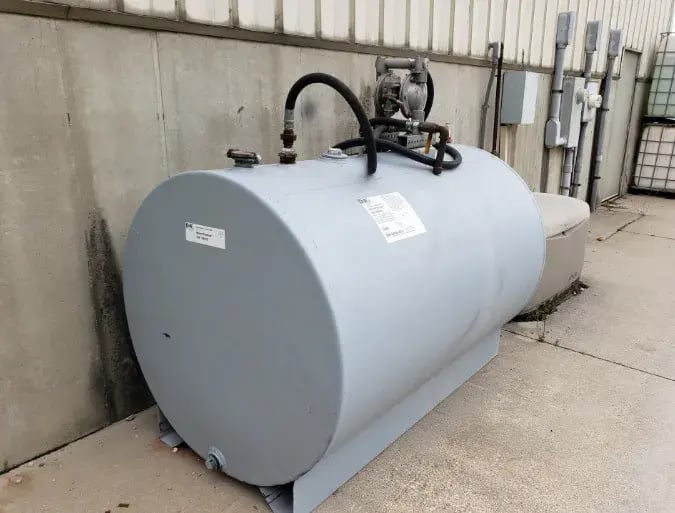
Alarms, Gauges, Shutoffs, and Delivery Procedures for Bulk Oil Storage at New Jersey Facilities
Most oil tank spills don't come from a rusted wall or a failed weld. They come from a delivery that went a few minutes too long, a gauge nobody checked, or an alarm that sounded in an empty office. Overfills are one of the most common ways a tank at an industrial or commercial facility puts oil on the ground, and they're also one of the easiest to prevent when the right equipment and the right habits are in place.
The federal Spill Prevention, Control, and Countermeasure (SPCC) rule, which EPA Region 2 enforces in New Jersey, spells out what overfill prevention has to look like for bulk storage tanks. In this article we'll walk through each option the rule allows, how alarms, shutoffs, and gauge-based procedures differ in practice, how often to test them, and what to coordinate with your fuel supplier before the truck pulls in. If you'd rather have someone review your tanks and your plan with you, feel free to reach out to RMA at any point.
Table of Contents
TL;DR
Under 40 CFR 112.8(c)(8), each bulk oil storage container needs at least one overfill prevention measure: a high-level alarm, a high-level pump cutoff, direct communication between the person gauging and the person pumping, or a fast-response gauging system with someone watching it. The device also has to be tested regularly, and your supplier has to know how your tank is filled and who stops the flow. Small containers can use a documented filling procedure instead. New Jersey adds its own rules for underground tanks and for discharges, so check which ones apply to you.
What Does the SPCC Rule Require for Oil Tank Overfill Prevention?
The rule that governs this is 40 CFR 112.8(c)(8), and it applies to bulk storage containers, which in SPCC terms means containers that hold oil in 55-gallon or larger sizes at a facility that's regulated by the rule. In short, you have to engineer or update each container installation using good engineering practice to avoid discharges, and you have to provide at least one of four types of overfill protection. You also have to test the liquid level sensing devices regularly. That last piece is its own requirement, separate from picking a device.
The four options are easiest to compare side by side.
| Option in the rule |
What it is |
What has to be true for it to work |
| High liquid level alarm |
An audible or visual signal at a constantly attended operation or surveillance station. In smaller facilities, an audible air vent may be enough. |
Someone is there to hear or see it and knows how to stop the flow right away. |
| High liquid level pump cutoff |
A device set to stop flow at a predetermined level in the container. |
It's wired to the pump that's moving the oil, and the set point leaves room in the tank. |
| Direct audible or code signal communication |
Communication between the person gauging the container and the pumping station. |
Both people are in place for the whole transfer and can reach each other instantly. |
| Fast response level system |
Digital systems, telepulse, or direct vision gauges that show the liquid level quickly. |
A person is present to monitor the gauges and the overall filling of the container. |
Each option depends on either a person who's paying attention or a device that acts on its own, and "at least one" is the minimum. On larger tanks we like to see two layers, such as a gauge someone watches plus an independent high-level alarm, because a single point of failure is how most overfills get through. EPA put out a technical alert in 2024 on overfill prevention failures at large substantial harm facilities, and the lesson applies at any size.
The type of SPCC plan you have also matters. Facilities with a Tier I qualified facility plan have some flexibility to use a system or documented procedure, as long as the plan describes it. Our article on the different types of SPCC plans helps you tell which one you have, and our overview of SPCC plans explains the 1,320-gallon threshold that brings a facility under the rule.
How Do High-Level Alarms and Automatic Shutoffs Work for Oil Tanks?
A high-level alarm tells a person to act. An automatic shutoff acts without waiting for one. That difference drives which device fits which tank.
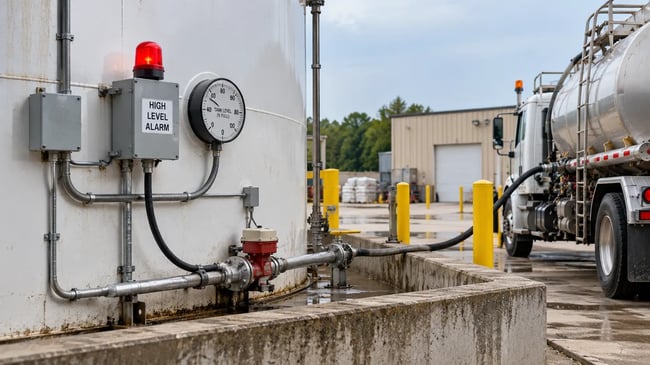
With an alarm, location is everything. The rule says the signal has to reach a constantly attended station, so an alarm horn mounted on the tank in a fenced yard doesn't count if the only person on site is inside the building with the door closed. For delivery tanks, the best place is wherever the driver stands during the fill, with a light or horn you can hear over truck noise. The set point matters too. If the alarm trips at the very top of the tank, there's no room left to react. EPA's SPCC guidance points to the filling rate, the container size, and the reaction time as the things to weigh, so a tank that fills at a high flow rate needs the alarm set well below the maximum fill level to give someone time to close a valve or stop a pump.
Automatic shutoffs have a catch that trips people up. A pump cutoff controls the pump it's wired into. If your facility pump is moving oil between tanks, a cutoff on that pump does its job. But if a delivery truck is pushing fuel in with its own pump, your cutoff can't stop it. For truck deliveries, a shutoff valve on the fill line or an alarm paired with a driver who stays at the fill point is usually the better match. Which device suits a particular tank is an engineering question, and for PE-certified plans the engineer should have the answer on record.
Think about how each device fails. Floats stick, batteries die, forklifts cut wiring, and an alarm someone silenced last spring can stay silenced. Monthly inspections catch those problems, and our article on SPCC monthly inspections covers what to look at.
When Do Gauge Reading and Constant Communication Count as Overfill Prevention?
Plenty of facilities don't have an alarm or shutoff on every tank, and the rule doesn't force one. The third and fourth options let a trained person and a reliable way to read the level do the job.
Direct gauge reading means the level is visible, either on a direct vision gauge or a digital readout, and someone is watching it from the start of the transfer until the end. The word "present" in the rule carries weight. A gauge that someone glances at twice during a forty-minute fill is not monitoring. If the fill port is on one side of the yard and the gauge is on the other, the person at the truck can't see the level, so you need a second person at the gauge and a way for them to talk. That's the direct audible or code signal communication option: a radio, a phone line left open, a horn code, anything that gets a stop message from the gauger to the pumping station without delay. Agree on the signal ahead of time and write it down.
What About Drums, Totes, and Small Tanks?
EPA's guidance recognizes that an alarm or fast-response system makes sense for a large stationary tank, while a simpler procedure may be right for a small container that's easy to watch, as long as the filling procedure is documented in the SPCC plan. That procedure usually means verifying the container has enough free space for the transfer before you start, and posting the written steps next to the fill pipe. Many facilities also have drums, intermediate bulk containers, and totes that are never filled on site, only swapped out full, which changes the overfill picture entirely. If you're unsure whether your drums count toward the plan, take a look at our article on 55-gallon drums and SPCC plans.
The guidance says "smaller containers" without drawing a line, so we tell clients to ask one question: can a person at the fill point see the level and shut things off before it overflows? If the answer is yes every time, a documented procedure can work. If it's "usually," get a device.
How Often Should You Test Overfill Prevention Devices?
The rule says to test liquid level sensing devices regularly to ensure proper operation, and it stops there. There's no federal interval written into 112.8(c)(8). That leaves you to set a schedule, put it in your plan, and then follow it, because an inspector will compare what the plan says to what your records show.
Start with the manufacturer's instructions, since they often specify how and how often to test a given alarm or switch. A schedule we commonly recommend is a quick function check during each monthly inspection and a fuller test at least once a year. The test itself should prove the device works at the level it's supposed to trip. For many float switches and alarms, that means manually lifting the float or using the test function rather than waiting for a delivery to find out.
Keep a dated record every time, with who tested it, what was done, and what happened. If a device fails, fix or replace it promptly and note when. Your staff should also know what the devices do and what to do when one sounds, which fits the SPCC training topics we cover elsewhere, or for a course from our online training library.
What Should You Coordinate With Your Fuel Supplier Before a Tank Delivery?
Deliveries are where most tank overfills happen, and they involve two companies with two sets of assumptions. The driver assumes the tank has room because the order was placed, and the facility assumes the driver will stop at the right level. A short conversation before the first delivery, and a written procedure after that, closes the gap. Your supplier has its own driver procedures, but you're responsible for what happens at your tank.
Here's what we'd work out with the supplier, by stage of the delivery.
| When |
What to coordinate |
| Before the order |
Check the current level yourself and order by quantity, based on the room you know is available, rather than telling the driver to fill it. Make sure the supplier has the tank's capacity and the maximum fill level your plan allows. |
| Before the truck connects |
Make sure the fill port is accessible and labeled, and any containment at the fill point is clear of water and oil. Show the driver where the alarm or gauge is, and who on site can stop the delivery. |
| During the delivery |
The driver stays at the fill point the whole time. If the tank has an alarm, someone can hear it. If you rely on a gauger, the stop signal is agreed and tested before flow begins. |
| After the delivery |
Check the final level, look for oil in containment or around the fill port, make sure any silenced alarm is armed again, and record the quantity delivered. Report near misses to whoever is responsible for your SPCC plan. |
Post the filling procedure by the fill port so a substitute driver or new employee sees the same instructions every time, and if the supplier changes, walk the new driver through the setup. If a spill ever happens during a delivery, the sheen rule is a good place to start for understanding reporting.
How Do New Jersey Rules Affect Oil Tank Overfill Prevention?
The SPCC rule is federal, and in New Jersey it sits alongside state programs that cover the same tanks from different angles. For aboveground tanks, SPCC is the main overfill requirement, but the New Jersey Spill Compensation and Control Act (the Spill Act) makes anyone who discharges a hazardous substance, including oil, responsible for reporting it and for the cleanup. Liability under the Spill Act is strict, and in general it can extend to more than one party, so an overfill that reaches soil or a storm drain can become an expensive state matter as well as an SPCC one. An environmental attorney is a reasonable call if you've had a discharge and aren't sure of your exposure.
Underground tanks are handled differently. New Jersey regulates them under N.J.A.C. 7:14B, and those rules are specific about overfill. They require that the available volume in the tank always be greater than the volume being transferred, and that the transfer be monitored constantly. Overfill prevention equipment is required unless the tank is filled by transfers of 25 gallons or less at a time, and the equipment has to be inspected at installation and at least once every three years, with records kept for five years. Whether a particular tank counts as a regulated underground tank depends on its size, contents, and use, so confirm with NJDEP's UST program. Work on regulated USTs generally needs NJDEP-certified contractors.
Larger facilities face another layer. Under N.J.A.C. 7:1E, a "major facility" has to maintain Discharge Prevention, Containment and Countermeasure (DPCC) and, where it applies, Discharge Cleanup and Removal (DCR) plans. Whether you count as a major facility depends on your total storage capacity and what you store, so check the rule against your own inventory. Aboveground tanks may also fall under the Uniform Fire Code, which your local fire official enforces, so it's worth a call to them about fill and vent arrangements.
If you're adding or replacing tanks as part of a building or expansion project, the construction-phase permits and tank installation approvals are a matter for your engineer and contractor, and RMA doesn't prepare those. Once the facility is running, the overfill procedures, plan amendments, inspection routine, and training are the operational pieces we help with. For more on the state picture, see our article on SPCC plans in New Jersey. If an overfill happens, put safety first, call 911 if there's a fire or danger to people, and report the discharge to NJDEP. Get the current hotline number from NJDEP's website and keep it posted at the tank.
How Can RMA Help With SPCC Overfill Prevention?
If your facility is small and your tanks are simple, you may not need us. A documented filling procedure, a posted sign, and a monthly check cover a lot of ground, and our overlooked SPCC requirements article is a useful self-check. Where we help is on the harder cases: larger tanks, remote fill ports, deliveries from several suppliers, or a plan that says one thing about overfill prevention while the yard does another.
We can review the overfill section of your plan against what's installed on site, walk your tanks with you, write a delivery procedure your supplier and your staff can follow, and set up a test schedule with records. Senior staff do the work, and we'll tell you plainly if something you have is already fine. There's no obligation in a conversation. You can call us, send an email, or fill out the form on our website, and if you'd like to talk to RMA about your tanks, we'll take it from there at your pace. For a look at how enforcement works, see our article on top SPCC plan violations and fines.