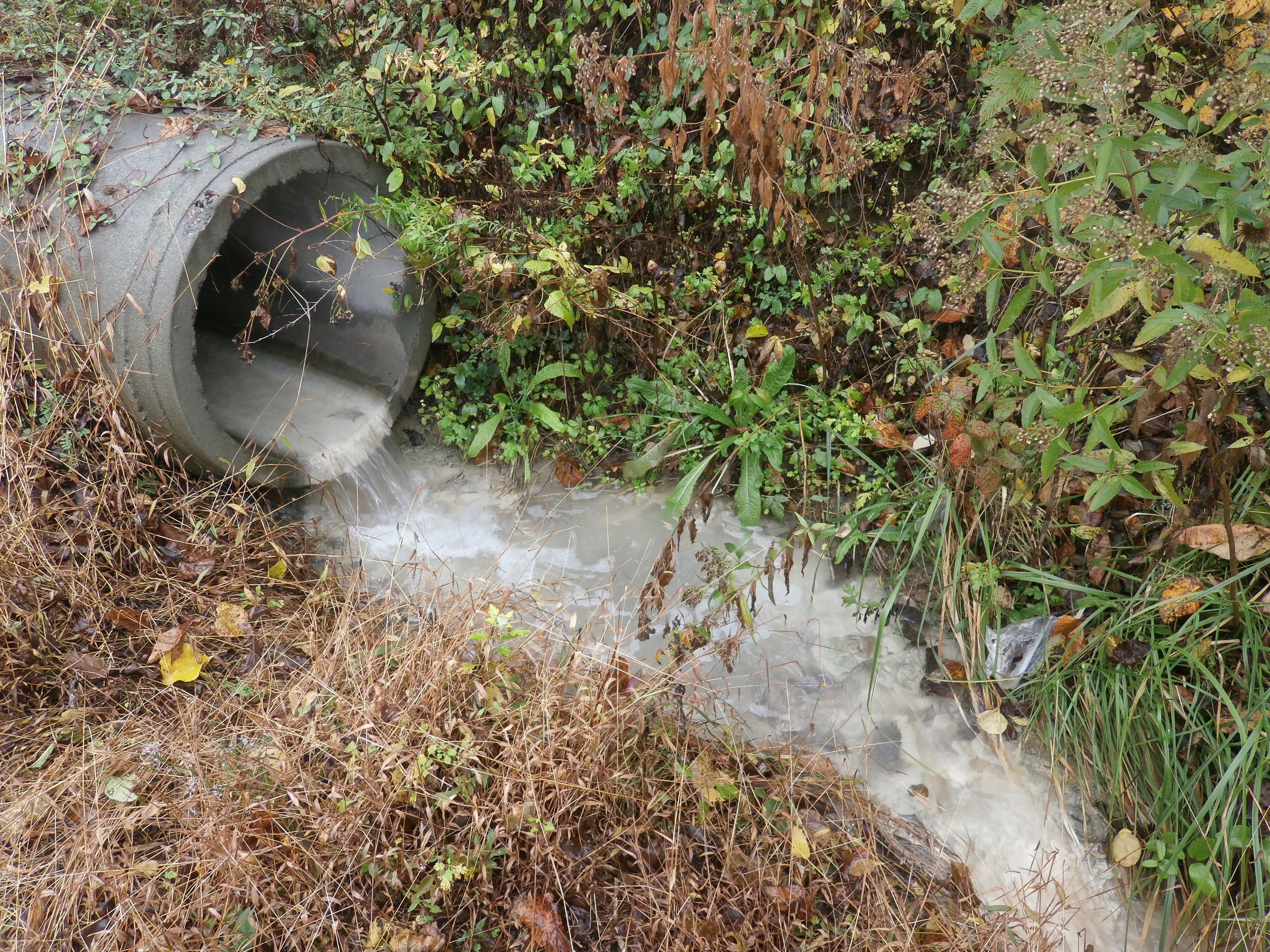
What to Keep, How Long to Keep It, and How to Organize Your PAG-03 Files So a PA DEP Stormwater Inspection Goes Smoothly
PAG-03 is the general permit from the Pennsylvania Department of Environmental Protection (DEP) that covers stormwater leaving industrial facilities. Nearly all of its day-to-day work leaves a paper trail: plans, inspection forms, lab reports, electronic reports, training sheets, and notes about what you fixed. When a DEP inspector shows up, that paper trail is the first thing they ask for, and it's usually where a manageable visit either stays manageable or doesn't. Plenty of facilities do the work and still can't prove it, because the proof is scattered across three desks and an old email account.
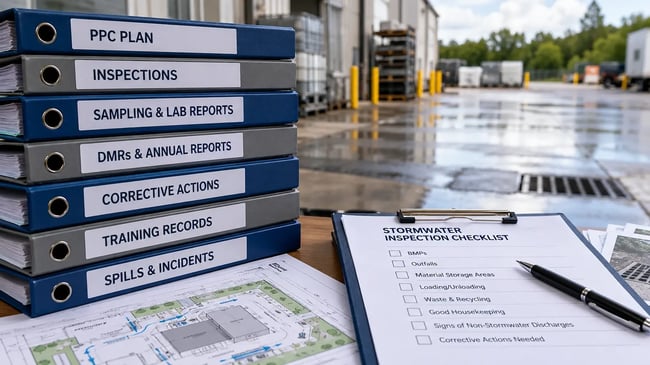
So what does DEP expect to see? In short, a current PPC Plan with a site map, inspection records, sampling results with the lab reports behind them, copies of your eDMR and annual report submissions, training records, corrective action documentation, spill and incident records, and your correspondence with DEP. This article walks through each one, explains how long to keep them, and gives you a checklist table to hand to whoever runs your file. If you'd rather have a second set of eyes on your records before an inspector does, you can reach out to RMA and we'll tell you where you stand.
Table of Contents
TL;DR
A PAG-03 facility should keep its current PPC Plan (the site-specific pollution prevention and response plan) with a site map, inspection records, sampling results with the original lab reports, copies of its eDMR and annual report submissions, training sign-in sheets, corrective action notes, spill and incident records, and all correspondence with DEP. DEP's standard permit language sets a 3-year minimum from the date of the sample or report, and DEP can extend it, so we suggest keeping everything for the full 5-year permit term. A file organized by year and ready to hand over in minutes makes a PA DEP inspection far smoother. Check the recordkeeping language in your own permit for the exact requirements.
What Records Does a PAG-03 Permit Require You to Keep?
PAG-03 doesn't hand you one tidy list titled "records." The requirements are spread across the permit. The main permit covers self-monitoring, reporting, and recordkeeping, along with best management practices (BMPs, the physical and operational controls that keep pollution out of your runoff), routine inspections, and the PPC Plan. The sector appendix that matches your industry adds its own sampling and BMP requirements. The current permit runs from March 24, 2023 through March 23, 2028, and details can differ by appendix, so read the permit and appendix that apply to you alongside this article.
Boiled down, the records do three jobs. They show the plan you made for your site, they show you carried it out, and they show what you did when something went wrong. The PPC Plan covers the first job. Inspection forms, sampling results, and training sheets cover the second. Corrective action notes and incident reports cover the third. The permit also lets DEP and EPA representatives enter your facility and copy any records it requires, so the records review usually comes first in an inspection, and the inspector uses it as a map for the walk through the yard. We cover that sequence in our post on what happens during a PA DEP stormwater inspection.
What Should Your PPC Plan, Site Map, and NOI Package Look Like in the File?
The PPC Plan goes at the front of the file, because everything else gets measured against it. PPC stands for Preparedness, Prevention, and Contingency. It's the site-specific plan DEP requires under 25 Pa. Code Section 91.34, and it identifies the pollutant sources at your facility, describes the practices that keep them away from stormwater, spells out how you'll respond to spills, and includes a plan for training employees. A PPC Plan also has to go in with every complete PAG-03 Notice of Intent (NOI), the application that gets you coverage. If you're not sure how it differs from the SWPPP you may have seen in other states, our comparison of Pennsylvania SWPPPs and PPC Plans under PAG-03 walks through it.
The permit expects you to review the plan at least once a year and update it when something changes, such as new equipment, a changed process, or a plan that failed in an emergency. When you update it, save the old version with its date instead of overwriting it. If an inspector asks why a storage area isn't on the map, a dated trail answers the question in a minute. Keep the site map with the plan. It should show drainage areas, outfalls (the points where stormwater leaves your site), material storage, and your controls, and it should match the yard as it looks today. Next to it, keep the NOI package exactly as you submitted it, DEP's authorization letter, and a note of which sector appendix applies to you.
How Should You Document PAG-03 Inspections and the Annual Report?
PAG-03 requires routine visual inspections at least twice a year, in calendar semiannual periods. The inspection covers areas where industrial materials or activities are exposed to stormwater, the pollutant sources your PPC Plan identifies, and the BMPs you rely on. Because the findings feed your annual report, the inspection form is the raw record behind that report.
A useful form is simple. It has the date and time, who did the inspection, which areas they covered, what the weather was, what they found, and what needs fixing. It also has a follow-up line showing who fixed each problem and on what date. Inspectors read those lines closely, because a list of problems with no fixes tells them the program stops at noticing. Dated photos of a problem and its repair cost a few minutes and settle most questions. If your team walks the site more often than the minimum, keep those notes too. Our post on how to do a stormwater visual inspection the right way covers the walk-around itself.
What Belongs With Your Annual Report?
The annual report is due to DEP by May 1 each year and covers the previous calendar year. It documents your visual inspections, your PPC Plan review, your annual employee training, and your sampling events. Keep a copy of exactly what you submitted, proof of when and how you submitted it, and the backup behind each answer. If the report says the PPC Plan was reviewed, the dated plan version should be in the file. If it says training happened, the sign-in sheet should be there.
How Should You Keep PAG-03 Sampling Results, Lab Reports, and eDMR Records?
Sampling creates the biggest pile of paper in a PAG-03 file, and it's where mismatches show up. Most sectors sample twice a year, and your sector appendix sets the parameters and benchmark values. DEP's standard permit language says to record the exact place, date, and time of each sample, who took it, when the analyses were done and by whom, the methods and detection level, and the results. The lab report covers the analysis side. The sampling side is on you, which is why a simple field sheet for each event is worth the trouble. Our post on Pennsylvania's PAG-03 permit and how to take stormwater samples covers collection in detail.
For each event, keep the field sheet, the original lab report, the chain of custody form, and your rainfall notes. Keep the original report, not just the numbers you typed into a spreadsheet, because the report is what an inspector can verify. Our post on where to get rainfall data points you to sources. Pennsylvania's laboratory accreditation rules in 25 Pa. Code Chapter 252 apply to labs analyzing samples for permit compliance, so confirm accreditation up front. Our guide on how to pick a water testing lab covers what to ask. If you couldn't collect a required sample, write down why while it's fresh. A missed sample with a documented reason reads very differently from an unexplained gap.
What Should You Keep From eDMR Submissions?
eDMR is DEP's electronic Discharge Monitoring Report system, and PAG-03 permittees report sampling results through it. Save the confirmation and a PDF of every submission, and compare the numbers to the lab report before you send them. A typo between the lab report and eDMR is one of the easiest problems for an inspector to spot and one of the easiest for you to prevent. Our guide to Pennsylvania's eDMR reporting shows the process step by step, and our post on what to do with stormwater samples after collecting them covers the handoff to the lab.
What Corrective Action and Training Records Does DEP Expect Under PAG-03?
Benchmark values in your sector appendix aren't effluent limits. They're thresholds for judging whether your controls are working. Repeated exceedances at the same outfall over consecutive monitoring periods can trigger a corrective action plan, with more controls to follow, and the exact triggers depend on your appendix and permit version. Our explainer on benchmark values versus effluent limits covers the difference.
For each exceedance, keep the result, what you checked to find the cause, what you changed, the date of the change, and what the next sample showed, plus the corrective action plan and anything you sent DEP about it. A lab report with a high result and nothing behind it looks like nobody read it. The same report with a short investigation note and a dated repair looks like a program that works. Our post on what to do if your stormwater sampling results are high walks through next steps.
Training records are the easiest to forget and the easiest to produce. The PPC Plan includes a plan for training employees and contractors, and PAG-03 permittees report in the annual report whether the required annual training took place. Keep a sign-in sheet for each session with the date, topic, trainer, and every attendee's name, plus the materials used, and note when new hires get trained between sessions. Our post on whether stormwater training is required and our online training library are good starting points.
How Should You Keep Spill, Incident, and DEP Correspondence Records?
Pennsylvania's rules on incidents that cause or threaten pollution set tight clocks. Under 25 Pa. Code Section 92a.41(b), you notify DEP orally as soon as possible and no later than 4 hours after you become aware of the incident, then follow with a written submission within 5 days. Not every spill reaches that level, but log the ones that happen either way so you can show the pattern. Record what happened, when you found it, who you notified and when, how you cleaned it up, where the waste went, and what you changed afterward. If oil is involved, our post on when you have to report an oil spill covers the sheen rule.
Your DEP correspondence belongs in the file too: the authorization letter, renewal notices, inspection reports and follow-up letters, information requests, and your responses. Emails count. Save them in a shared folder instead of one person's inbox, because that person will eventually move on. If a letter turns out to be a notice of violation, that's the point to talk with an environmental attorney, and also the point to resist tidying the file. Never recreate or backfill a record after the fact. If one is missing, document that it's missing and what you're doing about it. The permit carries penalties for knowingly false statements in required records.
How Long Do You Have to Keep PAG-03 Records?
DEP's standard NPDES permit language follows the federal rule at 40 CFR 122.41(j)(2). It says to keep records of monitoring activities and results, copies of all reports the permit requires, and the data used to complete the permit application for 3 years from the date of the sample, measurement, report, or application. DEP or EPA can extend that period, and a longer period applies if the permit requires one. Your own PAG-03 authorization and sector appendix control, so check the recordkeeping language in your permit for the exact wording.
Three years is the floor, and we'd treat it that way. We suggest keeping everything for at least 5 years, which matches the length of a PAG-03 permit term. Sampling data from earlier years can feed your renewal application, and when DEP reissued PAG-03 in 2023, facilities could use data from previous years on the renewal NOI. Keep your PPC Plan versions, NOI package, and DEP authorization for as long as you hold coverage. And if you're in the middle of a dispute or enforcement matter, don't discard anything until it's resolved and your attorney says you can.
What Does a PAG-03 Recordkeeping Checklist Look Like?
Here's the full list in one place. The retention column shows our suggested minimum, which is longer than the 3-year baseline in DEP's standard permit language, and "life of coverage" means for as long as you hold PAG-03 coverage. Sampling and reporting frequencies depend on your appendix and permit version, so confirm them against your own authorization.
| Record |
What to Keep |
Suggested Retention |
| PPC Plan and site map |
Current plan, site map with outfalls and drainage, dated prior versions, annual review notes |
Life of coverage, with prior versions kept at least 5 years |
| NOI package and DEP authorization |
NOI as submitted, DEP's approval letter, applicable sector appendix |
Life of coverage |
| Routine inspection records |
Dated forms, findings, follow-up and repair dates, photos |
At least 5 years |
| Sampling records and lab reports |
Field sheet, chain of custody, rainfall notes, original lab report, reasons for any missed sample |
At least 5 years |
| eDMR submissions |
Confirmation and a copy of each submission |
At least 5 years |
| Annual report (due May 1) |
Copy as submitted, proof of submission, supporting backup |
At least 5 years |
| Corrective action |
The exceedance, investigation notes, corrective action plan, repair dates, follow-up results |
At least 5 years after it's closed out |
| Training records |
Sign-in sheets, topics, trainer, materials, new hire training dates |
At least 5 years |
| Spill and incident records |
What happened, notifications and times, cleanup, waste disposal, photos, plan changes |
At least 5 years, longer if an enforcement matter is open |
| DEP correspondence |
Letters, emails, inspection reports, information requests, your responses |
Life of coverage |
How Do You Organize PAG-03 Files So a PA DEP Inspection Goes Smoothly?
Keep everything in one place, either a binder or a shared folder, organized by calendar year, with a tab for each record type in the checklist above. Put the PPC Plan, site map, and DEP authorization at the front, since that's what an inspector usually asks for first. Make sure at least two people know where the file lives, because the person who built it will be on vacation the day DEP shows up. Then put the recurring dates on a shared calendar with reminders well ahead of each one: the two inspections, each sampling period, the annual PPC Plan review and training, and the May 1 annual report.
Try a simple test. Ask someone who didn't build the file to put the PPC Plan, last year's inspection forms, the most recent lab report, and the matching eDMR confirmation on a table. If that takes five minutes, you're in good shape. If it takes an hour, you've found what to fix before DEP finds it for you. While you're at it, check that the lab report, the eDMR entry, and the annual report tell the same story. We can't promise how any inspection will go, because that depends on your site and what the inspector finds. A file you can pull together in minutes is the one part of the visit you control completely.
How Does RMA Help With PAG-03 Recordkeeping?
Plenty of facilities keep a clean PAG-03 file on their own. If you've got a calendar, a binder, and somebody who owns it, you may not need us, and we'll tell you so. We come in when the file has gaps, the person who built it has moved on, or an inspection is on the calendar and you'd rather find the problems first. We review your PPC Plan, inspection records, sampling and lab reports, eDMR submissions, and annual reports against your permit, point out what's missing or doesn't match, and help you fix it. We can also help with ongoing sampling, inspections, training, eDMR reporting, annual reports, and PPC Plan updates so the file stays current. A senior member of our team does the review, not someone junior.
There's no pressure and no obligation. You can call us, email us, or fill out the form on our website. If you want to see how our NPDES and stormwater support works first, our service and company fit guide lays it out. Otherwise, get in touch with RMA whenever you're ready.