A Side-by-Side Look at Pennsylvania's PAG-03 and the Industrial Stormwater General Permits Next Door, Built for Operators With Facilities in More Than One State
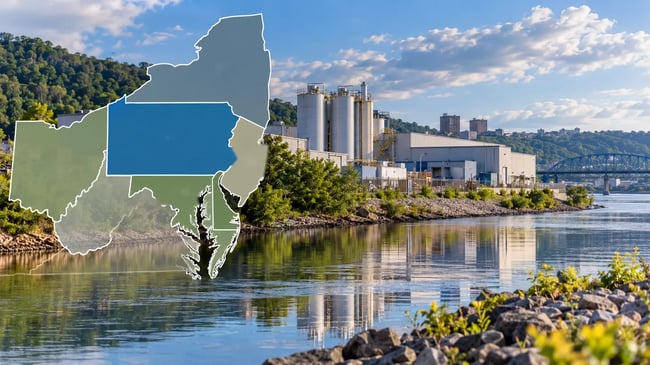
If you run facilities in more than one state, you've probably noticed that "the industrial stormwater permit" isn't one permit. Under the federal NPDES program (the National Pollutant Discharge Elimination System, which regulates what leaves your site in runoff), every state writes its own general permit with its own name, its own plan, its own sampling schedule, and its own agency answering the phone. Pennsylvania's is PAG-03, the general permit PA DEP (the Department of Environmental Protection) issues for stormwater associated with industrial activity. A manager who knows it well can still get thrown the first time they open the equivalent permit in New Jersey, New York, Ohio, or Maryland.
The short answer is that all five are general permits built on the same federal model with the same basic idea: if industrial activity is exposed to rain and snowmelt, you need permit coverage and a plan for keeping pollutants out of runoff. The differences are in the details, and they're big enough to matter when you're managing sites in several states. Below, we compare each permit's name, plan type, monitoring approach, and administering agency in one table, then take the differences that trip people up one at a time. If you'd like a second set of eyes on how your own facilities line up, reach out to RMA and we'll talk it through.
Table of Contents
TL;DR
Pennsylvania's PAG-03, New Jersey's 5G2, New York's GP-0-23-001, Ohio's OHR000007, and Maryland's 20-SW are all NPDES general permits, run by PA DEP, NJDEP, NYSDEC, Ohio EPA, and MDE. The biggest differences are the plan (a PPC Plan in Pennsylvania, a SWPPP or SPPP elsewhere), whether the plan gets sent to the agency, and how much you sample and inspect. New Jersey's basic permit is the outlier, since it covers indoor or under-cover operations and requires no sampling. These permits are reissued on different schedules, so check each agency's current permit text before relying on any summary.
How Do PAG-03 and the Neighboring State Stormwater Permits Compare Side by Side?
The table below sets the five permits next to each other. Each cell is a high-level summary, so the permit text controls wherever the two differ. It covers permits for operating industrial facilities. Construction-phase stormwater permits are a separate set of permits in each of these states, and RMA doesn't prepare them.
| |
Pennsylvania |
New Jersey |
New York |
Ohio |
Maryland |
| Administering agency |
PA DEP |
NJDEP (Division of Water Quality) |
NYSDEC |
Ohio EPA |
MDE (Industrial Stormwater Permits Division) |
| Main general permit |
PAG-03 |
5G2 Basic Industrial Stormwater General Permit, plus industry-specific general permits |
SPDES Multi-Sector General Permit, GP-0-23-001 |
Industrial Stormwater General Permit (Multi-Sector), OHR000007 |
General Discharge Permit for Stormwater Associated with Industrial Activities, 20-SW |
| Plan required |
PPC Plan (Preparedness, Prevention, and Contingency) |
SPPP (works like a SWPPP) |
SWPPP |
SWPPP-style plan |
SWPPP |
| Plan sent to the agency? |
Generally attached to the NOI |
Generally kept on site and produced on request |
Electronic copy filed with the NOI |
Kept on site |
Submitted with the NOI and fee |
| Sampling |
Set by industry appendix, commonly semiannual where it applies |
None under 5G2, though industry-specific permits can add it |
Semiannual, with corrective action for exceedances |
Benchmark sampling (four quarterly samples) in the first two years for some sectors |
Industry-specific benchmarks, with corrective action when exceeded |
| Inspections and visual checks |
Routine inspections plus an annual inspection and compliance evaluation |
Monthly inspections plus an annual comprehensive inspection |
Quarterly visual monitoring |
Quarterly visual assessments, including snowmelt |
Quarterly visual monitoring |
| Reporting |
eDMR |
Annual fee, with no sampling results to report under 5G2 |
NetDMR |
NOIs and renewals through the Ohio EPA eBusiness Center |
NetDMR |
| No exposure option |
No Exposure Certification, approved by DEP and renewed every five years |
Permanent no exposure certification (high bar) |
No Exposure Certification |
No Exposure Certification |
No Exposure Certification (NEC) |
Pennsylvania, New York, Ohio, and Maryland all run sector-based permits, where your industry decides what you monitor and how often. New Jersey's basic permit works differently, and it gets its own section below. One housekeeping point before the details: these permits are reissued on their own schedules, and an agency can leave a permit in effect past its stated end date while the next version is written. Check each agency's website for the version currently in force before you rely on any summary, ours included.
Why Does Pennsylvania Call It a PPC Plan When Other States Say SWPPP?
Pennsylvania asks for a PPC Plan, short for Preparedness, Prevention, and Contingency Plan. It does the same core job as the Stormwater Pollution Prevention Plan (SWPPP) that New York, Maryland, and most other states require. It identifies where pollutants could reach stormwater and documents the best management practices (BMPs, the physical and operational controls) that keep them out. The PPC Plan adds spill preparedness and emergency response as core sections, where a lot of SWPPP templates mention them only briefly. Our article on how PPC Plans compare to SWPPPs goes through the contents in more detail. New Jersey's permit text calls its plan an SPPP, though in practice it works like a SWPPP, and Ohio's permit requires a SWPPP-style plan as well.
Where the plan goes after you write it differs too. Pennsylvania generally has you attach the PPC Plan to the Notice of Intent (NOI, the application for permit coverage). New York asks for an electronic copy of the SWPPP with the NOI, and Maryland wants the SWPPP submitted along with the NOI and fee. New Jersey and Ohio generally have you keep the plan on site and produce it when asked. For a multi-state operator, that means a plan template can't just be renamed and reused. A plan written to New Jersey's on-site standard may not hold up once it's sitting in a Pennsylvania or New York agency file from day one. Our explainer on New York's SPDES permit and its SWPPP covers how the permit and the plan get mixed up in that state, and our general guide to what a SWPPP is covers the basics.
How Do Stormwater Sampling and Inspection Requirements Differ by State?
Monitoring splits into two kinds of requirements. Sampling means collecting stormwater during a storm and sending it to a lab. Inspections and visual checks mean walking the site and looking at what's happening around your outfalls and exposed areas. The five states mix the two differently.
Pennsylvania's PAG-03 sorts facilities into industry-based appendices, and the appendix that matches your industry sets the parameters you sample, with semiannual sampling common where sampling applies. Results go in through DEP's eDMR (electronic Discharge Monitoring Report) system, and the permit also requires routine inspections and an annual inspection and compliance evaluation. New York continues semiannual monitoring and reporting through NetDMR and adds quarterly visual monitoring. Ohio requires quarterly visual assessments, including a snowmelt assessment, from covered facilities, and adds benchmark sampling for some sectors, four quarterly samples within the first two years of the permit term. Maryland pairs quarterly visual monitoring with industry-specific benchmark monitoring and a corrective action program when benchmarks are exceeded, and it takes results through NetDMR.
Benchmarks generally show up in all four sector-based permits. A benchmark value is a concentration that signals it's time to take a closer look at your controls when your results run above it, and it isn't a pass or fail effluent limit. Our explainer on benchmark values versus effluent limits covers the difference. For what the day-to-day looks like, see our guides to PAG-03 stormwater sampling, Pennsylvania eDMR reporting, and handling exceedances under New York's SPDES permit. Sampling requirements vary by industry sector in every one of these states, and some sectors have none, so the sampling row in the table describes the pattern and not what your own facility owes.
How Does New Jersey's 5G2 Permit Compare to PAG-03?
RMA is based in New Jersey, so this is the comparison we get asked about most. New Jersey's Basic Industrial Stormwater General Permit, known as 5G2 and administered by NJDEP, isn't a sector-based permit like PAG-03. It's a permit for facilities that keep their industrial materials and activities indoors or under cover. In exchange for removing exposure to stormwater within six months of authorization, you skip stormwater sampling entirely. What you do owe is a stormwater plan, documented monthly inspections, an annual comprehensive inspection, and annual training. Our article on the 5G2 Basic Industrial Stormwater Permit goes through each piece, and our answer on taking 5G2 training online covers the training requirement.
Facilities that work outdoors in New Jersey don't use 5G2. They look to one of the industry-specific general permits, such as the SM2 permit for scrap metal or the R13 and RSG permits for mining, or, if nothing fits, an individual permit. New Jersey runs a long list of industry-specific permits, which is part of why NJPDES requirements (New Jersey's version of NPDES) can look so different from one facility to the next. Our guide to NJPDES stormwater permit requirements is a good starting point.
The surprise runs in both directions. A New Jersey manager used to 5G2 who takes over a Pennsylvania site may expect a lighter program than PAG-03 delivers, since PAG-03 is built for facilities with industrial activity exposed to stormwater and attaches a plan, sampling, and eDMR reporting to that. A Pennsylvania manager with an indoor-only site would generally look at a No Exposure Certification rather than PAG-03 coverage, and New Jersey has its own version of that certification, though the bar is high.
What Are the No Exposure and Individual Permit Options in Each State?
All five states give indoor-only facilities a way out of general permit coverage, usually called a No Exposure Certification (NEC). The idea is the same everywhere: if your industrial materials and activities are sheltered from rain and snowmelt, you certify that and skip the permit's plan and sampling work. The bar is high in practice. In Pennsylvania, DEP has to approve the certification, it's renewed every five years, and it isn't available to facilities that discharge directly to High Quality or Exceptional Value waters. Ohio, New York, and Maryland each run their own certification process, and our piece on Maryland's Non-Exposure Certification walks through what that state looks at. For the concept itself, see what No Exposure means under an NPDES permit.
When a facility doesn't fit the general permit, the fallback is an individual permit, written for one site. In Pennsylvania, a direct discharge to High Quality or Exceptional Value waters rules out PAG-03 and puts a facility on the individual permit path, and DEP generally issues those for five-year terms. Because an individual permit is written for one facility, it tends to ask for a closer look at your operations, drainage, and receiving waters than a general permit does. New Jersey's version is covered in our article on individual NJPDES industrial permits, and our overview of general, individual, and No Exposure permits covers the choice in any state. Whether a facility lands in a general permit, a certification, or an individual permit depends on its industry, its exposure, and where its runoff goes, so the answer for a given site comes from looking at the site.
How Can Multi-State Operators Keep Five Stormwater Programs Straight?
Most multi-state operators run into the same three problems: a plan template that's right for one state and wrong for the next, sampling calendars that don't line up, and permit renewals nobody's tracking. A few habits help. Keep one tracker with each facility's permit name, agency, plan type, sampling and inspection schedule, reporting system, and renewal date, so nobody assumes Pennsylvania's eDMR rules carry over to Maryland, where results go through NetDMR. Write each plan to its own state's permit, since reusing a New York SWPPP in Pennsylvania means adding the preparedness and contingency sections a PPC Plan expects. And train the people at each site on their state's version, because the inspection and sampling duties differ enough that generic stormwater training will leave gaps. Our online environmental training library is one place to start for site staff.
If you run a few indoor-only sites with simple permits and someone on staff who's comfortable reading a general permit, you may not need outside help at all. Consultants earn their keep when the facilities are covered by sector-based permits, when sampling is in play, or when the permits sit with five different agencies. Anyone building that in-house knowledge can start with our guide to NPDES stormwater permits.
How Can RMA Help With Multi-State Stormwater Permits?
We're a family-run firm based in New Jersey that works with facilities across the country, and we help multi-state operators sort out which permit applies at each site, build plans that match each state's permit instead of one template stretched across all of them, and set up the sampling, inspections, and reporting that follow. Senior staff do the work, and we'll tell you plainly if a site's needs are simple enough that you can handle them yourself. If you'd like to see how we approach Pennsylvania in particular, our Pennsylvania NPDES and stormwater help page lays out PAG-03, individual permits, and No Exposure Certifications, and our NPDES and stormwater learning center collects our guides for every state we've covered.
There's no pressure and no obligation. Give us a call, send an email, or fill out the form on our website, and tell us what you're managing and where. If you'd like to talk through how your facilities line up across state lines, contact RMA and we'll help you figure out what applies to each one.