What "Permanently Closed" Means for Your Oil Storage Count, and What Pennsylvania Requires on Top of It
If you've got an old oil tank sitting idle, you're probably still counting it. Under the federal oil spill rule, a tank that's empty, unplugged, or labeled "out of service" can still add to your facility's oil storage total, and that total decides whether you need a written oil spill plan at all. The way to take a tank out of the count is to permanently close it exactly as the rule defines that term, and for tanks that Pennsylvania regulates, the state runs its own closure process on top of the federal one.
The short answer is that a container is permanently closed when the oil and sludge are out, the piping is disconnected and blanked off, the valves are locked shut, and a sign on the tank says it's permanently closed and gives the date. This article walks through each of those steps, shows how closure changes your capacity math, explains the Pennsylvania tank closure requirements that sit alongside the federal rule, and covers what happens to your oil spill plan afterward. If you'd like a second set of eyes on your tank inventory, you can reach out to RMA at any point.
Table of Contents
TL;DR
Under the federal oil spill rule, a tank is permanently closed only when all oil and sludge are out of the tank and its lines, the piping is disconnected and blanked off, the valves are closed and locked, and a sign on the tank states it's permanently closed with the date. Once a tank meets that definition, its capacity stops counting toward the 1,320 gallon aboveground threshold, which can drop a facility below the rule entirely. Pennsylvania adds its own closure rules for tanks that the state regulates, and those can include advance notice to DEP, a DEP-certified installer, a site assessment, and an amended registration. Meeting one set of rules doesn't satisfy the other, so plan for both.
What Is an SPCC Plan and How Does Oil Storage Capacity Count Work?
An SPCC Plan is a Spill Prevention, Control, and Countermeasure Plan. It's a written plan required by EPA under 40 CFR Part 112 for facilities that store oil and could reasonably be expected to discharge it to a waterway or shoreline. If you haven't heard of it, you're in good company. Many facility managers first run into it when an insurer, lender, or inspector asks for a copy, and the basics of what an SPCC Plan is are worth a quick read if this is new to you. In Pennsylvania, EPA Region 3 enforces the rule.
The trigger is a capacity number. A facility generally comes under the rule when its aboveground oil storage capacity is more than 1,320 gallons, counting only containers of 55 gallons or more, or when its completely buried capacity is more than 42,000 gallons. Capacity means the shell capacity of the container, so what's inside it on any given day doesn't change the math. An empty 500 gallon tank counts as 500 gallons. The oil can be petroleum, hydraulic fluid, lube oil, used oil, or animal fats and vegetable oils, and oil-filled equipment adds to the total as well. If you're not sure how your own containers add up, the four steps for figuring out whether you need a plan walk through the counting. The article on how 55 gallon drums are counted covers the most common surprise.
This is why closing a tank is worth understanding. If an idle tank is the thing pushing you over 1,320 gallons, closing it the right way may mean you don't need a plan. If you already have a plan, closing the tank changes what the plan has to describe. Either way, the rule only gives you credit when the tank meets its definition of closed.
What Does "Permanently Closed" Mean Under the SPCC Rule?
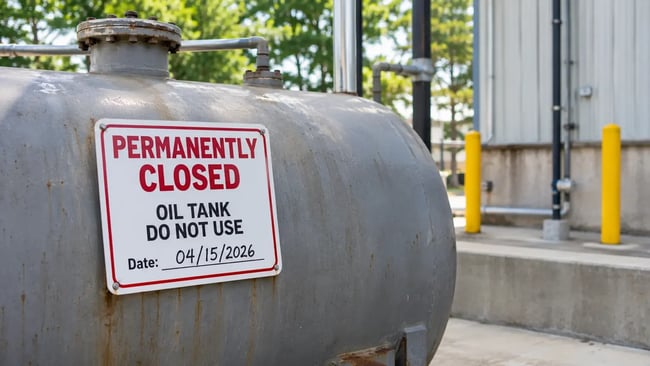
The definition sits in 40 CFR 112.2, and it applies to any container or facility. It has two parts, and every piece of both has to be true at the same time. First, all liquid and sludge has to be removed from the container and from the connecting lines. Second, the connecting lines and piping have to be disconnected from the container and blanked off, all valves (except ventilation valves) have to be closed and locked, and conspicuous signs have to be posted on each container stating that it's permanently closed and noting the date of closure.
| Federal requirement |
What it looks like at the tank |
How it gets missed |
| Liquid and sludge removed from the container and connecting lines |
Tank bottom, sumps, and product lines all emptied, not just a gauge reading zero |
Sludge left in the bottom, or piping still holding product |
| Lines and piping disconnected and blanked off |
A physical break at the tank, capped or fitted with a blind flange |
Pipe still attached with a valve shut ahead of it |
| Valves closed and locked (ventilation valves excepted) |
A lock on every remaining valve |
Valves closed but not locked |
| Conspicuous sign on each container saying it's permanently closed, with the date of closure |
A durable sign you can read from a few feet away |
No sign, a faded sign, or a sign with no date |
Notice what the definition doesn't say. It doesn't require you to remove the tank, cut it up, or fill it with inert material. It doesn't set a vapor standard, and it doesn't call for a notice or form sent to EPA. Permanent closure under SPCC is a physical condition you can show at the site, and it's the condition an inspector will look at. That's also why we suggest taking dated photos of each step and keeping the paperwork from whoever emptied the tank.
What Happens to the Oil and Sludge You Remove?
Getting the oil and sludge out is the step with the most moving parts, because what comes out of an old tank has to go somewhere legal. Depending on what it is, it may be managed as used oil, as product that can still be reused, or as a waste that needs to be characterized before it's hauled off. Our guide to used oil regulations covers the most common case. Tanks that held fuel can also hold flammable vapors, so cleaning, cutting, or welding on one is work for people trained to do it safely, not a weekend project for maintenance.
How Does Closing a Tank Remove It From Your SPCC Capacity Count?
The rule spells it out in 40 CFR 112.1(d)(2). When you add up a facility's aboveground storage capacity, the total excludes the capacity of any container that's permanently closed as defined in 112.2, and the same exclusion applies to the completely buried capacity total. Here's how that plays out. Say a facility has a 1,000 gallon diesel tank for a generator and an old 500 gallon heating oil tank nobody's used in years. The two together come to 1,500 gallons, which is over the 1,320 gallon line. If the old tank is permanently closed, the counted capacity drops to 1,000 gallons. If nothing else at the site pushes the total back up, the facility is under the threshold. The catch is that drums, totes, and oil-filled equipment all count, so run the full inventory before you assume the answer.
| Tank status |
Counts toward the 1,320 gallon total? |
| In use and holding oil |
Yes |
| Empty but still in place and piped |
Yes, because capacity counts, not contents |
| Standby, seasonal, or temporary storage |
Yes, the rule covers these unless they're permanently closed |
| Emptied with valves shut, but lines still connected, valves unlocked, or no dated sign |
Yes, it doesn't meet the definition |
| Meets every part of the permanently closed definition |
No |
Dropping below the threshold means the federal rule no longer applies to the facility on the capacity test, but it's not a permanent free pass. EPA's regional administrator keeps the authority under 112.1(f) to require a plan at a specific facility, and a tank that gets reopened, replaced, or added to can put you right back over the line. Keep the closure photos, the disposal records, and the old plan on file so you can show what the facility looked like and when it changed.
Why Doesn't an Empty or Idle Tank Count as Permanently Closed?
Because "empty" and "closed" are different conditions. An idle tank with a valve shut and a note taped to the side feels closed to the people who work around it, but if the piping is still attached, the valves aren't locked, or the sign has no date, the tank still counts at full shell capacity. The same goes for tanks labeled "out of service" or "decommissioned" in a maintenance system. Those labels describe how the facility treats the tank, and they don't change the definition. Standby and seasonal tanks are covered by the rule specifically, so a generator tank you only fill before storm season counts all year.
The Pennsylvania side has a similar trap. DEP recognizes a temporary out-of-service status for tanks, and under its 2018 revisions an aboveground tank is supposed to be permanently closed within five years of being placed out of service unless the owner asks for an extension in writing and DEP approves it. Temporary out-of-service status with DEP doesn't take the tank out of your SPCC count, and closing a tank for SPCC purposes doesn't satisfy DEP's closure steps. Each set of rules has to be met on its own terms. The other mistakes we see are partial closures, where one tank is closed but its piping still serves another tank, and signs that fade or fall off a year later so nobody can show the tank was ever closed.
What Are Pennsylvania's Tank Closure Requirements Beyond SPCC?
Pennsylvania runs a separate storage tank program through DEP under the Storage Tank and Spill Prevention Act and 25 Pa. Code Chapter 245. It applies only to tanks DEP regulates, and whether a particular tank falls under it depends on its size, type, and use, so confirm yours against DEP's storage tank program before you assume either way. A tank can be exempt from DEP's rules and still count toward your SPCC total, and a tank can be regulated by DEP at a facility that's well under the SPCC threshold. For a regulated tank, DEP's closure page lays out a multi-step process, and the regulations fill in the details.
For larger regulated aboveground tanks, 25 Pa. Code 245.561 requires the owner and operator to notify DEP at least 30 days before beginning permanent closure, unless DEP allows less time, the work is a response to corrective action, or DEP waives the notice. DEP provides an Aboveground Storage Tank Closure Notification Form for this. The work itself is done under a DEP-certified installer (DEP's closure page describes this person as a certified remover). The owner and operator also have to complete a site assessment to check for a release and prepare a closure report, and they have to keep the results for three years. Contents removed from the tank have to be reused, treated, or disposed of under state and federal waste rules. A tank left onsite has to be cleaned, rendered free of hazardous vapors, and ventilated, and it has to be legibly marked with the date of permanent closure. A tank closed in place also has to be rendered inoperable and secured against unauthorized entry. If the tank is under a fire marshal or other state, county, or local permit, that agency has to be notified. Within 30 days of finishing closure, the owner submits an amended tank registration form signed by the owner and the certified installer who directly supervised the work.
Smaller aboveground tanks fall under a simpler part of the rules, 25 Pa. Code 245.618. It calls for the tank to be cleaned, vapor-free, and ventilated if it stays onsite or emptied and removed if it doesn't. Piping has to be removed or capped and fill ports secured, capped, or dismantled. The owner does a visual examination of the surface and soil around the tank for signs of a release, and the same 30 day amended registration signed by the certified installer applies. If a release is confirmed at any point, the rules call for notifying the DEP regional office within 24 hours of confirmation. Safety and reporting come first if that happens, and an environmental attorney may be appropriate. Underground tanks have their own closure notification form and technical document on DEP's closure page, and DEP also tells owners to obtain any necessary permits from the local municipality, since fire code and local permit requirements vary from town to town.
| |
Federal SPCC closure |
Pennsylvania DEP tank closure |
| Who enforces |
EPA Region 3 |
DEP's storage tank program |
| What it decides |
Whether the tank's capacity still counts toward the SPCC threshold |
Whether a regulated tank has been closed properly under state rules |
| Advance notice |
The definition has no notice or filing step |
At least 30 days before closure for larger regulated aboveground tanks, unless DEP allows less |
| Who does the work |
The facility, using qualified people |
A DEP-certified installer for regulated tanks |
| Marking |
Conspicuous sign on each container with the closure date |
Tank left onsite legibly marked with the date of permanent closure |
| Paperwork |
Your own closure records and an updated plan |
Closure notification, amended registration within 30 days, closure report when required, records kept 3 years |
We don't remove or close tanks, and we don't prepare local permits or approvals for tank work. That belongs to your DEP-certified tank contractor and, depending on the project, your engineer or the local fire marshal. Where we help is the operational side, and the order of events matters there. Because the DEP notice can go out weeks ahead of the work, it's smart to line up the SPCC side at the same time, so the sign, the lock, and the records are ready the day the tank contractor finishes.
How Does Permanent Closure Change Your SPCC Plan?
If you already have an SPCC Plan, a closed tank is a change to your facility, and the rule expects the plan to keep up. Section 112.5 lists decommissioning containers as an example of a change that may call for an amendment. When an amendment is needed, it has to be prepared within six months and implemented as soon as possible, but no later than six months after it's prepared. In practice the plan's tank inventory, site diagram, capacity totals, and secondary containment calculations all need to reflect the closed tank, and your monthly inspection routine shouldn't be walking past a locked, signed tank as if it were in service. If your plan is due for its five year review anyway, closure is a natural time to do both, and the article on five year reviews explains how those work.
Whether the change counts as a technical amendment that needs a professional engineer's certification depends on the type of plan you have and what's changing. Facilities with self-certified plans follow different rules than facilities with PE-certified plans, so check with whoever prepared or certified yours. If your plan came from another firm, updating it isn't always practical, and sometimes rebuilding is the cleaner route. If closing the tank puts you under the threshold, you may not need a plan going forward, and if you've never had one but the closure still leaves you over, you'll need to get one. Staff who handle oil at the site should also know which tanks are closed and why, and online training is one way to cover that.
How Can RMA Help With Permanent Tank Closure and Your SPCC Plan?
We help facilities work out whether a tank is counting against them, whether permanent closure would bring them under the threshold, and what the plan needs to say once the tank is closed. That can mean building a new SPCC Plan, rebuilding one that's out of date, or reviewing your closure steps against the federal definition so the sign, the locks, and the paperwork hold up if an inspector asks. We can also point you toward the right tank contractors and engineers for the physical closure and the DEP filings, since that work isn't ours to do.
You may not need us at all. If you've got one idle tank and it's clear you'd land well under 1,320 gallons, the four closure steps above are something your own team can handle. If the inventory is murky, the tank is regulated by DEP, or you already have a plan that needs to change, we're glad to talk it through with no obligation. You can call us at 888-RMA-0230, send an email, or use the form on our site, and the easiest way to start is to contact RMA.