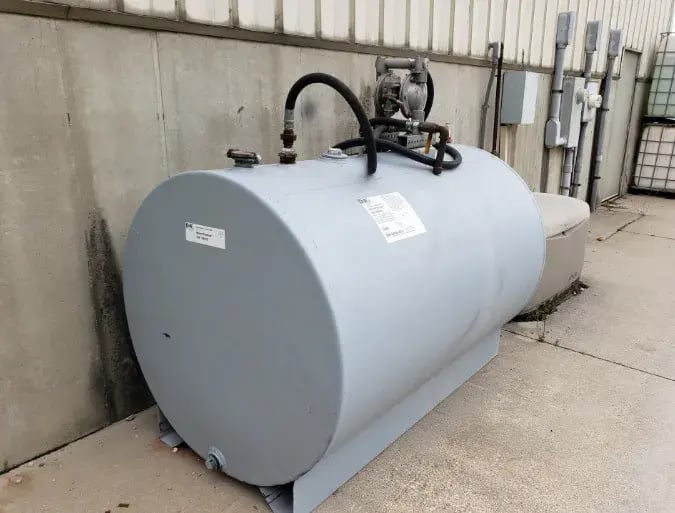
Rainwater in Your Containment Dike: How New Jersey Facilities Should Inspect, Drain, and Document It
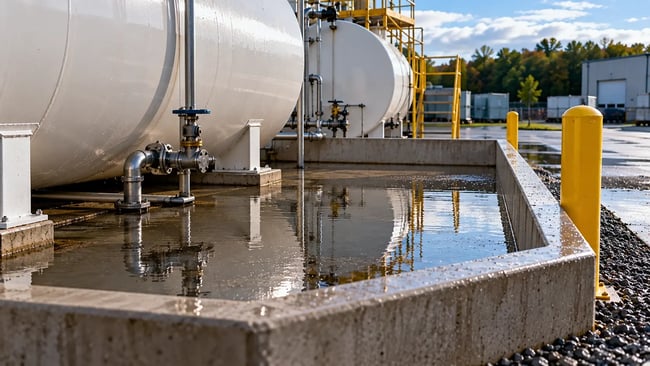
Every tank farm, generator pad, and drum storage area with a containment dike has the same chore after a storm. Rain collects inside the walls, and someone has to decide what to do with it. Open the drain valve and you might be fine, or you might have sent a sheen of oil into a storm drain and handed an inspector a violation. Leave the water alone, and you lose the containment capacity the dike exists to provide.
The short answer is that you can drain rainwater from a containment dike if you follow a routine: keep the drain valve closed, inspect the water before you open it, release it only where your plan and permits allow, close the valve again, and write the event down. Below, we cover what the federal Spill Prevention, Control, and Countermeasure (SPCC) rule says about each step, what New Jersey adds through stormwater permitting and its major facility rules, and a procedure you can adapt. If you'd rather have someone look at your setup, you can reach out to RMA.
Table of Contents
TL;DR
You can drain rainwater from a containment dike if you keep the drain valve closed and sealed or locked, check the water for sheen first, drain it under supervision to a place your plan and permits allow, reseal the valve, and log the event. If there's a sheen, don't drain it, and call NJDEP if oil has reached a storm drain or water body. In New Jersey, your NJPDES stormwater permit can also apply, and major facilities have a state rule on holding precipitation until it's confirmed clean.
What Does SPCC Require for Draining Rainwater From a Containment Dike?
The federal SPCC rule is 40 CFR Part 112, and dike drainage for most onshore facilities is covered in section 112.8. EPA Region 2 enforces it in New Jersey, and we've written about who enforces SPCC plans. The rule starts from a simple idea: the dike holds oil if a tank fails, so its drain stays shut unless someone has a reason to open it.
Drainage from diked areas has to be restrained by valves, and they have to be manual, open-and-closed valves. Flapper-type drain valves are ruled out because they can let liquid out without anyone deciding to open them. If you empty a dike with a pump or ejector, someone has to start it by hand after looking at what's in the dike.
When rainwater drains from the dike to a storm drain or open watercourse and bypasses a treatment system, the rule allows it only if four things are true. The bypass valve is normally sealed closed. The retained rainwater is inspected to make sure it won't cause a discharge, which in practice means no sheen. The valve is opened and resealed under responsible supervision. And adequate records are kept.
The federal text says sealed closed, not locked. The rule's security provision does require your plan to describe how you secure master flow and drain valves, and a lock is the usual answer, so we recommend one. The same section requires containment for the largest container plus freeboard for precipitation, which is why rainwater has to come out at all. If you're unsure your dike has the room, see our article on how big your SPCC oil spill containment needs to be.
Why Does Sheen Matter When You Drain SPCC Secondary Containment?
Sheen is the practical test. Under the federal oil spill rules, a thin film or rainbow on a waterway counts as a discharge, and the amount of oil doesn't have to be large. Once you open the drain, whatever is in the water goes wherever the drain goes, so the inspection is your last chance to stop it. A sheen that reaches a storm drain can trigger federal and state notification, and our article on the oil spill sheen rule explains when a release becomes reportable.
What Should You Look for in Containment Water Before Draining?
Look over the whole surface in good light, including along the walls and around tank bases. Check for sheen, a petroleum odor, staining on the dike walls, and signs that a tank, valve, or fitting has been dripping. Disturbing the surface with a clean stick, or touching a sorbent pad to the water, can reveal a sheen that's hard to see. If you can't tell whether the water is clean, treat it as if it isn't.
What Should You Do if There's Oil in the Dike Water?
Leave the valve closed. The SPCC rule requires you to promptly remove accumulated oil from diked areas, so skim or absorb it and find the source. Oily water generally gets managed as waste rather than released, which usually means a waste determination and a licensed hauler, or treatment before it goes anywhere.
If oil has reached a storm drain or water body, call NJDEP right away at its 24-hour hotline, 1-877-WARNDEP (1-877-927-6337). The state's discharge notification rule, N.J.A.C. 7:1E-5.3, calls for immediate notice and presumes a call made more than 15 minutes after you knew or should have known isn't immediate. It has exemptions for small discharges, but they come with conditions, so read the current text before relying on one.
Behind it sits New Jersey's Spill Compensation and Control Act, or Spill Act, which makes the parties responsible for a discharge of petroleum or other hazardous substances liable for cleanup and removal costs, and that liability can be strict and joint and several, meaning it doesn't depend on fault. An environmental attorney can tell you how that applies to your situation, and a Licensed Site Remediation Professional (LSRP) is typically brought in when cleanup goes beyond the immediate response.
How Should You Drain Rainwater From a Containment Dike, Step by Step?
Here's a procedure that follows the federal conditions and adds a few habits we recommend. Adapt it to your site, and make sure your SPCC plan describes the same steps, since inspectors compare practice against the plan.
Procedure: Draining Rainwater From a Containment Dike
- Check the valve. Confirm it's closed and its seal or lock is intact. If not, record that and find out why first.
- Inspect the water. Check the whole surface for sheen, odor, staining, and leaking equipment, and take photos.
- Stop if you find oil. Leave the valve closed, remove the oil, find the source, and manage oily water as waste. If oil has reached a storm drain or water body, call NJDEP at 1-877-927-6337.
- Confirm the destination. Make sure the discharge point is one your SPCC plan and stormwater permit allow, and that nothing but rainwater is in the dike.
- Open under supervision. A responsible person stays at the valve or discharge point and closes the valve if a sheen appears.
- Close and reseal. Shut the valve completely, then reseal or relock it.
- Write it down. Record the date, start and stop times, who inspected and supervised, what you found, the estimated volume, where the water went, and that the valve was resealed. Sign it and file it with your SPCC records.
If your drain is a flapper valve or can't be held positively closed, replace it first. That's contractor work, and local officials may have requirements for it. We don't handle construction-phase permits or approvals, but we can update your plan and procedures to match what's installed. Changes to the engineering of a PE-certified plan generally need a licensed Professional Engineer to review and certify them, so bring the PE in before you change how the dike drains. Anyone who opens a dike drain should be trained on this procedure, and our online training library is one place to look.
What Records Do You Need for Secondary Containment Drainage Events?
The rule requires adequate records of each drainage event and doesn't prescribe a form. Inspection and test records are signed by the supervisor or inspector and kept with the SPCC Plan for three years, and the rule sets no separate period for drainage events, so keeping the drainage log with your inspection records for at least three years is the simplest approach.
A good log is short enough that people fill it out: one line per event, using the fields in the procedure above. Log the times you chose not to drain, too, with the reason. An entry showing you found a sheen and held the water is evidence your program works, and a missing log is an easy finding for an inspector.
The rule asks you to look for accumulated oil inside diked areas during inspections, so the walk to the drain valve is a good time to check the dike walls, floor, and valve for cracks and staining. Our guide to the top 10 things to do during monthly SPCC inspections pairs well with the log.
Do NJPDES Stormwater Rules Apply to Containment Water Releases in New Jersey?
They can, depending on the facility. NJPDES, the New Jersey Pollutant Discharge Elimination System, is the state's version of the federal NPDES permit program. Industrial stormwater discharges in New Jersey generally need authorization through an NJPDES permit, either individual or a general permit such as the 5G2 Basic Industrial Stormwater permit, unless the facility has certified that its industrial materials and activities aren't exposed to stormwater. NJPDES covers discharges to ground water as well as surface water, so letting dike water soak into the ground doesn't take it outside the program.
The wrinkle is that containment water isn't ordinary runoff. Rain on a clean roof is stormwater. Rain that collects in a dike around oil tanks has been in an area built to catch oil, so whether your permit treats a release of it as authorized stormwater, or as something needing its own authorization, depends on what's in the water, what your permit and plan say, and where it ends up. We can't give one answer for every facility, but three things should match: your SPCC plan, your stormwater permit and plan (an SPPP in New Jersey's general permits), and what your staff does after a storm. If your SPPP says dike water is never released to the storm drain and your crew opens the valve after every storm, an inspector can spot the mismatch.
For more, see our articles on what you can discharge under a stormwater permit and the difference between stormwater and process water, and our guides to NJPDES stormwater permit requirements for New Jersey facilities and the 5G2 basic industrial stormwater permit.
This table shows which rule set asks which question about your dike water.
| Rule set |
What it asks about your dike water |
Where to look |
| Federal SPCC (40 CFR 112.8), enforced by EPA Region 2 |
Valve sealed closed, water inspected for sheen, drainage supervised, records kept |
SPCC Plan and drainage log |
| NJPDES stormwater (N.J.A.C. 7:14A-24 and your permit) |
Is the release authorized, and does your stormwater plan describe it? |
Permit authorization and SPPP |
| Major facility rules (N.J.A.C. 7:1E-2.6) |
Is precipitation held until NJDEP is satisfied it's clean, or sent through a permitted treatment facility? |
DPCC plan |
What Changes if Your Facility Is a DPCC Major Facility?
New Jersey adds another layer for facilities it classifies as major facilities under N.J.A.C. 7:1E, which need a Discharge Prevention, Containment and Countermeasure (DPCC) plan. Whether you're a major facility depends on your storage capacity and what you store, so check the rule against your own inventory.
Two provisions of N.J.A.C. 7:1E-2.6 bear on this topic. Containment that can collect rainwater has to include extra capacity for six inches of rain on top of the largest tank's volume. And a diked area can't drain to a watercourse, ditch, sewer, pipe, or storm drain leading to a watercourse or public sewage treatment plant unless the facility holds accumulated precipitation, by valves or other positive means, until it's established to NJDEP's satisfaction that no hazardous substances will be discharged, or sends it through a permitted treatment facility operated under an NJPDES or NPDES permit. The rule is written around hazardous substances, so check how its definitions apply to what you store. On its face, that brings NJDEP's satisfaction into the process in a way the federal routine doesn't, so a major facility shouldn't assume the federal routine is enough, and its DPCC plan should describe how the dike drains.
Where Can Containment Water Go Besides the Storm Drain?
The storm drain isn't the only place dike water can go. This table compares the options.
| Where the water goes |
What governs it |
Confirm first |
| Storm drain or ditch |
SPCC bypass valve conditions, your NJPDES authorization, and for major facilities N.J.A.C. 7:1E-2.6 |
No sheen, the discharge point is covered by your permit and SPPP, and your plan describes the routine |
| Ground at the facility |
NJPDES covers discharges to ground water, and any oil brings in the Spill Act |
Your permit's language, or NJDEP's written answer |
| Sanitary sewer |
The local sewerage authority's rules and approval |
Written permission, plus any pretreatment or limits |
| Hauled off site |
Waste characterization and handling rules |
A waste determination and a licensed hauler |
| On-site treatment system |
The system's own permit, plus the SPCC drainage controls |
The system is designed for oily water and your plan says so |
Which option fits depends on your site, your permits, and what's in the water. If you're not sure, ask before the next storm.
How Does RMA Help With SPCC Containment Drainage in New Jersey?
We're based in New Jersey, and NJDEP's rules and EPA Region 2's SPCC program are part of our regular work. For this topic, we can review how your SPCC plan describes dike drainage, compare it with what your staff does and what your stormwater permit allows, write a procedure and log your team will use, and update the plan when the paperwork and practice don't match. When a change reaches the plan's engineering, a licensed Professional Engineer has to review and certify it, and we'll tell you when that's the case. If your plan has gone stale, see whether you can get your SPCC plan updated, and if you're newer to the state's rules, SPCC plans in New Jersey covers the basics.
If the procedure above is all you need, take it and use it. You don't need us for that. If you'd like to talk through your site, you can call, email, or fill out the form on our website, with no obligation. Just reach out to RMA whenever it suits you.