How Pennsylvania Facilities Should Handle Oil Tank Containment Water Under SPCC and Stormwater Rules
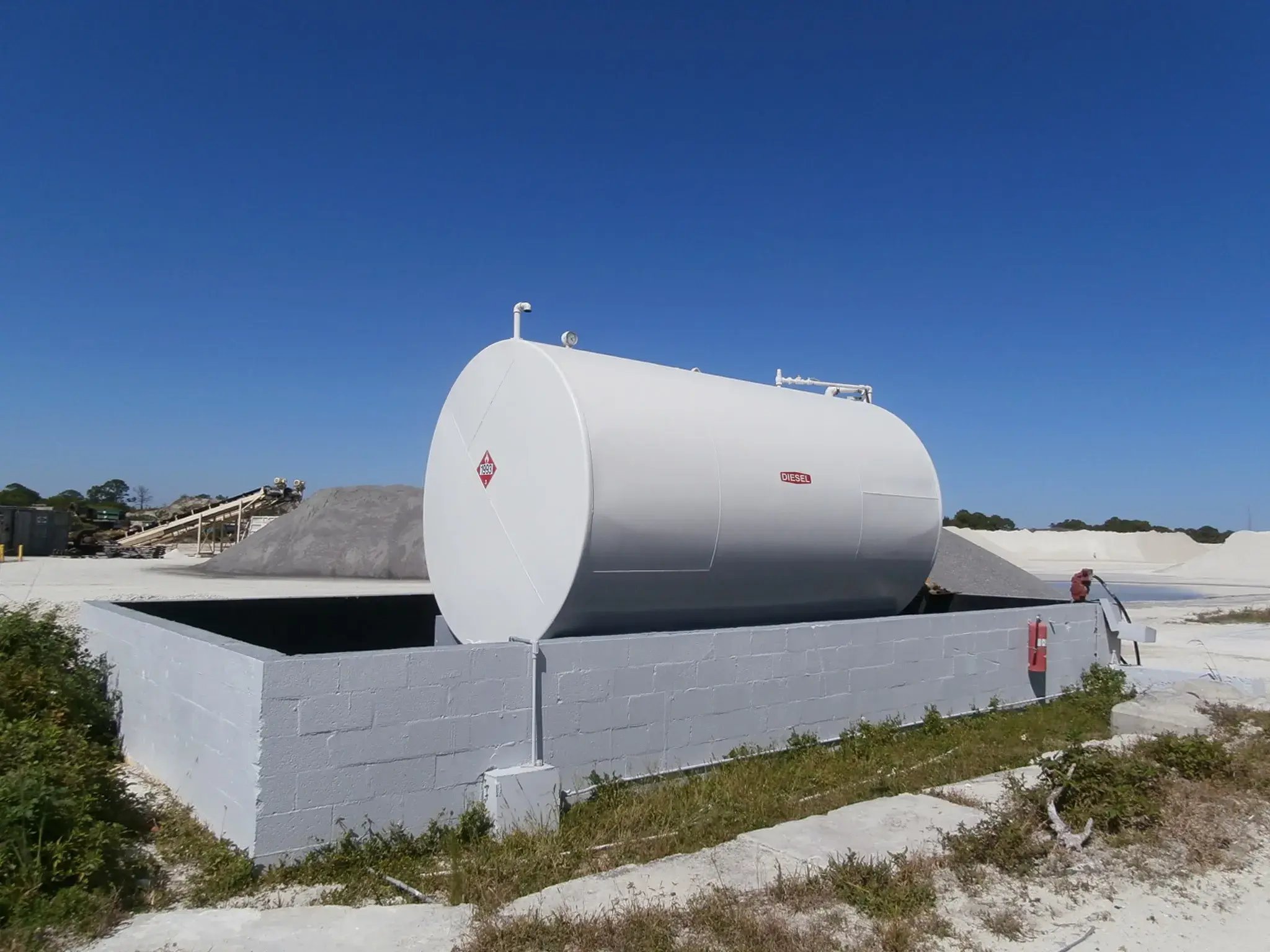
Rain falls into your oil tank dike, and sooner or later somebody has to decide what to do with it. Leave it sitting, and it eats up the space the dike is supposed to keep open for a spill. Drain it carelessly, and an ordinary rainy Tuesday can turn into an oil discharge to a storm drain or a stream. That's why draining secondary containment, meaning the dike, berm, or walled area built to catch oil if a tank or pipe fails, is one of the most common trouble spots we see at facilities that store oil.
In this article we walk through what the federal oil spill prevention rule requires before you open a drain valve, how to check the water for sheen, how Pennsylvania's stormwater permitting program can add its own layer, and a step-by-step drainage procedure you can adapt for your own site. If you'd rather talk through your specific situation, you're welcome to reach out to RMA at any point.
Table of Contents
TL;DR
You can drain rainwater from an oil tank containment dike only if the drain valve stays sealed closed the rest of the time, someone checks the water for sheen first, the valve is opened and closed again under supervision, and you record every drainage event. Water with any sign of oil stays in the dike until it's cleaned up and handled properly. In Pennsylvania, where the water goes counts too, because facilities with an industrial stormwater permit need drainage that fits that permit and their written spill plan, and water that picked up oil isn't stormwater at all.
Why Does Rainwater in Oil Tank Containment Cause So Many Problems?
The federal Spill Prevention, Control, and Countermeasure (SPCC) rule, 40 CFR Part 112, applies to facilities that store more than 1,320 gallons of oil in aboveground containers (counting only containers of 55 gallons or more) or more than 42,000 gallons buried, and that could reasonably be expected to discharge oil to navigable waters or adjoining shorelines. If that's you, you need a written SPCC Plan that describes how your containment works and how you drain it. Not sure whether you're over the line? Start with our guide to the four steps to figure out if you need an SPCC Plan.
Rainwater causes trouble from two directions. The rule requires secondary containment sized for the entire capacity of your largest container plus freeboard, which is extra room for rainfall, so a dike with a foot of standing water holds less than your plan says it does. On the other side, a drain valve is a deliberate hole in that containment, and every minute it's open, a leak from the tank or piping has a path straight out. The job is getting clean water out without letting any oil out with it. We cover sizing separately in how big SPCC oil spill containment needs to be, so this article stays on the water.
What Does the SPCC Rule Require Before You Drain a Containment Dike?
For most facilities storing petroleum and other non-vegetable oils, the controlling text is 40 CFR 112.8(c)(3). It says you can't drain uncontaminated rainwater from a diked area into a storm drain or an open watercourse, lake, or pond, bypassing your treatment system, unless four conditions are met. Nearby paragraphs add rules for the valves and pumps.
| Requirement |
What It Means at Your Facility |
Rule |
| Keep the bypass valve sealed closed |
Shut and secured between drainage events. A padlock or tamper-evident seal is the usual method. |
112.8(c)(3)(i) |
| Inspect the retained rainwater |
Someone confirms the water won't leave a sheen on the receiving water. |
112.8(c)(3)(ii) |
| Open and reseal under responsible supervision |
A person who knows the procedure watches the drainage and secures the valve afterward. |
112.8(c)(3)(iii) |
| Keep adequate records |
One log entry per drainage event, kept with your plan. |
112.8(c)(3)(iv) |
| Use manual, open-and-closed valves |
Something like a gate or ball valve. Flapper-type drain valves aren't allowed on diked areas. |
112.8(b)(2) |
| Start any pumps by hand |
Pumps can empty a dike, but a person starts them after inspecting the water. |
112.8(b)(1) |
The rule says "sealed" closed, which is why locking the valve is so common. Your plan describes how you secure it, and an inspector checks that your practice matches. Notice the word "uncontaminated" too. The rule gives you a path for clean rainwater, not for water that has picked up oil. (Facilities with animal fats or vegetable oils, like cooking oil, have parallel requirements in 40 CFR 112.12.)
Under 112.7(e), inspection and test records, signed by the supervisor or inspector, stay with your plan for three years. EPA Region 3 enforces SPCC in Pennsylvania (we explain who does what in who enforces SPCC Plans), and EPA's SPCC penalty worksheets have long listed unsealed bypass valves, uninspected rainwater, unsupervised drainage, and missing records as separate violations. Our rundown of the top SPCC Plan violations and fines shows where those fit among the rest.
How Do You Check Containment Water for Oil Sheen Before Draining?
The test comes from EPA's Discharge of Oil rule, 40 CFR 110.3, which treats a discharge as harmful if it causes a film or sheen on the water or shoreline, discolors the surface, or leaves sludge or an emulsion beneath it. There's no minimum amount. So if the water you're about to release would put a sheen on the ditch, stream, or pond it flows to, it stays in the dike.
Look closely rather than glancing from the dike wall. Check for rainbow film, dull or colored patches, floating droplets, an oily smell, and staining on the walls at the waterline, and check in several spots, especially near the tank base, pump seals, pipe penetrations, and the low corner. A clear glass jar lets you pull a sample from just below the surface and see it against the light. Water can also carry contaminants that don't produce a sheen, like antifreeze from a leak, so if anything besides oil is stored in or near the dike, treat the visual check as the minimum.
What Should You Do If You See Oil Sheen in the Dike?
Stop and leave the valve closed. The rule requires you to promptly remove accumulations of oil in diked areas (112.8(c)(10)), so soak up or skim the oil with sorbent pads and find where it came from, such as a weeping pump seal, a leaking flange, or a drip during a delivery. Recovered oil and oily water have to be managed under the waste rules, usually through a licensed hauler, and our guide to used oil regulations covers what applies. Don't try to make a sheen disappear with soap or chemicals. That doesn't remove the oil and can make the problem bigger.
What If Oil Has Already Left the Dike?
If anyone could be in danger, from fire, vapors, or a large release, call 911 first. A sheen inside the dike isn't a reportable discharge, but a sheen on a stream, a ditch that flows to one, or the shoreline is. In that case the person in charge needs to call the National Response Center at 1-800-424-8802 immediately, and in Pennsylvania you'll also want to notify DEP at 1-800-541-2050. Our article on the sheen rule and when you have to report an oil spill has the details. A reported discharge can bring agency questions, penalties, and cleanup liability, so you may want an environmental attorney involved before you answer them.
How Do Pennsylvania Stormwater Rules Apply to Containment Dike Water?
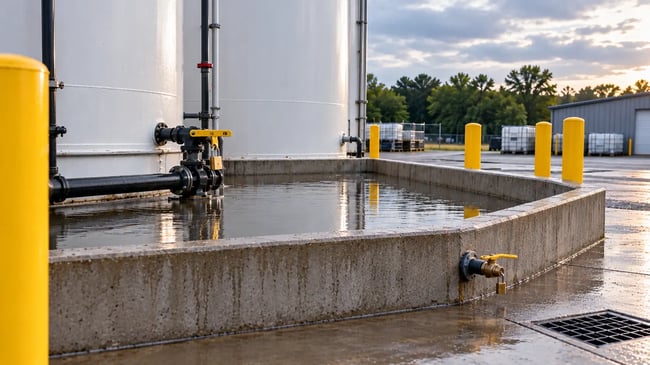
SPCC is one of two rulebooks that touch your dike water. The Clean Water Act's NPDES program (the National Pollutant Discharge Elimination System) regulates discharges to streams and storm sewers, and in Pennsylvania DEP runs it. Many industrial facilities get coverage under PAG-03, DEP's general permit for industrial stormwater, and must keep a Preparedness, Prevention, and Contingency (PPC) Plan, which is DEP's version of a stormwater and spill plan. We explain both in our guides to Pennsylvania's PAG-03 stormwater permit and PPC Plans compared to SWPPPs. Whether any of that reaches your dike depends on your facility.
| Your Situation |
What Applies to Dike Water |
| You're covered by PAG-03 or an individual NPDES permit |
Clean rainwater drained to a permitted outfall is generally handled as part of your stormwater discharge, so your drainage practice should match your PPC Plan and permit conditions. |
| You don't need a stormwater permit |
No permit conditions apply, but SPCC still does. Pennsylvania's Clean Streams Law still prohibits discharging pollutants to waters of the Commonwealth, and a municipality may limit what can enter a local storm drain. |
| The water has a sheen or other contamination |
It isn't stormwater anymore. General permits like PAG-03 authorize stormwater plus a short list of named non-stormwater discharges, so this water doesn't go out under the permit. It gets treated, hauled as waste, or handled under a separate authorization. |
Three practical points follow. SPCC cares whether draining causes a discharge to navigable waters, so water released onto the ground inside your fence isn't automatically fine if it runs off to a stream. Draining to a sanitary sewer needs approval from the local sewer authority. And drainage logs and stormwater inspection records can live side by side, but they're separate documents, and stormwater sampling is its own requirement. Our article on the difference between an SPCC Plan and a SWPPP explains how the two plans fit together.
Oil and gas well sites in Pennsylvania have their own DEP containment rules in 25 Pa. Code Chapters 78 and 78a, with a similar precipitation-only, no-sheen approach, so operators there should read them alongside SPCC and check with DEP on how they apply. For everyone else, EPA Region 3 looks at the dike through the SPCC lens while DEP looks at the water through the permit and Clean Streams Law lens, so one dike can draw two agencies for two different reasons.
What Is a Good Step-by-Step Procedure for Draining a Containment Dike?
If you have an SPCC Plan, it should contain your drainage procedure, and your crew should follow it. If the two differ, one needs to change. If you're over the threshold without a plan, you'll need one, and the procedure below is a reasonable starting point for what it should say. A new valve, pump, or discharge point can require a plan amendment under 112.5(a), and technical amendments to a PE-certified plan generally need a professional engineer's certification.
Containment Dike Drainage Procedure
- Confirm who's responsible. The person opening the valve should be trained on your plan and named as supervisor for the event.
- Check for a source. Look at the tank, piping, pumps, and valves for drips or stains, and think about recent deliveries.
- Inspect the water. Check for sheen, color, odor, floating oil, and sludge in several spots.
- Stop if anything looks wrong. Leave the valve sealed closed, remove the oil, find the source, and arrange proper handling.
- Confirm where the water goes. Make sure the discharge point fits your plan and any stormwater permit.
- Open the valve by hand. Break the seal or unlock it, open slowly, and start any pump by hand.
- Stay with it. Close the valve at once if a sheen appears, and check the last of the water near the bottom.
- Close, lock, and verify. Reseal the valve and confirm it's secure.
- Log the event. Record the date, start and stop times, supervisor, what you saw, valve condition before and after, and the weather. Sign it and file it with your plan.
A few lines per event is enough. Many SPCC Plan templates include a dike drainage log, and a clipboard or a digital form both work as long as your plan says where the records live. Keep them for at least the three years the rule requires. A log full of signed entries that say what the crew saw tells an inspector the procedure is real, and a blank one tells them it isn't.
What Containment Dike Drainage Mistakes Do We See Most Often?
The most common problem is a drain valve that's open or unlocked when it should be shut, often because someone opened it after a storm and nobody closed it. Close behind are flapper-type or automatic drains the rule doesn't allow, a plan that says one thing while the crew does another, logs that were never started, and draining with nobody looking at the water first. Training is behind most of these. The rule requires training for oil-handling personnel and a discharge prevention briefing at least once a year, and anyone who might open that valve belongs in the group. We cover the requirement in annual SPCC training, and our online training library is there if you want a ready-made option. Your routine inspections, like the ones in our guide to SPCC plan inspections, are a natural time to check the dike, the valve, and the log together.
What Can You Do When You Can't Drain the Containment Water?
Clean water can sit and evaporate, but a dike that stays full runs short on freeboard. A vacuum truck or licensed waste hauler can take the water away, and that's the route for anything with a sheen. If your site has on-site treatment, such as an oil/water separator, routing the water through it may be an option. If the dike is always full, look for the cause: a leaking drain valve, roof or yard runoff flowing in, or a low spot. The fix may involve a cover, a diversion, or a rebuilt dike. We help facilities evaluate their containment and update the plan afterward, but designing and building containment is work for an engineer or contractor, and construction-phase permits and approvals aren't something we prepare.
How Can RMA Help With Containment Drainage and Your SPCC Plan?
If you have an SPCC Plan, we can compare what it says about containment drainage with what your crew does, rewrite the procedure where they've drifted apart, and set up logs your team will use. If another firm wrote your plan and it needs more than a tweak, we usually rebuild it from scratch rather than patch it. If you have a dike and aren't sure you need a plan, we can help you work that out, and a new plan from us includes free initial SPCC training for your oil-handling staff. We work with facilities across Pennsylvania on both sides of this topic, including Pennsylvania SPCC Plans and PAG-03 and PPC Plan support, so the oil and stormwater pieces line up.
There's no pressure and no obligation. You can call us at 888-RMA-0230, fill out the form on our website, or contact RMA with whatever you're trying to figure out, and we'll tell you if you don't need us.