How the SPCC "Reasonable Expectation of Discharge" Test Works, and Why "We're Not Near Water" Rarely Gets a New Jersey Facility Out of an Oil Spill Plan
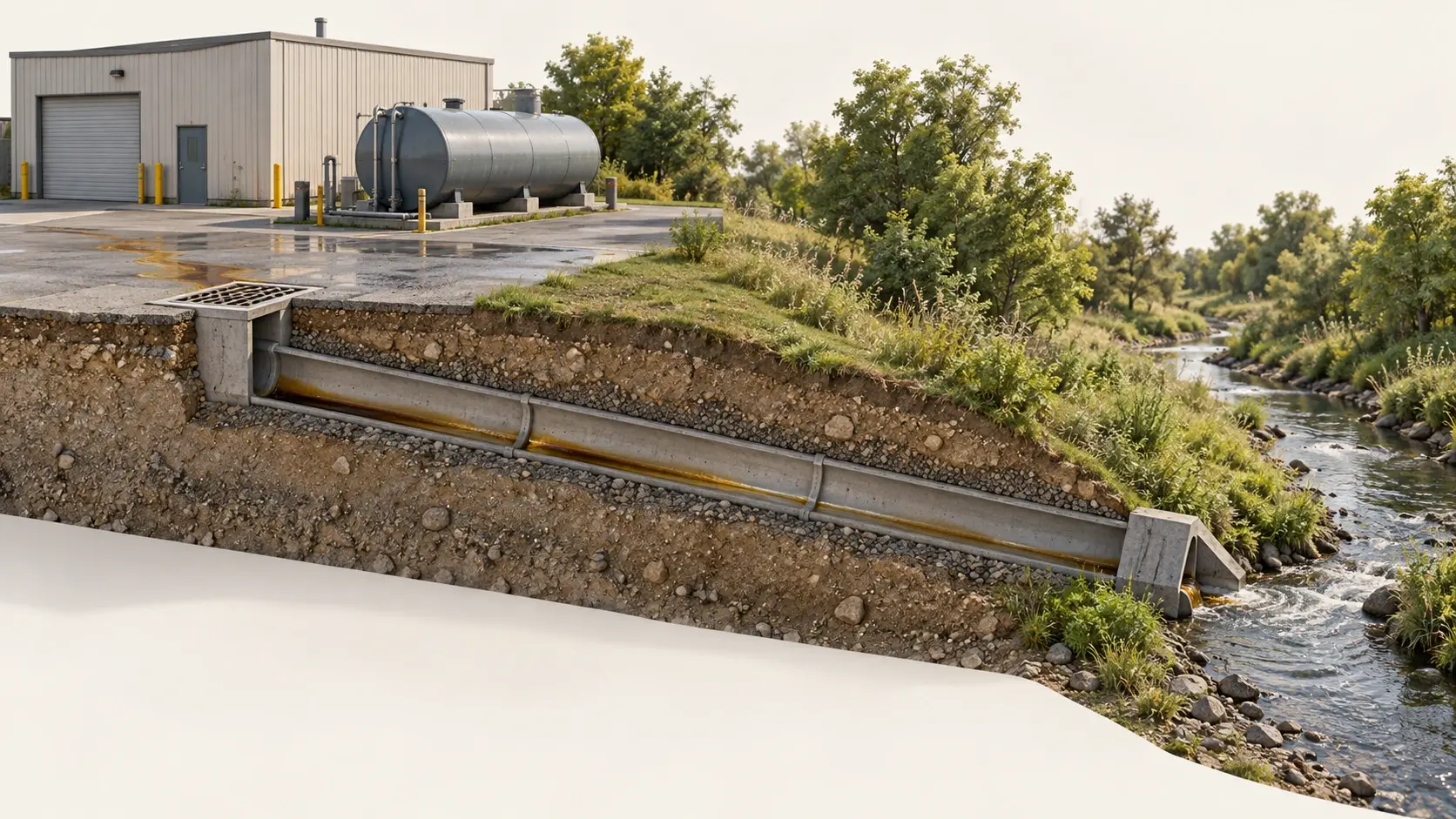
A lot of facility managers hear that the federal oil spill plan rule only applies to sites that could spill oil into a waterway, look around the property, see no creek, and decide they're off the hook. It's an easy conclusion to reach, and in New Jersey it's usually wrong. The rule doesn't ask whether there's water on your lot. It asks whether oil leaving your site could reasonably be expected to reach a stream, river, wetland, or shoreline by any path, including a storm drain at the edge of the parking lot or a ditch behind the building. And it asks that question as if your containment berms and dikes weren't there. Given how many streams, wetlands, and storm sewers run through this state, very few facilities with enough oil storage to meet the rule's thresholds can honestly pass that test.
Below, we walk through what the "reasonable expectation of discharge" test means, what EPA counts as water, the factors EPA looks at, why manmade structures are left out of the analysis, and why New Jersey's geography makes the exemption so hard to claim. We'll also cover how to document your decision either way and why New Jersey's own spill law still applies even if the federal rule doesn't. If you're trying to figure out whether your site needs a plan, feel free to reach out to RMA and we'll talk it through with you.
Table of Contents
TL;DR
The federal oil spill plan rule applies to facilities over the storage thresholds that could reasonably be expected to spill oil into waterways or onto shorelines, and not having a creek on site doesn't settle that. The decision has to be based on location, land contour, and drainage alone, so storm drains and ditches that lead to streams count against you, while dikes, berms, and other manmade containment can't be counted in your favor. In New Jersey, with its dense web of streams, wetlands, and storm sewers, very few facilities can honestly claim the exemption. Even when one can, the state's Spill Act still covers spills onto land.
What Is the SPCC Reasonable Expectation of Discharge Test?
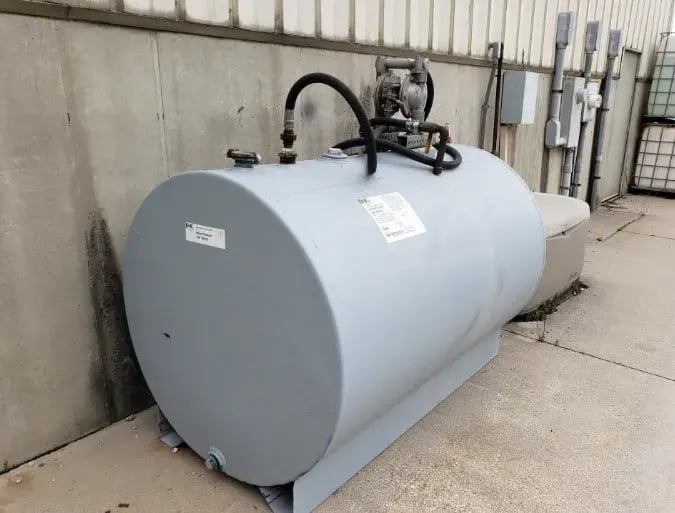
The federal oil spill prevention rule, known as SPCC (Spill Prevention, Control, and Countermeasure) and found at 40 CFR Part 112, requires certain facilities that store oil to write and follow a spill prevention plan. Two things have to be true for the rule to apply. First, the facility has to store more than 1,320 gallons of oil aboveground, counting only containers of 55 gallons or more, or more than 42,000 gallons in completely buried tanks that aren't already covered by the underground tank rules. That's based on container capacity, not how much oil is in them on a given day, and it includes things like oil-filled transformers, hydraulic equipment, and vegetable oils.
Second, and this is the piece people try to lean on, the facility has to be located where it could reasonably be expected to discharge oil in harmful quantities into navigable waters or onto adjoining shorelines. The rule states this in reverse at 40 CFR 112.1(d)(1)(i), which exempts facilities that, because of their location, couldn't reasonably be expected to have that kind of discharge. "Harmful quantities" is a low bar, too. Under EPA's discharge rule in 40 CFR Part 110, an amount that causes a sheen on the water is enough.
The facility owner or operator makes this call. Nobody at EPA signs off on it in advance, and there's no form to file. That's convenient, but it also means the decision is yours to defend if an inspector or a spill ever puts it to the test. If you're still working out whether you cross the storage threshold in the first place, our guide on the best four steps to figure out if you need an SPCC Plan covers the capacity side of the question.
What Counts as Navigable Waters for SPCC Purposes?
"Navigable waters" sounds like it means rivers big enough for a boat. It doesn't. For SPCC, the term ties back to the Clean Water Act's "waters of the United States," which reaches well beyond shipping channels. Depending on the facts, it can include smaller streams, tributaries, lakes and ponds, and wetlands connected to those waters, along with tidal waters and the shorelines next to all of them.
The exact reach of "waters of the United States" has been fought over in court and rewritten by EPA more than once in recent years, and it may keep shifting. We don't recommend building an exemption on a fine legal reading of whether a particular ditch or wetland is federally jurisdictional this year. That's a question for an environmental attorney, and it's a shaky foundation for a decision you're making on your own. The practical question is simpler: if oil left your containers on a bad day, where would it go, and would it end up in a stream, river, bay, or wetland?
How EPA Evaluates SPCC Discharge Potential at a Facility
The rule tells you exactly what you're allowed to consider: the geographical and location aspects of the facility, such as proximity to navigable waters or adjoining shorelines, land contour, and drainage. EPA's guidance for its inspectors expands on that and tells them to look at the whole pathway oil could take, not just the straight-line distance to the nearest creek. Here's how those factors tend to play out on a real site.
| Factor |
What It Means on Your Site |
How It Usually Cuts |
| Distance to water |
How far your tanks and equipment sit from streams, ponds, wetlands, and shorelines, including ones off your property |
Distance alone rarely settles it. A long distance helps only if there's no fast path in between. |
| Land contour |
Which way the ground slopes from each oil storage area |
Any slope toward a drain, ditch, or low area that connects to water works against the exemption. |
| Storm drains and storm sewers |
Catch basins in your lot or the street that discharge to a stream or river |
One of the most common reasons the exemption fails. A storm drain is a pipe straight to a waterway. |
| Ditches, swales, and culverts |
Open channels that carry runoff off site, even if they're dry most of the year |
Usually counts as a pathway, especially in a storm, when spills are most likely to travel. |
| Soil and ground conditions |
Pavement, compacted gravel, or soils that shed water instead of absorbing it |
Paved and compacted sites move oil faster and farther. |
| Weather and volume |
What happens if your largest container fails during heavy rain |
The test assumes a realistic bad day, not a dry afternoon with a small drip. |
EPA's guidance also makes the point that a discharge can reach water indirectly. Oil that runs into a storm sewer, gets carried down a drainage ditch, or flows across a neighbor's property and into a stream still counts. Whether oil seeping into groundwater that feeds surface water counts is a more complicated legal question, but you don't need to answer it for most sites, because the surface pathways usually decide things first.
Why Dikes and Berms Don't Count Toward SPCC Applicability
This is the rule that catches the most people. When you decide whether a discharge could reasonably reach water, you have to ignore manmade features like dikes, berms, curbing, walls, equipment, buildings, and other structures that might hold a spill back. The regulation says it plainly. You evaluate the site as if that containment weren't there.
The logic is pretty simple once you see it. Secondary containment is one of the main things an SPCC Plan requires. If a facility could point to its containment to say it doesn't need a plan, the rule would excuse the exact sites it's meant to cover, and nothing would be checking whether that containment is sized right, inspected, drained properly, or even still intact. Berms crack, dike valves get left open, and rainwater fills containment until there's no room left for oil. The plan is what keeps those things in check, so the containment can't also be the reason you skip the plan.
So if your applicability argument starts with "but our tank sits inside a concrete dike," it's already off track. Good containment is worth having, and it'll be part of your plan, but it doesn't decide whether you need one. If you want to understand how containment gets sized once you do need a plan, see our article on how big SPCC oil spill containment needs to be.
Why "We're Not Near Water" Rarely Works for SPCC in New Jersey
New Jersey is small, crowded, and wet. It sits between the Delaware River, the Hudson and Raritan Bay, and the Atlantic coast, and it's crossed by a thick network of rivers and creeks like the Passaic, Hackensack, Raritan, Millstone, Rancocas, and Maurice. Add tidal marshes along the coast and the Meadowlands, wetlands scattered through the Pinelands and the Highlands, and countless small tributaries that don't look like much until it rains. In most of the state, you don't have to go far before you hit one.
Then there's the infrastructure. Most industrial and commercial facilities in New Jersey sit on paved lots that drain to catch basins, and those catch basins drain to municipal storm sewers that empty into local streams. Some older cities, including Newark, Jersey City, Camden, and others, also have combined sewer systems that can overflow into rivers during heavy rain. A storm drain fifty feet from your fuel tank is often a more direct route to a waterway than a creek half a mile away.
Put those together and the exemption gets very hard to claim. The sites that might honestly qualify tend to be ones with no storm drains, no ditches, ground that slopes away from any water, a long distance to the nearest stream, and soils that would hold a spill, all evaluated without counting any berms or curbs. That combination does exist, but it's uncommon here. We'd also point out that EPA Region 2, which enforces SPCC in New Jersey, can require a plan from a facility that claimed the exemption if it disagrees, under 40 CFR 112.1(f). For more on how enforcement works and who shows up for inspections, see who enforces SPCC Plans.
The cost of guessing wrong is real. A facility that should have had a plan and didn't is exposed to federal civil penalties for each day of violation, and those numbers are adjusted for inflation every year under 40 CFR Part 19. Missing plans are one of the most common findings we see, which is why it shows up on our list of top SPCC Plan violations and fines. And if oil does reach water, the exemption you claimed won't help you, because you'll be dealing with the cleanup and the reporting regardless.
Documenting Your SPCC Applicability Decision
If you look at your site carefully and conclude it really couldn't reasonably discharge oil to water, write that down. The rule doesn't require a written exemption memo, but an undocumented "we're not near water" won't hold up well in an inspection. A good write-up describes each oil storage area, the slope of the ground around it, every drain, ditch, and culvert on and near the site and where it leads, the distance to the nearest water in each direction, and why a worst-case spill from your largest container wouldn't reach it, all without relying on containment. Photos, a site map with drainage arrows, and a date and signature make it much more credible.
That analysis also needs revisiting when things change. Repaving a lot, adding a catch basin, relocating a tank, or adding storage capacity can all change the answer. A decision that was reasonable ten years ago may not be today.
In our experience, the exercise usually ends the other way. Once someone traces where the storm drains go, the answer is clear and the next step is a plan. For facilities with smaller storage volumes, that may be a relatively simple self-certified plan rather than a full engineer-certified one. Our overview of the different types of SPCC Plans explains which one fits which situation, and the complete guide to SPCC Plans covers what goes into one.
New Jersey's Spill Act Applies Even Without an SPCC Plan
Even a facility that legitimately falls outside the federal rule isn't outside New Jersey's. The state's Spill Compensation and Control Act, usually called the Spill Act, covers discharges of petroleum and other hazardous substances onto the land as well as into the water. You don't need a stream nearby for it to apply. A spill onto soil can trigger the duty to notify NJDEP through its hotline, along with cleanup obligations, and in many cases an LSRP (a Licensed Site Remediation Professional, the state-licensed professional who oversees most cleanups in New Jersey) will need to be involved. Liability under the Spill Act is broad and can reach multiple parties. If you're facing a spill or a cleanup, it's smart to talk with an environmental attorney about your specific situation. For the current hotline number, check NJDEP's website.
Larger facilities may also fall under New Jersey's own discharge prevention rules at N.J.A.C. 7:1E, which require DPCC and DCR plans (Discharge Prevention, Containment, and Countermeasure plans and Discharge Cleanup and Removal plans) from "major facilities." Whether a site counts as a major facility depends on its total storage capacity and what it stores, so check N.J.A.C. 7:1E against your own inventory. Like the Spill Act, that program doesn't turn on how close you are to water. The overall picture for the state is covered in our article on SPCC Plans in New Jersey, and federal reporting thresholds are explained in when you have to report an oil spill.
How RMA Helps New Jersey Facilities With SPCC Applicability
We've been helping facilities with oil spill plans since 1992, and we're based in New Jersey, so we know the state's drainage, its agencies, and how these questions tend to come up during inspections. We can walk your site or review your drawings, trace where a spill would go, and give you a straight answer on whether the federal rule applies. If you don't need a plan, we'll tell you, and we'll help you document why. If you do, we'll explain which type fits your facility and what it'll take, whether you want to handle it yourself or have us prepare it.
There's no pressure and no obligation. Give us a call, send us an email, or fill out the form on our website, and one of our senior staff will follow up. If you'd like to talk through your site, reach out to RMA and we'll help you figure out where you stand.