DEP Closure Steps, Who Can Do the Work, and What to Change in Your SPCC Plan When the Tank Is Gone
Maybe you're retiring an old diesel tank, swapping a big fuel tank for a smaller one, or shutting down a building that's been sitting idle. Whatever the reason, pulling an aboveground tank out of service in Pennsylvania sets off two separate sets of paperwork. Pennsylvania DEP cares about the tank itself: how it's closed, who removes it, and whether the ground underneath is clean. EPA cares about whether your facility's oil spill prevention plan still matches what's sitting on the property.
The short answer is that you notify DEP at least 30 days before you close or remove a regulated tank, hire a DEP-certified installer to do the work, assess the site for releases, and file an amended registration within 30 days of finishing. Then, if the tank was covered by a federal oil spill prevention plan (an SPCC Plan), you amend that plan and its site diagram within six months. This article walks through each step in order, explains the SPCC side, and shows when removing a tank can take you below the SPCC threshold altogether. If you'd like a second set of eyes on your situation, feel free to reach out to RMA.
Table of Contents
TL;DR
To remove a regulated aboveground tank in Pennsylvania, you notify DEP at least 30 days ahead, hire a DEP-certified installer, assess the site for releases, and file an amended registration within 30 days of finishing. If the tank was part of an SPCC Plan, you amend the plan and its facility diagram within six months of the change. If removal drops your total aboveground oil storage to 1,320 gallons or less, counting only containers of 55 gallons or more, you may no longer need an SPCC Plan at all.
Does DEP Regulate the Aboveground Tank You're Removing?
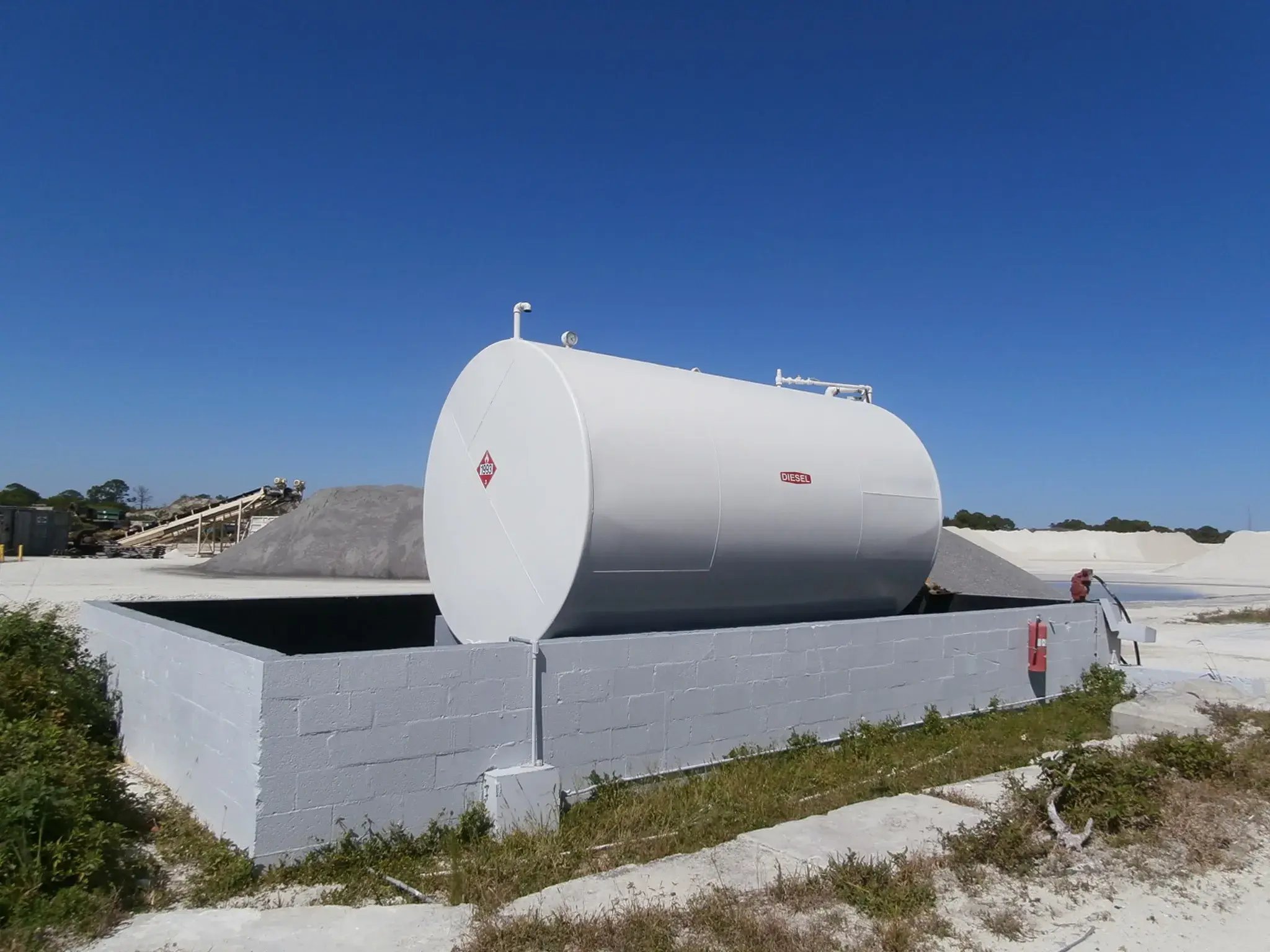
Before you plan anything, confirm the tank falls under DEP's storage tank program. DEP generally regulates stationary aboveground tanks with a capacity over 250 gallons that hold regulated substances, and those tanks have to be registered with the department. Exemptions depend on what's stored and how it's used. Heating oil burned on the same premises and some small farm or non-commercial motor fuel tanks of 1,100 gallons or less are common examples, so the answer for your tank turns on its size, contents, and use. DEP's Division of Storage Tanks can confirm it, and you can reach them at 1-800-42-TANKS from inside Pennsylvania.
DEP's rules and the federal SPCC rule use different tests. DEP looks at the size of the tank and the type of substance in it. The SPCC rule looks at your facility's total aboveground oil capacity, counting every container of 55 gallons or more. A 500-gallon tank might be exempt from DEP registration and still count toward your SPCC total, while a regulated tank of a non-oil chemical might need DEP closure paperwork with no SPCC angle at all. If you're not sure which of your tanks count under the federal rule, our guide to figuring out if you need an SPCC Plan walks through the count.
What Are the DEP Steps for Closing or Removing an Aboveground Storage Tank in Pennsylvania?
DEP's closure page describes a multi-step process, and 25 Pa. Code § 245.561 supplies the deadlines. Procedures and forms get updated from time to time, so check DEP's page for the current versions before you submit anything. Here's the order most tank owners follow.
- Plan the closure. DEP publishes a Planning for Permanent Closure Checklist for aboveground tanks and a technical document called Closure Requirements for Aboveground Storage Tank Systems. Read both before you hire anyone.
- Notify DEP at least 30 days before the work starts, using the Aboveground Storage Tank System Closure Notification Form. DEP can accept less notice in some cases, and notice isn't required when the work responds to a corrective action or DEP waives it, but plan on the full 30 days unless DEP tells you otherwise.
- Handle local permits and notices. If the tank is under a fire marshal, flammable and combustible liquids, or other state, county, or local permit, that agency has to be notified. Municipal permits for the removal itself are a separate item and vary by township or borough.
- Hire a DEP-certified installer to do the tank handling work. More on that in the next section.
- Empty and clean the tank. Whatever comes out has to be reused, treated, or disposed of under state and federal waste rules. A tank left on site must be cleaned, freed of hazardous vapors, and ventilated.
- Remove or close the tank and assess the site. The assessment checks for any release from the tank system.
- File an amended tank registration within 30 days of finishing the closure. The owner and the certified installer who supervised the work both sign it.
- Complete the closure report, submit it when DEP requires or requests it, and keep the site assessment results and the report for 3 years.
The deadlines are easier to track side by side, so here they are in one place.
| Step |
Timing |
Who handles it |
| Closure notification to DEP |
At least 30 days before work starts (DEP can allow less) |
Tank owner and operator |
| Local permits and agency notices |
Before the tank is touched |
Owner, usually with the installer |
| Tank handling and removal |
After the notice period |
DEP-certified installer |
| Site assessment and closure report |
Assessment follows the DEP notice; records kept 3 years |
Owner and operator |
| Amended tank registration |
Within 30 days of completing the closure |
Owner and the supervising certified installer |
| SPCC Plan amendment (federal) |
Prepared within 6 months, then implemented within 6 months |
Facility owner or operator |
Who Can Remove an Aboveground Storage Tank in Pennsylvania?
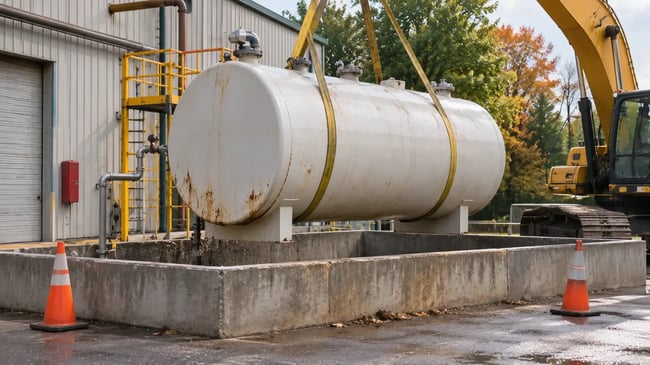
On a regulated tank, the removal has to be done by a DEP-certified individual, and your own maintenance crew doesn't qualify no matter how handy they are. DEP certifies installers by activity and tank type, so a contractor who's certified to remove shop-built manufactured tanks isn't automatically certified for field-constructed ones. Ask to see the certification, confirm it covers your type of tank, and make sure the installer will provide direct onsite supervision, because that person co-signs your amended registration when the job is done. Some municipalities also ask for a copy of the contractor's DEP certification before they issue a removal permit.
We don't remove tanks, we don't hold DEP installer certifications, and we don't handle local permits for the removal work. What we can do is help you work out what the SPCC side needs while your contractor handles the physical job. If the removal is part of a larger building or site project, the construction-phase permits (building, fire, erosion and sediment control) are a separate track that your engineer or contractor manages. We can point you toward the right people for that.
Closing a Tank in Place or Changing Its Service
Removal isn't the only way out. A tank can be closed in place or changed to a different service, and both fall under the same section of the regulation. A tank closed in place has to be rendered inoperable and incapable of storing liquid, secured against unauthorized entry, and legibly marked with the date of closure, and the notice, assessment, and registration steps above still apply. Change-in-service, such as converting a tank to an unregulated use, also requires the notification and the amended registration. Keep the SPCC consequence in mind with either option. A tank that's still on the property and still holds oil, or could, can keep counting toward your federal totals.
What Does the Site Assessment Check for After an Aboveground Tank Removal?
The site assessment is how DEP knows the tank didn't leave a problem behind. You measure for any release from the tank system, which in practice means soil sampling (and water sampling where it applies) around and beneath where the tank and its piping sat. DEP publishes a document called Site Assessment Sampling Requirements at Regulated Storage Tank System Closures that lists the recommended sample containers, the test parameters for soil and water, and the action levels for confirmatory samples. The regulation also lets you assess the site by another method, as long as it's at least as protective of public health and the environment and meets all statutory and regulatory requirements.
If the sampling or your own observation turns up contaminated soil, sediment, surface water, groundwater, or free product, you move into DEP's corrective action process under Subchapter D of Chapter 245. DEP's closure guidance also points to 25 Pa. Code § 245.305, which calls for notifying the regional office as soon as practicable and no later than 24 hours after a release is confirmed. A release discovered during a removal can get expensive and slow, and a call to an environmental attorney alongside your consultant is reasonable when the findings look significant. The cleanest outcome is a clean assessment, a filed closure report, and a site that looks the way it did before the tank existed.
How Does Removing a Tank Change Your SPCC Plan and Facility Diagram?
An SPCC Plan is the written oil spill prevention plan that EPA's oil pollution prevention rule (40 CFR Part 112) requires for facilities with more than 1,320 gallons of aboveground oil storage, counting only containers of 55 gallons or more. If you've never had one, our overview of what an SPCC Plan is explains the basics, and you'll want to read the next section to see whether removing this tank changes your answer. If you do have a plan, the tank coming out is a change to your facility, and the plan has to reflect it.
The rule behind that is 40 CFR § 112.5(a). It requires you to amend the plan when a change in facility design, construction, operation, or maintenance materially affects the potential for a discharge, and it lists decommissioning containers among the examples. An amendment has to be prepared within six months of the change and implemented as soon as possible, but no later than six months after it's prepared. That window is there for the work, not for putting the plan off, so most facilities are better off treating the amendment as part of the removal project.
In practice, the update touches every part of the plan that referenced the tank. The facility diagram needs to show the container gone, the container inventory and capacity totals need to change, and any secondary containment calculation that covered that tank needs another look. Inspection checklists, spill response steps, and the content of your annual employee training may all mention the tank as well. If you're refreshing training anyway, our online training library is one place to start. Our guide on when to update your SPCC Plan covers other triggers worth knowing about.
Does a Professional Engineer Have to Certify the Amendment?
It depends on the type of plan you have. Under § 112.5(c), technical amendments to a PE-certified plan need a Professional Engineer's certification, which means an engineer reviews and stamps the changes. Facilities that qualify for a self-certified plan can generally amend and self-certify it themselves, provided they still meet the qualifying criteria. Our article on the different types of SPCC Plans explains which kind you probably have, and our piece on Professional Engineers and SPCC Plans covers what the engineer's role involves. When a PE is needed on our projects, we work with an outside professional engineer, which adds a review step and some time.
Can Removing an Aboveground Tank Take You Below the SPCC Threshold?
It can, and that's the best-case outcome. Add up the capacity of every aboveground oil container of 55 gallons or more at the facility after the tank is gone: remaining tanks, drums and totes, and oil-filled equipment such as hydraulic systems and transformers. If the total is 1,320 gallons or less, and you don't have more than 42,000 gallons of completely buried oil storage, the facility isn't subject to the SPCC rule and no plan is required. EPA counts capacity, not contents, so a half-empty tank counts at its full size and an empty tank counts too. Our article on 55-gallon drums and SPCC Plans covers one of the most commonly missed items in that count.
A container only stops counting when it's gone from the site or it's permanently closed under the federal definition, which is a much higher bar than shutting a valve and calling it retired.
| Tank Condition |
Counts Toward SPCC Capacity? |
| In use and holding oil |
Yes |
| Empty but still in service |
Yes, capacity counts rather than contents |
| Declared out of service, but not permanently closed |
Yes, and it stays in your plan and inspections |
| Permanently closed under 40 CFR 112.2 and left on site |
No |
| Removed from the site |
No |
To be permanently closed under 40 CFR § 112.2, all liquid and sludge has to be removed from the container and its connecting lines, the lines have to be disconnected and blanked off, valves have to be closed and locked, and conspicuous signs have to be posted stating that the container is permanently closed and giving the date of closure. That lines up well with DEP's requirement to mark a closed-in-place tank with the closure date, so one careful closure can satisfy both.
What Order Should the DEP and SPCC Steps Happen In?
Treat them as one project. The 30-day DEP notice period is a natural window to draft the SPCC amendment or run the capacity count, so the paperwork is ready when the tank leaves. Once the work is done, the amended DEP registration is due within 30 days, and the SPCC amendment follows inside its six-month window. If you're now below the threshold, we'd suggest keeping your old plan on file along with a dated capacity worksheet and the DEP closure records. If the count is close to 1,320 gallons, have someone double-check it, because EPA Region 3 enforces the SPCC rule in Pennsylvania and a missed container is an easy way to end up out of compliance. Our articles on who enforces SPCC Plans and common SPCC violations and fines show what that looks like.
How Can RMA Help With Tank Removal and SPCC Plan Updates?
Our part of a tank removal is the oil spill prevention side. We can help you work out whether the removal takes you below the SPCC threshold, and if it does, tell you plainly that you may not need a plan anymore. If you still need one, we can handle the plan amendment, the updated facility diagram, and the training that goes with it. If another firm wrote your existing plan, we usually rebuild it rather than edit it, and we'll tell you that up front. Our SPCC plan cost guide has real price ranges if you want to see what that looks like before you call.
There's no pressure and no obligation. You can call us at 888-RMA-0230, send an email, or fill out the form on our website, and we'll talk through what you're planning. If you'd like to read more first, our SPCC resource library has guides on nearly every part of the rule. Whenever you're ready, reach out to our team and we'll help you sort out the next step.