Replacing an Oil Tank at a New Jersey Facility: SPCC Plan Amendments, PE Certification, and Closing the Old Tank
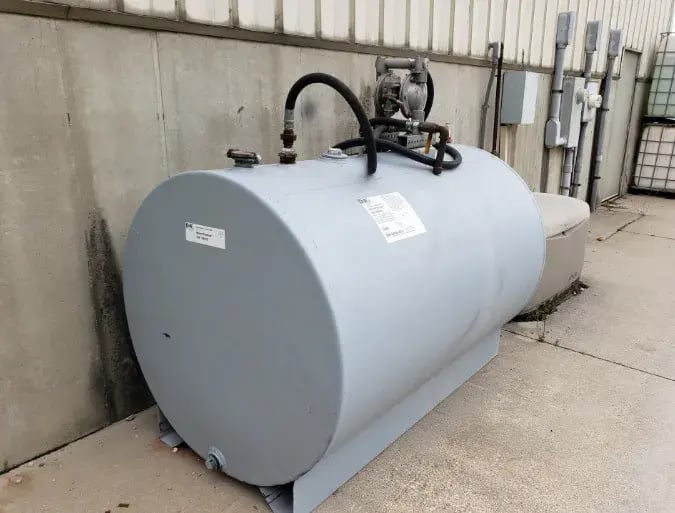
A tank reaches the end of its life, or the facility needs a bigger one, and the project gets moving. The maintenance manager, the contractor, and the tank supplier are all in the loop. The SPCC Plan usually isn't. That plan, short for Spill Prevention, Control, and Countermeasure, is the federal oil spill prevention plan EPA requires for facilities storing more than 1,320 gallons of oil aboveground. So does swapping one tank for another count as a plan amendment? In most cases, yes. EPA lists replacing a container as an example of a change that can require an amendment, and a swap almost always changes enough about the facility that we treat it as one, even when the new tank looks identical to the old one.
This article covers why a replacement is generally handled as an amendment, when that amendment needs a Professional Engineer's certification, and how to sequence the swap so the paperwork keeps up with the steel. It also covers what New Jersey adds on top, including NJDEP's underground storage tank closure rules if the old tank is buried. If you'd rather talk through your own tank, you can reach out to RMA at any point.
Table of Contents
TL;DR
Yes, in most cases. EPA lists replacing a container as a change that can require an SPCC Plan amendment, and a swap rarely leaves your spill risk untouched. A replacement is a technical amendment, so a PE-certified plan needs a licensed Professional Engineer to certify the changes, while a smaller facility with a self-certified plan can usually certify it themselves. You have six months to prepare the amendment, but we'd update the plan before the new tank goes into service. If the old tank is buried, New Jersey adds its own closure process, including notice to the state at least 14 days ahead, a certified closure firm, and a licensed cleanup professional if contamination turns up.
Does Replacing a Tank Trigger an SPCC Plan Amendment?
The rule is 40 CFR 112.5(a). It says you have to amend the plan when there's a change in facility design, construction, operation, or maintenance that materially affects the potential for a discharge. EPA then gives examples, and replacement of a container is on the list, right next to commissioning or decommissioning containers, moving them, and rebuilding or replacing piping. A tank swap is exactly the kind of change the amendment rule was written for.
EPA words those examples as changes that may require an amendment, so there's a judgment call built in. You'll sometimes hear that a new tank identical to the old one, in the same spot, holding the same product, changes nothing. That's hard to sustain once you look at the details. A replacement tank almost always arrives with different dimensions, supports, fill and vent connections, overfill prevention equipment, and piping tie-ins. Any of those can change what your plan says about the container, what the facility diagram shows, or whether your secondary containment still holds the volume it needs to. The plan is supposed to describe what's on the ground, and a tank that's on site but not in the plan is a gap anyone reviewing the file can see.
Two related points. You don't send the amendment to EPA for approval, and the plan stays at the facility. EPA Region 2 enforces SPCC in New Jersey, and the agency can require further changes if it decides a plan falls short, which is covered in our article on who enforces SPCC plans. The second point is capacity. SPCC applies once a facility has more than 1,320 gallons of aboveground oil storage, counting containers of 55 gallons or more, and it's the container's capacity that counts, not how full it is. If the new tank is larger than the one it replaces, the swap can push a facility across that line for the first time, or across the Tier I and Tier II limits covered in the next section.
Is a Tank Replacement a Technical Amendment That Needs PE Certification?
The rule sorts amendments into two groups. Non-technical amendments are administrative, like a new emergency contact, a changed phone number, or a company name change, and they don't need an engineer's sign-off. Technical amendments are changes to the facility itself that affect discharge potential. A container replacement lands in this second group. Under 40 CFR 112.5(c), a technical amendment to a PE-certified plan has to be certified by a licensed Professional Engineer. Whether that applies to you depends on the type of plan you have.
| Plan type |
Who certifies a tank replacement amendment |
What to watch for |
| PE-certified plan |
A licensed Professional Engineer reviews and certifies the changes |
Applies to any facility over the qualified facility limits, and to any facility that chose a PE-certified plan |
| Tier II qualified facility (self-certified) |
The owner or operator self-certifies |
Limited to 10,000 gallons or less of aggregate aboveground storage and a clean spill history. A PE must certify amended provisions if the swap touches a PE-certified piece, such as an alternative containment measure |
| Tier I qualified facility (self-certified template) |
The owner or operator self-certifies |
Same limits as Tier II, plus no single container over 5,000 gallons |
The size of the new tank can change which row you're in. If a replacement pushes a Tier I facility past 5,000 gallons in one container or 10,000 gallons in total, you have six months after preparing the amendment to move to a Tier II plan, if you still qualify, or to a full PE-certified plan. A Tier II facility that tips over 10,000 gallons has six months from the change to get a PE-certified plan in place. If you're not sure which type of plan you have, our guide to the different types of SPCC plans walks through the differences.
When a PE is required, a licensed engineer has to review and approve the amended sections before the amended plan counts. Some consulting firms have a PE on staff, and others work with a trusted outside engineer. Either way, what you're paying for is the engineer's review of the changes, so it's worth knowing who that engineer will be before the tank order goes in. Our article on Professional Engineers and SPCC plan requirements covers what a PE reviews and what they're attesting to.
How Do You Handle a Tank Swap and the SPCC Amendment Together?
The rule gives you six months to prepare the amendment and up to six more months to implement it. That window is a backstop, not a plan. We'd update the SPCC Plan before the new tank goes into service, because inspections, overfill prevention checks, and staff training should start on day one, and the nameplate data, dimensions, and containment measurements are easiest to capture while they're in front of you. If your five-year plan review is coming due anyway, doing both at once saves a round of work, and our article on SPCC plan five-year reviews explains how the two fit together.
| Stage |
What to do |
| Before the swap |
Pull your current plan and check your total capacity against the 1,320 gallon, Tier I, and Tier II thresholds. Confirm the secondary containment can hold the largest container plus rainfall freeboard. Find out whether the facility is a New Jersey major facility. Line up the closure firm, contractors, and permits. If your plan needs a PE, get the engineer involved early. |
| During the swap |
Drain and clean the old tank and manage what comes out of it as the waste it is, since used oil or hazardous waste rules can apply depending on what it held. Keep spill response materials at hand during transfers. Record the new tank's capacity, dimensions, and construction details, and photograph the containment. Call the NJDEP hotline if anything is discharged. |
| After the swap |
Update the container inventory, facility diagram, capacity and containment calculations, overfill prevention, and inspection and testing sections. Get the amendment certified by whoever your plan type requires, log it in the plan's amendment record, and get management approval. Brief everyone who handles oil on the new tank and what changed. |
The containment check is the step most likely to turn up a surprise. Secondary containment has to hold the capacity of the largest single container plus freeboard for precipitation, so a bigger replacement tank can quietly turn a compliant dike into an undersized one. We cover the math in how big your SPCC oil spill containment needs to be. Staff training follows the same logic, since an updated plan nobody on the shift has seen doesn't prevent much, and RMA's online training library is one place to start. If you're wondering whether you can handle a simple update yourself, our article on when to update your SPCC plan and whether you can do it yourself gives a straight answer.
What Are New Jersey's UST Closure Rules If the Old Tank Is Buried?
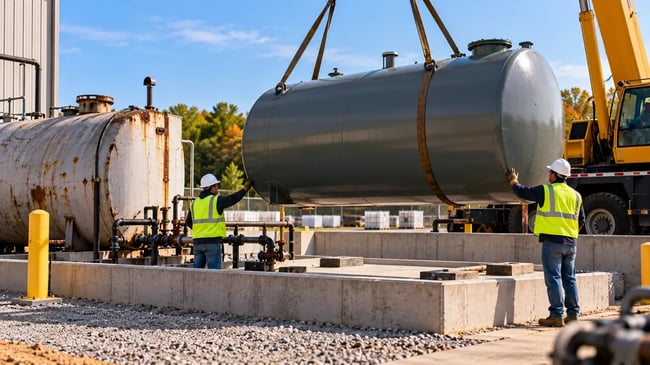
If the old tank is underground, you've got a second project running next to the SPCC amendment. NJDEP regulates underground storage tanks, or USTs, under N.J.A.C. 7:14B, and closing one follows a defined process. Not every buried tank is covered. The rule exempts heating oil tanks of 2,000 gallons or less serving a nonresidential building, and heating oil tanks serving residential buildings. Even an exempt heating oil tank isn't a free-for-all, because NJDEP has certification requirements for work on unregulated heating oil tank systems under N.J.A.C. 7:14B-16 and separate cleanup rules at N.J.A.C. 7:26F. Check your tank's size, contents, and building type against the rule before assuming it's exempt.
For a regulated tank, N.J.A.C. 7:14B-9.2 lays out the closure steps.
| Closure step |
What the rule asks for |
| Registration |
The facility has to be registered with NJDEP before closure starts, and you can't close a tank at an unregistered facility |
| Notice of intent to close |
Submitted through NJDEP Online at least 14 calendar days before closure, naming the certified closure firm and, if remediation is involved, the licensed site remediation professional. NJDEP's approval goes to the municipal and county health departments at least 14 days ahead and to the local authority with the demolition permit application |
| Certified closure firm |
The closure work is done by a firm certified under N.J.A.C. 7:14B-13 |
| Closure plan |
A site investigation under N.J.A.C. 7:26E-3.3 and a tank decommissioning plan, kept at the facility and available to NJDEP, the local code official, or health officials |
| Closure method |
Closure follows API Recommended Practice 1604. The secured tank is examined for holes, and the NJDEP hotline gets a call if holes or a discharge are found. The tank is then removed |
| Abandonment in place |
Allowed only if no contamination exceeds applicable standards or removal isn't feasible. It takes a statement from a New Jersey licensed PE explaining why removal isn't feasible, a cleaned tank filled with sand, cement, or similar inert material, and fill pipes removed to at least one foot below grade |
| Local codes |
Compliance with the New Jersey Uniform Construction Code and any local demolition permit requirements |
What Happens If Contamination Turns Up During Tank Closure?
Pulling an old tank can reveal a leak nobody knew about, and the rule plans for that. If the tank has holes or a discharge is confirmed, the NJDEP hotline gets a call at 1-877-WARNDEP (1-877-927-6337) unless the discharge was already reported. If contamination exceeds applicable remediation standards, the cleanup has to follow N.J.A.C. 7:26C, which in practice means a Licensed Site Remediation Professional, or LSRP, runs it. Under the Spill Act, New Jersey's primary cleanup and liability law, parties responsible for a discharge can be liable for cleanup costs regardless of fault, so a find like this is a good time to bring in an environmental attorney alongside the LSRP. Our piece on the sheen rule and oil spill reporting covers the federal side of reporting.
How Does a Buried Tank Fit Into the SPCC Plan?
Completely buried tanks that are subject to all of the technical requirements of the federal UST rules, or a state program EPA has approved, are exempt from SPCC. Those tanks still have to be marked on the facility diagram if the facility is otherwise subject to SPCC. Whether your tank falls under that exemption depends on whether it's covered by all of those technical requirements, so check your own tank rather than assuming. A buried heating oil tank outside the UST rules isn't exempt this way and generally counts toward your SPCC coverage. The reverse applies too. If you replace an exempt buried tank with an aboveground tank, the new tank counts toward the 1,320 gallon threshold, and a facility that never needed an SPCC Plan can find itself needing one. Either way, removing a buried tank changes your facility diagram.
What Other New Jersey Oil Storage Rules Apply to a Tank Replacement?
Facilities that qualify as major facilities under N.J.A.C. 7:1E have a second plan to think about. Those facilities need a DPCC plan (Discharge Prevention, Containment and Countermeasure) and a DCR plan (Discharge Cleanup and Removal), which NJDEP approves. Whether you're a major facility depends on your total storage capacity and what you store, so check the rule's definition and hazardous substance list against your own inventory. If you are one, the plan has to reflect your changes. The rule requires the owner or operator to amend the DPCC and DCR plans within 30 days of a modification that necessitates a plan change, certify the amendment, and submit it to NJDEP for approval. Certain changes also call for advance notice to NJDEP before the work starts, so it's worth calling the agency's discharge prevention staff before the tank is ordered rather than after it's installed. That 30 day clock is much shorter than the federal six months, so a major facility shouldn't plan around the federal timeline.
The Spill Act also covers hazardous substances beyond oil, and it requires immediate notice to NJDEP when a discharge occurs. The hotline is 1-877-WARNDEP (1-877-927-6337). A tank swap involves draining, cutting, lifting, and transferring product, all of which carry some spill risk. Make sure the crew doing the work knows the number and has spill materials staged. Our article on SPCC plans in New Jersey gives the broader picture of how the federal and state layers fit together, and our rundown of the top SPCC plan violations and fines covers the kinds of violations that come up when a plan falls behind the facility.
What About Construction Permits for the New Tank?
Installing a tank is construction work, and New Jersey has its own approvals for it. Depending on the tank and the site, that can mean Uniform Construction Code permits, fire code approvals from your local fire official (the Uniform Fire Code is statewide but enforced locally), and, if the work disturbs enough ground, soil erosion and sediment control certification through your Soil Conservation District. A new UST has to be installed by NJDEP-certified contractors under its own permit process. We don't prepare any of those construction-phase permits or approvals. Your engineer, tank contractor, or a soil erosion specialist is the right person for that piece, and if you're not sure who to call, we can point you in the right direction.
What we do handle is everything the facility needs once the tank is in service: the SPCC amendment, spill reporting procedures, inspections, training, and, for major facilities, the DPCC and DCR updates. Those pieces are easy to overlook while everyone is focused on the install date.
How Much Does an SPCC Plan Amendment for a Tank Replacement Cost?
The cost depends mostly on your plan type and how much the swap changes. A simple Tier I update runs about $1,500. A PE-certified plan with a more complex facility, such as several containers, containment calculations that need rework, or a larger tank that changes the whole containment picture, starts around $7,500 and goes up from there. The drivers are the number of containers affected, whether secondary containment has to be re-evaluated, whether a PE has to review and certify the changes, and how complete your existing plan and records are. Our guide to SPCC plan costs goes through the numbers in more detail. If you'd like a figure for your own facility, the pricing calculator below is RMA's way of giving you a realistic range before you ever talk to anyone.
How Can RMA Help With an SPCC Amendment After a Tank Replacement?
We're based in New Jersey, so NJDEP's rules and the way they overlap with the federal SPCC rule are familiar ground. We can help you work out whether your swap needs an amendment and which tier you'll land in after it, prepare the amended plan, and make sure the PE review happens when your plan calls for one. We can also check whether your facility is a major facility under the state rules, and we'll tell you which construction-phase pieces to take to your engineer or contractor. And if you have a simple self-certified plan and a straightforward swap, we'll tell you plainly if you can handle the amendment yourself. There's no obligation and no pressure either way. You can call us, email us, or fill out the form on our website, and you can also contact RMA directly with questions about your tank.