What Pennsylvania Facilities Need to Do About the Oil Spill Plan, DEP Tank Closure, and Registration When an Old Tank Gets Swapped for a New One
You've got an old diesel or heating oil tank that's reached the end of its life, and a replacement is on order. The tank contractor will handle the physical swap, but the paperwork around it is less obvious. If your facility stores enough oil to fall under the federal oil spill prevention rule, you have (or are supposed to have) a written oil spill plan called an SPCC Plan, short for Spill Prevention, Control, and Countermeasure. That plan lists every oil container on site, and once the old tank leaves, the list is wrong. Pennsylvania adds a second layer, because DEP regulates the tank itself. The old tank has to be closed out properly and the new one registered.
So, is replacing a tank an SPCC amendment? In most cases, yes, even when the new tank is identical to the old one. Whether a Professional Engineer has to certify the change depends on what kind of plan you have. This article walks through the federal amendment rules, the deadlines, the Pennsylvania closure steps for the old tank, and the registration steps for the new one. If you'd rather hand the whole question to someone, you can reach out to RMA at any point.
Table of Contents
TL;DR
If your facility already has an SPCC Plan, replacing an oil tank, even with an identical one, is generally treated as a change that requires amending the plan. A Professional Engineer has to certify the amendment if you have a full PE-certified plan, while a facility with a self-certified qualified-facility plan can usually certify it on its own. In Pennsylvania, you also need to give DEP at least 30 days' notice before closing the old tank, use a DEP-certified installer, and file amended registration paperwork within 30 days of closing the old tank and installing the new one. If you don't have a plan yet, the new tank can still push your total storage over the federal threshold, so check your capacity before you order.
Does Replacing a Tank Require an SPCC Plan Amendment?
The federal rule (40 CFR Part 112, enforced in Pennsylvania by EPA Region 3) says you amend your SPCC Plan when there's a change in the facility's design, construction, operation, or maintenance that materially affects its potential for an oil discharge. The rule then gives examples, and replacement of containers is on the list, right alongside commissioning or decommissioning containers, moving them, replacing piping, and construction that alters secondary containment. The list says these changes may require an amendment, and that's the wiggle room people point to when they argue a like-for-like swap doesn't count.
We treat it as an amendment, and so will most inspectors. An SPCC Plan describes each container by ID, size, contents, construction, and location, and the site diagram, capacity totals, secondary containment calculations, and inspection checklists all point back to those specific tanks. A new tank has a new serial number, often a slightly different capacity, sometimes a different footprint on the pad, and the old tank's entry has to come out. Even a same-model tank in the same containment involves one container being decommissioned and another being commissioned, and both of those are on the rule's own list of triggers. If you want to see how this fits into a broader update, our guide on when to update your SPCC Plan and whether you can do it yourself covers the other common triggers.
If you don't have an SPCC Plan at all, the question changes. A facility is generally subject to the rule when its total aboveground oil storage capacity is over 1,320 gallons, counting only containers of 55 gallons or more, or when buried capacity is over 42,000 gallons. It's capacity that counts, not how full the tanks are. A replacement tank that's bigger than the old one can push you across that line, and a temporary tank sitting on site during the swap can count toward your total while it's there. If the new tank puts you over, you'll need to get a plan in place. Our walkthrough on the best four steps to figure out if you need an SPCC Plan and our explainer on what an SPCC Plan is will help you run the numbers.
Is a Tank Replacement a Technical SPCC Amendment That Needs PE Certification?
SPCC amendments come in two types. Non-technical amendments are administrative: a new contact name, a changed phone number, a corrected address. Technical amendments are changes that affect how the facility prevents or contains spills, such as swapping a tank, changing containment, rerouting piping, or storing a different product. The federal rule says a Professional Engineer (PE) must certify technical amendments, except where the qualified-facility provisions say otherwise. Container replacement falls on the technical side, and when it's unclear which side a change falls on, treating it as technical is the safer call.
Who actually certifies the amendment depends on the type of plan you have.
| Type of SPCC Plan |
Who certifies a tank-replacement amendment |
What to watch for |
| Full plan certified by a PE |
A Professional Engineer reviews and certifies the amendment |
Build the engineer's review time into your schedule, and expect a review fee. |
| Tier II qualified facility, self-certified |
The owner or operator can self-certify |
If a PE certified any portion of the plan (alternative measures, for example) and the change affects that portion, a PE has to recertify it. |
| Tier I qualified facility, using EPA's template |
The owner or operator self-certifies the technical amendment |
The facility has to stay at 10,000 gallons or less in total, with no single container over 5,000 gallons. |
The qualified-facility limits are where a tank swap can surprise people. If you replace a 2,000 gallon tank with a 6,000 gallon one, you've moved from Tier I to Tier II, and you'll need to prepare the plan to the Tier II requirements. If the replacement pushes your total aboveground storage over 10,000 gallons, you're out of qualified-facility status entirely and into a full PE-certified plan. EPA's guidance also notes that some states restrict self-certification, so it's worth a quick check with the state's engineering licensing board before you sign anything yourself. Our articles on the different types of SPCC Plans and on Professional Engineers and SPCC Plan requirements go deeper on each path.
One note on how RMA handles PE certification. We don't have a Professional Engineer on staff. When a plan needs one, we work with an outside PE licensed in the state where the plan is being used. Our team typically does the site visit and builds the plan, and the engineer then reviews, stamps, and seals it, which adds some time to the process.
How Long Do You Have to Amend the SPCC Plan After Replacing a Tank?
The rule gives you six months from the change to prepare the amendment, and then you have to implement it as soon as possible, no later than six months after it's prepared. In practice, finishing the amendment before the new tank goes into service is cleaner. The plan on file should match what's sitting in the yard when an inspector shows up, and the new tank's containment, overfill protection, and inspection routine should be in place on day one rather than discovered later. Treat the six-month window as a ceiling, not a target.
The amendment usually reaches past the container list. Here's what a tank replacement can change in the plan.
| Part of the plan |
What a tank replacement can change |
| Container inventory and total capacity |
New tank ID, size, contents, and construction; old tank removed; facility total recalculated |
| Site diagram |
Tank location, drainage paths, and fill or loading areas |
| Secondary containment |
In most cases containment has to hold the largest container plus room for rainfall, so a bigger tank can outgrow the existing dike or basin |
| Overfill prevention and piping |
New gauges, alarms, fittings, and connected piping |
| Inspections and integrity testing |
Monthly checklists and the testing schedule for the new tank |
| Training and procedures |
Anyone who fills, inspects, or responds to a spill at the tank needs to know the new setup |
| Qualified-facility status |
Facility total and largest single container, which decide who can certify the plan |
Containment sizing is the item that catches the most facilities off guard, because the new tank is often ordered before anyone checks whether the existing dike can hold it. Our guide on how big your SPCC oil spill containment needs to be explains the math. The amendment is also separate from the five-year review the rule requires. If your review is coming up, doing both at once saves effort, and our article on SPCC Plan five-year reviews covers how the two fit together.
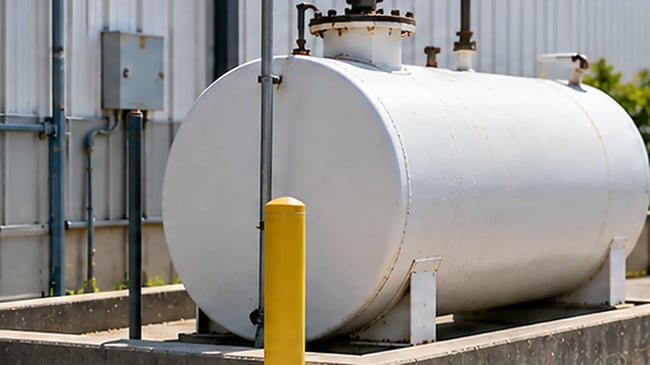
How Do You Close the Old Tank Under Pennsylvania's DEP Storage Tank Rules?
Pennsylvania regulates stationary aboveground tanks that hold more than 250 gallons of a regulated substance, which includes petroleum products like diesel, gasoline, and heating oil. These rules come from the Storage Tank and Spill Prevention Act and 25 Pa. Code Chapter 245. If your old tank is in that group, you can't just cut it up and haul it away. A tank that's out of service has to stay registered, and the annual fee keeps coming, until it's properly closed or removed. If the tank is 250 gallons or less, DEP's closure rules don't apply, though the SPCC amendment still does when the tank is 55 gallons or more and counts toward your plan.
For a regulated tank, closure follows a sequence set out in 25 Pa. Code § 245.561 and DEP's closure guidance.
| Step |
What's required |
| 1. Notify DEP |
Submit DEP's Aboveground Storage Tank System Closure Notification Form at least 30 days before closure starts. DEP can allow less time, and the notice isn't required when the closure is a response to corrective action or DEP waives it. |
| 2. Local permits |
Get any permits the municipality requires. If the tank is under a fire marshal or flammable and combustible liquids permit, notify that state, county, or local agency too. |
| 3. Hire a certified professional |
Tank handling work, including removal and closure, has to be done by a DEP-certified installer or remover. |
| 4. Empty and clean |
Contents have to be reused, treated, or disposed of under state and federal waste rules. The tank is cleaned and freed of hazardous vapors, then removed. A tank left on site has to be marked with the closure date, and one closed in place has to be made inoperable and secured against entry. |
| 5. Site assessment |
After notifying DEP, assess the area for releases using DEP's sampling guidance and prepare a closure report. Keep the results and report for 3 years, and submit the report when DEP requires or requests it. |
| 6. Handle any contamination |
Contamination found during closure moves into DEP's corrective action process. A confirmed release has to be reported to the DEP regional office as soon as practicable and no later than 24 hours after confirmation, and a certified installer who finds one reports it within 48 hours. |
| 7. Amend the registration |
Submit an amended registration form, signed by the owner and the certified installer who supervised the work, within 30 days of completing the closure. |
The 30-day notice is the item that drives your schedule, since you can't book the removal for next week and expect to be compliant. Sampling under an old tank also sometimes turns up decades of small drips, and if it does, that becomes its own project with its own timeline. Ask your installer before work starts what they'll sample, who handles the lab work, and what happens if results come back above DEP's action levels.
How Do You Register and Permit the New Tank With Pennsylvania DEP?
Installing a regulated tank is tank handling work, so it has to be done by a DEP-certified installer, and larger tanks (those over 21,000 gallons, along with field-constructed tanks) are inspected by a certified inspector at installation. Within 30 days of installing a new or replacement tank at an existing facility, the owner submits an amended registration form to DEP, signed by the certified installer. The registration form also serves as the operating permit application. Certain classes of tanks need a separate site-specific installation permit before construction of a new or replacement tank begins, and the registration form doesn't satisfy that requirement. If your replacement is a large one, ask your installer about it before you order.
Registration comes with an annual fee based on the tank's capacity.
| Aboveground tank capacity |
Annual DEP registration fee |
| 5,000 gallons or less |
$50 per tank |
| 5,001 to 50,000 gallons |
$125 per tank |
| Over 50,000 gallons |
$300 per tank |
DEP invoices the owner and issues a registration certificate once the fee is paid. That certificate has teeth, because your fuel distributor is required to verify the tank's operating permit status on your current registration certificate before delivering. An unregistered replacement tank can leave you with a full new tank and no fuel delivery.
Two other pieces can be affected. If your facility's total aboveground capacity is over 21,000 gallons, DEP requires a Spill Prevention Response Plan, and the plan on file may need to reflect the new tank, so check it against its own update triggers. Local fire code requirements for tanks are enforced by the municipality and vary from place to place, so confirm what your local code office requires before the tank is ordered, not after it's delivered.
What Order Should You Handle the SPCC Amendment, Closure, and Registration?
Several of these tasks run on their own clocks, and a sequence keeps them from colliding. If you bring in a temporary fuel tank to keep generators or equipment running during the swap, count it too, since it's oil storage while it's on site and can count toward your SPCC capacity.
| When |
What to do |
| Before you order the tank |
Check your total capacity and plan type, confirm the existing containment can hold the new tank, ask the installer whether a site-specific installation permit applies, and check local fire code. |
| At least 30 days before closure |
Submit DEP's closure notification for the old tank and line up local permits. |
| Before installation |
Draft the SPCC amendment, including containment sizing and overfill protection, and line up the PE if your plan needs one. |
| During the swap |
The certified installer closes or removes the old tank, completes site assessment sampling, and installs the new tank. |
| Within 30 days of closure and of installation |
File the amended registration with DEP and pay the registration invoice. |
| After the new tank is running |
Finalize and certify the SPCC amendment, update the monthly inspection checklist, train the staff who work with the tank, and keep the closure report. |
A word on the construction side. Building and fire permits for the tank installation, site work, and the installation itself are handled by your installer, contractor, or engineer, and RMA doesn't prepare construction-phase permits or approvals. Once the tank is in and running, the operating pieces take over: the SPCC amendment, DEP registration, inspections, integrity testing, and training. That's where we help, and we're also glad to help you figure out what the construction phase needs and point you toward the right people for it. For staff training on the new setup, our online training library is one option, and our guide to the top 10 things to do during your SPCC Plan monthly inspections helps you rebuild the inspection routine around the new tank.
How Can RMA Help With an SPCC Plan Update After a Tank Replacement?
You may not need us. If you have a Tier I plan that you wrote yourself from EPA's template, and the new tank keeps you within the Tier I limits, you may be able to handle the amendment on your own, and our article on whether you can get your SPCC Plan updated explains where that works and where it doesn't.
If you'd rather have help, we work with facilities that need a new plan, including those whose new tank pushes them over the threshold for the first time. If another firm wrote your existing plan, we typically don't update it and usually rebuild it from scratch instead. Tier I plans generally run about $1,500 to $4,000, and SPCC work overall runs about $1,500 to $15,000 depending on the size and complexity of the facility, with a PE's review added when your plan requires one. Initial SPCC training is free with a new RMA plan. We don't install or remove tanks, and in Pennsylvania that work has to go to a DEP-certified installer anyway.
There's no obligation in asking. You can call us, email us, or fill out the form on our website, and a member of our team will talk through your tank swap, tell you what applies to your facility, and let you know if you're better off handling it yourself. If you're ready, get in touch with RMA and we'll take it from there.


