Spill Pallets, Containment Lockers, Berms, and Indoor Storage Compared, Plus How Sizing Works and What Inspectors Look For
Most New Jersey facilities don't have a tank farm. They have drums of hydraulic oil by a dock door, a couple of 275-gallon totes of used oil in the corner of the shop, and a pallet of 55-gallon drums outside because the building ran out of room. Each one is a place where oil can reach a floor drain, a storm inlet, or bare ground, and federal and state rules expect something in place to catch a leak before it gets there. So what do you buy or build?
This article covers the four most common ways to contain drums and totes: spill pallets and decks, containment lockers and buildings, bermed or curbed areas, and indoor storage with drain protection. The short answer is that containment has to hold the largest container plus room for rain, and New Jersey adds its own requirements for drum and tote storage areas at major facilities. We'll cover sizing, compare the options on cost, capacity, and best use, and walk through what inspectors check. It complements our core guide on how big SPCC oil spill containment needs to be, so we keep the math light and focus on the hardware. And if you'd rather hand the question to someone who does this every day, you can reach out to RMA at any point.
Table of Contents
TL;DR
Drums and totes that hold oil need secondary containment that can catch the largest container plus room for rain, and New Jersey adds rules for drum and tote storage at major facilities. A spill pallet is the simple answer for a few drums or a tote, a containment locker suits covered outdoor storage, a berm or curbed pad suits larger groups of containers, and indoor storage works only when drains and doorways are controlled. Inspectors check capacity, condition, drains, rainwater, and whether what's on the ground matches your SPCC Plan.
What Federal Secondary Containment Rules Apply to Drums and Totes?
The federal Spill Prevention, Control, and Countermeasure (SPCC) rule, 40 CFR Part 112, applies when a facility stores more than 1,320 gallons of oil above ground, counting every container of 55 gallons or more. The count uses container capacity, not contents, so ten half-empty drums count the same as ten full ones. "Oil" covers petroleum, lubricants, hydraulic fluid, used oil, and vegetable oils. Our guide on whether 55-gallon drums are included in SPCC plans covers the counting rules.
Once a facility is covered, the rule asks for two kinds of containment. General containment, under 40 CFR 112.7(c), means dikes, berms, curbing, drip pans, sumps, sorbent materials, or something equivalent wherever oil could escape. Sized containment, under 40 CFR 112.8(c)(2) and 112.8(c)(11), applies to bulk storage containers and mobile or portable containers, which is where drums and totes land. It calls for a secondary means of containment for the entire capacity of the largest single container, plus enough freeboard to contain precipitation. EPA has also said you don't need a separate containment system for each drum. A group of containers can share one containment area sized for the largest one.
How Does New Jersey Treat Secondary Containment for Drum and Tote Storage?
New Jersey layers its own rules on top of the federal ones. The Spill Compensation and Control Act, usually called the Spill Act, covers discharges of petroleum and other hazardous substances, and N.J.A.C. 7:1E applies in full to facilities NJDEP classifies as "major facilities." Whether yours is one depends on its total storage capacity, drums and totes included, and on what it stores, so check N.J.A.C. 7:1E against your own inventory. If you are a major facility, the rules speak directly to containers like yours: tote, drum, bag, and other small container storage areas must have secondary containment or diversion systems built to the standards in N.J.A.C. 7:1E-2.6.
Those standards are stricter than the federal rule in specific ways. The system has to block every probable route a leak could take to become a discharge. Its components have to be impermeable and kept that way. Where rain can collect, the capacity has to include an extra six inches of rainwater. And a containment system can't double as backup storage or serve any use that cuts into its capacity. Major facilities also submit a combined Discharge Prevention, Containment and Countermeasure (DPCC) and Discharge Cleanup and Removal (DCR) plan to NJDEP, separate from the SPCC Plan. Our overview of SPCC Plans in New Jersey shows how the pieces fit.
Facilities that aren't major facilities still have to report discharges. State rules call for immediate notification to NJDEP's 24-hour hotline, 1-877-WARNDEP (1-877-927-6337), and the Spill Act makes those responsible for a discharge strictly liable for cleanup and removal costs, with or without fault. Good containment keeps a leaking drum from turning into that phone call. For the reporting side, see when you have to report an oil spill and how the sheen rule works. If a discharge has already happened, an environmental attorney can explain how liability applies to your situation.
How Does Secondary Containment Sizing Work for Drums and Totes?
The starting point is the largest single container in the containment system, plus freeboard. For a group of 55-gallon drums, the sump has to hold at least 55 gallons with room to spare. A standard 4-drum spill pallet carries a 66-gallon sump, which is 120 percent of one drum, and a four-drum pallet isn't sized for 220 gallons because only one container is assumed to fail at a time. Many facilities design to 110 percent of the largest container, though that figure comes from industry practice, not the federal rule. EPA has said freeboard sized for a 25-year, 24-hour storm is appropriate for most facilities, while stopping short of writing it into the rule.
Freeboard is where outdoor storage gets tricky. Take six inches of rain, the figure New Jersey uses for major facilities. On a pallet footprint of roughly 51 by 51 inches, that's close to 68 gallons of rainwater, more than the whole 66-gallon sump. An uncovered pallet can fill in one storm and have nothing left for a leak, which is why a roof or cover changes the math. Totes work the same way. Single-tote pallets are commonly sold with sumps of about 330 to 385 gallons, so compare the tote's actual capacity to the sump, not how full it is on the day you check. When a Professional Engineer (PE) certifies your plan, the engineer reviews this math, and our guide to professional engineers and SPCC plan requirements explains when certification is needed. Keep your calculations on file either way so you can show an inspector how you got your numbers.
Are Spill Pallets and Decks Enough for Drum and Tote Containment?
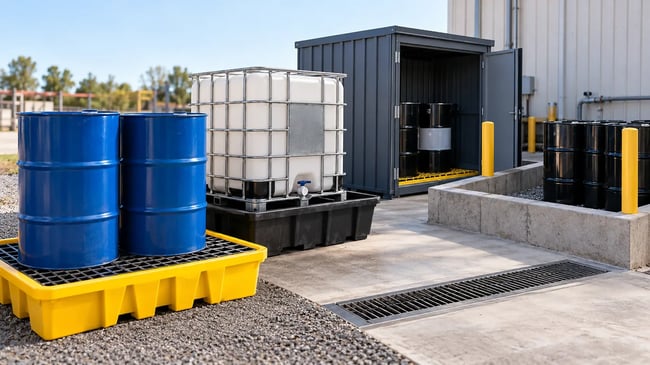
For a handful of containers, usually yes. Spill pallets are molded polyethylene or welded steel platforms with a grated deck over a sump, sold for 2 to 8 drums or for one or two IBC totes. They're the easiest option to buy, they move with a forklift, and they work indoors or out. A 4-drum polyethylene pallet runs roughly $350 to $1,350 depending on brand and features, and tote pallets run roughly $1,600 to $3,500. A drain plug lets you empty the sump without lifting the drums, but outdoors it has to stay closed and be treated like any other drain.
The limits show up in use. Check the load rating against fully loaded drums, which can weigh 400 pounds or more each, and against any forklift loading, since ratings on common pallets run from about 3,000 to 8,000 pounds. Put the pallet where containers are dispensed from, because most spills happen during transfers. Steel suits solvents and flammables that would attack polyethylene, and polyethylene suits most oils and corrosives. A cracked or bowed pallet doesn't hold what its label says, so replace it. And a drum parked next to a pallet gets no protection, which is the easiest finding for an inspector to write down.
When Does a Containment Locker or Building Make Sense for Drum Storage?
A locker or building makes sense when you store drums outside and want them covered, locked, and vented. A polyethylene shed holding eight drums runs roughly $3,600 to $4,800 and comes with a built-in sump of about 72 to 75 gallons. The roof keeps rain out, so freeboard stops being the main issue and the sump only has to handle leaks. Steel buildings are a different category. Non-combustible and fire-rated drum buildings for flammable and combustible liquids are typically custom built and listed at $30,000 or more for an 8 to 10 drum unit, and lead times can run for months.
The fire code can decide this choice before the SPCC rule does. New Jersey's Uniform Fire Code is statewide but enforced by local fire officials, and its rules on storing flammable and combustible liquids can call for a fire-rated structure, spacing from buildings, or ventilation. Talk to your local fire official before you buy. Also check that the sump fits your largest container. A shed built for 55-gallon drums on standard pallets won't take a 275-gallon tote.
How Do Bermed and Curbed Areas Work for Drum and Tote Storage?
When the container count climbs past what pallets handle neatly, a bermed or curbed area usually covers everything at lower cost. One containment area can serve many drums and totes, sized for the largest container plus rain. Portable berms with foam, collapsible, or modular walls work for staging areas and storage that changes shape, and modular drive-in systems start near $3,800. A permanent concrete curb or poured pad suits long-term storage, and its cost depends on site work, so get contractor quotes.
The walls and floor have to be sufficiently impervious to hold oil, so gravel or bare soil inside a berm doesn't qualify without a liner, and cracked concrete or failed joint sealant counts as a defect. Rainwater rules apply too. Under 40 CFR 112.8(b), drain valves stay closed, you inspect the water before releasing it, and you keep a record of each drainage. A permanent pad is a construction project, so building permits and local approvals run through your engineer or contractor. RMA doesn't prepare construction-phase permits, but once the pad is in service we make sure your SPCC Plan reflects it and your inspections and training cover it.
Can Indoor Storage With Drain Protection Count as Secondary Containment?
Sometimes, but it's the option that depends most on the specifics. EPA has said oil-filled equipment inside buildings with limited drainage, where a leak couldn't reach waters of the United States, may already meet the general containment requirement. A sealed concrete floor with no floor drains, tight doorways, and no path outside can fill that role. A bare floor with an open drain, a roll-up door at grade, and a ramp to the yard can't. Some reviewers don't treat a building floor as sized containment for bulk containers at all, so the call has to be explained in the SPCC Plan and a certifying PE has to be comfortable with it.
If you rely on the room, treat the drains and doorways as part of the system. Floor drains need covers, plugs, or mats that stay in place, with a labeled inspection point so they don't get forgotten. Doorways and ramps need curbing or sorbent berms, and floors need sealing and crack repair. Many facilities end up putting spill pallets indoors anyway, since pallets are cheap and settle the sized containment question without debate. Whatever you choose, trace where each drain goes. A drain to a storm sewer or the sanitary system is a direct route out of the building.
How Do Drum and Tote Containment Options Compare by Cost, Capacity, and Best Use?
The table puts the options side by side. Prices are retail listing ranges we saw in fall 2026 and cover equipment only, so freight, installation, and site work come on top. Treat them as ballparks for budgeting, not quotes.
| Option |
Typical Equipment Cost |
Typical Capacity |
Best Use |
| Spill pallet (2 to 8 drums) |
About $350 to $1,350 for a 4-drum poly pallet |
Commonly a 66-gallon sump for 4 drums |
A few drums indoors or under cover, where containers are dispensed from |
| IBC tote spill pallet or deck |
Roughly $1,600 to $3,500, single or double |
About 330 to 385 gallons for one tote, 535 for two |
One or two totes in use or dispensing |
| Polyethylene containment shed |
About $3,600 to $4,800 for an 8-drum unit |
Roughly 72 to 75 gallon sump, roofed |
Covered, locked, vented outdoor drum storage for oils and similar materials |
| Steel locker or building (non-combustible or fire-rated) |
$30,000 or more, custom order |
Varies by model, for example a 250-gallon sump in a 10-drum unit |
Flammable and combustible liquids near buildings, where the fire code calls for it |
| Portable or modular berm |
Modular drive-in systems start near $3,800, smaller collapsible berms cost less |
Set by footprint and wall height |
Staging areas and storage that changes shape |
| Permanent bermed or curbed pad |
Varies widely with site work, so get quotes |
Designed to the largest container plus rain |
Larger, long-term storage with many drums and totes |
| Indoor room with drain protection |
Lowest equipment cost, but depends on floor repair, curbing, and drain work |
Depends on the room and curbing, often paired with pallets |
Storage and dispensing inside a building with sealed floors and controlled drains |
Those numbers cover equipment. Getting containment into your SPCC Plan correctly, with the sizing documented, is a separate cost, and RMA's published range for SPCC Plans runs from about $2,500 to $15,000 depending on the facility. If you'd like a ballpark for having us review your containment and handle the plan, the pricing calculator below will give you one.
What Do Inspectors Look for in Drum and Tote Containment?
Three agencies can show up depending on the issue. EPA enforces the SPCC rule, and for New Jersey that's EPA Region 2, as covered in our piece on who enforces SPCC plans. NJDEP handles Spill Act and N.J.A.C. 7:1E matters, and local fire officials enforce the Uniform Fire Code. The walk-through follows a similar path for each.
Inspectors start by checking whether containers are in or on the containment, not beside it. Then they compare the sump or berm volume to your largest container and ask how you got the number. Next comes condition: cracked or bowed pallets, corroded sumps, failed liners, gaps in concrete joints, and peeled sealant. They look at what's inside the containment too, whether that's standing rainwater, an oil sheen, or stored materials crowding the sump. New Jersey's major facility rules add that containment can't be used as extra storage. Finally, they compare the site to the paper. Containers missing from your SPCC Plan, a locker added without updating the plan, and gaps in monthly inspection records all raise questions. Our guide to monthly SPCC plan inspections covers what to check, and our breakdown of the top SPCC plan violations and fines shows how those gaps turn into penalties. Staff who work next to the containers are the most likely to spot a cracked pallet or an open drain valve, so our online environmental training library is a good place to start.
How Can RMA Help With Drum and Tote Secondary Containment?
RMA is a family-run environmental consulting firm based in New Jersey, and we've been helping facilities with oil storage and spill prevention since 1992. For drums and totes, that usually means working out which containers count toward your SPCC threshold, checking whether your containment is sized and documented the way the rule expects, and writing or updating the SPCC Plan so it matches what's on your site. Where a plan needs PE certification, we'll walk you through when one is required and what the engineer will review.
We'll also tell you when you don't need us. If you only have a couple of drums and you're nowhere near the threshold, a spill pallet and a few minutes with our guide on figuring out whether you need an SPCC Plan may be all it takes. If you're closer to the line, or you've got a mix of drums, totes, and a shed or two, you can call us at 888-RMA-0230, send us an email, or fill out the form on our website. There's no obligation, and you'll talk with someone who does this work every day.