Spill Pallets, Containment Lockers, Berms, and Indoor Storage Options for Pennsylvania Facilities
Drums and totes are the containers people forget to count. A shop with six drums of hydraulic oil, a tote of lube oil by the back door, and a few more drums in the garage doesn't look like an oil storage site, but under the federal oil spill rule it can be. That rule is SPCC, short for Spill Prevention, Control, and Countermeasure, and it applies when a facility stores more than 1,320 gallons of oil aboveground, counting only containers of 55 gallons or larger. Over that line, you need a written SPCC Plan, the document that spells out how your facility prevents oil spills and what contains one if it happens. If you already have a plan, it should describe how every drum and tote is contained, and changing your storage setup means updating it.
So what secondary containment do drums and totes need? Each one needs a secondary means of containment that can hold the largest single container, plus room for rain if the containers sit outdoors. The hardware that gets you there runs from a spill pallet that costs a few hundred dollars to a fire-rated building that costs tens of thousands. This article walks through spill pallets, containment lockers, bermed areas, and indoor storage with drain protection, compares them by cost, capacity, and best use, and covers what inspectors look for. We keep the sizing math light because our guide on how big your SPCC containment needs to be covers it in depth. If you'd rather have someone look at your site, you can reach out to RMA any time.
Table of Contents
TL;DR
Drums and totes covered by the federal oil spill rule (SPCC) need secondary containment that holds the largest single container, plus room for rain if they're outdoors. Spill pallets are the lowest-cost fit for small counts, lockers suit large or flammable stock at a much higher price, bermed areas handle mixed or changing storage, and indoor storage works when floor drains are sealed or treated. Inspectors check capacity, condition, drains, and whether your plan matches what's on the floor.
What Does the SPCC Rule Require for Drum and Tote Containment?
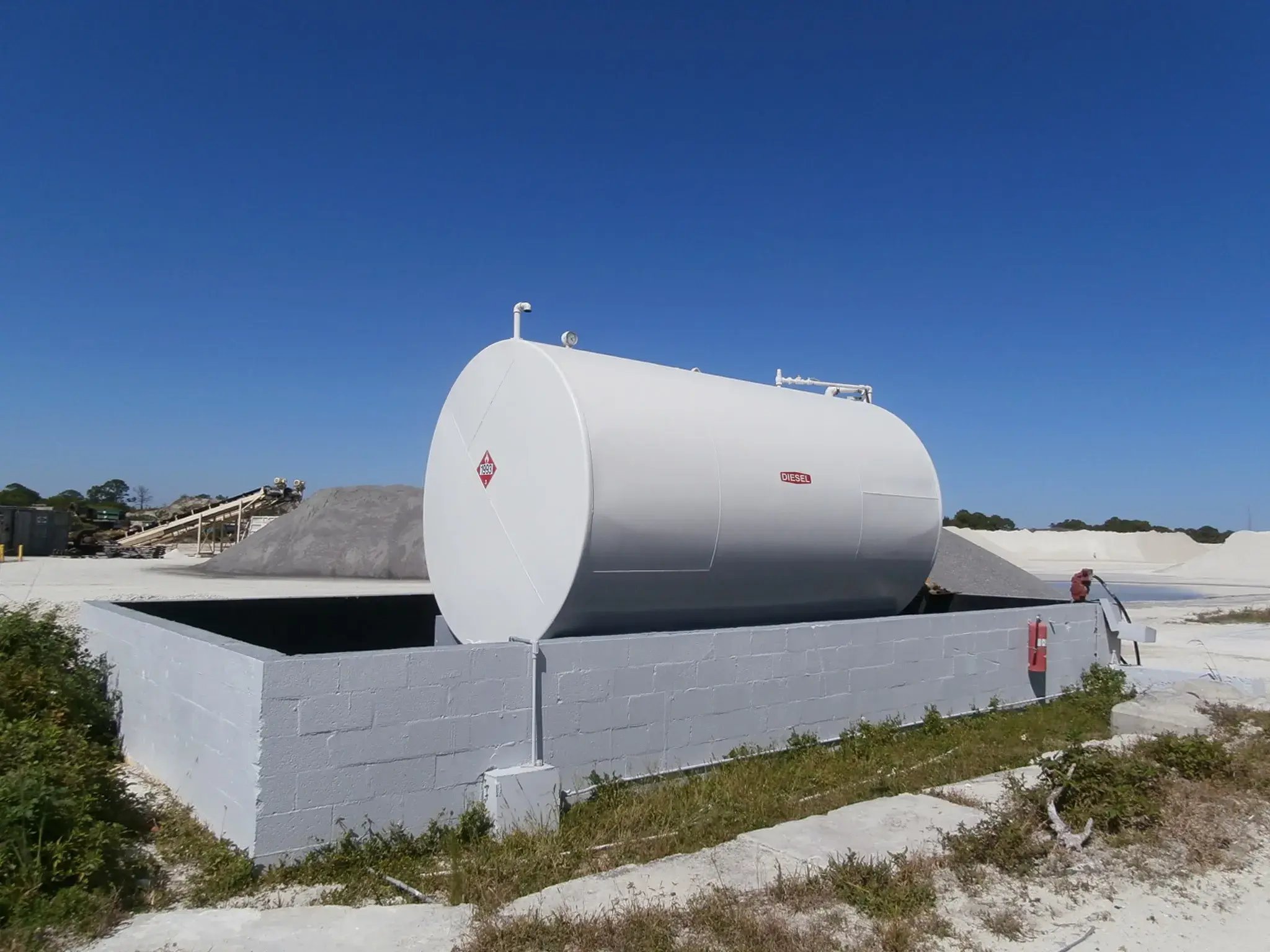
The rule that covers drums and totes is 40 CFR 112.8(c)(11), which deals with what EPA calls mobile or portable oil containers. It asks you to position these containers so a leak can't reach waterways, and to provide a secondary means of containment, such as a dike or catchment basin, big enough to hold the largest single container with enough freeboard for precipitation. EPA's inspector guidance names 55-gallon drums, totes, intermediate bulk containers (IBCs), and skid tanks as examples. Vegetable oil and animal fat are treated the same way, as we explain in our article on SPCC Plans for cooking oil, and the counting rules are in our piece on whether 55-gallon drums are included in SPCC Plans.
The requirement applies to every covered facility, large or small, attended or not. The containment also has to work when nobody's watching. EPA's guidance says engineered structures like dikes, curbs, and berms are the most effective way to contain oil, and that counting on someone to deploy absorbent pads after a spill is a risky way to handle a major container failure. Finally, the places where drums and totes sit, and where you dispense from them, belong on the facility diagram in your plan. A drum staged outside the marked storage area is easy for an inspector to spot, and it often has no containment at all.
How Does Containment Sizing Work for Drums and Totes?
Sizing is simpler for drums and totes than for a tank farm, because containment only has to hold the largest single container, not everything stored in the area. A spill pallet that cradles four drums needs to hold one drum's worth of oil, plus room for precipitation if it's outdoors.
| Setup |
What the containment has to hold |
| One pallet of drums, indoors |
55 gallons, the largest drum, plus whatever margin your plan uses |
| Four drums on one uncovered outdoor pallet |
55 gallons plus rain, which is roughly 14 gallons per inch on a pallet about 4.8 feet square |
| One 330-gallon tote outdoors |
330 gallons plus rain landing on the containment area |
| Two drums and a tote in one bermed area |
The tote's 330 gallons, plus rain if open to weather, plus allowance for the space the containers take up |
| Containers piped or manifolded together |
Their combined capacity, because EPA treats them as a single container |
Rain is where drum pallets usually fall short. If a pallet's sump is rated at 66 gallons and one 55-gallon drum is the largest container, you have about 11 gallons of freeboard, and a single heavy storm can use that up. You can put the pallet under a roof, pick one with a bigger sump, or keep the sump empty and keep records that show you check it. Inside a building, precipitation isn't a factor, and EPA's guidance says rain freeboard typically doesn't apply there.
Product labels can mislead. Many pallet and berm spec sheets cite 40 CFR 264.175, the container storage rule for permitted hazardous waste facilities, which sizes containment at 10% of total container volume or the largest container, whichever is greater. That's a different formula from the SPCC rule, so check the sump capacity against your own largest container and rain allowance instead of relying on the label.
How Do Spill Pallets and Spill Decks Work for Drums and Totes?
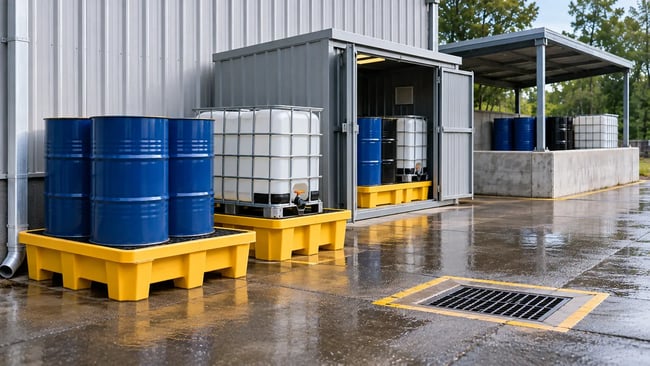
A spill pallet is a molded polyethylene or steel platform with a sump underneath and grating on top. Drums sit on the grating, and anything that leaks drains into the sump. They come in one-drum to six-drum sizes, and tote versions hold a single IBC. Sump ratings on the models we looked at ran from roughly 60 to 130 gallons for drum pallets and about 365 to 385 gallons for single-tote units, which gives a standard 330-gallon tote a modest margin.
Pallets are the lowest-cost, lowest-effort option, and they move when your storage does. Poly four-drum models ran roughly $425 to $730, and steel versions climbed to about $1,750. For small drum counts, dispensing points, and shops that shuffle drums around, a pallet is often all you need. The weak spots are capacity and discipline. A pallet only works if the drums are sitting on it, nothing overhangs the edge, and the sump is empty when a leak starts. Once you have more than a handful of drums, the cost and floor space of a dozen pallets add up, and a locker or berm starts to look like the better buy.
When Do Containment Lockers and Buildings Make Sense for Drums?
A containment locker or building is a prefabricated steel enclosure with a leak-tight sump built into the floor, lockable doors, and often ventilation and fire-rated walls. Sizes run from a two-drum unit up to buildings that hold sixteen or more drums. Because there's a roof, rain isn't part of the capacity question, and many facilities choose them because a fire code or an insurer pushes oil and other flammable liquids out of the main building and into a rated enclosure.
The cost is the catch. Catalog prices ran from about $13,900 for a four-drum non-combustible outdoor locker to roughly $33,700 for a sixteen-drum one, and fire-rated models went past $46,000. Freight, a pad or foundation, installation, and lead times of several weeks to several months come on top. That makes lockers a good fit for a steady stock of drums or flammable liquids, and a poor fit for the occasional drum. A listing that says it meets EPA requirements describes the product, not your facility, so confirm the sump holds your largest container and that any totes will fit through the door.
How Do Bermed Storage Areas Work for Drums and Totes?
A bermed area is a raised wall or curb around a section of floor or ground, with the containers inside it. Permanent berms are concrete pads with curbs or dikes built on site. Portable berms are lined frames, either collapsible-wall or rapid-rise, that you set out and take down. Bermed areas handle large container counts, mixed drum and tote sizes, and forklift traffic better than pallets, and the capacity scales with the footprint. Portable berms we found ran from roughly $600 for a small model holding about 180 gallons, to $2,400 to $2,800 for roughly 1,500 to 2,200 gallons, and $4,500 to $8,600 for roughly 4,500 to 7,400 gallons. Permanent berms depend on size, site prep, and drainage, so they take a contractor's quote.
Any berm open to the sky collects rain, and the rule expects you to manage it. Valves that drain diked areas have to be manual, open-and-closed types, not flapper-style. You inspect the accumulated water for oil before you release it, and you keep a record each time you drain. The floor and walls also have to hold oil until you clean up, which rules out bare soil, and EPA's guidance warns about untreated cinder block and loose, sandy material. With a portable berm, the wall lowered to drive a forklift in has to go back up whenever containers are stored.
What Does Indoor Drum Storage Need for Drain Protection and Containment?
Storing drums inside can serve as containment on its own. EPA's guidance allows a building to count as secondary containment when the walls, sealed floor, and doorways hold the oil. The catch is drainage. The containment can't have open floor drains or an automated sump pump unless the drainage system is equipped to treat a discharge, with something like a properly sized oil-water separator, because a floor drain can be a direct path to a storm sewer, a sanitary sewer, or a waterbody. Doorways and other openings that let a spill flow outside count, too.
Start by finding out where each floor drain goes. If you don't need a drain in the storage area, seal it permanently. If it has to stay open for washdown, set up a curbed or ramped zone that keeps oil away from it. Drain covers and mats are active measures that only work if a person places them in time. Absorbent pads and socks are backup, not the main plan: EPA's guidance puts a high-capacity pad at under 0.7 gallons, so a leaking 55-gallon drum would take close to 80 of them. Our article on when you have to report an oil spill covers what happens when oil does get outside.
How Do Drum and Tote Containment Options Compare by Cost, Capacity, and Best Use?
The table puts the options side by side. Prices are catalog prices for equipment we found in late 2026, before freight and installation, so treat them as ballpark figures and not as quotes.
| Option |
Typical capacity |
Rough equipment cost |
Best use |
Watch for |
| Spill pallet or deck |
About 60 to 130 gallons of sump for drums; 365 to 385 for one tote |
Poly four-drum about $425 to $730; steel up to about $1,750 |
Small drum counts, dispensing points, moving storage |
Rain in sumps, drums overhanging the edge |
| Containment locker or building |
Two to sixteen or more drums |
About $13,900 to $46,000 or more, before freight and install |
Steady drum stock, flammables, security and fire code needs |
Lead time, sump size, totes that won't fit |
| Portable berm |
About 180 to 7,400 gallons |
About $600 to $8,600 |
Temporary or changing storage, mixed drums and totes |
Rain, punctured liners, walls left down |
| Permanent curbed pad or dike |
Sized to the site |
Contractor's quote |
Long-term storage of many containers |
Drain valve records, cracks, failed joints |
| Indoor storage with drain protection |
The room's own capacity, once sealed |
Drain plugs are low cost; curbs and sealing are contractor work |
Sealed-floor maintenance rooms and warehouses |
Open floor drains, doorways, covers nobody deploys |
Hardware is only part of the cost. The plan that documents your containment is the other part, and it depends on how many containers and locations you have and whether the plan needs a Professional Engineer's certification. A Tier I SPCC Plan from RMA typically runs about $1,500 to $4,000, and complex PE-certified plans cost more. Our SPCC pricing calculator below gives you a number for your facility, and our article on the different types of SPCC Plans explains which kind you'd likely need.
What Do Inspectors Look for in Drum and Tote Containment?
An inspector, usually from EPA Region 3 in Pennsylvania, typically starts with your SPCC Plan and then walks the site to see whether the two match. For drums and totes, that means checking that the plan lists them, that storage and dispensing areas are on the diagram, that your inventory reflects what's on the floor, and that the containment holds the largest container. Round up when you count drums, since extra ones show up at most sites sooner or later. Our rundown of the top SPCC Plan violations and fines shows where facilities tend to get cited.
EPA's guidance gives inspectors a checklist for dikes and berms: cracks, discoloration, standing liquid, corrosion, erosion, drain valve condition, debris, rain sitting in the area, and drainage records. Expect the same eye on a pallet, with questions about a cracked sump, rust on a steel deck, or a drum parked half off the edge. Your own monthly checks should look for the same things, and our list of the top 10 things to do during monthly inspections makes a good template. Inspection records stay with the plan for three years.
Sometimes sized containment is impracticable, such as in a tight space or under a fire code constraint. Then a licensed Professional Engineer has to certify the plan, which must explain why, add integrity testing, include an oil spill contingency plan, and commit manpower, equipment, and materials. Cost alone doesn't qualify. Our article on professional engineers and SPCC Plan requirements explains when a PE comes into the picture.
How Do Fire Codes, Construction, and Pennsylvania Rules Affect Containment?
Fire codes are enforced locally and run alongside the SPCC rule. Many are built on NFPA 30, and they can limit how much flammable or combustible liquid you store in a building and where a locker can sit relative to structures and property lines. Your local fire marshal and insurer can tell you what applies, and requirements vary by municipality, so confirm yours before you buy a locker or move drums indoors.
On the state side, DEP's storage tank program under 25 Pa. Code Chapter 245 is written around stationary aboveground tanks over 250 gallons, so portable drums and totes generally sit outside tank registration. A tote that's hard-piped and left in one spot raises a closer question, so confirm yours with DEP. Pennsylvania's Storage Tank and Spill Prevention Act also calls for removing residual substances from the ground or affected waters within 15 days, one more reason to keep containment tight instead of leaning on soil.
The construction side is separate from what we do. A new concrete pad, a foundation for a locker, or a building for drums can require local building and fire permits, and depending on how much ground you disturb, Chapter 102 erosion and sediment control requirements can apply. We don't prepare those construction-phase permits or approvals. Your engineer, contractor, or an erosion and sediment control specialist handles them. Once the containment is built, you still need the operational pieces: an SPCC Plan that describes it, amendments when you change it, inspections, and training. That's where we help.
How Can RMA Help With Drum and Tote Containment?
If you're not sure whether your drums and totes put you over the SPCC threshold, we're happy to help you count them. Some facilities are under it and don't need a plan, and we'll tell you so. If you do need one, we review your inventory, work out the containment each container needs, document it in your plan, and tell you plainly when a pallet will do the job and when a locker or berm is worth the money. The hardware comes from spill containment suppliers and contractors, and when a plan needs a PE certification, we coordinate it through an outside PE. Initial SPCC training is free with a new RMA plan, and our online training library covers refreshers.
There's no pressure and no obligation. You can call, email, or fill out the form on our website, and a member of our team will follow up. If you'd rather start with a conversation about your site, you can contact RMA whenever it suits you.