A Practical Guide to Settling Basins, Stockpiles, Haul Roads, and Washing Under New Jersey's RSG Sand and Gravel Stormwater Permit
If you run a sand and gravel pit in New Jersey, rain does a lot of your sediment work for you, and not in a good way. It strips fines off stockpiles, carries silt down haul roads, and pushes cloudy water toward the edge of your property. The state regulates that water under a stormwater permit written specifically for sand and gravel operations, and keeping sediment where it belongs is the heart of that permit.
This guide covers what the RSG permit expects and how operators typically meet it, with practical detail on settling basins, stockpile stabilization, haul road runoff, and washing operations. We'll also cover how inspections and your written plan tie it all together. If you'd rather have someone walk your site and sort out where your controls stand, you can reach out to RMA at any point.
Table of Contents
TL;DR
New Jersey's RSG permit covers stormwater at sand and gravel operations that send their water to groundwater, not to a stream or ditch, so the whole idea is keeping sediment on your site. You do that with settling basins that are sized for fine silt and cleaned out on schedule, stockpiles that are shaped, bermed, and covered or seeded when idle, haul roads graded into the pit with a way to stop trucks from tracking material out, and wash water that's recycled instead of released. A written plan and regular inspections tie those controls together. The permit was renewed effective January 1, 2026, so work from the current version, not an old copy.
What Does the RSG Permit Cover at a New Jersey Sand and Gravel Pit?
The RSG is the Sand and Gravel Activity general permit, issued by the New Jersey Department of Environmental Protection (NJDEP). It's part of the New Jersey Pollutant Discharge Elimination System, or NJPDES, which is the state's version of the Clean Water Act permit program. One thing makes New Jersey different from most states: NJPDES regulates discharges to groundwater as well as discharges to streams and lakes. At a pit, that's a big deal, because a lot of the rain that falls on one soaks into the ground or collects in the excavation instead of running off.
NJDEP describes the RSG as authorizing stormwater discharges to groundwater at sand and gravel mining and quarrying operations that have no discharge to surface water. Sites that were once covered by the older Mining and Quarrying (R13) general permit but don't send water to a surface water body may be eligible for the RSG instead. NJDEP has also removed mining and quarrying from the Basic Industrial Stormwater (5G2) and construction (5G3) general permits, so an old authorization under either of those is worth checking. Our guide on which NPDES permit you need lays out how those categories fit together, and our overview of stormwater associated with industrial activity explains why a pit counts as an industrial site in the first place.
Where your water goes decides everything. If your pit floor catches all its own runoff and the rest stays inside your boundary, the RSG is a natural fit. If a haul road ditch or a settling pond overflow reaches a stream, you're outside what the RSG covers, and you'd be looking at a different category or an individual permit. Our article on individual NJPDES industrial permits covers that path. NJDEP renewed the RSG with an effective date of January 1, 2026, and posted a minor modification in January 2026, so pull the current text from NJDEP's website before you build or revise anything.
What Does the RSG Permit Expect for Sediment Control and Your SPPP?
The expectation, as NJDEP has described it, is simple to state and harder to meet: stormwater stays on site and doesn't reach surface water. Sediment is the pollutant that gets out of a pit most easily, which is why NJDEP has named mining and quarrying, including sand and gravel, among the industries it watches most closely. Inspectors from NJDEP and, in many cases, soil conservation districts look at what's on the ground, so the controls have to be visible and working.
The permit asks for a Stormwater Pollution Prevention Plan, which New Jersey calls an SPPP. It's the same idea as the SWPPP you'll see in other states, and our explainer on what a stormwater pollution prevention plan is covers the basics. For a pit, the plan maps your working areas, shows where water flows, identifies where sediment comes from, and describes the best management practices, or BMPs, you use to hold it back. NJDEP's renewal outreach points to structural BMPs and sizing calculations as part of what the plan should show, and the exact contents are spelled out in the current permit, so treat that document as your checklist. If BMPs are new to you, we've covered what stormwater BMPs are in plain terms.
NJDEP's renewal presentation also describes the permit as having no monitoring section. That doesn't mean there's less to prove. With no sampling results to point to, your BMPs are judged by what an inspector sees: a basin with room left in it, a stockpile that isn't slumping toward a property line, a clean exit onto the public road. The table below shows where sediment typically escapes at a pit and what usually keeps it in. These are common operating practices, not a quote of permit text, so your SPPP and the current permit have the final say.
| Area of the Pit |
How Sediment Leaves |
What Usually Keeps It On Site |
| Settling basins and ponds |
Overflow when full of fines or undersized |
Enough capacity, baffles, scheduled cleanout, overflow routed to a controlled area |
| Stockpiles |
Rain erosion of pile faces, runoff downslope, wind |
Stable slopes, perimeter berms, setbacks from boundaries, cover or seeding on idle piles |
| Haul roads and exits |
Concentrated flow down the road, material tracked onto public roads |
Grading toward the pit or a basin, clean stone surface, tracking pad, sweeping |
| Wash plant |
Silt and clay in wash water |
Closed-loop recycling through settling ponds, no release to surface water |
| Exposed faces and bare ground |
Gully erosion, slope failure |
Drainage turned inward, stabilization of inactive areas |
How Should Settling Basins Work at a Sand and Gravel Pit?
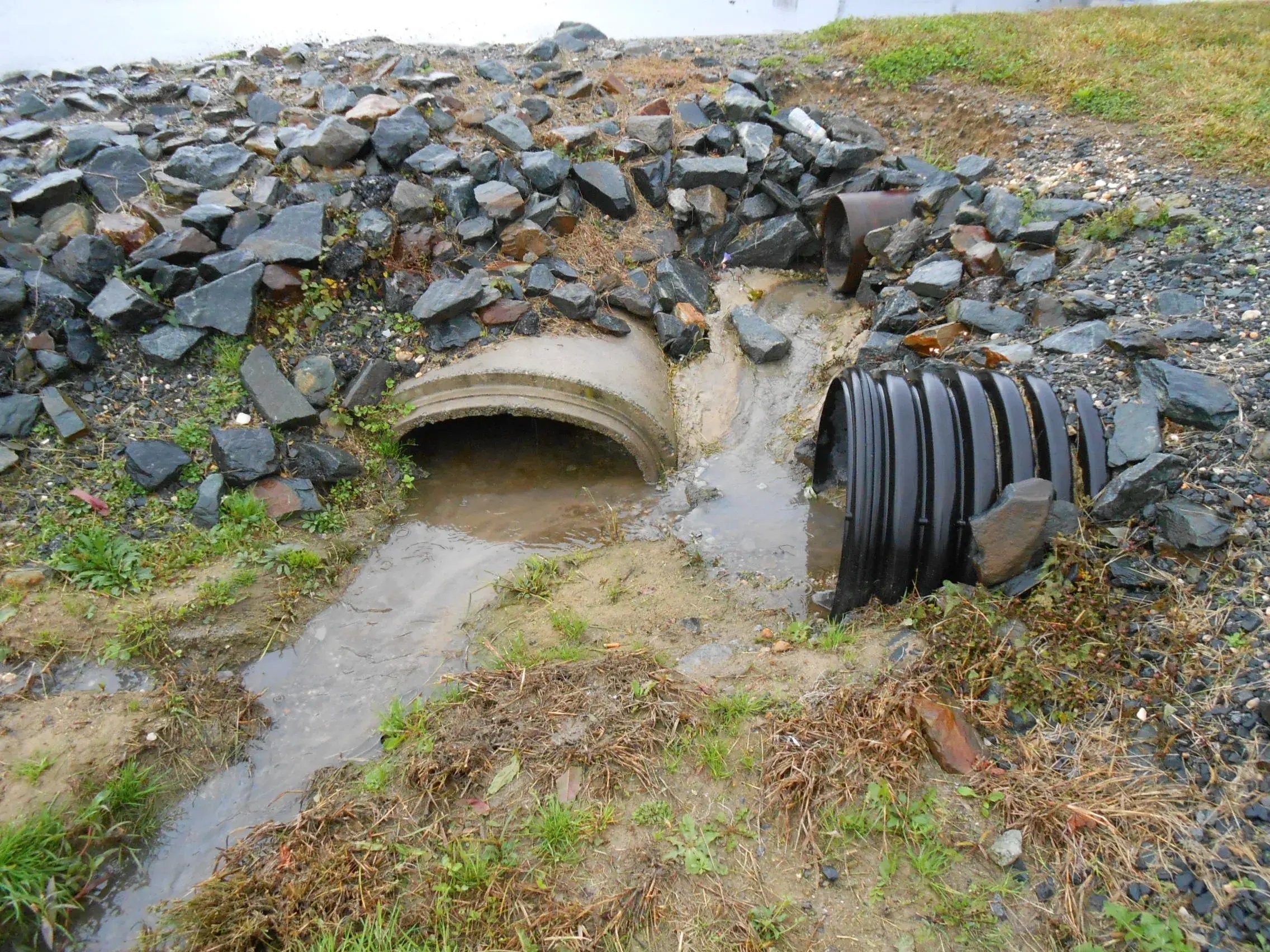
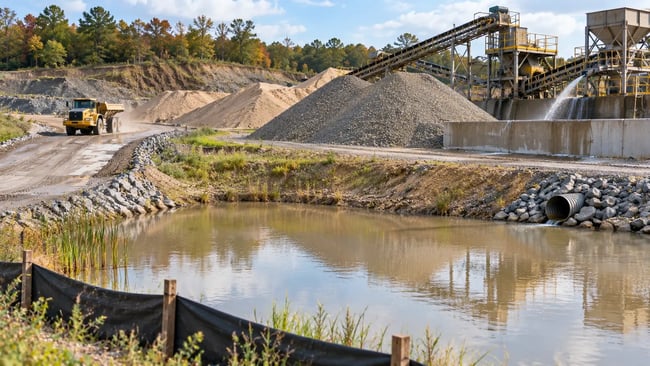
Sand and gravel operators have an advantage most industrial sites don't: the pit itself is a very large basin. Coarse material drops out of water almost immediately, so a pit floor or a simple pond handles the sand fraction without much help. The trouble is the fines. Silt and clay can stay suspended for hours or days, and they're the particles that turn a pond overflow cloudy. A basin that looks fine for sand can still fail for silt, so size and manage it around the finest material you're trying to hold.
A few habits separate basins that work from basins that don't. Give water a long path from inlet to outlet, or add baffles, so it can't shortcut across the surface. Keep the outlet well away from where water enters. Leave room for an excavator to reach every part of the basin, because a basin you can't clean out gets cleaned out never. Then clean it before it fills, not after, and write down when you did. A basin that's half full of settled fines has half the capacity your plan assumed, and the first big storm will show it.
Where basins are meant to soak water into the ground, watch the bottom. Fines seal infiltration surfaces over time, and a basin that stays wet for days after a rain is telling you it needs attention. Designing a new or enlarged basin, including the sizing calculations, is usually a job for your engineer. We help make sure what's built matches what your SPPP says and what the permit expects. If you're planning to expand, our guide on how long a New Jersey stormwater permit takes will help you plan around approval time.
How Do You Stabilize Sand and Gravel Stockpiles Under the RSG?
Stockpiles are the most visible sediment source at a pit, and they're also the easiest to fix because you control where they go. Start with placement. Keep piles away from property lines, drainage paths, and the lip of the excavation, and don't stack material where runoff from higher ground will run through it. A pile built across a drainage line becomes its own channel the first time it rains hard.
Shape matters next. Piles built at their natural angle of repose hold together far better than steep, overbuilt ones, and a perimeter berm or a line of stone at the toe catches whatever does slump or wash off. For finished products that move quickly, that may be all you need. For fines, sand, and soil blends, which move more easily with both water and wind, consider keeping them in bins or against walls and covering them when they won't be moved soon.
Material that sits is where stabilization pays off. A stockpile that won't be touched for weeks can be covered, or seeded and mulched, so rain isn't hitting bare fines. Sites that rotate their stockpile locations should note that in the SPPP, because a plan that shows piles where they were three years ago doesn't help an inspector or your own crew. When a pile is hauled away, check the footprint too. The ground underneath is often loose and bare, and it needs stabilizing or grading back into the pit's drainage.
How Do You Control Haul Road Runoff and Tracking at a Sand and Gravel Pit?
Haul roads do two jobs at once: they move trucks and they move water. A road that slopes toward the property boundary will carry sediment there, and a road with no crown or cross-slope will turn into a channel in the first heavy rain. The fix is mostly grading. Shape roads so that runoff turns back toward the pit or toward a basin, add water bars or cross drains where a long grade gives water room to build speed, and keep the surface in good repair so ruts don't become gullies.
A clean stone surface on frequently used roads cuts down on the fine material trucks pick up and drop, and it holds up better in wet weather than bare dirt. At the exit, a stone tracking pad, or a rumble-type stabilized entrance, knocks material off tires before trucks reach the public road. NJDEP's renewal outreach lists minimizing tracking among its BMP topics, and it's an easy thing for an inspector, or a neighbor, to see. Pair it with a sweeping routine for the public road at the entrance and a note in your records when it's done.
Dust and sediment are related problems, since the same fines that blow off a dry road wash off a wet one. Watering roads during dry stretches helps, but watch that you aren't creating a muddy runoff problem of your own. Check roads after heavy storms, not just on a schedule, because damage shows up fast and gets worse with every truck that crosses it.
How Should Washing Operations and Process Water Be Handled Under the RSG?
Wash water is process water, not stormwater, and the two are treated differently. Stormwater is rain that runs across your site. Process water is water your operation uses, such as wash plant water, slurry, and truck or equipment washdown. NJDEP's renewal outreach states that process water can't be discharged to surface water bodies under the RSG. Our article on the difference between stormwater and process water explains where the line falls.
In practice, the standard approach for a wash plant is a closed loop. Water goes through the plant, flows to a series of settling ponds where the silt and clay drop out, and returns to the plant to be used again. Make-up water replaces what leaves with the product and what evaporates. The ponds are your sediment control for the whole washing operation, so they need the same attention as any basin: capacity, baffling, and scheduled cleanout. Sludge from those ponds has to go somewhere too, so plan where it's dried and stored, and keep that area out of any stormwater path.
Vehicle and equipment washing is its own topic. NJDEP's renewal outreach includes vehicle and equipment washing among its BMP topics, including washing indoors where practicable. If a wash pad is outside, it shouldn't drain to a stormwater path or off site. The permit's treatment of process water is specific, and not every wash setup fits neatly, so read that part of the current text closely. If your operation sends any water anywhere other than back through your own ponds, ask NJDEP or us whether it fits under the RSG before you assume it does.
How Do Inspections and Records Keep RSG Sediment Controls Working?
Controls only work while they're maintained, and the paperwork is how you show that they are. Walk the site on a routine schedule and after significant storms, looking at basins, berms, stockpile faces, the haul road, and the exit. Write down what you saw and what you fixed. A short log with dates, observations, and corrective actions does more for you in an inspection than a long plan nobody follows. Our guide to doing a stormwater visual inspection the right way walks through what a good one looks like.
Pits change constantly. Working faces advance, stockpile locations move, new haul roads get cut, and ponds are relocated. Your SPPP has to keep up, so build a habit of updating it when the site layout changes instead of waiting for an annual review. The specific inspection frequencies, certification steps, and any annual paperwork come from the permit text, and they can differ between permit categories, so confirm them in the current RSG. Staff training is part of keeping this working, and we've covered whether stormwater training is required if you're not sure what applies to your crew. You can also find our online environmental training library useful for getting staff up to speed.
Most RSG problems we see aren't dramatic. They're a basin nobody cleaned, a plan that doesn't match the site anymore, or a log that stops in the spring. Our article on common NPDES permit problems covers the usual ones. Fixing any of them takes less time and money than answering a notice of violation.
How Can RMA Help With RSG Sediment Control and Your SPPP?
We're based in New Jersey and work with NJDEP's permit categories regularly, including the mining and sand and gravel permits. We can help you figure out whether the RSG is the right fit for how your site drains, prepare or update your SPPP so it matches what's on the ground, build an inspection routine your crew can keep up, and train your staff to run it. If your pit has changed since the plan was written, a site review is often the fastest way to see where it stands.
A couple of limits worth knowing. We don't design or engineer basins, and we don't prepare construction-phase or site development approvals for a new or expanded pit. Your engineer and the right local agencies handle those. Once the operation is running, the operational permits and plans are where we help, and we can point you toward the right people for the construction side. There's no pressure and no obligation. You can call us, email us, or fill out the form on our site, and if you're not sure we're the right fit, we'll tell you. When you're ready, contact RMA and we'll start with a conversation about your site.