Signs Your Oil Spill Plan Has Outgrown Your Team, and the Kind of SPCC Help That Fits Each One
If your New Jersey facility stores oil, you either have a Spill Prevention, Control, and Countermeasure (SPCC) plan or you're supposed to. It's the federal oil spill plan EPA requires once a facility stores more than 1,320 gallons of oil aboveground. Plenty of facilities write the plan, put it in a binder, and don't think about it again until something forces the issue. The plan only protects you when it matches the site you have today, and sites change faster than binders do.
This article walks through the situations where we see facilities get stuck, from crossing the storage threshold to a phone call from EPA, and explains what kind of help fits each one. Some of them call for a full plan rebuild. Some call for an hour on the phone with someone who knows the rule, and a few call for no consultant at all. If you're already in one of these spots, you can reach out to RMA and we'll tell you plainly whether you need us.
Table of Contents
TL;DR
A New Jersey facility needs outside help with its SPCC plan when it crosses the 1,320-gallon storage threshold, adds tanks or generators, misses its five-year review, has a spill, hears from EPA, or loses the person who understood the plan. The right help ranges from a short plan review to a full rebuild with a Professional Engineer's certification. A facility with a current plan, trained staff, and no changes on site may not need a consultant at all.
How Do You Know Your New Jersey SPCC Plan Needs Outside Help?
The signs below are the ones we see most often, and each comes with the kind of help that fits.
Two quick definitions first. SPCC is the federal rule at 40 CFR Part 112, and EPA Region 2 enforces it in New Jersey. New Jersey adds its own layer on top. The Spill Compensation and Control Act (the Spill Act) governs spill reporting and cleanup liability, and larger "major facilities" must also have Discharge Prevention, Containment and Countermeasure (DPCC) and Discharge Cleanup and Removal (DCR) plans under N.J.A.C. 7:1E, which NJDEP administers. Whether your facility counts as a major facility depends on its total storage capacity and what it stores, so check the rule against your own inventory. Our guide to SPCC plans in New Jersey covers the basics, and this article focuses on the moments when basics aren't enough.
Your Facility Just Crossed the SPCC Threshold
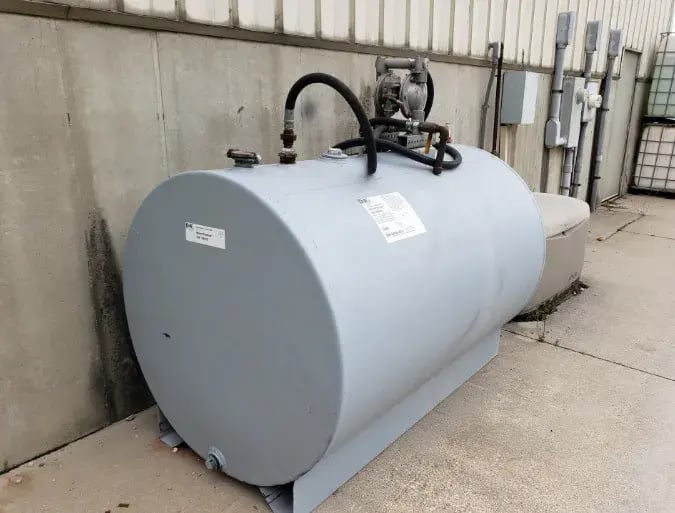
The federal trigger is more than 1,320 gallons of oil stored aboveground, counting only containers of 55 gallons or more, or more than 42,000 gallons of completely buried oil storage. The count uses container capacity, not what's in them on a given day, so a 5,000-gallon tank that's usually half full counts as 5,000. Oil-filled equipment such as hydraulic systems and transformers counts too, and so do used oil and vegetable oil. Propane doesn't.
The other half of the test is whether a spill could reasonably be expected to reach navigable waters, and you can't count manmade structures like a berm or storm drain system as stopping it. Because New Jersey storm drains empty into creeks, rivers, and wetlands almost everywhere, most facilities over the volume line meet this test too. The rule expects the plan to be prepared and implemented before the oil storage goes into service, so crossing the line without one is already a gap.
The help that fits here is a plan written from scratch. A consultant can add up your storage correctly, confirm the rule applies, and decide which kind of plan you need. A facility with 10,000 gallons or less of aboveground storage and a clean spill history can often self-certify, while larger or more complicated facilities need a plan reviewed and certified by a Professional Engineer. Our article on the basics of SPCC plans explains what the finished plan covers.
You're Adding Tanks, Generators, or Oil-Filled Equipment
Any change in design, construction, operation, or maintenance that materially affects your chance of a discharge means the plan needs an amendment. Under 40 CFR 112.5, you have six months to prepare the amendment and another six months to put it into practice. Adding a tank, moving a fuel station, swapping a generator, changing the piping, enlarging or removing containment, and starting to store a new kind of oil are all examples. Technical amendments generally need a Professional Engineer's certification unless the facility qualifies to self-certify.
Generators are the most common trigger we see, especially at data centers and manufacturers adding backup power. A generator with a belly tank adds oil to your total, and it can raise air permit questions for emergency backup generators as well. The installation itself is a separate matter. Tank and generator work typically needs local construction and fire permits under the Uniform Fire Code, enforced by your municipality, and underground tanks must be installed by NJDEP-certified contractors under N.J.A.C. 7:14B. We don't prepare construction-phase permits or approvals, and your engineer or contractor will handle those, though we can point you toward the right people. What we handle is the operational side: updating the SPCC plan, and DPCC or DCR plans if you're a major facility, so they're in place when the equipment starts running.
If we wrote your plan, we'll amend it. If someone else wrote it, we'll read it and tell you whether it can carry the changes. In most cases we'd rebuild it, because we can only stand behind a plan we've built and examined ourselves.
Your SPCC Plan Is Overdue for Its Five-Year Review
Every SPCC plan has to be reviewed at least once every five years, and the review has to be documented with a signed statement saying whether you'll amend the plan. If the review turns up field-proven technology that would significantly reduce your discharge risk, you amend within six months. A missing statement is easy for an inspector to spot. Our articles on what to do when a plan is over five years old and on whether to update, renew, or redo at the five-year mark go deeper on the options.
A review is only as good as the comparison behind it. A plan that was accurate in 2018 and describes six tanks isn't helped by a signature if you now have nine. If nothing has changed and your records are in order, your own team may be able to do the review. If the site has changed, the plan was written by someone you can't reach, or the certification is old, a consultant should compare the plan to the facility and tell you whether it can be updated or needs a rebuild.

Your Facility Had an Oil Spill
If a spill is happening right now, safety comes first. Get people clear of fire, vapor, and slip hazards, call emergency services if anyone is at risk, and stop the source if you can do it safely. The plan can wait an hour.
Once things are under control, reporting comes next. Federally, an oil discharge that reaches navigable waters or causes a sheen must be reported to the National Response Center, and our article on the sheen rule explains the trigger. New Jersey has its own duty under the Spill Act to report discharges to NJDEP, and the current hotline number is on NJDEP's website. Spill Act liability for cleanup costs is strict and can be joint and several, so an environmental attorney is a reasonable call if the spill is significant. Cleanup beyond a minor spill typically involves a Licensed Site Remediation Professional (LSRP), and that work is separate from the plan.
The SPCC rule adds its own requirement. Under 40 CFR 112.4, a facility that discharges more than 1,000 gallons in one event, or more than 42 gallons in each of two events within twelve months, must send EPA's Regional Administrator the cause, a failure analysis, and its planned prevention steps within 60 days. A spill of that size also affects your plan type, because self-certification requires no discharge over 1,000 gallons, and no two over 42 gallons within a year, in the prior three years. That can push a self-certified facility into needing a Professional Engineer's certification. We help with the failure analysis, the plan changes, and the containment, inspection, and training fixes that keep the next spill from happening. The cleanup belongs to your LSRP and spill response contractor.
EPA Called, Wrote, or Scheduled an SPCC Inspection
EPA Region 2 can inspect a New Jersey facility, ask for its plan, inspection records, and training records, and send an information request letter. Inspections often follow a spill, a tip, or a regional initiative targeting an industry. Our article on who enforces SPCC plans describes how the process usually unfolds, and the most common SPCC violations and fines show where inspectors usually find problems.
Under the inflation-adjusted figures in 40 CFR Part 19, for penalties assessed on or after January 8, 2025, Clean Water Act administrative penalties for oil violations run up to $23,647 per violation for Class I cases (capped at $59,114) and up to $23,647 per day for Class II cases (capped at $295,564), and judicial penalties are higher. These numbers adjust yearly, so check the current table. If you've received a notice of violation or a penalty proposal, bring in an environmental attorney before you respond, because they can handle the legal side while we handle the technical one.
If you're facing an inspection or already responding to one, we can read your plan and records the way an inspector would, tell you where the gaps are, and help you fix the facility and the paperwork. We won't backdate inspection logs or paper over problems, and neither should anyone else. It's also the wrong move legally.
Nobody on Staff Understands the SPCC Plan
This one is quieter than a spill but just as common. The person who wrote or managed the plan retires, changes jobs, or moves to another site, and what's left is a long document with no owner. The plan itself is only the start. Facilities also have to do monthly and annual inspections, keep signed inspection records for three years, drain diked areas properly, and brief oil-handling staff on spill prevention at least once a year. If none of that is happening because nobody knows it's required, you can be out of compliance with a perfectly good plan sitting on the shelf.
The help that fits can be light. A consultant can walk the site with your team, explain each requirement in plain language, set up inspection forms that match your equipment, and train staff. Our guides to monthly SPCC inspections and annual SPCC training help you get started, and our online training library covers staff briefings. If the plan doesn't match the site, a rebuild may be the better fix.
Other Signs Your SPCC Plan Needs Professional Help
A few other situations send facilities to a consultant, and most don't look like emergencies at first. Buying, leasing, or taking over a site is one. Existing SPCC obligations can come with the property, and the previous owner's plan rarely reflects how you'll operate. A lender or insurer asking for proof of compliance is another, and our article on why insurers ask about SPCC plans explains what they usually want to see.
Plans built from a template, copied from another site, or generated by software deserve a close look, because they tend to describe containers you don't own and skip the ones you do. We tested that in our piece on whether AI can write an SPCC plan, and we don't use AI to produce client deliverables. Secondary containment is another frequent trouble spot. If nobody ever calculated whether your dikes, curbs, or containment pallets hold the required volume, our guide to sizing SPCC containment shows what the math involves.
What Kind of SPCC Help Fits Each Situation?
This table matches common situations to the help that usually fits. Your own situation may sit between two rows, which is normal.
| Your Situation |
Help That Usually Fits |
| Just crossed 1,320 gallons |
New plan |
| Adding tanks or generators |
Amendment or rebuild |
| Overdue five-year review |
Plan assessment, then update or rebuild |
| Spill |
Plan review and prevention fixes |
| EPA contact |
Gap review and corrective work |
| Nobody understands the plan |
Walkthrough and training |
| New site, lender, or insurer request |
Plan review |
One piece shows up in many of these rows. Unless your facility qualifies for self-certification, a Professional Engineer has to review and certify the plan, which means visiting the site and attesting that the plan follows good engineering practice. Our article on Professional Engineers and SPCC plan requirements explains when that applies, and when we take a project on, we line up the PE review and certification as part of it. If you're wondering what working with a consultant is like, we described the experience of hiring an SPCC consultant in a separate article.
What Does Outside SPCC Help Cost?
SPCC plans from RMA generally run from $2,500 to $15,000. Where a facility lands in that range depends on total storage capacity, the number and type of containers, whether a Professional Engineer's certification is needed, whether the secondary containment needs evaluating, and how many buildings or yards the plan has to cover. If you're a New Jersey major facility, DPCC and DCR plans are a separate piece of work, and the cost depends on your storage capacity and the hazardous substances you keep. Our article on what drives SPCC plan costs breaks it down further.
The cheapest quote is rarely the best deal. A plan that skips the site visit or the containment math looks fine until an inspector reads it, and compared with the penalty figures above, fixing a weak plan costs far more than building a good one. The calculator below shows what RMA's help would cost for your facility, based on the details you enter.
When Can You Handle Your SPCC Plan Without a Consultant?
Some facilities don't need us, and we'd rather say so. If your plan is less than five years old, your site matches the diagrams, your inspections are logged, your staff gets briefed every year, and you're a qualified facility with 10,000 gallons or less of aboveground storage, you may be able to keep the plan current on your own. Our article on when to update your SPCC plan and whether you can do it yourself lays out the line.
A new tank, a spill, a missed review, or a lost point person each means the answer may have changed. A short conversation with a consultant costs little compared with finding out during an inspection.
How Does RMA Help New Jersey Facilities With SPCC Plans?
We're a family-run firm based in New Jersey, and we've been helping facilities with environmental compliance since 1992. Senior staff do the work on your plan. We know NJDEP's rules and the way EPA Region 2 approaches inspections, and we'll tell you up front if a simpler option fits better than hiring us. We can help you figure out which of the situations above you're in, build or rebuild the plan, line up the Professional Engineer's review when it's needed, and set your team up to keep it running.
There's no obligation in starting a conversation. You can call us, email us, or fill out the form on our website, and we'll go over your site and tell you what we'd do. If you're not sure where to begin, contact RMA and ask. We'd rather answer a question now than help you sort out a problem later.