SPCC Training for New Jersey Oil-Handling Employees: Who Needs It, What It Covers, and How to Document It
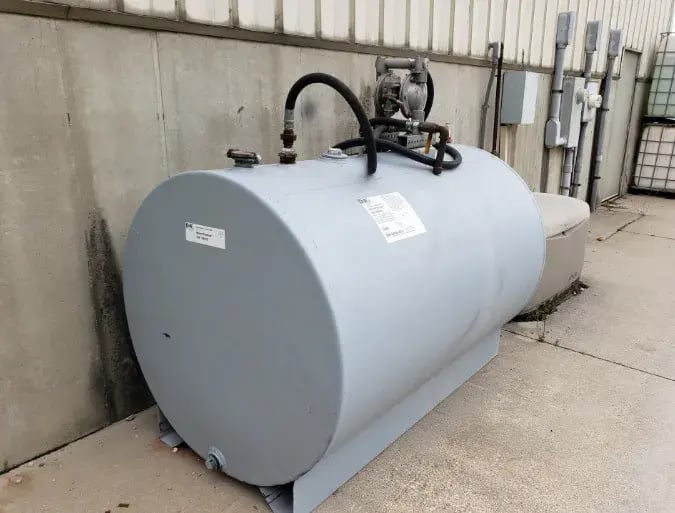
If your facility stores oil in New Jersey, there's a good chance you're subject to a Spill Prevention, Control, and Countermeasure (SPCC) Plan, the federal oil spill prevention plan EPA requires for facilities that store more than 1,320 gallons of oil aboveground, counting containers of 55 gallons or more. The plan comes with a people requirement: employees who handle oil have to be trained on it, and someone has to run a discharge prevention briefing at least once a year.
The short answer is yes. Oil-handling employees need training on equipment operation and maintenance, discharge procedures, applicable pollution control laws, general facility operations, and the contents of your plan, and they need a discharge prevention briefing every year. New Jersey adds a stricter training layer for its larger "major facilities." Below we cover who counts as oil-handling personnel, what good training includes, a sample agenda you can adapt, how to document it all, and where New Jersey's own rules come in. If you'd rather talk it through with someone, feel free to reach out to RMA at any point.
Table of Contents
TL;DR
Yes. Under the federal SPCC rule, anyone who handles oil at your facility has to be trained on how to prevent discharges, what to do if one happens, the laws that apply, and what's in your SPCC Plan. You also have to hold a discharge prevention briefing at least once a year and name one person who's accountable for spill prevention. New Jersey facilities that qualify as major facilities have an additional written training program with yearly refreshers. Whatever you do, write it down, because training you can't show is hard to defend in an inspection.
What Does the SPCC Rule Require for Annual Employee Training?
The training requirement lives in 40 CFR 112.7(f), and it has three parts. First, you have to train your oil-handling personnel on five topics: operating and maintaining equipment to prevent discharges, discharge procedure protocols, the pollution control laws and regulations that apply, general facility operations, and the contents of your SPCC Plan. Second, you have to designate one person at the facility who's accountable for discharge prevention and who reports to facility management. Third, you have to schedule and conduct discharge prevention briefings for your oil-handling personnel at least once a year, so they understand the plan for that specific facility.
It helps to notice what the rule leaves out. There's no minimum number of hours, no required curriculum, no list of approved trainers, and no required format. That flexibility is convenient until an inspector decides your training wasn't enough, and the rule gives you no checklist to point to. In New Jersey, EPA Region 2 enforces SPCC, and the rule's own words (accountable person, annual briefing, plan-specific understanding) are the standard they'll hold you to. Our article on who enforces SPCC plans covers how that plays out, and our post on annual SPCC training covers the basic question.
Training and the annual briefing are two different things. Training happens when someone starts handling oil. The briefing is a recurring check on the plan. A yearly slideshow doesn't cover a new hire who fueled equipment alone from March until the next session.
Who Counts as Oil-Handling Personnel at Your Facility?
The rule never defines the term, but EPA has. Its guidance says oil-handling personnel is interpreted according to industry standards and includes employees who operate and maintain oil storage containers or the equipment related to them, plus emergency response personnel. It excludes secretaries, clerks, and others who are never involved in operation or maintenance of oil storage or equipment, oil transfers, emergency response, countermeasures, or similar activities. In plain words, if someone touches your oil, your oil equipment, or your spill response, they're on the list.
| Role |
Train? |
Why |
| Fuel transfer and tank filling operators |
Yes |
They run oil transfers and watch container levels. |
| Maintenance staff who service oil-filled equipment |
Yes |
Hydraulic systems, compressors, and transformers can all leak. |
| Whoever performs your tank and containment inspections |
Yes |
They're the first to spot a problem. |
| Spill response team members |
Yes |
EPA names emergency response personnel specifically. |
| Supervisors and the designated accountable person |
Yes |
They run the program and make the calls during a spill. |
| Contractors who handle oil on your site |
Usually |
Train them, or get written confirmation of equivalent training. |
| Office staff who never touch oil, transfers, or response |
Generally no |
EPA specifically excludes personnel with no role in these activities. |
Two gray areas come up a lot. Vegetable oil counts under SPCC along with hydraulic and lubricating oil, so food service employees who handle bulk cooking oil may belong on your list. Fuel delivery drivers work for your supplier, but they connect hoses to your tanks, so a short orientation on your fill procedures is cheap insurance. When you can't decide whether someone counts, train them. An extra hour of someone's time costs far less than explaining to an inspector why the person who caused a spill was never briefed.
What Should SPCC Training Cover for Oil-Handling Employees?
The rule gives you five topics, and each one translates into something specific at a real facility.
| Rule topic |
What it looks like at your facility |
| Operation and maintenance of equipment to prevent discharges |
How your tanks, valves, pumps, and containment work, how to fill and transfer without overfilling, and how to drain rainwater from containment safely. |
| Discharge procedure protocols |
Who to tell first, how to stop the source if it's safe, where spill kits are, and who makes the outside calls. |
| Applicable pollution control laws, rules, and regulations |
The federal SPCC rule, New Jersey's Spill Act reporting duties, and any state program that applies to your site. |
| General facility operations |
Where oil is stored and used, how drainage flows, and which nearby storm drains and waterways are at risk. |
| Contents of the SPCC Plan |
Where the plan is kept, the container list and site diagram, secondary containment, inspection schedules, and the contact list. |
The annual briefing has its own content requirement. The rule says it has to highlight and describe any known discharges and any failures or malfunctioning components, along with any precautionary measures you've developed recently. That means you can't reuse last year's slides unchanged. If a valve leaked in June or a containment dike needed repair, the briefing should cover what happened and what changed.
Good training also matches the audience. A forklift operator who tops off a day tank needs hands-on detail about that tank, its fill procedure, and where the spill kit sits. A plant manager needs the regulatory picture and the reporting steps. We go deeper in what SPCC training should include. Online courses can work for the general material when you pair them with a facility walkthrough, and our post on doing SPCC training online explains the tradeoffs.
What Does a Sample SPCC Training Agenda Look Like?
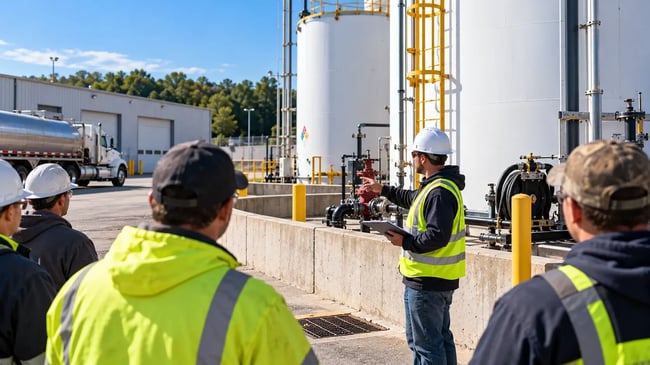
Here's a 75-minute agenda that hits every item in the rule and includes the annual briefing content. Treat it as a starting point. Swap in your own tank names, locations, and incidents, and trim it for experienced staff who only need the annual refresh.
| Time |
Segment |
What gets covered |
| 0 to 5 min |
Welcome and purpose |
Why the facility has an SPCC Plan, who the designated accountable person is, and where the plan is kept. |
| 5 to 15 min |
Rules that apply |
The federal SPCC rule, New Jersey's Spill Act reporting duties, and DPCC/DCR requirements if the facility is a major facility. |
| 15 to 30 min |
Plan walkthrough |
Oil types and container capacities, the site diagram, secondary containment, and drainage paths. |
| 30 to 45 min |
Routine handling |
Loading and unloading, transfers, overfill prevention, inspection duties, and draining containment. |
| 45 to 55 min |
Discharge response |
Stop, contain, and report. The contact list, spill kit locations, and who calls whom. |
| 55 to 65 min |
Year in review |
Known discharges, equipment failures, near misses, and any new precautionary measures. |
| 65 to 75 min |
Questions and sign-off |
A short quiz or scenario, questions, and the sign-in sheet. |
A few small choices make the session better. Hold the plan walkthrough on site if you can, standing at the tanks instead of showing photos of them. Ask people to explain what they'd do if the transfer hose let go, because that exposes gaps faster than a lecture does. And fold your monthly inspection routine into the handling segment so people know what the inspector is looking for. Our list of the top 10 things to do during SPCC monthly inspections is a good companion for that segment.
How Do You Document SPCC Training and Annual Briefings?
Inspectors commonly ask to see training records, and from their side of the table, training you can't show is hard to tell apart from training that never happened. The SPCC rule doesn't prescribe a form, and it doesn't set a retention period for training records the way it does for inspections. The rule does require inspection and test records to be kept with the plan for three years, and keeping training records for at least that long is a sensible match. EPA's sample plan template includes an appendix for recording discharge prevention briefings and training, so a log kept alongside your plan is the format regulators already expect to see.
| What to record |
Why it helps |
| Date, location, and length of the session |
Shows the annual briefing happened inside the year. |
| Trainer's name and qualifications |
Shows who delivered it and that they knew the material. |
| Signed attendee list with job titles |
Connects each oil-handling employee to a session. |
| Agenda, slides, or course certificate |
Proves the five required topics were covered. |
| Notes on discharges, failures, and new measures discussed |
Satisfies the annual briefing content requirement. |
| Name of the designated accountable person |
Shows the rule's second requirement is met. |
Don't overlook new hires and people who change jobs. A one-time training for someone who just started handling oil gets its own entry, dated when it happened. If your facility has a lot of turnover, the easiest fix is a short onboarding module that every new oil handler completes in their first week, logged the same way as the annual session. And when a plan gets updated, say after a tank is added or containment is changed, brief the affected employees on the change and log it. Our post on why employees need annual SPCC training makes the case for treating this as an ongoing habit instead of a yearly chore.
Do New Jersey's DPCC and DCR Rules Add Training Requirements?
For some facilities, yes. New Jersey has its own oil and hazardous substance discharge rules under N.J.A.C. 7:1E, and they apply to "major facilities." A major facility has to prepare a Discharge Prevention, Containment and Countermeasure (DPCC) plan and a Discharge Cleanup and Removal (DCR) plan, and submit them to the New Jersey Department of Environmental Protection (NJDEP) for approval. Whether your site counts as a major facility depends on its total storage capacity and what it stores, so check N.J.A.C. 7:1E against your own inventory. Many facilities with an SPCC Plan are not major facilities, but a good number are.
If yours is one, the training rule is more detailed than the federal one. N.J.A.C. 7:1E-2.12 requires a written training program for employees who handle hazardous substances, which includes petroleum. The program has to set minimum in-house training time for each position, cover job-specific training for new or newly assigned employees, address updated or new standard operating procedures, and include refresher training at least once a year. That refresher can be combined with training required under another state or federal program, which is useful because it lets one annual session do double duty. The program also has to specify what qualifications trainers need, and training documentation has to identify who was trained, what was covered, and the dates, kept for each employee.
The DPCC plan itself has to describe the training program, including how contractors get instructed, and the DCR plan has to include an annual simulated emergency response drill. NJDEP's discharge prevention program audits regulated facilities and can interview facility employees during those audits, so what your people know matters as much as what your binder says. Even if you aren't a major facility, New Jersey's Spill Act sets discharge reporting duties that are separate from the federal ones, and your employees need to know the current NJDEP reporting number, which NJDEP posts on its website. Our articles on SPCC plans in New Jersey and when you have to report an oil spill go further on both.
How Can RMA Help With SPCC Training in New Jersey?
If you'd rather not build training from scratch, we have an online training library where you can sort by the service SPCC to see every SPCC course we currently offer. There are two main ones, and they're built for different people. The SPCC deep dive is the manager's course. It covers everything you could need to know about the rule and your responsibilities under it. The annual SPCC course works for all industries and is a little less in depth, which makes it a good fit for the general staff who need their yearly training. We also have industry-specific courses, and we add more as time goes on. Our post on how much SPCC training costs compares the online, on-site, and live options.
Training only works when it matches your plan, so we'd also suggest making sure your plan is current before you train people on it. If it's more than five years old or your tanks have changed, our SPCC library will help you figure out where you stand. Sometimes an online course and a clean sign-in sheet are all you need, and we'll tell you so. If you want help with a plan, a New Jersey question, or training that's tailored to your site, you can call us at 888-RMA-0230, email info@rmagreen.com, fill out the form on our website, or contact RMA directly. No pressure, and no obligation.