A Plain-Language Guide for New Jersey Businesses on What Counts Toward the SPCC Oil Storage Threshold, What Doesn't, and How to Add It All Up
If you've heard there's a federal rule that kicks in once a business stores more than 1,320 gallons of oil, you've probably also wondered how anybody is supposed to add that up. Is it what's in the tanks today, or what they could hold? Does the 5-gallon pail of hydraulic fluid on the shelf count? What about the generator out back, the hydraulic press on the shop floor, or the old heating oil tank in the basement nobody has touched in years? New Jersey facilities get this wrong in both directions. Some write plans they don't need, but far more skip a plan they do need because they counted the wrong way. The short answer is this: you add up the full shell capacity of every aboveground oil container and piece of oil-filled equipment that holds 55 gallons or more, you leave out a short list of exempt items, and if the total is more than 1,320 gallons and a spill could reach water, you need an SPCC Plan.
In this article we walk through each counting rule one at a time: why capacity beats contents, where the 55-gallon cutoff applies, how oil-filled equipment gets counted, what you're allowed to leave out, and how buried tanks are handled separately. Then we add up a realistic New Jersey facility in a simple table so you can see how a site that looks small ends up over the line. We finish with what to do if your total lands right around 1,320 gallons, and how New Jersey's own spill rules still apply even if you're under it. If you'd rather have someone walk your site and do the count with you, reach out to RMA and we'll help you figure out where you stand.
Table of Contents
TL;DR
To see if you need an oil spill plan, add up the full size of every aboveground oil tank, drum, tote, and piece of oil-filled equipment that holds 55 gallons or more, no matter how much oil is in it right now. Leave out anything smaller than 55 gallons, vehicle fuel tanks, and tanks that have been properly and permanently closed, and count buried tanks separately against a 42,000-gallon limit. If your aboveground total is more than 1,320 gallons and a spill could reach a storm drain, creek, or other water, you need an SPCC Plan. If you're close to the line, either keep a documented count that keeps you under it or get a plan, and remember New Jersey's spill reporting rules apply no matter how much you store.
What Is the 1,320-Gallon SPCC Oil Storage Rule?
SPCC stands for Spill Prevention, Control, and Countermeasure. It's a federal rule, found at 40 CFR Part 112, that requires certain businesses to have a written oil spill plan and to follow it. The plan covers things like where your oil is stored, how spills are contained, how often tanks get inspected, and who gets trained. In New Jersey, the rule is enforced by EPA Region 2, the regional office that also covers New York, Puerto Rico, and the U.S. Virgin Islands. NJDEP doesn't run the SPCC program, although the state has its own spill rules we'll get to later. If you want the background on who shows up for inspections, our article on who enforces SPCC Plans covers it.
A facility needs an SPCC Plan when three things are true. It isn't transportation-related (most shops, plants, yards, warehouses, and data centers aren't). It has more than 1,320 gallons of aboveground oil storage capacity, or more than 42,000 gallons of completely buried storage capacity. And because of where it sits, it could reasonably be expected to discharge oil into navigable waters or onto adjoining shorelines. That last test is based only on geography, like slope, drainage, and distance to water. You can't count berms, curbs, walls, or buildings that would hold a spill back. In a state as packed with storm sewers, wetlands, and streams as New Jersey, very few sites can honestly say a spill could never reach water, since a storm drain in the parking lot usually leads to a creek somewhere.
"Oil" is broader than most people assume. It includes diesel, gasoline, heating oil, motor oil, hydraulic oil, lubricating oil, gear oil, transformer oil, used oil, and even vegetable oils and animal fats. Propane doesn't count, because it's stored as a gas under pressure and isn't treated as oil under this rule.
Why SPCC Counts Oil Storage Capacity, Not How Much Oil Is in the Tank
This is the mistake we see most. The rule counts storage capacity, which EPA defines as the shell capacity of the container. That's the full volume the tank, drum, or reservoir could physically hold, not the amount of oil that happens to be in it on the day you walk around with a clipboard. A 1,000-gallon diesel tank that you only ever fill to 300 gallons counts as 1,000 gallons. A 55-gallon drum that's a quarter full counts as 55 gallons. A tank with a "safe fill" line at 90 percent still counts at its full shell size.
Empty containers usually count too. If a tank is empty but still connected, still usable, or just sitting there waiting for next season, it's in your total. The rule specifically covers containers used for standby, seasonal, or temporary storage. The only way an empty container comes off the count is if it meets EPA's definition of permanently closed, which has specific steps we cover below. "We don't use that one anymore" isn't one of them.
The logic behind this is practical. Inventory goes up and down every week, but capacity doesn't. Capacity is what tells an inspector how much oil could end up on the ground in a bad moment, and it's something you can read right off a nameplate or a manufacturer's spec sheet. When you're doing your own count, use the nameplate or spec sheet number wherever you can rather than guessing from the outside dimensions.
Which Oil Containers Count Toward the 1,320-Gallon SPCC Threshold?
The second big rule is the 55-gallon cutoff. When you add up aboveground capacity, you only count containers that hold 55 gallons or more. Anything smaller doesn't count at all, even if you have a lot of them. Twenty 5-gallon pails of hydraulic fluid add zero gallons to your SPCC total. So do a 30-gallon drum, a case of quart bottles, and a 54-gallon container. Once a container reaches 55 gallons, though, every one of them counts at full size. Our article on whether 55-gallon drums are included in SPCC Plans goes deeper on drums specifically, since they're the most common item that tips facilities over.
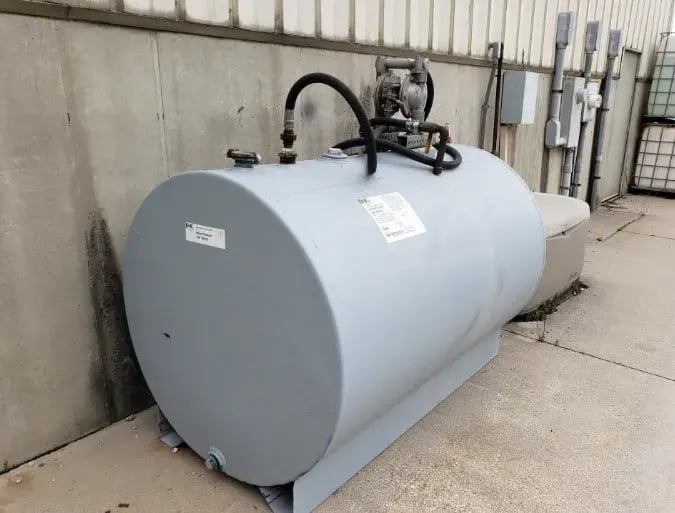
Containers that typically land in the count include aboveground storage tanks for diesel, gasoline, and heating oil, 55-gallon drums, 275- and 330-gallon totes, generator fuel tanks and day tanks, used oil tanks and drums, portable or skid tanks, and fuel trailers or refuelers that stay on site. Tanks that are partially buried, bunkered under earth, or sitting in a vault are all treated as aboveground containers for SPCC purposes, even though they're partly or mostly out of sight.
Used oil is a common blind spot. A shop might think of its used oil tank as a waste container rather than oil storage, but it holds oil and it counts. If you want to understand how used oil is handled more broadly, our used oil regulations guide lays it out. The same goes for food businesses. A restaurant group, bakery, or food processor with large cooking oil or grease containers is storing oil under this rule, which surprises a lot of owners. We cover that in our article on SPCC Plans for cooking oil and used cooking oil.
Does Oil-Filled Equipment Count Toward SPCC Oil Storage Capacity?
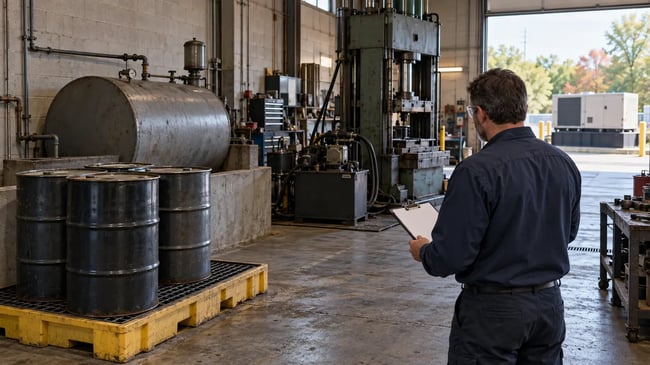
Yes. This is the piece that catches manufacturers and industrial sites. EPA's rule covers oil-filled operational equipment, which means equipment where the oil is there to make the machine work rather than being stored for later. Examples listed in the regulation include hydraulic systems, lubrication systems, gearboxes, machining coolant systems, heat transfer systems, transformers, circuit breakers, and electrical switches. If the oil reservoir or compartment holds 55 gallons or more, its capacity goes into your total, the same as a tank would.
On a shop floor, that means a large hydraulic press, an injection molding machine, a baler, or a big compressor with a 60- or 100-gallon reservoir is part of your count. Each one might not seem like much, but three or four of them can add a few hundred gallons without anyone thinking of them as "oil storage." Transformers deserve a closer look. If your company owns the transformer, it's yours to count. Pad-mounted transformers owned by the utility are generally the utility's responsibility, but ownership varies from site to site, so it's worth confirming with your utility rather than assuming.
Emergency generators are a little different. The generator's fuel tank, whether it's a sub-base tank under the unit or a separate day tank, is a bulk storage container, so it counts by its full capacity. Our article on emergency backup generators and environmental permits explains the other rules a generator can trigger. One bit of good news for equipment: once you're covered, the SPCC rule gives qualified oil-filled operational equipment some flexibility on secondary containment, so a press or transformer doesn't always need the same kind of berm or pan a storage tank would.
What Doesn't Count Toward Your SPCC Oil Storage Total?
The rule lists specific items you can leave out of the aboveground total. These are the ones that come up most at New Jersey facilities, and the reason each one is excluded.
| Item |
Counts Toward 1,320? |
Why |
| Containers under 55 gallons (pails, small drums, bottles) |
No |
Excluded by the 55-gallon cutoff |
| Permanently closed containers |
No |
Only if every closure step is completed and posted |
| Vehicle and equipment fuel tanks (trucks, loaders, forklifts) |
No |
Motive power containers, including onboard hydraulics |
| Fuel trucks or trailers that deliver or transfer fuel |
Yes |
Storing oil for distribution isn't motive power |
| Heating oil tank at a business |
Yes |
The exemption is only for single-family homes |
| Propane tanks |
No |
Propane isn't treated as oil under SPCC |
| Hot-mix asphalt and its containers |
No |
Specifically exempt |
| Pesticide application equipment and mix containers |
No |
Specifically exempt |
| Milk and milk product containers |
No |
Specifically exempt |
Permanently closed has a precise meaning, and it's the exclusion people stretch the most. To qualify, all liquid and sludge must be removed from the container and its connecting lines. All connecting piping has to be disconnected and blanked off, all valves except vents closed and locked, and a conspicuous sign posted on the container saying it's permanently closed, with the closure date. An empty tank with its fill pipe still attached isn't permanently closed. Neither is a tank that's been "out of service" since the last owner left. The motive power exclusion also has a limit worth knowing. Your trucks' fuel tanks don't count, but fueling those trucks from a tank on your site doesn't make that tank exempt.
How Are Buried Oil Tanks Counted Under SPCC?
Completely buried tanks are counted separately from everything above ground. They aren't added to your 1,320-gallon total. Instead, they have their own threshold: a facility is covered if its completely buried oil storage capacity is more than 42,000 gallons. You need to be under both limits to be exempt, so a site with a small buried tank and 1,500 gallons of aboveground storage still needs a plan because of the aboveground side.
Many buried tanks drop out of the SPCC count entirely. A completely buried tank that's subject to all of the technical requirements of the underground storage tank (UST) rules is excluded, along with its connected underground piping. The federal UST rules sit at 40 CFR Part 280, and in New Jersey the state's UST program operates under N.J.A.C. 7:14B. A typical regulated gasoline or diesel UST at a fleet yard, with leak detection and an NJDEP-certified contractor handling the work, falls into this group. Those tanks don't need to be in your SPCC capacity math, although if your facility does need an SPCC Plan, exempt buried tanks still have to be shown on the facility diagram.
The tricky one is heating oil. The federal UST rules don't cover tanks storing heating oil that's used on the premises, which means a buried heating oil tank at a business isn't excluded that way and does count toward the 42,000-gallon buried threshold. New Jersey's own UST rules also handle heating oil tanks differently depending on size and use. For most small and mid-size businesses, buried heating oil capacity won't come anywhere near 42,000 gallons, but older New Jersey buildings often have more buried and basement tanks than anyone remembers, so it pays to know what's on the property.
Worked Example: Adding Up Oil Storage at a Typical New Jersey Facility
Here's a realistic example. Picture a small metal fabrication shop in an older industrial building in central New Jersey. There's a storm drain in the parking lot that ties into the municipal system and runs to a nearby stream, so the "could reach water" test is easy to meet. The owner walks the site and lists everything that holds oil. Here's how each item scores.
| Item |
Shell Capacity |
Counts? |
Gallons Counted |
| Emergency generator sub-base diesel tank |
500 gal |
Yes, bulk storage container |
500 |
| Six 55-gallon drums of hydraulic and lube oil (some half full) |
55 gal each |
Yes, full size counts |
330 |
| Used oil tank in the maintenance bay |
275 gal |
Yes |
275 |
| Hydraulic press reservoir |
90 gal |
Yes, oil-filled equipment |
90 |
| Parts washer |
30 gal |
No, under 55 gallons |
0 |
| Twelve 5-gallon pails of cutting fluid and grease |
5 gal each |
No, each is under 55 gallons |
0 |
| Propane forklifts and the diesel delivery truck |
Varies |
No, propane isn't oil and vehicle tanks are motive power |
0 |
| Utility-owned pad-mounted transformer |
Varies |
No, owned and counted by the utility (confirmed) |
0 |
| Old basement heating oil tank, empty but still piped |
330 gal |
Yes, not permanently closed |
330 |
| Total aboveground capacity |
|
|
1,525 |
At 1,525 gallons, this shop needs an SPCC Plan. What's interesting is where the overage comes from. The owner's first guess was "maybe 800 gallons," because the drums were half empty and the basement tank hadn't been used in a decade. Counting the drums at full size and catching the basement tank, which still had its lines connected and no closure sign, pushed the total well past the threshold.
Now look at what happens if the owner has that basement tank emptied, disconnected, blanked off, locked, and posted as permanently closed. The total drops to 1,195 gallons, under the line. That's a legitimate way to get out from under the rule. But it only leaves 125 gallons of room. Three more drums of hydraulic oil delivered during a busy month, or a bigger generator tank in a future upgrade, and the shop is over again. That's the reality for a lot of facilities near the threshold, and it's why the next section matters.
What Happens If Your Facility Lands Right Around the 1,320-Gallon SPCC Threshold?
The threshold is "more than" 1,320 gallons, so a facility at exactly 1,320 is not covered. At 1,321, it is. There's no grace band, and EPA counts what's on site the day an inspector walks in, not what you had last quarter. If you're close, you have two honest choices.
The first is to stay under on purpose and be able to prove it. That means keeping a written inventory of every container 55 gallons and up with its capacity, setting a hard limit on how many drums can be on site, properly closing or removing tanks you don't use, and having someone check the count when anything new comes in. Plenty of small facilities do this well. The weak point is drift. Drums pile up, a vendor drops off an extra tote, a new machine arrives with a bigger reservoir, and nobody reruns the numbers. If your whole compliance strategy depends on staying 50 gallons under a line, it needs an owner.
The second is to get a plan, which is often easier than people expect at this size. A facility with 10,000 gallons or less of aboveground storage and a clean spill history is a "qualified facility," meaning it can usually self-certify its own plan instead of hiring a Professional Engineer. The clean history part means no single discharge over 1,000 gallons and no two discharges over 42 gallons each within any 12-month period, looking back three years. If no individual aboveground container is larger than 5,000 gallons, the facility can generally use EPA's Tier I template, which is about as simple as SPCC gets. Our articles on Tier I self-certified SPCC Plans and the different types of SPCC Plans walk through which one fits. If you're a small shop just over the line, you may be able to fill out the Tier I template yourself, and we'll tell you that if it's true.
If you'd rather have help, our SPCC Plan costs generally range from $2,500 to $15,000 depending on the size and complexity of the site, and facilities near the threshold usually land toward the low end. Simple Tier I updates run about $1,500. You can get a quick estimate for having RMA prepare or update your plan using the SPCC pricing calculator below. Skipping a required plan altogether is the expensive option, and our breakdown of top SPCC violations and fines shows why.
How New Jersey's Spill Rules Apply Even Below the SPCC Threshold
Landing under 1,320 gallons gets you out of the federal SPCC Plan requirement. It doesn't get you out of New Jersey's spill rules. The state's Spill Compensation and Control Act, usually called the Spill Act, applies to discharges of petroleum and many hazardous substances regardless of how much you store. If oil or a covered substance gets released, the Spill Act's duty to report applies, and reports go to the NJDEP hotline at 1-877-WARNDEP (1-877-927-6337). Federal reporting rules can apply at the same time when oil reaches water, which our article on when you have to report an oil spill covers.
The Spill Act also carries broad cleanup liability. In general terms, responsibility for a discharge can be strict, meaning it applies regardless of fault, and joint and several, meaning one responsible party can be on the hook for the whole cleanup. Cleanups in New Jersey are typically overseen by a Licensed Site Remediation Professional (LSRP). How those rules apply to any specific situation is a legal question, and an environmental attorney is the right person to ask. The practical point for this article is simple. Even a facility that's comfortably under the SPCC threshold benefits from basic spill habits: drums on containment, a spill kit near the oil, and staff who know who to call.
New Jersey also has a separate state plan requirement for much larger sites. Facilities that meet the state's "major facility" definition under N.J.A.C. 7:1E need a Discharge Prevention, Containment, and Countermeasure (DPCC) Plan and a Discharge Cleanup and Removal (DCR) Plan. The state threshold is far higher than SPCC's and is counted under the state's own rules, which include hazardous substances as well as oil, so most small and mid-size businesses won't qualify. Large terminals and bulk plants often need both an SPCC Plan and DPCC/DCR plans. Local fire officials also look at oil storage under the Uniform Fire Code, so a tank that's fine for SPCC purposes can still raise fire code questions. Our overview of SPCC Plans in New Jersey puts these layers side by side.
How RMA Helps New Jersey Facilities Count Oil Storage and Build SPCC Plans
We're based in New Jersey, and we've been helping facilities here and across the country sort out their oil storage since 1992. A lot of our SPCC work starts with exactly the exercise in this article: walking the site, finding every container and piece of oil-filled equipment, reading nameplates, and figuring out whether you're over 1,320 gallons, under it, or close enough that you need a plan for staying under. Our senior staff do that work themselves. If the count shows you don't need a plan, we'll say so. If you're a qualified facility that can self-certify, we'll tell you that too, and help you get the Tier I template right if you want a second set of eyes.
If you do need a plan, we can prepare it, handle Professional Engineer certification when it's required, and help you set up the inspections, training, and recordkeeping that make the plan work day to day. For staff training, our online environmental training library is an easy way to cover the basics. There's no pressure and no obligation. Call us at 888-RMA-0230, send us an email, or fill out the form on our website, and contact RMA to talk through your site. We're happy to help you figure out where you stand.