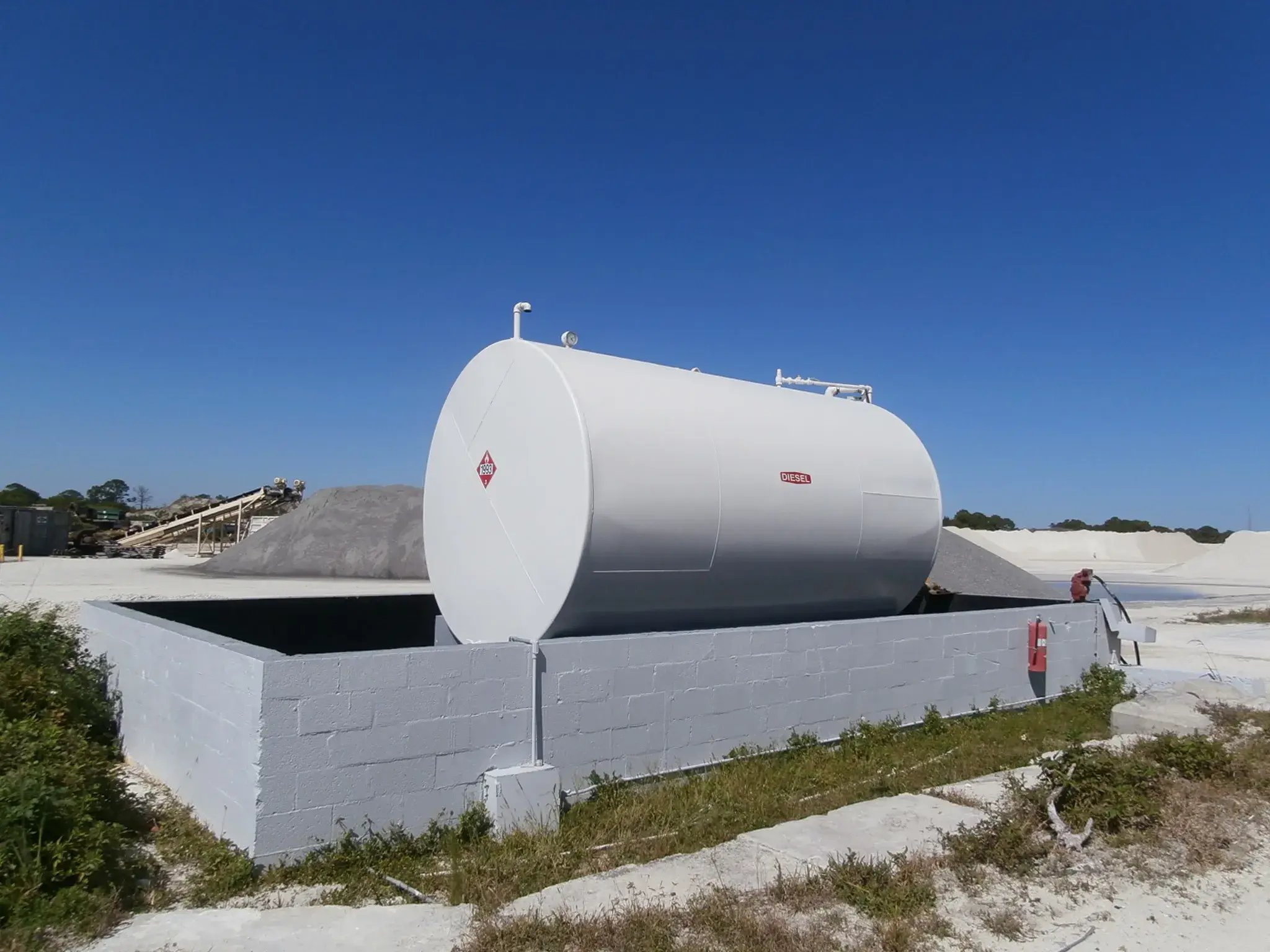
A Plain-English Guide to Adding Up Tanks, Drums, and Oil-Filled Equipment at a Pennsylvania Facility, With a Worked Example
Most people who ask whether they need an oil spill plan already know the number: 1,320 gallons. What trips them up is the counting. Do half-empty drums count? What about the hydraulic press, the generator, or the old heating oil tank nobody has touched in ten years? Here's the short answer. Add up the full capacity of every aboveground oil container that holds 55 gallons or more, including oil-filled equipment, and leave out permanently closed containers and a short list of exempt items. If the total is more than 1,320 gallons and a spill could reasonably reach a creek, river, or storm drain, the federal rule applies and you need a written plan.
Below we walk through each piece of the count the way an EPA inspector would: capacity versus contents, the 55-gallon cutoff, oil-filled equipment, exclusions, and buried tanks. Then we add up a typical Pennsylvania facility in a table, show how DEP's tank program counts differently, and cover what to do if you land near the line. If you'd rather have someone run the numbers with you, feel free to reach out to RMA.
Table of Contents
TL;DR
Add up the full size of every aboveground oil container that holds 55 gallons or more, whether it's full or empty, including generator fuel tanks, hydraulic systems, and transformers you own. Permanently closed containers, vehicle fuel tanks, and anything under 55 gallons don't count, and fully buried tanks are measured against a separate 42,000-gallon line. If your aboveground total is over 1,320 gallons and a spill could reach water, you need an oil spill plan, and near the line one new drum can push you over. Pennsylvania DEP separately regulates individual tanks over 250 gallons, so check both.
What Is the 1,320-Gallon SPCC Threshold?
SPCC stands for Spill Prevention, Control, and Countermeasure. An SPCC Plan is a written oil spill prevention plan that EPA requires under 40 CFR Part 112 for facilities that store, use, or handle oil above certain amounts. In Pennsylvania it's enforced by EPA Region 3, not DEP. Our guide to everything you need to know about SPCC plans covers what goes into one.
The rule applies when two things are true. First, your aggregate aboveground oil storage capacity is greater than 1,320 gallons, or your completely buried capacity is greater than 42,000 gallons. Exactly 1,320 is under the line. Second, your facility could reasonably be expected to discharge oil to navigable waters or adjoining shorelines. That call can only rest on geography, like distance to water, slope, and drainage. Dikes, berms, curbs, and buildings don't count. In a state laced with creeks and storm sewers feeding the Delaware, Susquehanna, and Ohio river systems, that second test rarely gets a Pennsylvania site off the hook, so the capacity number usually decides it.
Why the SPCC Rule Counts Oil Storage Capacity, Not Contents
The most common counting mistake we see is adding up how much oil is on site instead of how much the containers can hold. The rule defines storage capacity as shell capacity, meaning the container's full size. A 275-gallon tote with 40 gallons in the bottom counts as 275 gallons. A 1,000-gallon diesel tank that your supplier only ever fills to 600 gallons counts as 1,000 gallons. A drum that's empty today but will get refilled next month counts as 55 gallons.
Any container can be filled to the top on any given day, and the full volume is what could hit the ground if it fails. So "we never keep more than a few hundred gallons on hand" doesn't help, and neither do working capacity or delivery tickets. Use the nameplate or spec sheet, or purchase records and a tape measure for older tanks. Keep a dated inventory of each container's location, contents, and capacity. If you need a plan, it becomes the backbone. If you don't, it's your proof when an inspector, insurer, or buyer asks.
Which Oil Containers Count Toward the 1,320 Gallons?
Only containers of 55 gallons or more go into the count. A standard 55-gallon drum counts. A 30-gallon drum or a 5-gallon pail doesn't, no matter how many you have. That gives you handy math: 1,320 gallons is exactly 24 drums, and the 25th drum puts you at 1,375. We go deeper on drums in our post on whether 55-gallon drums are included in SPCC plans.
What Counts as Oil Under the SPCC Rule
Drums get undercounted because they move around and come and go with deliveries, so count every drum you keep for oil, empties included, along with totes, day tanks, and fuel cubes. The definition of oil is broad: diesel, gasoline, fuel oil, motor, hydraulic, and gear oils, lubricants, mineral oil, used oil, and also animal fats and vegetable oils. Fryer oil counts toward the same 1,320 gallons as diesel, which we cover in our post on SPCC plans for cooking oil and used cooking oil. Propane and diesel exhaust fluid (DEF) aren't oil under the rule, so those tanks stay out.
Does Oil-Filled Equipment Count Toward SPCC Capacity?
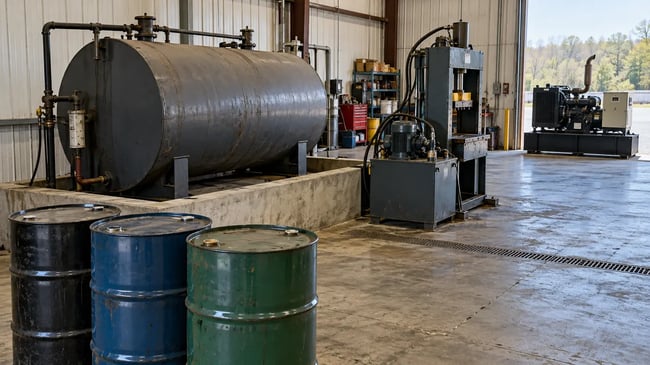
Yes. The rule calls it oil-filled operational equipment, where oil is there only to make the machine work. EPA's examples include hydraulic systems, lubricating systems, gear boxes, machining coolant systems, heat transfer systems, transformers, circuit breakers, and electrical switches. Any reservoir of 55 gallons or more goes into your total, just like a tank. In a typical plant that means hydraulic presses, injection molding machines, hydraulic elevators, and transformers or switchgear you own. The plan can handle containment for equipment a little differently, but for the threshold, a gallon in a reservoir is the same as a gallon in a drum.
Generators deserve their own mention. The belly tank or sub-base tank under a generator is fuel storage, and it counts at full capacity even if the generator rarely runs. One standby unit can eat up a big piece of your 1,320 gallons. Our post on emergency backup generators and environmental permits covers the other rules generators can bring with them.
Ownership matters too. A pad-mount transformer owned and maintained by your utility is generally the utility's to account for, not yours. If you own it, it counts. When in doubt, ask the utility before you leave it out.
What Doesn't Count Toward the 1,320-Gallon Total?
The rule lists specific items that stay out of the aboveground count. Here they are side by side with the look-alikes that do count.
| Item |
Counts? |
What to watch for |
| Containers under 55 gallons |
No |
Pails, small drums, and bottles stay out no matter how many you have. |
| Permanently closed containers |
No |
Only if they meet every part of the closure definition below. |
| Empty tanks and drums that aren't permanently closed |
Yes |
Empty isn't the same as closed. They count at full size. |
| Onboard vehicle fuel tanks (motive power containers) |
No |
Tanks that power trucks, loaders, and forklifts. |
| Fuel trailers, skid tanks, and fuel cubes |
Yes |
They store fuel to refuel other equipment, so they aren't motive power. |
| Heating oil tank at a single-family home |
No |
A heating oil tank at a business or commercial building does count. |
| Containers used only for wastewater treatment |
No |
Oil recovery or recycling doesn't qualify as wastewater treatment. |
| Milk containers, hot-mix asphalt, pesticide application equipment |
No |
Specific exemptions written into the rule. |
| Propane and DEF tanks |
No |
Not oil under the SPCC rule. |
What "Permanently Closed" Means for SPCC Capacity
"We stopped using it" isn't closed. All liquid and sludge has to be removed from the container and its lines, the lines disconnected and blanked off, valves (except vents) closed and locked, and a conspicuous sign posted stating it's permanently closed with the closure date. A drained tank that's still piped up counts at full capacity. Closing an unused tank properly is one of the few legitimate ways to lower your number. The vehicle exemption has a limit too. A transfer tank in a pickup bed or a fuel trailer by the loader is storage, and it counts.
How Buried Tanks Fit Into the SPCC Oil Storage Count
Completely buried tanks, meaning entirely below grade and covered with earth, gravel, or asphalt, run on a separate track against a 42,000-gallon threshold. You don't add them to your aboveground total. But partially buried tanks, bunkered tanks, and tanks in vaults are treated as aboveground. A diesel tank in a below-grade vault, or a heating oil tank in a basement, goes into your 1,320-gallon count.
Buried tanks subject to all the technical requirements of the federal underground storage tank rules at 40 CFR Part 280, or an EPA-approved state program, are left out of the buried count entirely. Buried tanks those rules don't fully cover, like an underground heating oil tank serving the building it sits under, still count toward 42,000. For most small and mid-sized Pennsylvania facilities, the buried threshold never comes into play.
Worked Example: Counting Oil Storage at a Pennsylvania Facility
Picture a small metal fabrication shop in Lancaster County with an emergency generator, a few drums, a used oil tank, a hydraulic press, and an old basement heating oil tank retired when the building switched to natural gas. The owner walks the site and lists every container.
| Item |
Shell capacity |
Counts? |
Gallons counted |
| Emergency generator belly tank (diesel) |
500 gal |
Yes, fuel storage |
500 |
| Used oil tank |
275 gal |
Yes |
275 |
| Hydraulic press reservoir |
150 gal |
Yes, oil-filled equipment |
150 |
| 4 drums of hydraulic oil (two full, two partly used) |
4 x 55 gal |
Yes, at full size |
220 |
| 2 empty drums kept for refilling |
2 x 55 gal |
Yes, empty isn't closed |
110 |
| 6 pails of gear oil |
6 x 5 gal |
No, under 55 gallons each |
0 |
| Basement heating oil tank (drained, lines blanked, valves locked, signed and dated) |
550 gal |
No, permanently closed |
0 |
| Box truck and forklift onboard fuel tanks |
Varies |
No, motive power |
0 |
| Utility-owned pad-mount transformer |
Utility's equipment |
No, not the shop's |
0 |
| Aggregate aboveground oil storage capacity |
1,255 |
The shop lands at 1,255 gallons, 65 under the line, so no federal plan is required today. The partly used and empty drums count at a full 55 gallons each, though together they hold maybe 60 gallons. The generator alone uses more than a third of the allowance. The basement tank is the swing item. Because it was closed properly, it stays out. If it had only been drained, the shop would be at 1,805 gallons. And 65 gallons isn't much room. One more drum makes 1,310, still under, and a second makes 1,365. Used oil also comes with its own handling rules, summarized in our top things to know about used oil regulations.
How Pennsylvania DEP Tank Rules Count Oil Storage Differently
EPA's SPCC rule looks at your facility total. DEP's storage tank program, under the Storage Tank and Spill Prevention Act and 25 Pa. Code Chapter 245, looks at individual tanks. The Act passed in 1989, a year after the Ashland Oil tank collapse at Floreffe sent diesel into the Monongahela River and cut off drinking water downstream. Under DEP's program, a stationary aboveground tank holding more than 250 gallons of a regulated substance, including petroleum, generally has to be registered, as do underground tanks over 110 gallons. DEP currently lists the annual fee at $50 per aboveground tank of 5,000 gallons or less. The definition has a long list of exemptions, including certain heating oil tanks and oil-filled equipment, so a tank over 250 gallons isn't automatically regulated, but it needs a closer look.
In the example, the 500-gallon generator tank and 275-gallon used oil tank both need checking against DEP's definition, even though the shop is under the federal line. The reverse happens too, where a site is over 1,320 gallons with only drums and equipment and has no DEP tank at all. Run both counts. Much larger aboveground facilities also need Pennsylvania's Spill Prevention Response Plan, and local fire codes set their own tank rules, so check with your fire marshal.
What If Your Oil Storage Lands Right Around 1,320 Gallons?
Under the line, you don't need a federal SPCC Plan. Keep your dated count on file anyway, recount whenever you add a tank, drum rack, generator, or hydraulic equipment, and remember you still have to report and clean up spills. If you want to stay under, there are honest ways: return empty drums instead of stockpiling them, buy lubricants in smaller containers, and properly close tanks you'll never use. If that's easy for your operation, do it. You may not need us or anyone else. Calling a tank closed when it isn't, or arguing you only fill it halfway, won't hold up in an inspection.
If you need the oil or know growth is coming, plan ahead. A new facility needs its plan in place before it starts operating, and EPA expects the same when an existing facility adds capacity and crosses the line, so have the plan ready before that container goes into service. Once covered, the plan needs a review at least every five years and an amendment when changes affect your spill potential. Our post on when to update your SPCC plan walks through those triggers.
Near the threshold, the plan is usually simple. With 10,000 gallons or less aboveground, no container over 5,000 gallons, and no qualifying spills in the last three years, you're likely a Tier I qualified facility and can self-certify using EPA's template instead of hiring a Professional Engineer. Our post on Tier I self-certified SPCC plans explains how, and plenty of small facilities handle it themselves. If you'd rather have help, SPCC Plans we prepare typically run $2,500 to $15,000, with small, simple facilities at the low end. Our breakdown of SPCC plan costs covers what drives the price, and you can get a quick estimate for our help with the pricing calculator below.
How RMA Helps Pennsylvania Facilities Count Oil Storage and Meet SPCC Rules
We're a family-run environmental consulting firm based in New Jersey, and we work with facilities across Pennsylvania on questions like this one. Sometimes that's a quick look at your inventory to confirm you're under the line. Sometimes it's a full count of a busy site, a check of which tanks fall under DEP's program, and an SPCC Plan written by senior staff who know what Region 3 inspectors look for. We can also help with training through our online environmental training library. And if your count shows you don't need a plan, we'll tell you so. To check on your own first, try our four steps to figure out if you need an SPCC plan.
There's no pressure and no obligation. Call us, send an email, or fill out the form on our website. When you're ready, contact RMA and we'll help you figure out where your facility stands and what, if anything, comes next.