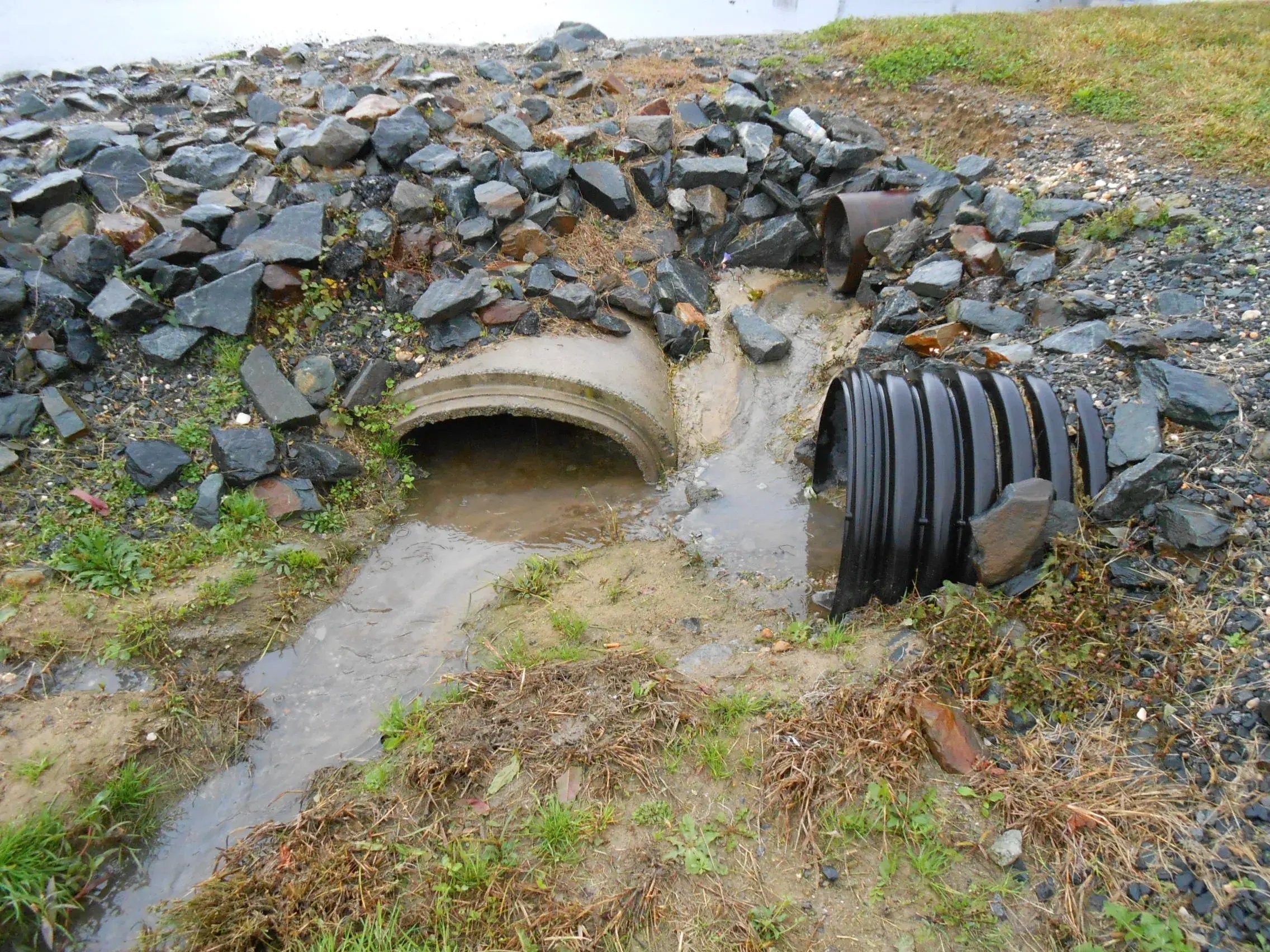
The 5G2 Annual Inspection and Certification Explained: What NJDEP Expects, Who Signs, and How to Submit It
If your facility is covered by New Jersey's Basic Industrial Stormwater General Permit (the 5G2), NJDEP expects one piece of paperwork from you every year: a signed certification form. It isn't a data report, and you don't send in your plan, your inspection logs, or lab results. It's a statement, signed by the right person, that you completed your annual inspection, evaluated your stormwater pollution prevention plan (a SWPPP, which NJDEP calls the SPPP and some people call an SP3 or just the stormwater plan) against the permit, and met the other permit requirements the form lists. That signature carries legal weight, so the work behind it needs to be real.
This article covers what the annual inspection looks at, what you're certifying when you sign, who NJDEP's rules allow to sign, how and when the form gets submitted, and what can go wrong. There's a practical checklist near the end that you can hand to whoever owns the task at your facility. If you'd rather have someone walk through it with you, you're welcome to reach out to RMA, and if you're comfortable handling it yourself, everything below should be enough to get it done.
Table of Contents
TL;DR
The 5G2 annual certification is a form you submit electronically to NJDEP once a year, in the calendar quarter assigned to your facility. It confirms that you did the annual inspection, evaluated your stormwater plan, and met the permit's other requirements, like monthly inspections and annual training. The form has to be signed by a person who meets NJDEP's signatory rules, such as a responsible corporate officer for a corporation. You don't send in the plan or your records. You keep them on site, along with a copy of the form, and the permit doesn't require stormwater sampling.
What Is the 5G2 Annual Certification and Is It a Report?
The 5G2 is NJDEP's Basic Industrial Stormwater General Permit, a New Jersey Pollutant Discharge Elimination System (NJPDES) permit for regulated industrial facilities that have eliminated, or can eliminate within six months of authorization, all exposure of industrial materials and activities to rain and snowmelt. Exposure usually gets eliminated by moving things indoors or putting them under cover. NJDEP's current master general permit took effect February 1, 2023, and the permit, fact sheet, and certification form all live on the 5G2 page of NJDEP's stormwater website. If you're still sorting out whether this is the right permit for your site, our 5G2 permit overview covers who qualifies and who doesn't.
Because a 5G2 facility has no exposed source materials, the permit doesn't ask for stormwater sampling or discharge monitoring reports. That's why "annual report" is a loose way to describe the yearly obligation. NJDEP's fact sheet for the permit describes it as requiring you to prepare the plan, certify that you prepared and implemented it, and then keep it current. The yearly submission to NJDEP is the certification form, and everything else stays at your facility as proof you can show an inspector.
The certification only makes sense in the context of the other recurring 5G2 tasks, because the form is a statement that you did them. Here's how the pieces fit together.
| Recurring 5G2 Task |
How Often |
Sent to NJDEP? |
| Routine inspection of areas exposed to rain and snowmelt |
Monthly |
No, keep the log on site |
| Comprehensive annual inspection, including plan and records review |
Once a year |
No, keep the report on site and certify that it happened |
| Employee training on the plan and its practices |
At least annually |
No, keep attendance and content records on site |
| Certification form |
Once a year |
Yes, electronically |
NJDEP also bills an annual permit fee separately. It's not part of the certification, but a missed bill can put your coverage at risk, so it belongs on the same calendar reminder.
What Does the 5G2 Annual Inspection Cover?
The annual inspection is a bigger, slower version of your monthly walk. The permit frames it around three questions: is your SWPPP current, is it being followed, and is it eliminating exposure of source materials and industrial activity to stormwater. The permit's annual inspection section has the exact wording, so read it in the current version rather than relying on a summary, ours included.
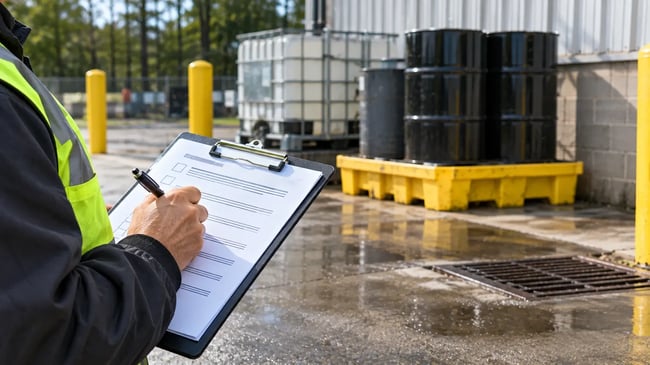
In practice, you walk the entire site that sheds rain or snowmelt, not just the loading dock. That means the roof if there's any activity or equipment on it, the dumpsters and whether the lids are closed, the parking and access areas, the storm drains and where they lead, and the exterior of every building. You're looking for uncovered materials, leaks and stains, trash, tracked-out debris, damaged covers, and anything that has drifted outside since the last inspection. The monthly inspection looks for the same things, so the annual one is where you also step back and ask whether the plan still matches reality. New equipment, a new product line, a rearranged yard, or a new tenant sharing the building can all make a SWPPP out of date without anyone noticing. Our guide to doing a stormwater visual inspection the right way is a good companion for the walk itself.
The second half of the annual inspection happens at a desk. You review the monthly inspection logs for the year, check that problems found were corrected and the fix was written down, confirm that training happened and was documented, and compare the SWPPP against what you saw outside. Write up the results with the date, who did the inspection, what was found, and what was done about it. That write-up is the document an NJDEP inspector will ask to see.
What If the Annual Inspection Turns Up a Problem?
Fix it, record the fix, and check that it worked before anyone signs the form. The permit and the certification form spell out how noncompliance found during the inspection is handled, so read that part of the current versions before you decide what to check off. If you find exposure that you can't eliminate, such as an outdoor process or storage you can't cover or move, the 5G2 may no longer fit your site. In that case, call NJDEP's stormwater bureau to talk through your options, which could include an industry-specific general permit or an individual permit. Our articles on which NPDES permit you need and on whether you need an individual NJPDES industrial permit lay out those paths.
What Are You Certifying, and Who Can Sign the 5G2 Form?
NJDEP publishes the 5G2 Certification Form on the same 5G2 page as the permit. The form is used for more than one kind of certification, so make sure you check the box for the annual certification and not the one for plan preparation. NJDEP updated the form to include a list of permit requirements that you review and check off, and the annual certification confirms that the annual inspection was done, with its date, and that the SWPPP was evaluated as the permit requires. By signing, you're also stating that the facility is meeting the permit's conditions, which is why every box you check should have a record behind it. An inspector can test any of them against your files.
The form also tells you not to submit the SWPPP with it. The plan, your inspection and training records, and a copy of the signed form stay at the facility, and the permit requires you to make the plan available to NJDEP if asked. If you lease your space, check the permit's language on providing copies of the plan and certifications to the property owner.
Who Is Allowed to Sign the Certification?
The answer comes from N.J.A.C. 7:14A-4.9, the NJPDES rule on signatories for permit applications and reports. For a corporation, it's a responsible corporate officer, a term the rule defines, and it generally points to a senior officer instead of a plant or facility manager. For a partnership or sole proprietorship, it's a general partner or the proprietor. For a municipality or other public agency, it's a principal executive officer or ranking elected official. The rule also lets a signer delegate signing authority to a duly authorized representative in writing, under conditions it lays out.
That matters because the person who runs your inspections is often not the person the rule names. If an EHS manager or plant manager will sign, read the full rule and confirm the written delegation is in place before the form goes out. Whoever signs should also see the inspection report and the records first. Signing a certification you haven't looked behind is how a routine form turns into a problem.
How and When Do You Submit the 5G2 Annual Certification?
NJDEP assigns each facility a calendar quarter for its annual certification. Your authorization letter shows yours, and the certification form includes a due-date table, so read the table on the current form instead of counting months from memory. If you can't find your authorization, NJDEP's records or a quick call to the stormwater bureau will tell you the quarter.
Submission is electronic. NJDEP's fact sheet for the permit renewal explains that the permit now requires electronic submission of all permit submittals, removed the mailing addresses, and lists an email address for each type of submittal, which fits with EPA's electronic reporting requirements. So the process is to complete the current form, have the right person sign it, and email it to the address listed in your permit for annual certifications. NJDEP has changed submittal addresses before, so use the one printed in your current permit or on the current form, not one from an old file or a template someone gave you years ago.
Send it early in your quarter instead of on the last day. Keep the sent email as proof of when you submitted, and file it with your copy of the signed form. If you don't get an acknowledgment, follow up, because a certification that never arrived is the same to NJDEP as one you never sent.
5G2 Annual Certification Checklist
This is the order we'd work through it, start to finish. Adjust the details to your site, and check each step against the current permit.
| Step |
What to Do |
What to Keep on File |
| 1. Confirm your due quarter |
Check your authorization letter and the due-date table on the current form, and set a calendar reminder well ahead of the deadline. |
Authorization letter |
| 2. Pull the current documents |
Download the current 5G2 permit and certification form from NJDEP's 5G2 page instead of reusing last year's copy. |
Current permit and blank form |
| 3. Review the year's monthly logs |
Look for missed months, repeat problems, and issues that were noted but never closed out. |
Twelve months of inspection logs |
| 4. Do the annual inspection |
Walk the whole site, check roofs, dumpsters, docks, drains, and yard areas, and record the date, who inspected, and what was found. |
Signed annual inspection report |
| 5. Compare the SWPPP to the site |
Check the site map, material inventory, practices, and contacts, and update anything that changed, signing and dating changes as the permit requires. |
Updated, signed SWPPP |
| 6. Confirm training is done and documented |
Record who attended, when, what was covered, and who delivered it. Any format works if it covers your plan's practices. |
Training records and sign-in sheets |
| 7. Fix problems before signing |
Correct what you found, document the fix, and re-check it. Read the permit's noncompliance language if anything can't be fixed. |
Corrective action notes |
| 8. Match every box to a record |
Go through the form line by line and check only what your files support. |
Completed form |
| 9. Get the right signature |
Have a person who meets N.J.A.C. 7:14A-4.9 review the records and sign. |
Signed form and any written signing delegation |
| 10. Submit and file |
Email the form to the address in your current permit, confirm receipt, and keep everything together at the facility. |
Sent email, acknowledgment, and form copy with the SWPPP |
If your annual training is the step that slips, the online route is a legitimate option. We explain what the permit asks for in our article on taking 5G2 training online, and our online training library has courses your team can complete on its own schedule.
What Happens If You Miss or Misstate the 5G2 Certification?
NJDEP can inspect a 5G2 facility, and when it does, the inspector usually asks for the SWPPP, the inspection logs, the training records, and your certifications. A missed or late certification is a permit violation. Under the Water Pollution Control Act and NJDEP's penalty rules at N.J.A.C. 7:14-8, the Department can assess civil administrative penalties of up to $50,000 for each violation, and NJDEP's own permit language for this program has cited penalties of up to $50,000 per day, per violation.
A false or inaccurate certification is treated more seriously than a late one. NJDEP's penalty rules let it assess a penalty against anyone who submits inaccurate information or a false certification, with the amount depending on intent and speed of correction: up to $50,000 for an intentional or knowing act, up to $30,000 for other violations not corrected within 10 days of becoming aware of them, and up to $1,000 for violations corrected within 10 days. The Water Pollution Control Act also carries criminal penalties that can reach knowingly false statements. That's the main reason to check only the boxes your records support.
In our experience, a first paperwork miss on a 5G2 facility usually draws a Notice of Violation and a deadline to correct it, not a large fine. NJDEP has discretion, though, and a pattern of missed certifications or an obviously inaccurate form changes how it responds. If you've missed a certification, submit it late instead of skipping it, and call NJDEP's stormwater bureau if you're unsure how to handle the gap. If you've already received a Notice of Violation or a penalty assessment, or you think a past certification was inaccurate, talk to an environmental attorney before you respond.
How RMA Helps With 5G2 Annual Inspections and Certifications
Plenty of facilities handle all of this on their own, and if you have someone who can run the inspections, keep the SWPPP current, document training, and a qualified signer who can review the records, you don't need us. Where we help is the ongoing part that tends to slip. We send reminders ahead of your due quarter, help prepare for the annual inspection or do the walk with you for an outside set of eyes, help interpret what you find, update your SWPPP when your operations change, and train your team so the annual requirements don't depend on one person. Some clients want us hands-on every year, and others only want a call when a question comes up. Both work. You can also browse our NPDES and stormwater learning center for more articles on New Jersey permits and plans.
If you'd like to talk it through, there's no pressure and no obligation. You can call us at 888-RMA-0230, email info@rmagreen.com, fill out the form on our website, or simply contact RMA with your questions. We'll tell you plainly whether we're a good fit for what you need, and if you don't need us, we'll say that too.