What Pennsylvania's Bay Commitments Mean for Sediment, Nutrients, and Stormwater Controls at an Industrial Facility
If your facility sits in central or northern Pennsylvania, the rain that runs off your yard probably ends up in the Susquehanna or Potomac River, and from there in the Chesapeake Bay. Pennsylvania has made commitments to cut the sediment and nutrients that reach the Bay, and those commitments don't stay in Harrisburg. They show up in how DEP writes permits, how counties and townships plan their stormwater work, and how closely regulators look at the streams your site drains to.
This article covers which parts of Pennsylvania drain to the Bay, what the state has committed to, and what that can mean for a facility with industrial stormwater coverage under PAG-03 (Pennsylvania's general permit for industrial stormwater discharges), an individual NPDES permit, or a No Exposure Certification. We'll also look at impaired streams, local stormwater programs, and the controls that cut sediment and nutrients. Specific requirements depend on your permit, your receiving stream, and your municipality, so if you want someone to look at your situation, reach out to RMA.
Table of Contents
TL;DR
About half of Pennsylvania drains to the Chesapeake Bay, and the state has committed to cutting the sediment and nutrients that flow there. For an industrial facility in that area, the day-to-day effect usually isn't a separate Bay permit. It's tighter attention to sediment and nutrient controls, extra scrutiny if your stream is impaired, no access to the general permit if you discharge to High Quality or Exceptional Value waters, and local stormwater programs that may be busier than elsewhere. What applies to you depends on your permit, your receiving stream, and your municipality.
Which Parts of Pennsylvania Drain to the Chesapeake Bay?
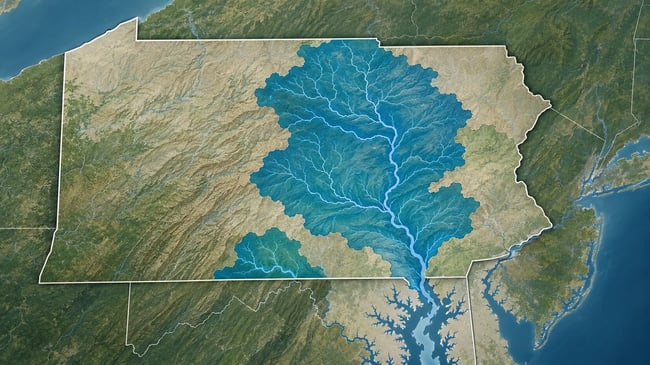
Roughly half of Pennsylvania's land area drains to the Bay, mostly through the Susquehanna and Potomac River basins. Pennsylvania makes up about 35 percent of the entire Bay watershed, and DEP counts all or part of 43 of the state's 67 counties as inside it. The Susquehanna alone supplies about half of the fresh water entering the Bay, which is a big reason the rest of the Bay states look to Pennsylvania when they talk about cleanup.
That covers a lot of industrial ground. The Bay watershed includes counties such as York, Lancaster, Dauphin, Cumberland, Centre, Lycoming, and Bradford, along with many others across the south-central and northern parts of the state. Facilities in the Pittsburgh area generally drain toward the Ohio River instead, and facilities in the Philadelphia area generally drain to the Delaware River, so they aren't part of the Bay picture. Some counties are split between watersheds, which means a county name alone won't settle it for your site.
How Do You Tell Whether Your Facility Drains to the Bay?
Follow the water. Your permit paperwork, site map, and PPC Plan (the Preparedness, Prevention and Contingency Plan that PAG-03 facilities use to document their stormwater controls) should name the stream your outfalls discharge to. From there, DEP's online mapping tools can trace that stream downstream to see whether it joins the Susquehanna or Potomac systems. If your runoff goes to a storm sewer instead of directly to a stream, the municipality that owns the sewer can usually tell you where it discharges.
What Are Pennsylvania's Chesapeake Bay Commitments for Sediment and Nutrients?
The Bay has a TMDL, short for Total Maximum Daily Load, which works like a pollution budget for a water body. The Bay TMDL sets limits on nitrogen, phosphorus, and sediment from the whole watershed. Each state in the watershed, Pennsylvania included, wrote Watershed Implementation Plans explaining how it would cut its share. Pennsylvania's third plan, which targeted goals through 2025, pushed much of the work down to the county level through Countywide Action Plans, backed by state grant money to counties and conservation districts.
Most of Pennsylvania's Bay pollution comes from diffuse sources like farmland and developed land, not from single pipes. That means industrial facilities aren't the largest source. They are, however, among the sources that already hold permits, which makes permitted discharges one of the more visible places where regulators can ask for improvement. DEP's Phase 3 plan has pointed to Bay-minded BMP (best management practice) implementation by industrial stormwater permittees as a goal and has noted that more than 1,000 industrial facilities in the Pennsylvania Bay watershed hold stormwater permits.
The original 2025 target date has passed, and the state and EPA keep reviewing Pennsylvania's progress. Programs and expectations in this area keep shifting, so treat anything you read here, including this article, as a starting point and confirm current details with DEP or with us.
How Does the Bay Watershed Affect PAG-03 and Other Industrial Stormwater Permits?
PAG-03 is a statewide permit, and DEP's published materials don't describe a separate set of Bay-only rules for industrial sites under it. The Bay shows up in more indirect ways, and a few of them are worth a look.
The reissued PAG-03 took effect on March 24, 2023, with a term running through March 23, 2028. It added Total Nitrogen and Total Phosphorus monitoring to every industry appendix, which gives DEP more nutrient data from industrial sites across the state. It also raised the response levels for repeated exceedances of benchmark values, the pollutant concentrations that signal your controls may need work. Our guide to benchmark values versus effluent limits explains how those thresholds work, and our PAG-03 permit and sampling guide covers the Pennsylvania specifics.
Where you discharge shapes your permit path as much as the permit text does. Facilities that discharge to High Quality or Exceptional Value waters can't use PAG-03 or a No Exposure Certification, and they generally need an individual NPDES permit written for the site. Individual permits give DEP room to set conditions based on the receiving stream, which can include limits or monitoring for sediment and nutrients where the stream's condition calls for it. Our article on which NPDES permit you need walks through how those three paths differ, and our comparison of SWPPPs and PPC Plans covers the plan side.
What Happens If You Discharge Stormwater to an Impaired Stream in the Bay Watershed?
An impaired stream is one DEP has assessed as not meeting its designated use, such as supporting aquatic life. DEP has counted more than 12,000 miles of polluted streams and rivers inside Pennsylvania's Bay watershed, and sediment and nutrients are among the common causes. If your outfall discharges to one of those streams, you can expect a closer look than a facility discharging to a healthy stream would get.
The table below shows how the receiving stream can change the picture. Treat it as a general guide, since the details depend on your permit and your site.
| Where Your Stormwater Goes |
What It Can Mean for Your Facility |
| A stream that isn't impaired or designated High Quality or Exceptional Value |
PAG-03 or a No Exposure Certification is usually available if you're eligible, with the monitoring and BMPs in your industry appendix. |
| A stream impaired for sediment or nutrients |
Sampling for the pollutant behind the impairment may be required with your application or renewal, and DEP may look harder at your results and controls. A TMDL for the stream may also assign load reductions. |
| A High Quality or Exceptional Value stream |
PAG-03 and No Exposure aren't available, and an individual NPDES permit is the usual route. |
| A municipal storm sewer |
The municipality's own stormwater permit, plan, and ordinances may apply in addition to anything DEP requires of you, so confirm locally. |
Our article on TMDLs, 303(d) impaired waters, and NPDES stormwater permits goes deeper on how impairment listings connect to permits. If your sample results come back high for sediment or nutrients on an impaired stream, read our guide on what to do when stormwater sampling results are high before your next report goes in.
Why Might Local Stormwater Programs Be More Active in Bay Watershed Counties?
Counties in the Bay watershed have spent the last several years writing and carrying out Countywide Action Plans, and conservation districts have been working with townships, farms, and landowners to find projects that cut sediment and nutrients. Many municipalities also hold MS4 permits. An MS4, or municipal separate storm sewer system, is the network of storm drains and ditches a municipality runs, and the permit covers what it discharges. In the Bay watershed, municipalities with MS4 permits have been required to prepare pollutant reduction plans for sediment and nutrients, though the details vary by permit cycle and by municipality.
For an industrial facility, the practical effect is hard to predict because it depends on your township or borough. You may see updated stormwater ordinances, more inspections, local fees, or requests for information, especially if your runoff enters the municipal system. Local rules can differ from DEP's, so it's worth asking your municipality directly instead of assuming the state permit is the only thing that applies.
What About Construction and Expansion in the Bay Watershed?
Building or expanding a facility usually brings construction-phase requirements too, including erosion and sediment control and post-construction stormwater management under DEP's Chapter 102 rules, plus county conservation district and township approvals. Sediment control tends to be a focus here because bare soil is a major sediment source. RMA doesn't prepare construction-phase permits or approvals. Your engineer, contractor, or a soil erosion specialist handles that piece.
Once the facility is running, you'll generally need the operational side: PAG-03 coverage or a No Exposure Certification, a PPC Plan, inspections, and sampling. We help with those, and we can help you work out what the construction phase needs and point you toward the right construction professionals.
Which Stormwater Controls Reduce Sediment and Nutrients at an Industrial Facility?
Controls that cut sediment usually cut phosphorus too, because phosphorus often travels attached to soil particles. That's why sediment control gets so much attention in Bay-related programs, and it's also the easiest place for an industrial site to make progress. Nitrogen and phosphorus can also come from landscaping fertilizer, bulk agricultural products, organic debris, and similar materials, depending on what your operation handles.
| Control |
What It Targets |
| Sweeping and housekeeping |
Dust, fines, and tracked-out material on paved areas before rain moves it to a drain. |
| Stabilizing bare ground and stockpiles |
Loose soil and aggregate that wash off in heavy rain. Gravel, vegetation, and covers all help. |
| Covering and containing materials |
Exposed bulk materials, fertilizers, and organic matter. Roofs, covers, and berms keep rain off them. |
| Inlet protection and filters |
Solids heading into storm drains. These need regular cleaning to keep working. |
| Swales, basins, and vegetated buffers |
Slowing flow so sediment settles out. These suit larger sites with room to spare. |
Which controls your permit requires depends on your industry appendix and your PPC Plan. Our overview of stormwater BMPs explains the options in plain terms, and your sample results tell you whether the ones you have are working. If your PPC Plan is current, your inspections are being done, and your results sit comfortably under benchmark values, you may not need to change much. Regulators tend to focus on what they can see, so it also helps to know what happens during a PA DEP stormwater inspection.
Controls only work when the people at the site keep them up. Housekeeping, inlet cleaning, and inspections fall to whoever is on shift, so consider our online environmental training library for staff who handle those tasks.
How Does RMA Help Pennsylvania Facilities in the Chesapeake Bay Watershed?
We're based in New Jersey and work with industrial facilities across Pennsylvania. For a facility in the Bay watershed, we can help you work out which stream your outfalls drain to, whether it's impaired or designated High Quality or Exceptional Value, and which permit path fits your site. From there we can help with the PPC Plan, stormwater controls, sampling, and eDMR reporting (DEP's electronic discharge monitoring report system), or review what you already have to see whether anything needs updating. Our guide to Pennsylvania eDMR reporting is a good place to start if you're newer to that system.
If you're not sure whether any of this applies to you, that's a fair question to start with, and we'll tell you if you don't need us. You can call, email, or fill out the form on our website, and there's no obligation. When you're ready, contact RMA and tell us a little about your facility.