Transformers, Hydraulic Presses, and Elevators: The Hidden Oil That Can Put a New Jersey Business Over the Oil Spill Plan Threshold
Ask a facility manager how much oil they store, and most will point to the diesel tank out back or the drums of hydraulic oil in the maintenance shop. Very few will point at the transformer pad, the stamping presses, or the elevator machine room. Federal oil spill rules don't care whether oil sits in a tank or inside a machine, though. If a piece of equipment holds 55 gallons or more of oil, its capacity counts toward the 1,320-gallon aboveground threshold that triggers a Spill Prevention, Control, and Countermeasure (SPCC) Plan, the written oil spill prevention plan EPA requires. Plenty of New Jersey manufacturers and commercial buildings are over that line without knowing it, and their equipment is the reason.
In this article we walk through what EPA calls oil-filled operational equipment, where it hides at typical New Jersey plants, utility sites, and commercial buildings, and how to count it. We also explain a little-known option in the rule that lets qualifying equipment rely on inspections and a contingency plan instead of physical secondary containment, and we cover the New Jersey spill rules that apply on top of the federal ones. If you'd rather have someone walk your site and do the count with you, reach out to RMA.
Table of Contents
TL;DR
Yes. Any equipment with an oil reservoir of 55 gallons or more, including transformers, hydraulic presses, elevators, compressors, and gearboxes, counts toward the 1,320-gallon aboveground threshold for an SPCC Plan, and it's often what pushes a New Jersey facility over the line. Once you're covered, that equipment needs spill controls, but qualifying equipment can use a documented inspection program and an oil spill contingency plan instead of physical containment around every unit. New Jersey's Spill Act also requires you to report discharges from that equipment to NJDEP immediately.
Why Does Oil-Filled Equipment Count Toward the SPCC Threshold?
The SPCC rule, found at 40 CFR Part 112, applies to non-transportation facilities that have more than 1,320 gallons of aggregate aboveground oil storage capacity and could reasonably be expected to discharge oil into navigable waters or adjoining shorelines. The key word in that sentence is capacity. EPA counts every aboveground container of 55 gallons or more, and a container includes the oil reservoir inside a piece of equipment. A 300-gallon hydraulic reservoir on a press counts exactly the same way as a 300-gallon tote of hydraulic oil parked next to it.
The reasoning is simple. Oil in a transformer or a hydraulic system spills just as easily as oil in a tank. Seals fail, hoses burst, cooling fins corrode, and forklifts back into things. A ruptured hydraulic line on a large press can dump most of its reservoir onto the floor in minutes, and from there the oil can run into a floor drain, out a loading dock door, and into a storm sewer. The rule treats that risk the same way it treats a leaking tank.
The problem is that most facilities build their oil inventory from purchasing records and the tank list. Equipment oil doesn't show up on either one. It came with the machine, maintenance tops it off, and nobody thinks of it as storage. That's why equipment keeps landing on our list of the most overlooked SPCC requirements, and why inspectors from EPA Region 2, which enforces SPCC in New Jersey, ask about it during site visits. If you're not sure who enforces SPCC Plans and what an inspection looks like, that article covers it.
What Counts as Oil-Filled Operational Equipment Under SPCC?
EPA defines oil-filled operational equipment as equipment that includes one or more oil containers where the oil is there only to support the function of the device. The regulation's own examples include hydraulic systems, lubricating systems for pumps, compressors, and other rotating equipment, gearboxes, machining coolant systems, heat transfer systems, transformers, circuit breakers, and electrical switches. If the oil is there to make the machine run, move, cool, or insulate, it's almost certainly operational equipment.
Two distinctions are worth knowing. First, oil-filled operational equipment isn't a bulk storage container. That's good news, because the tank-specific requirements in the rule, like integrity testing and overfill controls for bulk containers, don't apply to it. The general requirements that apply to every container still do. Second, the definition leaves out oil-filled manufacturing equipment where oil flows through as part of the process, such as a vessel that blends or treats oil products. That equipment is still regulated, just under different expectations, so it helps to sort your equipment into the right bucket early.
The counting rules are the same ones that apply to tanks and drums. Anything under 55 gallons is left out entirely, so a 40-gallon hydraulic power unit or a compressor with a 10-gallon sump doesn't count, no matter how many of them you have. Anything at 55 gallons or more counts at its full shell capacity, even if it's only half full. Our article on whether 55-gallon drums are included in SPCC Plans walks through the same threshold logic for portable containers.
Fuel oil, lube oil, hydraulic fluid, mineral oil dielectric fluid, synthetic oils, and vegetable-based fluids all count as oil. Some newer transformers use natural ester fluids made from vegetable oil, which catches people who switched to them for fire safety or environmental reasons. They're still oil under SPCC. Propane isn't oil under the rule, and fuel tanks that power vehicles are exempt as motive power containers. That exemption also covers hydraulic systems built into a vehicle, so the hydraulics on a forklift or a wheel loader don't count, but a stationary hydraulic press does.
Where Hidden Oil Shows Up at New Jersey Manufacturing Plants
New Jersey still has a big manufacturing base, especially along the Route 1 and Turnpike corridors through Middlesex, Union, and Somerset counties and in the industrial parks of Camden, Gloucester, and Burlington counties. Walk through almost any of those plants and you'll find oil in places that never made it onto a spreadsheet.
Metal fabricators and stamping shops are the classic case. Large hydraulic presses and press brakes often carry reservoirs in the hundreds of gallons, and a shop with a row of them can cross the threshold on presses alone. Plastics plants have injection molding machines, each with its own hydraulic system. Food and beverage plants have gearboxes on mixers and conveyors, hydraulics on packaging lines, and big refrigeration compressors. Chemical and pharmaceutical plants along the Raritan have thermal oil heating systems, large compressors, and their own electrical gear. Recycling yards and distribution centers run stationary balers and compactors that are basically hydraulic presses with a different job.
| Equipment |
Where You'll Find It in New Jersey |
Oil Type |
What to Check |
| Hydraulic presses and press brakes |
Metal stamping, fabrication, auto parts |
Hydraulic oil |
Reservoir capacity on the nameplate; larger units often exceed 55 gallons |
| Injection molding and die casting machines |
Plastics, packaging, metal casting |
Hydraulic oil |
Each machine is its own container |
| Air and refrigeration compressors |
Most plants, cold storage, food processing |
Lube oil |
Many sumps are under 55 gallons, but large industrial units can be over |
| Gearboxes and speed reducers |
Mixers, conveyors, crushers, kilns |
Gear oil |
Big drives on crushers and mills are the usual culprits |
| Thermal oil heating systems |
Chemical, plastics, food processing |
Heat transfer oil |
Count the expansion tank and system volume |
| Stationary balers and compactors |
Recycling, warehouses, retail distribution |
Hydraulic oil |
Large two-ram balers commonly hold well over 55 gallons |
Nameplates and manufacturer manuals are the fastest way to get capacities. Where those are missing, your maintenance team usually knows how much oil goes in during a full change. Record the number for each unit separately, because SPCC looks at each container on its own before anything gets added up. A press with a 50-gallon reservoir is out, and a press with a 60-gallon reservoir is in, even though the difference is ten gallons.
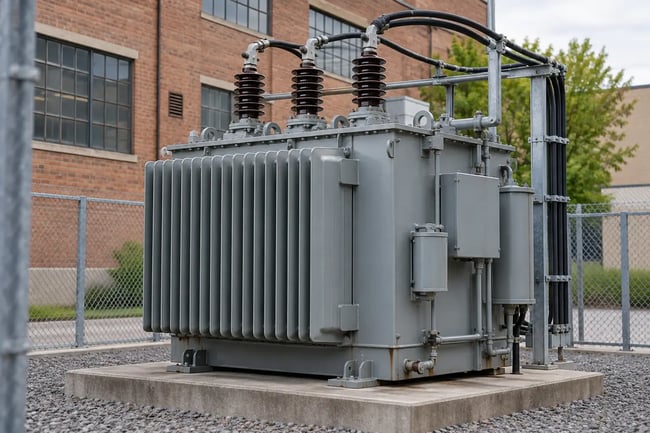
Electrical equipment is the other big source of hidden oil. Pad-mounted and substation transformers are filled with dielectric oil, and larger units can hold hundreds or even thousands of gallons. Oil-filled circuit breakers, switches, and regulators add more. Ownership matters here. Transformers owned and operated by your electric utility, whether that's PSE&G, JCP&L, Atlantic City Electric, or Rockland Electric, are generally the utility's responsibility. Larger plants, campuses, and hospitals often own their own transformers and switchgear behind the meter, though, and those belong in your count. If nobody knows who owns a unit, find out before you leave it off.
Utility-type operations have their own version of this problem. A water authority's pump station or a sewerage authority's treatment plant can have transformers, large pump motors with lube systems, and a backup generator, all spread across a site with storm inlets nearby. Electrical substations are subject to SPCC when they cross the threshold, and the sheer amount of oil-filled electrical equipment across the country is one of the main reasons EPA wrote a special option for it.
Elevators catch almost everyone off guard. Hydraulic elevators use a reservoir of hydraulic oil in the machine room, plus a jack cylinder that's often set into the ground below the car. Smaller passenger units may hold less than 55 gallons, but freight elevators and larger units can hold more. An office park, hospital, or warehouse in North Jersey with several hydraulic elevators and an emergency generator can reach 1,320 gallons with no tank farm at all.
Data centers are the extreme version, with rows of transformers on top of large generator fuel systems, and our data center guide to SPCC Plans covers that setup in detail. One note on backup generators in general: the fuel tank under a generator is a bulk storage container, not operational equipment, so it doesn't qualify for the equipment option described below. Our article on emergency backup generators and environmental permits covers the other rules a generator can trigger.
How to Count Oil-Filled Equipment Toward the 1,320-Gallon SPCC Threshold
Counting is mostly bookkeeping. List every aboveground container of 55 gallons or more, including tanks, drums, totes, and equipment reservoirs, write down its shell capacity, and add them up. If the total is more than 1,320 gallons, you've met the capacity part of the test. Completely buried tanks are counted separately against a 42,000-gallon threshold, and tanks regulated under the UST rules are generally left out of that count.
Here's an example for a mid-sized fabrication shop in Middlesex County. The numbers are made up, but they're realistic.
| Container |
Type |
Capacity (gallons) |
Counted? |
| Emergency generator base tank |
Bulk storage |
500 |
Yes |
| Four drums of hydraulic oil |
Bulk storage |
220 |
Yes |
| Ten 5-gallon pails of lube oil |
Bulk storage |
50 |
No, each is under 55 gallons |
| Hydraulic press #1 |
Operational equipment |
180 |
Yes |
| Hydraulic press #2 |
Operational equipment |
180 |
Yes |
| Company-owned pad-mounted transformer |
Operational equipment |
350 |
Yes |
| Air compressor sump |
Operational equipment |
12 |
No, under 55 gallons |
| Total, tanks and drums only |
|
720 |
Under the threshold |
| Total, with equipment |
|
1,430 |
Over the threshold |
Going by the tank list, this shop sits at 720 gallons and looks comfortably exempt. Count the presses and the transformer and it's at 1,430 gallons. That's the most common way we see facilities find out they needed a plan all along, usually during an insurance review, a property sale, or a lender's due diligence.
Capacity is only half the test. The other half is whether a discharge could reasonably reach navigable waters or adjoining shorelines. In New Jersey, with dense storm sewer systems and rivers, wetlands, and tidal waters everywhere, that's a hard argument to win. The rule also won't let you count manmade features like dikes, berms, or building walls when you make that call. Our guide to the four steps to figure out if you need an SPCC Plan walks through the full applicability process.
If you already have an SPCC Plan and never counted your equipment, that's a gap to close. Adding containers or changing your facility in a way that affects discharge potential means the plan needs an amendment, and our article on when to update your SPCC Plan explains when you can handle that yourself. Every plan also needs a review at least once every five years, which is a good moment to walk the floor again.
What Is the SPCC Contingency Plan Option for Oil-Filled Equipment?
Once a facility is covered, the general rule is that every container, equipment included, needs appropriate containment or diversionary structures to keep a discharge from leaving the site. For equipment, that's the general secondary containment requirement in 40 CFR 112.7(c). It's sized for the typical failure mode and the most likely quantity of oil released, not the full-capacity sizing that bulk storage tanks get. Curbing, drip pans, sumps, berms, and in some situations sorbent materials can all qualify. Our article on how big SPCC containment needs to be explains how that sizing works in practice.
Containing every piece of equipment isn't always realistic. Curbing around an outdoor transformer pad is straightforward. Containing a press in the middle of a production floor, or the in-ground cylinder of an elevator, is a different story. That's why EPA added 40 CFR 112.7(k) in 2006. It lets qualified oil-filled operational equipment skip general secondary containment if the facility commits to a different set of safeguards.
The Three Requirements of the SPCC Oil-Filled Equipment Option
First, the facility has to establish and document inspection procedures or a monitoring program designed to catch equipment failures and discharges. Second, the SPCC Plan has to include an oil spill contingency plan that follows EPA's contingency planning rules in 40 CFR Part 109. Third, the plan needs a written commitment of the manpower, equipment, and materials required to quickly control and remove any harmful quantity of oil that gets out. Facilities that already have a Facility Response Plan don't need the second and third pieces, since that plan covers them.
A contingency plan is more than a paragraph saying you'll call a cleanup contractor. It spells out who's responsible, how notifications happen, what specific steps people take to stop and contain a release, and what response equipment and outside help are available. The written commitment needs real backing too. Management is putting people and resources behind it, and an inspector may ask how you'd follow through.
When the SPCC Oil-Filled Equipment Option Fits, and When It Doesn't
Eligibility comes down to spill history. Equipment qualifies only if, in the three years before the plan was certified (or since the facility became subject to SPCC, if that's been less than three years), the facility hasn't had a single reportable discharge from oil-filled operational equipment over 1,000 gallons, or two reportable discharges from that equipment of more than 42 gallons each within any 12-month period. Discharges caused by natural disasters, acts of war, or terrorism don't count against you. Reportable here means oil that reached navigable waters or adjoining shorelines in a harmful quantity, not a drip on the shop floor.
This option is also different from claiming containment is impracticable. Under the separate impracticability provision, a Professional Engineer has to explain why containment won't work, and bulk storage containers then need periodic integrity testing on top of the contingency plan. The equipment option skips that impracticability finding. You can choose it simply because it's the better fit for a given piece of equipment.
| |
General Secondary Containment |
Inspections and Contingency Plan |
| What you put in place |
Curbing, berms, drip pans, sumps, or sorbents sized for a typical failure |
A documented inspection or monitoring program, a Part 109 contingency plan, and a written resource commitment |
| Best fit |
Outdoor transformers, equipment near drains or doors, units with a leak history |
Equipment where containment is hard to build, like production floors, elevators, and crowded electrical rooms |
| Ongoing work |
Inspecting the containment and managing rainwater that collects in it |
Running and recording inspections, keeping the contingency plan current, training staff |
| If a leak happens |
Oil stays inside the containment |
You depend on fast detection and response to keep oil on site |
| Availability |
Always an option |
Only if the facility's spill history qualifies |
Most facilities end up mixing the two. An outdoor transformer near a storm inlet usually gets curbing or a containment pan, because it's cheap and it protects you. Presses on an interior floor with no drains nearby are often good candidates for the contingency approach, as long as somebody really does the inspections. The inspection program is where this option succeeds or fails. If inspections exist on paper but not on the floor, an inspector will figure that out quickly. Our tips for SPCC monthly inspections apply to equipment as much as tanks, and the people doing the checks need to know what a weeping fitting or a failing seal looks like. Our online training library includes SPCC training for oil-handling staff.
New Jersey Spill Rules That Apply to Equipment Oil
SPCC is a federal program, but New Jersey adds its own layer. The Spill Compensation and Control Act, usually called the Spill Act, covers petroleum and a long list of other hazardous substances, and it requires a discharge to be reported to NJDEP immediately through the 24-hour hotline at 1-877-WARNDEP (1-877-927-6337). That applies to a burst press hose or a leaking transformer the same as a tank failure. The federal reporting test, which turns on whether oil reaches water, is explained in our article on the federal sheen rule, and New Jersey's reporting duty reaches further than that. If anyone is hurt or in danger, call 911 first.
The Spill Act also makes cleanup liability strict, which generally means fault doesn't matter, and that liability can be joint and several among responsible parties. Oil that soaks into soil can turn into a remediation case that needs a Licensed Site Remediation Professional (LSRP). If you're dealing with a release or questions about who's liable, it's smart to bring in an environmental attorney alongside your technical help.
Larger sites may also be major facilities under N.J.A.C. 7:1E, which covers facilities with an aggregate storage capacity of 20,000 gallons or more of hazardous substances other than petroleum, or 200,000 gallons or more of all hazardous substances combined. Major facilities need Discharge Prevention, Containment and Countermeasure (DPCC) and Discharge Cleanup and Removal (DCR) plans approved by NJDEP. Most of the plants described in this article are nowhere near those numbers, but if yours is, equipment oil belongs in that review too. Our overview of SPCC Plans in New Jersey covers how the state and federal programs fit together.
One more wrinkle for older New Jersey facilities: transformers and capacitors from before the late 1970s may contain PCBs, which are regulated under the federal Toxic Substances Control Act in addition to SPCC. If you have older electrical equipment and no test results for the oil inside it, get that answered before something leaks, because a PCB release changes the cleanup picture considerably.
What Does an SPCC Plan Cost When Oil-Filled Equipment Is Included?
Including equipment doesn't change what an SPCC Plan is, but it does add work. Someone has to inventory each unit, confirm capacities and ownership, decide unit by unit between containment and the contingency option, and write the inspection program and contingency plan if that option gets used. For a facility that's only over the threshold because of its equipment, though, the plan is often on the simpler end.
RMA's published range for a new SPCC Plan runs from about $2,500 to $15,000, depending on how much oil you have, how many containers there are, and whether the plan needs a Professional Engineer's certification. Facilities with 10,000 gallons or less of aboveground oil and a clean spill history may be able to self-certify, and our article on Tier I self-certified SPCC Plans explains who can use the simplest version. Updating an existing plan to add equipment that was missed runs about $1,500 for a simple Tier I update and $7,500 or more for a complex PE-certified plan. Our full breakdown of SPCC Plan costs goes deeper.
If you want a ballpark for what RMA's help would cost for your facility, try the SPCC pricing calculator below.
How RMA Helps New Jersey Facilities Account for Oil-Filled Equipment in SPCC Plans
We're based in New Jersey and we've been helping facilities with environmental compliance since 1992, so walking a plant floor and finding the presses, transformers, and elevator reservoirs nobody counted is familiar ground for us. We'll help you build an accurate inventory, figure out whether you're over the threshold, and decide where containment makes sense and where the contingency option fits better. If you turn out to be under the threshold once everything's counted, we'll tell you that too.
If you already have a plan and the equipment never made it in, we can help you update it, or let you know if it's a change you can make on your own. There's no pressure and no obligation. Give us a call, send us an email, or fill out the form on our website, and get in touch with RMA whenever you're ready.