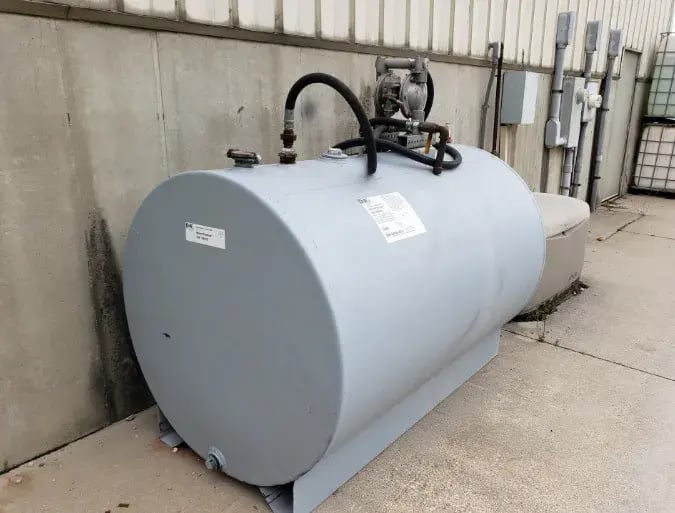
When Buried, Partially Buried, and Bunkered Oil Tanks Count Toward Your SPCC Plan Requirements
If you've got a buried oil tank somewhere on your property, it's easy to assume it falls outside your spill plan because nobody can see it. Sometimes that's right, and sometimes it's the opposite. The SPCC rule (Spill Prevention, Control, and Countermeasure, EPA's federal oil storage rule in 40 CFR Part 112) treats underground tanks differently depending on how they're installed and whether another set of rules already covers them. For most New Jersey facilities, the answer comes down to two questions: is the tank completely buried, and is it already regulated as an underground storage tank (UST) under the federal UST rules in 40 CFR Part 280?
Here's the short version. Completely buried tanks that fall under the federal UST rules are generally left out of your SPCC capacity count. Other buried tanks count toward a 42,000-gallon buried threshold, and partially buried and bunkered tanks are counted as aboveground. We'll walk through each category, explain where New Jersey's own UST program fits, and show you how to sort your tanks. If you'd like a second set of eyes on yours, you can reach out to RMA at any point.
Table of Contents
TL;DR
Completely buried tanks that are subject to the federal UST rules (40 CFR Part 280) don't count toward your SPCC capacity and don't get SPCC treatment, though they still go on your facility diagram. Other buried tanks, such as many nonresidential heating oil tanks and buried vegetable oil tanks, count toward the 42,000-gallon buried threshold and get covered by your plan if your facility is subject to SPCC. Partially buried tanks, bunkered tanks, and tanks in vaults are treated as aboveground and count toward the 1,320-gallon aboveground threshold. New Jersey's UST program sits on top of all of this, so the safe approach is to sort each tank by which rules cover it.
What Counts as a Completely Buried Tank Under the SPCC Rule?
The SPCC rule defines a completely buried tank as a container that's completely below grade and covered with earth, sand, gravel, asphalt, or other material. That's a tight definition. A tank in a vault doesn't qualify, and neither does a bunkered tank or a partially buried one. The rule treats all three as aboveground containers. Capacity also means the tank's full shell capacity, not however much oil happens to be in it on a given day.
The definition decides which of the rule's two thresholds a tank counts toward. A facility is outside the rule only if it meets both of two conditions: its completely buried capacity is 42,000 gallons or less, and its aggregate aboveground capacity is 1,320 gallons or less, counting only containers of 55 gallons or larger. Miss either one and the rule applies. A facility with a few small buried tanks and a single 2,000-gallon aboveground diesel tank is subject to SPCC no matter how little oil is underground. Once a facility is subject, EPA's position is that all of its aboveground containers and completely buried tanks fall under the rule unless something specifically exempts them. If you're still working out whether you're subject at all, our four-step guide to figuring out if you need an SPCC plan and our overview of what an SPCC plan is are good places to start.
Which Underground Tanks Are Left Out of SPCC Capacity Counts?
The big carve-out is for tanks already governed by the federal UST program. Under 40 CFR 112.1(d), a completely buried tank, along with its connected underground piping, ancillary equipment, and containment systems, is excluded when it's subject to all of the technical requirements of 40 CFR Part 280 or of a state program approved under Part 281. Its capacity also drops out of the 42,000-gallon buried calculation. The UST rules cover buried tanks holding petroleum or certain hazardous substances where 10 percent or more of the volume, counting connected piping, is beneath the ground. Think gas station tanks, fleet diesel tanks, and similar systems with leak detection, spill and overfill protection, and registration requirements.
Two details trip people up. First, the exclusion depends on the tank being subject to all of those technical requirements, not some of them. Second, excluded doesn't mean invisible. If your facility is otherwise subject to SPCC, the tank still has to be marked on your facility diagram. EPA's own example is a gas station with no aboveground storage that adds a large aboveground tank. The new tank brings the facility under SPCC, the existing UST stays exempt as long as it meets the UST criteria, and the plan shows that UST on the diagram.
Some other buried tanks drop out for different reasons. A tank that's permanently closed, as the rule defines it, doesn't count toward capacity. Closed means all liquid and sludge is out, the connecting lines are disconnected and blanked off, the valves are closed and locked, and a sign on the container says it's permanently closed along with the date. A tank that's simply sitting unused, or kept for standby or seasonal storage, still counts. Emergency generator tanks are another case worth checking. They were deferred from the federal UST rules for years, but the 2015 revisions brought them in, with older tanks required to meet the operating requirements by October 13, 2018 and newer ones required to meet them at installation. A generator tank that now meets Part 280 is in the same position as any other regulated UST, so don't lean on an old plan's assumption about it.
Which Buried Tanks Count Toward the 42,000-Gallon SPCC Threshold?
Any completely buried oil tank that isn't covered by the UST rules counts, and several common tanks land in that group because the UST rules leave them out. The federal definition of an underground storage tank excludes tanks that store heating oil for use on the same property, septic tanks, flow-through process tanks, and farm or residential motor fuel tanks of 1,100 gallons or less used for noncommercial purposes. The UST rules also exclude hydraulic lift tanks, tanks that are part of electrical equipment, tanks of 110 gallons or less, and wastewater treatment tank systems. They only cover petroleum and certain hazardous substances, so a buried vegetable oil or animal fat tank isn't a UST at all, even though SPCC treats those oils the same as petroleum.
A buried heating oil tank is the one we run into most. Picture a manufacturer with a 5,000-gallon buried No. 2 fuel oil tank feeding its boilers. The federal UST program doesn't touch that tank, so its capacity counts toward the 42,000-gallon buried threshold, and it belongs in the SPCC plan if the facility is subject. That tank alone rarely trips the threshold, because 42,000 gallons is a high bar. What usually triggers the plan is aboveground storage over 1,320 gallons, and at that point the buried tank comes along into the plan. Being in the plan means the plan has to address how you'll prevent, detect, and respond to a leak from it, the same way it does for your aboveground containers.
Buried tanks get one more break. EPA's instructions for its Tier I self-certified plan template note that completely buried tanks are subject to the rule but don't count toward the capacity criteria that qualified facilities have to meet. If you're sorting out which plan type fits your site, our guide to the different types of SPCC plans and our explainer on Tier I self-certified plans lay out the options.
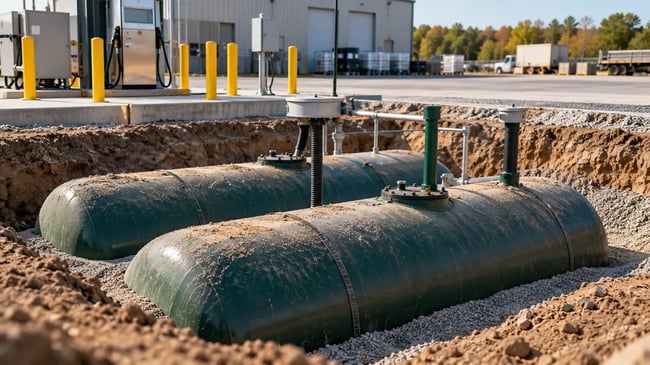
How Does SPCC Treat Partially Buried and Bunkered Tanks?
These count as aboveground containers. The rule defines a partially buried tank as one that's partially inserted or built into the ground but isn't entirely below grade and isn't completely covered. A bunkered tank is one that's placed in the ground by cutting the earth and re-covering it in a way that breaks the natural grade, or one that sits above grade and is covered with earth, sand, gravel, asphalt, or other material. Think of a tank under a mound of soil, or a tank set into a hillside with fill piled over it. Both are aboveground containers for SPCC purposes, and so is a container in a vault.
The practical result is that these tanks count toward the 1,320-gallon aboveground threshold and get the full set of requirements for aboveground bulk storage containers, including sized secondary containment, routine inspections, integrity testing, and overfill protection. A single partially buried 5,000-gallon diesel tank puts a facility over the aboveground line by itself. Because the UST carve-out is written for completely buried tanks, we read it as not automatically covering a bunkered or vaulted tank, even if a UST program also regulates it, so run those cases past someone who works with them regularly. A tank sitting on the floor of a basement or underground room isn't covered with earth, so it isn't completely buried either. Our articles on how big your SPCC oil spill containment needs to be and whether 55-gallon drums count in SPCC plans cover the aboveground side of the math.
How Does New Jersey's UST Program Fit With SPCC?
New Jersey runs its own UST program under N.J.A.C. 7:14B, administered through NJDEP's Site Remediation Program. It covers registration, operation, design, installation, release reporting, remediation, and closure. The program applies to tanks that store motor fuel, liquid petroleum products, waste oil, or other hazardous substances, and to heating oil tanks at nonresidential properties once the total on site passes 2,000 gallons. Residential heating oil tanks, smaller nonresidential heating oil tanks, flow-through process tanks, wastewater treatment tanks, and hydraulic lift tanks are exempt from the chapter, and so are farm and residential motor fuel tanks of 1,100 gallons or less. Owners register regulated tanks with NJDEP, and installing, testing, or closing one has to be done by NJDEP-certified individuals and firms. If a regulated tank leaks, the cleanup generally runs through a Licensed Site Remediation Professional (LSRP).
That means one tank can answer to two agencies. EPA Region 2 enforces SPCC in New Jersey, while NJDEP runs the UST rules, and each has its own rule book. A registered New Jersey petroleum UST that's meeting its requirements is the usual candidate for the SPCC exclusion. Our articles on who enforces SPCC plans and SPCC plans in New Jersey cover how the two layers work together.
The wrinkle is the nonresidential heating oil tank over 2,000 gallons. New Jersey regulates it, but the federal UST definition leaves it out. Under the federal rules for approving state programs, coverage a state adds beyond what federal law requires isn't part of the approved program. As we read it, that means these tanks generally don't earn the SPCC exclusion just because NJDEP regulates them, so they stay in your capacity count and your plan. That reading is worth confirming for any specific tank before you rely on it.
Installing or closing a regulated tank is a job for NJDEP-certified UST contractors, and it's outside what we do. We handle the SPCC side: how each tank gets counted, shown on the diagram, and covered in your plan, so the tank work and the plan don't contradict each other. If you ever find a leak or discharge, report it to NJDEP right away. NJDEP's website has the current hotline number.
How Do You Sort Your Tanks for an SPCC Plan?
Start with a tank inventory that lists every underground, partially buried, bunkered, and vaulted tank on the site, along with its size, what's in it, and whether it's registered with NJDEP. Then run each tank through the same questions in the same order. The table below shows where the common tank types land.
| Tank type |
SPCC treatment |
Counts toward |
| Completely buried tank subject to all of 40 CFR Part 280 (or an approved state program) |
Excluded, but marked on the facility diagram |
Neither threshold |
| Completely buried tank not covered by Part 280, such as a nonresidential heating oil tank, a vegetable oil tank, or a hydraulic lift tank |
Covered by SPCC |
42,000-gallon buried threshold |
| Permanently closed buried tank that meets the rule's definition |
Excluded from capacity |
Neither threshold |
| Partially buried tank |
Treated as aboveground |
1,320-gallon aboveground threshold |
| Bunkered tank |
Treated as aboveground |
1,320-gallon aboveground threshold |
| Tank in a vault |
Treated as aboveground |
1,320-gallon aboveground threshold |
The tanks that cause trouble are the ones nobody's sure about. Older sites often have a buried tank that was installed decades ago, changed hands once or twice, and has no paperwork. If you can't show that a tank is registered and covered by the UST rules, you can't comfortably treat it as excluded. Keep your UST registration records with your SPCC records so the reason a tank is excluded is written down. And when you add, close, or reclassify a tank, your plan usually needs updating. Our articles on getting an SPCC plan updated and when to update your SPCC plan explain how that works.
How Does RMA Help With Underground Tanks and SPCC Plans?
First, you may not need us. A facility with a few registered UST systems and no aboveground oil over 1,320 gallons may not be subject to SPCC at all, and a quick read of the numbers above will tell you. If your tanks are mixed, with some buried, some bunkered, and a few of unknown status, that's where we can help. We're based in New Jersey, we know how NJDEP and EPA Region 2 each treat these tanks, and our senior staff does the actual work rather than handing it off. We'll sort your tanks, work out what counts toward each threshold, and build or update your plan so it matches what's in the ground. Our write-ups on what SPCC plans cost and what it's like to hire an SPCC plan consultant show how we work before you commit to anything.
There's no pressure and no obligation. You can call or email us, or fill out the form on our website, and we'll talk through your tanks and tell you what you need, including when that's nothing. When you're ready, contact us and we'll take it from there.