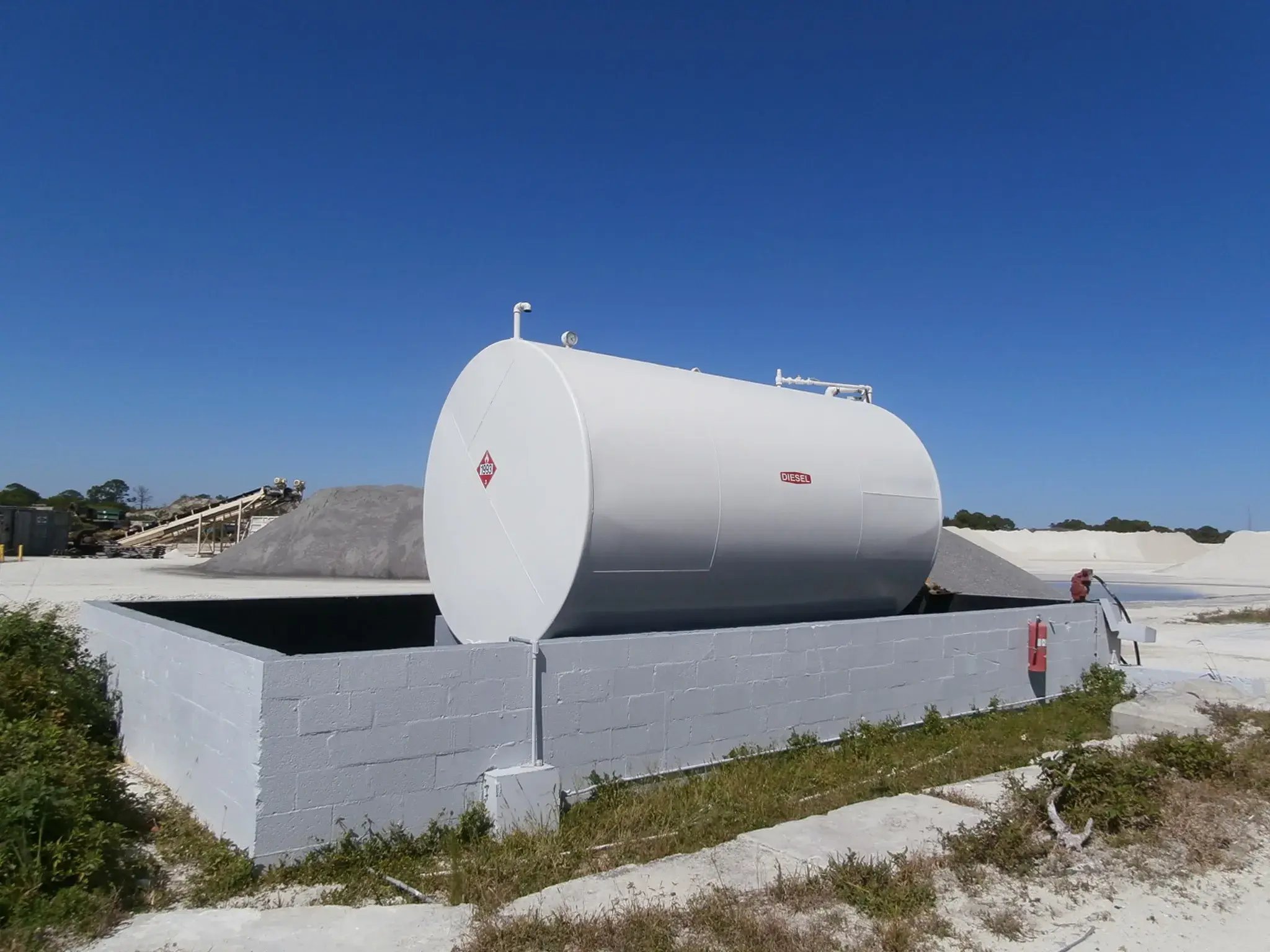
How Buried, Partially Buried, and Bunkered Tanks Are Counted Under the Federal Oil Spill Rule, and Where Pennsylvania's Storage Tank Program Fits In
If your facility has a tank in the ground, you've probably wondered whether it counts when you add up your oil storage for the Spill Prevention, Control, and Countermeasure (SPCC) rule. SPCC is EPA's oil spill prevention rule at 40 CFR Part 112, and it applies to a facility that stores more than 1,320 gallons of oil aboveground or more than 42,000 gallons completely buried. For buried tanks, the answer depends on two things: whether the tank is completely below grade, and whether it's already regulated as an underground storage tank (UST) under federal or state rules. Get either one wrong and your capacity math is off, which can mean a missing plan or a plan that leaves out tanks it should cover.
In this article we walk through how completely buried tanks are treated, which ones are excluded and which ones count toward the 42,000-gallon buried threshold, why partially buried and bunkered tanks are counted as aboveground, and how Pennsylvania's own UST program fits alongside the federal rule. If you'd rather have someone go through your tanks with you, you can reach out to RMA anytime, and we'll tell you straight if you don't need a plan.
Table of Contents
TL;DR
Completely buried tanks that are fully covered by the federal UST rules (40 CFR Part 280) or a state program approved under Part 281 are left out of your SPCC capacity count. Completely buried tanks that fall outside those rules, like many heating oil tanks used on the property and tanks of vegetable oil, count toward the 42,000-gallon buried threshold. Partially buried, bunkered, and vaulted tanks are treated as aboveground containers, so they count toward the 1,320-gallon aboveground threshold instead. Inventory every tank by how it sits relative to grade and which rules cover it before you decide whether you need a plan.
How Does SPCC Count Buried Oil Storage?
The SPCC rule uses two separate capacity tests, and crossing either one can bring a facility under the rule. The first counts aboveground storage: more than 1,320 gallons in total, counting only containers of 55 gallons or more. The second counts completely buried storage: more than 42,000 gallons. A facility only has to exceed one of them, and it also has to be the kind of facility that could reasonably be expected to discharge oil to navigable waters or adjoining shorelines. Our guide to the steps for figuring out if you need an SPCC plan covers that full applicability question, and our article on 55-gallon drums and SPCC plans explains how the 55-gallon cutoff works.
Capacity is what counts, not how much oil is in the tank today. An empty buried tank still counts toward the total unless it's been permanently closed, which is a defined term in 40 CFR 112.2 and not the same thing as being empty. Once a facility crosses a threshold, the plan has to address every container the rule reaches at that facility, buried tanks included, not just the ones that pushed it over.
So each tank lands in one of three buckets: excluded, counted toward the 42,000-gallon buried total, or, if it isn't completely buried, counted toward the 1,320-gallon aboveground total. The next three sections take those in order.
Which Completely Buried Tanks Are Excluded From the SPCC Count?
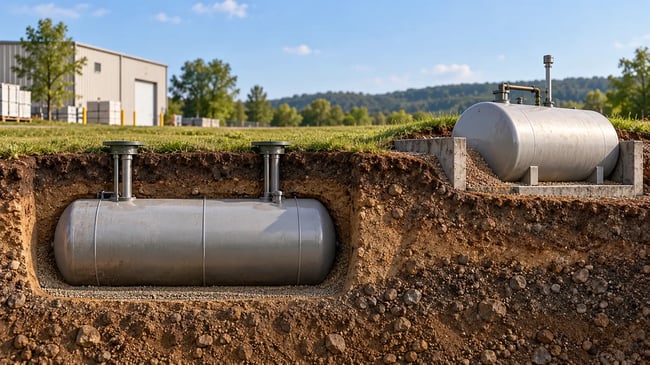
EPA defines a completely buried tank as any container completely below grade and covered with earth, sand, gravel, asphalt, or other material. The definition is narrow on purpose. It states that containers in vaults, bunkered tanks, and partially buried tanks are considered aboveground storage containers, and we cover those in a later section.
For a tank that does meet the completely buried definition, the big exclusion is for tanks already regulated as USTs. The SPCC rule leaves out any completely buried storage tank, plus its connected underground piping, underground ancillary equipment, and containment systems, that's subject to all of the technical requirements of 40 CFR Part 280 or of a state program approved under 40 CFR Part 281. That capacity also comes out of the 42,000-gallon buried total. The logic is that these tanks already have their own federal or state rules for release detection, corrosion protection, spill and overfill prevention, and operator training, so EPA doesn't stack SPCC on top. A fully compliant underground diesel or gasoline tank at a fueling station or fleet yard is the classic example.
Part 280 covers tanks that hold petroleum or CERCLA hazardous substances and that have 10 percent or more of their volume beneath the surface, and it has its own list of exclusions. Underground tanks that store fuel solely for emergency generators installed after October 13, 2015 have to meet all applicable Part 280 requirements from installation, and older ones had to meet the release detection requirements by October 13, 2018. That puts most buried generator tanks under the UST rules and outside your SPCC count. Our article on environmental permits for emergency backup generators covers the other permits generators tend to trigger.
The exclusion turns on whether the tank is subject to those rules. A buried tank outside them isn't excluded, which the next section covers.
Which Buried Tanks Count Toward the 42,000-Gallon SPCC Threshold?
If a completely buried tank isn't subject to Part 280 or an approved state program, it counts toward your completely buried capacity. The federal UST definition and Part 280's exclusions leave out several tanks that turn up at industrial and commercial facilities all the time.
| Completely buried tank |
Covered by the federal UST rule? |
Counts toward the 42,000-gallon buried total? |
| Gasoline, diesel, or used oil tank over 110 gallons, covered by all Part 280 requirements |
Yes |
No, excluded |
| Heating oil tank used on the property where the oil is consumed |
No, left out of the UST definition |
Yes |
| Farm or residential motor fuel tank of 1,100 gallons or less, noncommercial use |
No, left out of the UST definition |
Yes |
| Tank of 110 gallons or less |
No, excluded from Part 280 |
Yes, if it holds 55 gallons or more |
| Tank holding vegetable oil or animal fat |
No, not a regulated substance |
Yes |
| In-ground hydraulic lift tank |
No, excluded from Part 280 |
Yes if completely buried, aboveground if it sits in a vault |
Most facilities won't cross 42,000 gallons from buried tanks alone, so the buried threshold rarely triggers a plan by itself. These tanks still matter because once a facility is subject to SPCC for any reason, the plan has to cover them, including corrosion protection and the buried piping provisions we describe below. Vegetable oils and animal fats count the same way underground as they do aboveground, which our article on SPCC plans for cooking oil walks through.
How Are Partially Buried and Bunkered Tanks Counted for SPCC?
These are the tanks that cause the most mistakes. A bunkered tank is a container placed in the ground by cutting the earth and re-covering it in a way that breaks the surrounding natural grade, or one that lies above grade and is covered with earth, sand, gravel, asphalt, or other material. A partially buried tank sits partly in the ground and isn't entirely below grade or completely covered. EPA's rule says both are considered aboveground storage containers, and it says the same about containers in vaults.
| How the tank sits |
How SPCC treats it |
Threshold it counts toward |
| Completely buried |
Buried tank, unless excluded as a regulated UST |
42,000 gallons buried |
| Partially buried |
Aboveground container |
1,320 gallons aboveground |
| Bunkered (covered with earth or other material) |
Aboveground container |
1,320 gallons aboveground |
| In a vault |
Aboveground container |
1,320 gallons aboveground |
The word that trips people up is "underground." A tank doesn't have to be completely below grade to be a UST under the federal rule, because the UST definition reaches a tank with 10 percent or more of its volume beneath the surface. So a half-buried tank can be a UST for Part 280 purposes and still be an aboveground container for SPCC. The SPCC exclusion is written for completely buried tanks, so as we read the rule, a partially buried or bunkered tank counts as aboveground whether or not the UST rules also reach it. If you have one of these, confirm how it's being treated before you finalize your capacity count.
Being aboveground has consequences beyond the count. These containers pick up the aboveground bulk storage requirements, including secondary containment sized for the largest container plus freeboard, integrity testing, and overfill protection, along with a separate corrosion protection provision for partially buried and bunkered metallic tanks. Our article on how big your SPCC oil spill containment needs to be explains the sizing math.
Here's how this plays out in a hypothetical. Picture a fleet yard with a 20,000-gallon buried diesel tank that's fully covered by the UST rules, a 1,000-gallon buried heating oil tank, and a 2,000-gallon partially buried used oil tank. The diesel tank is excluded. The heating oil tank counts toward the buried threshold, but 1,000 gallons is a long way from 42,000. The partially buried tank is aboveground for SPCC purposes, and at 2,000 gallons it exceeds the 1,320-gallon aboveground threshold by itself. Assuming the yard could reasonably be expected to reach navigable waters with a spill, it needs an SPCC plan because of that one tank, and the plan covers the heating oil tank too.
How Does Pennsylvania's UST Program Work Alongside SPCC?
Pennsylvania facilities answer to two sets of oil tank rules that overlap but aren't the same. EPA Region 3 enforces the federal SPCC rule in Pennsylvania, and our article on who enforces SPCC plans covers how that works. Separately, PA DEP's Storage Tank Program administers the Storage Tank and Spill Prevention Act and the regulations at 25 Pa. Code Chapter 245, which cover both underground and aboveground storage tanks.
The state program is where a regulated UST gets its day-to-day requirements. A regulated underground tank in Pennsylvania generally means one holding more than 110 gallons of a regulated substance. Owners register each one with DEP within 30 days after installation or after acquiring an ownership interest, and DEP invoices registration fees every year after that. Installation and inspection work involves DEP-certified individuals, owners have the system inspected by a certified inspector at the frequency Chapter 245 sets, and owners have to designate and train Class A, B, and C operators.
For SPCC purposes, a tank that DEP registers and permits as a regulated UST is the clearest example of a tank subject to the UST requirements, and it's generally excluded from your SPCC capacity count. Heating oil tanks used on the property where the oil is consumed generally sit outside both the federal UST rule and DEP's tank program, which is why they land in the SPCC count even if DEP has never heard of them. DEP's rules don't replace SPCC, though. A facility can have every UST registered and permitted and still need an SPCC plan because of aboveground tanks, partially buried tanks, or buried tanks outside the UST rules. An SPCC plan doesn't replace DEP registration either. Whether a specific tank is regulated depends on its size, contents, and use, so confirm yours against DEP's storage tank program. DEP's Storage Tank Program customer service line is 1-800-42TANKS inside Pennsylvania or 717-772-5599.
If you're installing, replacing, or removing a buried tank, that work can involve DEP-certified installers and construction-phase approvals that we don't handle. You'd work with your engineer, contractor, or a DEP-certified tank company for that piece, and we can help you figure out what it needs and point you to the right people. We help with the operational side: how the tank is counted, whether your SPCC plan needs an amendment, and keeping the plan current.
What Should You Do to Sort Out Your Buried Tanks for SPCC?
Start with a tank inventory, and make it specific. For every container with a capacity of 55 gallons or more, write down its capacity, what it holds, how it sits relative to grade (completely buried, partially buried, bunkered, or in a vault), when it was installed, and whether DEP has it registered. DEP's active storage tank search can help you confirm what the state has on file for your facility.
Then sort the tanks into three groups: completely buried tanks covered by the UST rules (excluded), completely buried tanks outside those rules (counted toward the 42,000 gallons), and everything else, meaning partially buried, bunkered, vaulted, and aboveground containers (counted toward the 1,320 gallons). Add up each group separately. Oil-filled equipment counts too, so include it.
If you're over either threshold, the plan has to cover every tank the rule reaches, including the buried ones. For completely buried metallic tanks, that includes corrosion protection. For buried piping, the rule calls for inspecting piping that's exposed for any reason and for integrity and leak testing when piping is installed or modified. The plan also needs a five-year review, plus an amendment when you add, remove, or change a tank in a way that affects your spill potential. Our article on whether you can get an SPCC plan updated explains where updates get tricky.
Which type of plan you need depends on your aboveground capacity, your largest containers, and your spill history, and our guide to the different types of SPCC plans lays out the options. When a plan needs PE certification, we work with an outside professional engineer, and our article on professional engineers and SPCC plan requirements explains when that applies. Staff who work around these tanks also need to know the plan, and our online training library includes courses for that.
How Can RMA Help With Buried Tanks and Your SPCC Plan?
We help Pennsylvania facilities figure out which of their tanks count, whether they need an SPCC plan at all, and what the plan has to say about buried tanks if they do. Plenty of facilities with a compliant UST and a few small aboveground containers are under the thresholds, and we'll tell you so instead of selling you a plan. When a facility is over, we develop the plan, and initial SPCC training is free with a new RMA plan. If another firm wrote your current plan and it missed a buried or partially buried tank, we usually rebuild it from scratch rather than patch it, since a changed capacity count touches the whole document.
We're based in New Jersey and work with facilities across Pennsylvania. If you want a second set of eyes on your tank list, you can call us at 888-RMA-0230, email our team, or fill out the form on our website. There's no pressure and no obligation, and a short conversation is often enough to tell you where you stand.