Vegetable Oil vs. Petroleum Under SPCC: What Pennsylvania Snack Makers, Bakeries, and Renderers Need to Know
Most food plant managers think of an oil spill plan as something for a refinery or a fuel depot. Then an insurance auditor, a lender, or an EPA inspector asks about the plan for the fryer oil, and the question lands on a plant that has never considered it. The federal rule behind that question is the Spill Prevention, Control, and Countermeasure rule, or SPCC, and it treats vegetable oil and animal fat the way it treats diesel. If your site stores more than 1,320 gallons of oil aboveground, counting only containers of 55 gallons or larger, and a spill could reasonably reach a stream or a storm drain that leads to one, you need a written SPCC Plan. For a lot of food plants, the answer to the title question is yes.
This article covers what's the same and what's different between petroleum and edible oil under the rule, why Pennsylvania food manufacturers need to pay attention, how to count fryer oil, tallow, and used cooking oil storage, the mistakes we see most often, and what a plan costs. If you'd rather talk through your own plant, you can reach out to RMA at any point, and we'll tell you straight if you're under the threshold and don't need us.
Table of Contents
TL;DR
Yes, SPCC applies to vegetable oil and animal fat. The rule defines oil to include them, gives them their own subpart, and then asks for nearly the same plan, secondary containment, inspections, and training it asks for with petroleum. The main differences are a lighter inspection option for some food-grade stainless steel tanks and separate spill response planning for very large facilities. Food plants, snack makers, and renderers most often miss the rule by leaving fryer oil, bulk oil, and used oil storage out of the count, so add up the capacity of every container of 55 gallons or more and compare it to the 1,320-gallon threshold first.
Does SPCC Apply to Vegetable Oil and Animal Fat?
It does. The federal rule defines oil broadly. Beyond petroleum, it names fats, oils, and greases of animal, fish, or marine mammal origin, and vegetable oils, including oils from seeds, nuts, fruits, and kernels. Soybean oil, canola oil, palm oil, cocoa butter, tallow, and used fryer oil all fit. Congress directed federal agencies to treat different classes of oil differently where their properties justify it, and EPA's review found that vegetable oils and animal fats share common physical properties with petroleum and cause similar harm in water. They coat feathers and fish, smother aquatic life, deplete oxygen, and foul shorelines.
The rule is organized by oil type. Subpart A holds the general requirements for every facility and every oil. Subpart B covers petroleum and other non-petroleum oils, and Subpart C covers animal fats and vegetable oils. A plant that stores both diesel and soybean oil follows each subpart for the oil it holds, and one plan covers the whole site.
Whether your plant needs a plan comes down to two questions. First, does the site store more than 1,320 gallons of oil aboveground in containers of 55 gallons or larger, or more than 42,000 gallons completely buried? Second, could a spill reasonably reach navigable waters or their shorelines, which includes a storm drain or ditch that leads to a stream? That second question is judged by location alone, so dikes, curbs, and walls can't be counted when deciding. In Pennsylvania, EPA Region 3 enforces the rule, and our article on who enforces SPCC plans explains how that works in practice.
What's the Same for Vegetable Oil and Petroleum Under SPCC?
For most of what a plant does day to day, nothing changes. Subpart C was written to mirror Subpart B, and the spill prevention requirements for vegetable oil and animal fat track the petroleum requirements closely. The table shows the main pieces.
| Requirement |
What the rule asks for |
Same for both? |
| Written plan |
General requirements from Subpart A, including a facility diagram, procedures, and management approval |
Yes |
| Secondary containment |
Hold the entire capacity of the largest single container, plus freeboard for rain |
Yes |
| Diked area drains |
Manual open-and-closed valves, with no flapper-type drain valves |
Yes |
| Container inspections |
Regular integrity testing or inspection, plus frequent outside checks for leaks |
Yes, with one exception covered below |
| Overfill prevention |
At least one device such as a high-level alarm or pump cutoff, tested regularly |
Yes |
| Piping |
Regular inspection, protective coating on newer buried piping, capped lines when out of service |
Yes |
| Training and recordkeeping |
Trained staff and kept inspection records |
Yes |
The plan types are the same too. Smaller sites with a clean spill history can self-certify, and larger or more complex plants need a plan certified by a professional engineer. Our articles on the different types of SPCC plans and professional engineers and SPCC plan requirements walk through how to tell which one fits your plant.
What's Different for Vegetable Oil and Animal Fat SPCC Plans?
There are only a few differences, and one of them helps food plants. If a bulk storage container is subject to the FDA food manufacturing rules the SPCC rule cites, is elevated, is made of austenitic stainless steel, has no external insulation, and was shop-fabricated, you can use formal visual inspections on a regular schedule instead of the integrity testing other aboveground containers need. You still have to check the outside of the tank often for deterioration and leaks, and the plan has to document who's qualified to do the inspections. Petroleum tanks don't get this option. One caution: the rule cites 21 CFR part 110, and FDA has since moved its food manufacturing requirements, so confirm with whoever writes your plan that a specific tank fits before you rely on the lighter inspection.
The other difference is response planning for very large facilities. A small number of the largest oil facilities have to prepare a separate Facility Response Plan, and EPA gives edible oil facilities their own method for calculating the worst-case discharge, with its own definitions and rule sections. Most food plants never get near that size, but a large rendering or oilseed operation should check.
The oils behave differently too, and that shows up in a plan. Fats and some vegetable oils thicken when cold, so many plants heat their tanks, and the rule's provision on leaking internal heating coils applies. Steam return and exhaust lines that discharge to an open watercourse have to be monitored for contamination, or routed through a settling tank, skimmer, or other separation system. The assumption we hear most is that a food-grade oil can't be a pollutant. EPA's position is the opposite.
Why Do Pennsylvania Food Plants, Snack Makers, and Renderers Need to Pay Attention to SPCC?
Pennsylvania's Department of Community and Economic Development reports that the state ranks second in the country for snack food employment and first for confectionery employment. Pretzel bakeries are concentrated around Lancaster, York, and Berks counties, and chip makers and chocolate plants are spread across the state. These plants run on oil, and the oil sits in bulk tanks, totes, and drums before it reaches a fryer or a baking pan.
The storage that triggers the rule takes many forms. Snack makers and bakeries have bulk fresh oil tanks and fryer day tanks. Chocolate plants store cocoa butter and vegetable fats. Processors and renderers hold tallow, lard, and grease, often in heated tanks. Nearly everyone collects used cooking oil in tanks or drums, and most also have a diesel generator or hydraulic equipment that counts toward the same total.
Because the 1,320-gallon threshold adds all oil together, a plant that thinks of itself as a vegetable oil operation can be over the line because of the generator tank and hydraulic oil next to the fryer line. Milk and milk product containers are exempt, but every other oil container still counts, and plants that recover or recycle fats can't rely on the wastewater treatment exemption, because the rule says producing, recovering, or recycling oil isn't wastewater treatment.
Pennsylvania has creeks and storm sewer outfalls nearly everywhere, so most plants end up meeting the location test. A plant with a storm drain on its lot that discharges to a stream or river should assume a spill could reach it. We cover the kitchen and restaurant version of this question in our article on SPCC plans for cooking oil and used cooking oil.
How Do You Count Fryer Oil and Other Edible Oil Storage Toward the SPCC Threshold?
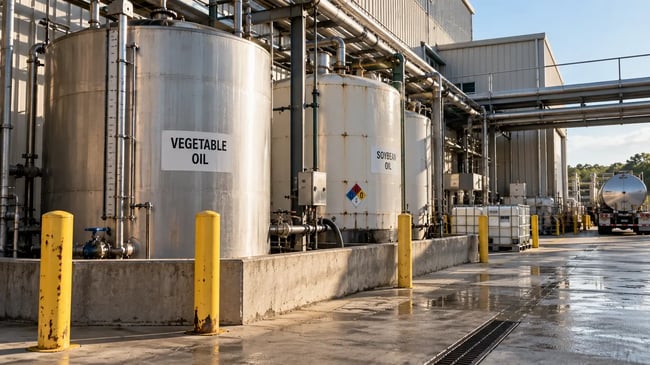
The rule counts the shell capacity of each container, not what's in it. A 5,000-gallon tank that's half full counts as 5,000 gallons, and an empty tank counts too. Only containers of 55 gallons or more go into the total. A container drops out only when it's permanently closed, which means it has been emptied of liquid and sludge, disconnected and blanked off, locked, and labeled with a sign showing the closure date. A tank you've stopped using but haven't closed that way still counts.
| Container |
Counts toward the 1,320 gallons? |
| Bulk fresh oil tank |
Yes, at full shell capacity |
| Totes and 55-gallon drums of fresh or used oil |
Yes, each container of 55 gallons or more adds its full capacity |
| Buckets and pails under 55 gallons |
No |
| Used cooking oil collection tank or bin |
Yes |
| Heated tallow, lard, or grease tank |
Yes |
| Diesel generator tank and oil-filled equipment |
Yes, added to the same total |
| Forklift and truck fuel tanks (motive power) |
No, exempt |
| Milk and milk product containers |
No, exempt |
| Fryers and other oil-filled process equipment |
Depends on how the equipment is classified, so evaluate each one |
Fryers deserve their own note. A fryer is process equipment, and the rule treats oil-filled manufacturing equipment differently than it treats a storage tank, so we look at each fryer and cooker individually instead of assuming it counts or doesn't. What isn't in question is the oil that feeds and drains them. The totes, drums, day tanks, and used oil tanks around a fryer line are storage, and they're the containers plants most often leave out of the count.
Our article on whether 55-gallon drums are included in SPCC plans goes deeper on drums. The inventory itself is a walk through the plant, including the outdoor pad, the dock, and the back corner where the used oil lives.
What Are the Most Common SPCC Mistakes at Food Plants?
The same handful of mistakes come up at plant after plant. The table lists them with the fix, and the paragraphs after it cover the ones that cause the most trouble.
| Mistake |
What it looks like |
The fix |
| Leaving fryer oil storage out of the count |
Totes, drums, and day tanks along the fryer line never get listed |
Inventory every container of 55 gallons or more, including ones that get moved |
| Counting contents instead of capacity |
"That tank is usually only a quarter full" |
Use the shell capacity of each container |
| Assuming edible oil isn't a pollutant |
"It's food, so it isn't regulated" |
The rule defines oil to include vegetable oil and animal fat |
| Overlooking used oil and grease storage |
An outdoor used oil tank or grease totes by the dock |
Add them to the inventory and the plan |
| Assuming indoor storage is exempt |
Tanks inside the building, with floor drains that lead outside |
Judge the location test by site drainage, not by walls |
The first mistake feeds the rest. A plant that never adds up its fryer-support storage never learns it's over the threshold, so it never writes a plan, builds containment, or trains anyone. Plans also get written once and left in a binder, even though the rule requires a review at least every five years and changes to the facility can trigger an amendment sooner, as our article on SPCC plan five-year reviews explains.
The indoor storage assumption trips up a lot of managers too. The location test looks at geography and drainage, such as proximity to waters, land contour, and where drains go, and it can't take credit for manmade structures that might hold a spill in. A tank room with a floor drain tied to a storm system, or a loading dock that slopes to an outside catch basin, can meet the test even when the tank never sees rain. Our article on top SPCC plan violations and fines covers what inspectors cite and what it can cost.
What Do SPCC Secondary Containment and Inspections Look Like at a Food Plant?
Bulk tanks need secondary containment that holds the full capacity of the largest container plus room for rain, built impervious enough to hold oil until someone recovers it. Totes and drums used as storage need containment sized the same way, and a couple of pallet containment units don't always cover it. Our article on how big SPCC containment needs to be goes through the sizing. Drains are where food plants get caught. Valves on diked areas have to be manual and open-and-closed, and spots where a spill could happen without containment, such as where tanker trucks unload, need drainage that sends oil to a catchment basin rather than a storm drain. Tank rooms with floor drains tied into a sanitary or storm system need a close look. Each container also needs at least one overfill prevention device, such as a high-level alarm or a pump cutoff, tested regularly.
The rule requires inspections on a regular schedule and leaves the frequency to industry standards and your plan, and many plants walk their tanks monthly. Our list of what to check during monthly SPCC inspections is a good starting point. Staff who handle oil also need training every year, and our article on annual SPCC training covers what that looks like. RMA also runs an online environmental training library if you'd rather not build the training yourself.
How Much Does an SPCC Plan Cost for a Food Plant?
Our SPCC plans run about $1,500 to $15,000 overall, and where a plant lands in that range depends mostly on how complicated the site is. A small bakery or snack plant that qualifies for a Tier I self-certified plan typically falls at about $1,500 to $4,000. Larger or more complex plants need professional engineer certification, and those plans sit higher in the range. RMA doesn't have a professional engineer on staff, so when a plan needs one we work with an outside PE in the state where the plant is located. Our team usually does the site visit and develops the plan, and the outside engineer then reviews, stamps, and seals it, which adds a review fee and some time.
| What drives the price |
Pushes it up |
Pushes it down |
| Container count and capacity |
Many tanks, totes, and drums across several buildings |
A few containers in one area |
| Plan type |
PE-certified plan |
Tier I self-certified plan |
| Secondary containment |
Containment that needs evaluating or sizing calculations |
Existing containment that's simple to document |
| Starting point |
No plan, or a plan from another firm that needs rebuilding |
A plan RMA wrote that needs an update |
Updates are cheapest for plans we wrote ourselves. We typically don't update another firm's plan and rebuild it from scratch instead. Initial SPCC training comes free with a new RMA plan. Our article on what SPCC plans cost goes deeper on pricing, and the pricing calculator below gives you a price range for RMA's help with your own plan based on your facility.
How Can RMA Help With Your Food Plant's SPCC Plan?
If you'd like a second set of eyes on your oil storage, we're happy to help, with no pressure and no obligation. We start with your container list and site layout, count the oil the way the rule requires, and tell you plainly whether you're over the threshold. If you are, our team develops the plan, brings in an outside professional engineer when the plan needs one, and trains your staff. If you're under it, we'll say so, and you won't need us. You can call, email, or fill out the form on our website, or simply contact RMA to start the conversation.


