Covered Dumpsters, Indoor Storage, Sealed Drums, and the Gray Areas: What Passes and What Fails a Pennsylvania No Exposure Walkthrough
If someone told you your facility might qualify for a No Exposure Certification instead of a Pennsylvania industrial stormwater permit, the next question is usually practical: what does that look like on the ground? A No Exposure Certification is a DEP approval that excludes a facility from needing PAG-03 coverage, Pennsylvania's general permit for stormwater from industrial sites, because nothing industrial ever touches rain or snow. In the field, that means every industrial material and activity sits under a roof or other storm-resistant shelter, with only a few narrow exceptions: tightly sealed containers in good shape, well-maintained vehicles, and finished products that won't wash off into runoff. It has to be true across the whole site, every day, and DEP has to approve it.
This article walks through what we look for when we walk a site with No Exposure in mind: dumpsters, loading docks, drum storage, parked equipment, and the roof that almost nobody checks. We'll describe what passes, what doesn't, and where it gets gray, then cover how to document your own site and what happens when conditions change. If you'd rather have someone look at your facility with you, feel free to reach out to RMA and we'll help you figure out whether No Exposure is a realistic option.
Table of Contents
TL;DR
No Exposure means every industrial material and activity at your Pennsylvania facility is under a roof or other storm-resistant shelter, across the entire site, so rain and snow never touch it. The only things allowed outside uncovered are tightly sealed containers in good condition, well-maintained vehicles, and finished products that won't wash into runoff. Covered dumpsters, indoor storage, and clean roofs pass, while open dumpsters, materials stacked by the dock, open or leaking drums, and dusty roof vents don't. DEP has to approve the certification, it lasts up to five years, and if anything becomes exposed you need a stormwater permit instead.
What Does "No Exposure" Mean for a Pennsylvania Stormwater Permit?
A few quick definitions first. NPDES, the National Pollutant Discharge Elimination System, is the Clean Water Act permit program for discharges to streams and rivers, and in Pennsylvania DEP runs it under federal law and the state's Clean Streams Law. Certain industries, identified mostly by SIC code, have to manage the rain and snowmelt that runs off their sites. Most get covered under PAG-03, DEP's general permit for stormwater associated with industrial activity, which comes with a PPC Plan (a Preparedness, Prevention and Contingency Plan), inspections, and sampling. A No Exposure Certification is the alternative for facilities where none of that activity ever meets the weather.
The rule comes from 40 CFR 122.26(g), which Pennsylvania incorporates through 25 Pa. Code Chapter 92a. It requires every industrial material and activity to be protected by a storm-resistant shelter. That covers raw materials, finished product, by-products, waste, machinery, and material handling, meaning storing, loading, unloading, and moving things. Three things get a pass without a roof: tightly sealed containers in good shape, adequately maintained vehicles, and final products that won't be carried off in runoff.
Pennsylvania adds some boundaries. No Exposure is facility-wide, so DEP won't approve it for one corner of a site while another corner is exposed. It isn't available if your stormwater discharges to waters classified as High Quality or Exceptional Value under Chapter 93. It has to be renewed every five years. Our guide to general, individual, and No Exposure permits lays out the three paths side by side, and our explainer on what non-exposure means under an NPDES permit goes deeper on the concept.
If your business isn't in a regulated category at all, you don't need a permit or a No Exposure Certification. That's common for car dealerships, body shops, and most contractors. But if you're in a covered category and everything happens indoors, the usual answer is still to file for No Exposure rather than do nothing, because the exclusion only applies once DEP has approved it.
The No Exposure Checklist We Walk Through at Pennsylvania Facilities
DEP's No Exposure application follows the federal list of materials and activities that can't be exposed to precipitation, now or in the foreseeable future. You answer yes or no to each, and a single yes means you don't qualify. That's why we walk a site with this list in hand instead of relying on a general sense that the place is clean. Here's what each item looks like in the yard.
| Checklist Item |
What Passes |
What Fails |
| Industrial machinery, and where it's used, stored, or cleaned |
Machines and parts washers indoors |
Spare equipment in the yard, parts pressure washed outside |
| Spills and leaks on the ground or in inlets |
Clean pavement, clean inlets |
Stained pavement by a tank, a sheen in a catch basin |
| Materials from past industrial activity |
Old process areas cleaned up |
Abandoned piles, old residue in a back lot |
| Material handling equipment |
Indoor conveyors, well-maintained forklifts |
Outdoor conveyors, leaking loaders |
| Loading, unloading, and transporting |
Enclosed dock bays or covered loading areas |
Bulk material unloaded in an open lot |
| Materials or products stored outdoors |
Everything indoors, or finished goods meant for outdoor use |
Raw materials on pallets beside the building |
| Open, deteriorated, or leaking containers |
Sealed drums in good condition |
Open drums, rusted drums, totes with working valves |
| Materials on roads or rail the facility maintains |
Clean access roads and sidings |
Spillage along a rail siding or haul road |
| Waste material |
Covered, non-leaking dumpsters |
Open roll-offs, overflowing dumpsters |
| Process wastewater application or disposal |
None, or handled under its own permit |
Wash water dumped on the ground |
| Residue from roof stacks and vents |
Clean roof, emissions handled under an air permit |
Visible dust deposits that show up in runoff |
Most sites don't fail on the obvious items. They fail on one dumpster, one pallet stack, or one drum nobody thought of as "industrial." The next sections go through those spots.
No Exposure Dumpsters and Waste Containers: Covered vs. Open
The federal rule allows waste in covered, non-leaking containers such as dumpsters. A passing dumpster has its lid closed, the drain plug in, nothing weeping from the seams, and a fill level low enough that the lid sits flat. A good example is boring: a closed container on dry pavement with no stain trail leading to the nearest inlet.
The failing version is easy to spot. The lid is flipped open because that's easier, or it's propped on a mound of overfill, or a plastic lid cracked months ago and nobody replaced it. The drain plug is missing, and a dark stain runs toward a storm drain. Cardboard compactors and food-waste containers leak liquid even with the lid shut. Open-top roll-offs full of scrap metal, wood pallets, or production rejects are exposed waste, and they're one of the most common reasons metal fabricators and manufacturers can't certify.
The fixes are usually cheap. Ask your hauler for lidded containers or roll-offs with secure covers, keep drain plugs in, and make closing lids part of the end-of-shift routine. No Exposure is a condition you certify will hold every day, not just the day DEP visits. If your crew props the lid open every afternoon, the dumpster fails no matter what it looked like when you took the photo.
No Exposure at the Loading Dock: Materials Indoors vs. Stacked Outside
The spot where we see facilities lose No Exposure most often is right outside the loading dock. Inside, the plant is clean. Outside the overhead door, there's a row of pallets "temporarily" staged since spring: bagged raw materials, steel coils, drums waiting for pickup, returned product, or overflow inventory.
A passing dock is simple. Trucks back into enclosed bays with dock seals, product moves straight from trailer to building, and nothing lives outside the door. Where a site loads outdoors, the loading happens under a canopy that keeps weather off the material. Loading and unloading count as material handling, so a forklift carrying open bags across an uncovered lot in the rain is exposure even if the bags spend the rest of their life indoors.
Finished products get some room. Final products intended for outdoor use, like new cars, can stay outside as long as rain doesn't carry pollutants off them. That doesn't extend to products that would wash away, and the regulation names rock salt as its example. Bagged lime, mulch, aggregate, or anything that sheds residue won't qualify just because it's finished goods. Shrink-wrapped pallets of raw material come up a lot. Wrap isn't a sealed container, it tears, and water pools on top and runs off, so we treat wrapped raw material outside as exposed.
No Exposure Drum, Tote, and Tank Storage: Sealed vs. Open in the Yard
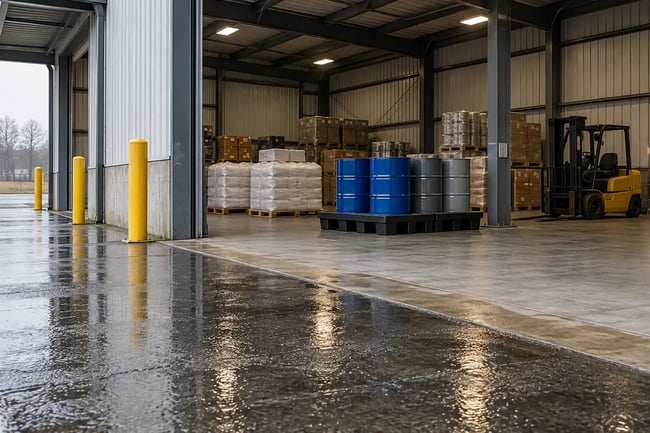
Drums, tanks, and similar containers don't need a roof if they're tightly sealed, not deteriorated, and not leaking. The rule defines sealed as banded or otherwise secured and without operational taps or valves. A drum with tight bungs, upright and in good condition, can meet the exception. A drum with a dispensing spigot, a funnel in the bung, or a hand pump in it doesn't, because it's in active use.
The failing examples we see most are open drums used for oily rags, rusted or dented drums at the back of the property, used oil drums by a maintenance door, and IBC totes with the bottom valve in service. Uncovered spill containment pallets are their own problem. They fill with rainwater that's been in contact with every drum on the pallet, and eventually somebody drains it onto the pavement.
A covered drum shed or roofed containment unit takes the "is this sealed enough?" question off the table. Aboveground tanks follow the same logic. A sealed tank can meet the exception, but filling, dispensing, and fueling are activities, so an uncovered fuel island or transfer area is exposed even if the tank itself is fine. Staining at the fill port tells an inspector the same story it tells us.
No Exposure for Forklifts, Trucks, and Equipment: Under Cover vs. in the Open
Adequately maintained vehicles used in material handling, like forklifts, yard trucks, and delivery trucks, can park outside without breaking No Exposure. The key word is maintained. A forklift parked with a drip pan under it is telling everyone it leaks, and so is a row of oil spots where the yard truck sits every night. A passing photo shows a forklift on clean, dry pavement with no staining underneath.
Equipment that isn't a working vehicle is a different story. Spare machinery, presses waiting to be scrapped, molds and dies, and equipment parked behind the building awaiting repair are all exposed industrial machinery. So is maintenance done outdoors. Changing oil in the lot, pressure washing equipment behind the shop, or fueling outside all count, and so does the residue they leave behind.
Transportation businesses have a narrower picture. For trucking, bus, and rail operations, only the vehicle maintenance, equipment cleaning, and fueling areas are industrial activity, and airports add deicing. A terminal that does all its maintenance and washing inside a shop may be a strong No Exposure candidate even with a lot full of parked trucks. A terminal that washes trucks in the yard usually isn't.
No Exposure Roofs and Vents: Clean Roofs vs. Dust From Stacks
The roof is the item people skip. The federal list includes particulate or visible deposits from roof stacks and vents that aren't otherwise regulated, such as under an air permit, and that show up in stormwater leaving the site. Rain washes the roof, the roof drains to downspouts, and downspouts often tie straight into the storm system.
A passing roof has normal grime but no film of process dust around exhaust fans, no powder drifted against the parapet, and no colored staining at the downspouts. A failing roof has a halo of dust around a vent from grinding, sanding, mixing, or woodworking, residue from a dust collector that exhausts outside, or a gutter full of material that clearly didn't come from trees. Food processors, woodworking shops, and plants that handle powders are where we find it most.
Emissions regulated under an air permit are handled through that program, but visible deposits still raise questions when they're obvious in the runoff. The practical check is to get on the roof safely after a dry stretch, then watch the downspout outlets during the next rain. Cloudy or colored water coming off the roof is an exposure issue to solve before you certify.
Gray Areas in Pennsylvania No Exposure Determinations
Not every situation is a clean pass or fail. These are the ones we get asked about most, and how we tend to look at them. DEP makes the final call on every certification, so treat this as a starting point rather than a ruling.
| Situation |
Why It's Gray |
How We Usually Look at It |
| Open-sided canopy |
Wind drives rain in, and runoff can cross the slab |
Works when material sits well back from the edges and water doesn't run through |
| Tarps over stored material |
Tarps tear, blow off, and collect water |
Rarely enough for long-term storage |
| Trailers used for storage |
A closed trailer is a shelter, but loading it may not be |
Closed and in good repair can work, open flatbeds don't |
| Stained pavement from old operations |
The activity stopped, but residue remains |
Clean it up first, since past materials are on the checklist |
| Office parking and employee lots |
Same property as the plant |
Generally outside the industrial area if drainage doesn't mix with plant runoff |
Where your water goes matters too. In older cities with combined sewers, including Philadelphia and Pittsburgh, some site runoff flows to a treatment plant, and the sewer authority may govern it instead of a DEP stormwater permit. That depends on the property, so don't assume either way. Cities, townships, and sewer authorities can also have their own stormwater rules and fees, so confirm the local picture for your site.
How to Document Your Site Before Applying for No Exposure in Pennsylvania
Before you apply, walk your site the way an inspector would and photograph it, including the back of the building, the fence line, and the corner where things pile up. Take a wide shot of each area, then close-ups of everything on the checklist: dumpsters, dock doors, drum storage, tank fill areas, parked equipment, roof vents, downspouts, and storm inlets. Do it once in dry weather and again during or right after a rain, when you can see where water flows and what it picks up. Date the photos and keep them with your records.
Those photos show you whether you're ready, give you a baseline for later, and back up the rest of the application. DEP's No Exposure application asks existing facilities for stormwater sample results from a representative outfall, and those results should look like runoff from a clean site. If the photos show a spotless yard but the sample comes back high, something's exposed that you haven't found. Our tips for taking a good stormwater sample help keep bad technique from making a clean site look dirty.
Depending on your answers about materials stored and handled on site, DEP may also require a PPC Plan with the application, and our comparison of SWPPPs and PPC Plans in Pennsylvania explains what that plan covers. Certifying also gives DEP the right to inspect your facility, so it helps to know what happens during a PA DEP stormwater inspection before one shows up.
What Happens When No Exposure Conditions Change at a Pennsylvania Facility?
No Exposure is a condition you've certified will continue. If you add outdoor storage, start a process outside, bring in a tenant who works in the yard, or install equipment outdoors, you may no longer qualify. Under the federal rule, once materials or activities become exposed, the exclusion stops applying and the discharge becomes subject to enforcement as an unpermitted discharge. If you can see a change coming, apply for PAG-03 coverage before it happens.
Sometimes the better move is keeping the change from causing exposure. A roof over a storage area or a drum shed can cost less over five years than holding a permit. DEP's PAG-03 fees alone are $500 to apply and $500 a year, before the PPC Plan, sampling, and reporting, and our breakdown of what a PAG-03 permit costs in Pennsylvania walks through the rest. New structures may need township approvals and, for larger projects, construction stormwater or erosion and sediment control approvals. We don't handle construction permits, so your contractor or engineer will take that piece, but we're glad to help with what the facility needs once it's running. Either way, keep the five-year renewal date DEP gives you on the calendar, and re-walk the site before each renewal so you're certifying what's there now.
How RMA Helps Pennsylvania Facilities With No Exposure Certifications
We help facilities across Pennsylvania figure out whether No Exposure is realistic or whether PAG-03 coverage is the right answer. That starts with walking the site against the checklist, pointing out the dumpster, dock, drum, or roof issues that would sink a certification, and talking through which fixes are worth making. When a facility qualifies, we prepare the certification paperwork and help with the sampling and supporting documents DEP asks for. When it doesn't, we'll say so and help with the permit path instead. And if you're not in a regulated category at all, we'll tell you that too.
There's no pressure and no obligation. Give us a call, send us an email, or fill out the form on our website, and contact RMA to talk through what you're seeing at your facility. We're based in New Jersey, work with facilities throughout Pennsylvania, and we're glad to help you sort out the next step.


