What the Term Means, Why DEP Uses It, and How to Read the Permit Numbers on Your Letters and eFACTS Records
Plenty of Pennsylvania business owners first meet the word NPDES on a letter from DEP, a line in a permit, or a record they stumble across online. The acronym sits next to a string of letters and digits, a deadline, or a facility name, and nothing explains what any of it refers to. If you've ever wondered whether that letter means you're in trouble, you're in good company, and the short answer is usually no.
This article explains what NPDES stands for, why DEP is the agency using it, and how to read the permit numbers that show up on Pennsylvania paperwork and in DEP's eFACTS database. We'll also cover which letters carry deadlines and what to do if one arrives for a permit you didn't know you had. If you'd rather talk it through, you can reach out to RMA and we'll look at your letter with you.
Table of Contents
TL;DR
NPDES stands for National Pollutant Discharge Elimination System, the federal Clean Water Act program that regulates discharges to surface waters. EPA delegated the program to Pennsylvania, so DEP issues the permits and puts the term on its letters. The prefix on a permit number tells you the type: PA0 for individual permits, PAR for PAG-03 stormwater coverage, and NOEX for No Exposure Certifications. If a letter mentions NPDES and you don't know why, look up your facility in eFACTS before you do anything else, and call for help if the record doesn't match what you expect.
What Does NPDES Mean on Your Pennsylvania DEP Paperwork?
NPDES stands for National Pollutant Discharge Elimination System. It's the federal permit program, created under the Clean Water Act, that governs what a facility can discharge to surface waters, whether that's process wastewater leaving a pipe or stormwater running off a yard. When a DEP letter, permit, or online record mentions NPDES, it means the agency is treating your site as a discharger under that program, or as a possible one. That isn't an accusation. Many of those letters are routine approvals, renewals, or reminders.
People also mix up an NPDES permit and a stormwater permit, and the paperwork doesn't help. For an industrial site, the stormwater permit is an NPDES permit, just a specific kind. Our comparison of an NPDES permit and a stormwater permit clears up where the terms overlap, and our overview of what an NPDES stormwater permit is covers the basics.
You also aren't the only one holding one. DEP's own program description reports that it issued 333 PAG-03 approvals, including No Exposure Certifications, between October 2019 and September 2021. That's a lot of Pennsylvania facilities whose owners opened a letter with the same question you have.
Why Does Pennsylvania DEP Run a Federal NPDES Program?
NPDES is a federal program, but in Pennsylvania you deal with DEP, not EPA. EPA has delegated administration of the program to the state, which means DEP writes, issues, and enforces NPDES permits here. That's the reason the term appears on DEP letterhead even though the Clean Water Act sits behind it.
State law backs the arrangement up. Pennsylvania's Clean Streams Law requires anyone who proposes to discharge pollutants to waters of the Commonwealth to apply for and obtain a permit. DEP's program description says it authorizes discharges only in amounts that will maintain or restore water quality in the receiving waters. So an NPDES permit in Pennsylvania carries federal requirements and state ones in a single document from a single agency.
Delegation also lets the state add its own requirements on top of the federal minimums, and Pennsylvania's industrial stormwater permit does. PAG-03 asks for a PPC Plan, a state-specific plan that our article on PPC Plans versus SWPPPs compares with the federal-style plan other states use. Knowing which agency wrote your permit tells you which rulebook to read.
How Do You Read a Pennsylvania NPDES Permit Number?
The permit number is usually the first thing you'll want to find on a DEP document, and the prefix tells you what kind of authorization you hold. DEP's NOI instructions and numbering procedures show three patterns you're likely to see:
| Number Pattern |
Example Format |
What It Usually Means |
| PA0 plus digits |
PA0123456 |
An individual NPDES permit written for one facility |
| PAR plus digits |
PAR123456 |
Coverage under the PAG-03 general permit for industrial stormwater |
| NOEX plus digits |
NOEX123456 |
A No Exposure Certification instead of permit coverage |
Those examples are patterns, not real permits, and we won't try to decode the individual digits. DEP assigns them, and the prefix is the useful part. If your paperwork shows PAR, you're under the general permit. If it shows PA0, you have an individual permit, which usually means your site isn't eligible for PAG-03, often because of the receiving stream, or discharges something other than stormwater. If it shows NOEX, you've certified that your industrial materials and activities are protected from rain and snow. Our guide to which NPDES permit you need compares the three types, and the one on what no exposure means covers the certification.
Numbers are a good place to catch mistakes. Pull up the permit number on your letter, your permit, and your eDMR account, and make sure they all match. A transposed digit or an old number carried over from a previous owner can send reports and notices to the wrong place.
What Are the DEP Client ID and Site ID on Your Paperwork?
The permit number isn't the only identifier DEP uses. Its NOI form asks for a DEP Client ID, a DEP-wide unique number assigned to the client, meaning the person or company responsible for the permit. It also asks for a DEP Site ID, a DEP-wide unique number assigned to the site itself. Those IDs let DEP connect your permit to your facility across its different programs.
The distinction helps when a company has more than one location. One client can have several sites, and each site has its own Site ID and its own authorizations. A permit tied to one site doesn't cover another, even if the company name on both is identical. If you operate two yards and only one shows up in DEP's records, the Site ID is where you'll notice it.
The NOI form asks for both numbers, so have them handy when you apply. If you inherited a facility, ask whoever ran it before you whether the IDs are already on file, since matching your paperwork to the existing records is easier than starting over.
What Can You Find About Your NPDES Permit in eFACTS?
eFACTS is DEP's online tool for looking up permits and other authorizations. Per DEP's NOI instructions, you reach it from DEP's website under Data and Tools, then Tools, then eFACTS, and you can use the Authorization Search to check on an application. DEP reorganizes its website now and then, so if that menu path has moved, searching for "DEP eFACTS" will get you there.
The most practical use is confirming what DEP has on file. After you submit a Notice of Intent, eFACTS lets you check the status of your authorization. Once you're covered, you can see whether the permit number, facility name, and address match what you expect. Mismatches can happen, particularly for facilities that changed hands, changed names, or moved offices, and they're much easier to fix before an inspection than during one.
Save a PDF or screenshot of your entry each time you check it, and keep it with your permit file. If DEP's record ever differs from yours, a dated copy shows what you saw and when. Check again after you submit anything, after a change of ownership, and before your renewal date.
Records like these are generally viewable by the public, so it's worth looking at your own entry the way an outsider would. eFACTS also tends to carry inspection and compliance information for many facilities, which means a customer, lender, or neighbor can look up a facility before you've said a word to them. If you see something wrong, or something that surprises you, that's a good reason to call DEP or a consultant before it comes up in conversation with someone else.
Which DEP Letters About NPDES Permits Come With Deadlines?
Not every DEP letter needs a response. An approval of coverage is mostly something to file, but you'll want to read it for the permit number, the facility name, and any conditions. Others set a clock: renewals, reissuance notices, requests for more information on an application, and notices that follow an inspection. When you open one, find the date first.
What the 2023 PAG-03 Reissuance Looked Like on Paper
A recent example shows how this works. DEP reissued the PAG-03 general permit effective March 24, 2023, with a new five-year term, and existing permittees had to submit a new Notice of Intent by March 23, 2023 to keep their coverage. The reissued permit also added total nitrogen and total phosphorus monitoring in all appendices. DEP says it publishes notice of general permit reissuances in the Pennsylvania Bulletin, so a facility that waits for a personal letter can miss the date.
No Exposure Certifications run on a five-year renewal cycle too, and DEP has to approve them. Put that date on a calendar the day you get approved, since nobody else is going to remind you. On the routine side, eDMR reporting has its own schedule, and our guides to discharge monitoring reports and Pennsylvania eDMR reporting explain what's due and when.
Letters after an inspection deserve the most careful reading. If you've been inspected, our article on what happens during a PA DEP stormwater inspection shows what to expect before and after, and the response date on a follow-up letter is one to take seriously.
What Should You Do If a DEP NPDES Letter Shows Up and You Don't Know Why?
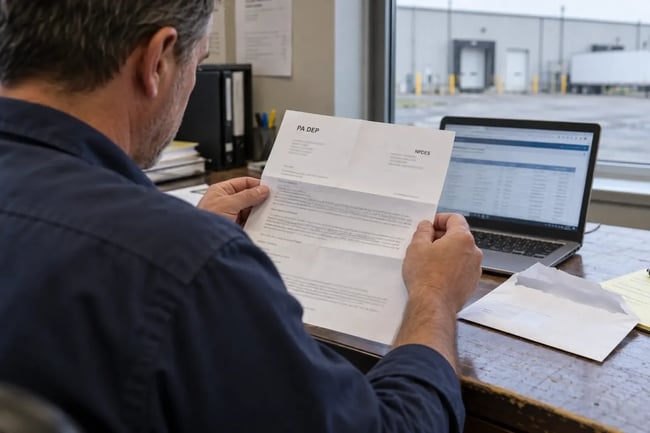
Start by reading it all the way through, because many of these letters turn out to be routine once you see which program they come from. Note the permit number if there is one, the facility name and address, the sender, and any date. Then look the facility up in eFACTS. If a permit or coverage number appears, you now know what DEP believes you hold.
The usual explanations are ordinary. The permit may belong to a previous owner or tenant, in which case coverage generally stays tied to the named permittee and a change of ownership means paperwork. It may be a facility you operate that someone else set up years ago. Or it may be an application or a certification that was never finished. In each case you want to know before DEP's next contact, not after, and ignoring a letter with a response date rarely helps.
Keep a simple log of what you do: the date the letter arrived, who you spoke with at DEP, and what they told you. Five minutes of notes now saves you from reconstructing it later, and it's the kind of record an inspector likes to see.
If you can't find any permit and the letter reads as though DEP expects one, check whether your site would need coverage in the first place. Industrial activity outside, water that leaves the property, and an SIC code in an industrial sector are the usual triggers, and RMA's online environmental assessment is a quick way to screen your facility. Our guide on who needs an NPDES stormwater permit lays out the same checks in more detail.
You may be able to handle all of this yourself. A permit lookup, a corrected record, or a renewal notice you simply file is often a job for one person with an afternoon. If you do need to apply, our article on getting a PAG-03 permit yourself will help you decide whether to do it in-house. We'd rather you know when you don't need us.
How Does RMA Help With Pennsylvania NPDES Paperwork?
When the letter is confusing, we can help you read it, find the permit it refers to, and work out whether anything needs to happen and by when. If you do need coverage, we handle the site walk, the PPC Plan, the Notice of Intent, DEP review, and the ongoing sampling and eDMR reporting if you want that help. Senior staff do the work, and if you don't need a permit at all, we'll say so. Our Pennsylvania NPDES and stormwater services page lays out the process in more detail.
There's no pressure and no obligation. You can call us, email us, or fill out the form on our website and tell us what's in your letter, and we'll help you figure out the next step. Whenever you're ready, contact RMA and we'll talk it through.