A Calm, Step-by-Step Look at How PA DEP Handles Stormwater Runoff Complaints, What the Inspector Will Check, and What Your Facility Can Do Before They Arrive
Somebody nearby, maybe a homeowner downhill, the business next door, or someone who walks the creek behind your property, saw muddy, oily, or discolored water coming off your site after a storm and reported it to the Pennsylvania Department of Environmental Protection (DEP). Now you're wondering what happens next, whether you're in trouble, and what you're supposed to do about it. The process is fairly predictable, and a lot of what happens from here is in your hands.
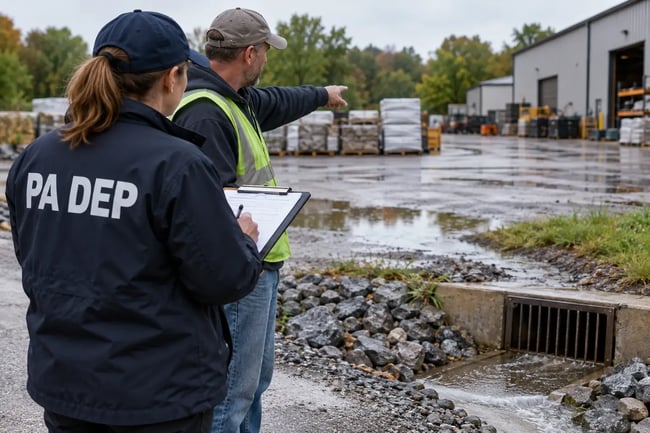
In most cases, DEP's regional office logs the complaint and sends an inspector out to look at the site, sometimes without calling ahead. The inspector checks where rainwater flows, where it leaves your property, and what it touches along the way, and may ask whether you have stormwater permit coverage and the plans and records that go with it. What comes out of the visit can be anything from no action at all, to a few recommendations, to a written notice of violation, depending on what they find. Below, we walk through each step and the practical things you can do right now, including how to handle the neighbor. If you'd rather talk it through with someone, you can reach out to RMA anytime.
Table of Contents
TL;DR
When a neighbor reports your runoff, PA DEP's regional office logs the complaint and often sends an inspector, sometimes unannounced, to look at how water drains off your site, where it leaves, and what's sitting outside in the rain. The inspector may ask whether you have stormwater permit coverage, a pollution prevention plan, and records of recent inspections. The result can be no action, some suggestions, or a formal violation notice if polluted or unpermitted water is leaving the property. Your best moves are to walk the site now, fix the obvious problems, pull your paperwork together, be straightforward with the inspector, and keep things civil with the neighbor.
How Does PA DEP Handle a Neighbor's Runoff Complaint?
Anyone can file an environmental complaint by calling one of DEP's six regional offices or using DEP's online Environmental Complaint Form, which routes it to the office covering your county. After-hours pollution reports go through DEP's emergency response program instead. DEP treats complaints as confidential. The person who called gets an acknowledgment and later a status update, but you generally won't be told who made the report.
From there, regional staff assign the complaint for follow-up, usually through the clean water program for a runoff issue. Timing varies. Something actively flowing into a stream may get a quick response, while tracked mud or an odd-looking puddle may take longer. Nobody can tell you how fast DEP will show up, so the safest assumption is that a visit could come any day.
| Stage |
What Usually Happens |
What It Means for Your Facility |
| Complaint filed |
The neighbor calls a regional office or submits the online form |
You probably won't know it happened until DEP contacts you or shows up |
| Logged and assigned |
Regional staff record it and decide on follow-up |
This is your window to get ahead of obvious problems |
| Site visit |
An inspector looks at drainage, discharge points, and exposed materials, sometimes unannounced |
Have someone ready to walk with them and answer questions |
| Inspection report |
The inspector documents what they saw and any violations |
Inspection results are recorded in DEP's eFACTS system, which the public can search |
| Follow-up |
No action, recommendations, a notice of violation, or further enforcement |
How you respond shapes what happens next |
What Will a PA DEP Inspector Check After a Runoff Complaint?
A complaint visit usually starts with whatever the neighbor reported. If it was brown water running into their yard, expect the inspector to look at that spot first, then work backward across your property, from roofs and paved areas to ditches, catch basins, and pipes. They'll look closely at your outfalls, which are the points where stormwater leaves your site, like a pipe into a creek, a ditch at the property line, or a low corner that drains to the street.
Along the way, they're looking at what rainwater can pick up: stockpiles, scrap piles, drums and totes stored outside, fueling and maintenance areas, wash pads, open dumpsters, and mud tracked onto the road. They'll also look for signs something already left the site, such as staining, an oily sheen, sediment in a ditch, or discolored water. Inspectors often take photos and may sample water if it's flowing.
Then come the paperwork questions. The inspector may ask whether your facility has coverage under PAG-03, which is Pennsylvania's general NPDES permit for stormwater from industrial activity, or a No Exposure Certification, which is DEP's approval for facilities that keep all their industrial materials and activities out of the weather. If you're covered under PAG-03, they'll likely ask to see your PPC Plan (your Preparedness, Prevention and Contingency Plan, which is the written stormwater plan PAG-03 requires), along with recent inspection and sampling records. We cover the visit in more detail in our article on what happens during a PA DEP stormwater inspection.
Sometimes the water isn't stormwater at all. Wash water, equipment rinse water, or process water that ends up outside is treated differently from rain and generally can't leave the site without its own authorization, so it helps to understand the difference between stormwater and process water before the inspector asks.
When the Runoff Comes From Construction or Local Storm Sewers
If the muddy water comes from earth moving or a paving project, it likely falls under Pennsylvania's construction erosion and sediment control rules in 25 Pa. Code Chapter 102, often handled with the county conservation district. RMA doesn't prepare construction-phase permits or erosion control plans, so your engineer, contractor, or a soil erosion specialist is the right first call there. Local rules can matter too. If your site drains to a municipal storm sewer, the township may take an interest, and in older cities with combined sewers, the sewer authority may have its own rules. Confirm which ones apply to your property.
What Are the Possible Outcomes of a PA DEP Stormwater Complaint?
Nobody can predict how a specific complaint will turn out, and we won't try. Plenty of complaint visits end with a conversation, and others lead to formal enforcement. Most of the difference comes down to what the inspector finds and how the facility responds.
| Possible Outcome |
When It Tends to Happen |
What Usually Follows |
| No action |
The inspector doesn't find a problem, or the water came from somewhere else |
The inspection is documented and the matter is closed |
| Recommendations |
Minor housekeeping issues, like an uncovered pile or a dumpster with the lid open |
You make the fixes, and the inspector may check back later |
| Notice of violation |
Evidence of an unpermitted discharge, pollution reaching water, or missing permit requirements |
A letter describing the violations, often asking for a written response and corrective steps |
| Further enforcement |
Serious or repeated violations, or problems that don't get fixed |
Orders, a consent order and agreement, or civil penalties |
A notice of violation (NOV) is a formal letter saying DEP believes something at your site doesn't comply. It isn't a fine on its own, but it typically asks what happened and what you're doing to fix it, and a prompt answer with real corrective action reads very differently from silence. If problems continue or are serious, DEP can move to orders or penalties. Under Section 605 of the Pennsylvania Clean Streams Law, civil penalties can reach $10,000 per day for each violation, and DEP considers things like how willful the violation was, the damage to the waters, and the cost of restoration when it sets an amount.
You also don't need to have a stormwater permit to be in violation. The Clean Streams Law prohibits discharges that pollute the waters of the Commonwealth whether or not a facility is permitted. A site that doesn't need PAG-03 coverage can still get an NOV if muddy or contaminated water is reaching a stream or storm drain. If you receive an NOV, or the conversation turns to penalties or orders, bring in an environmental attorney alongside whoever helps you with the technical side.
How to Walk Your Site for Stormwater Runoff Problems Before DEP Arrives
The most useful thing you can do today costs nothing. Walk your site the way the inspector will, ideally during or right after a rain so you see where water really goes. Start where the neighbor likely noticed the problem, trace the water back uphill, and at every exit point ask what that water touched on the way.
| Area |
What to Look For |
Quick Fixes |
| Property line and outfalls |
Sediment fans, staining, sheen, eroded channels |
Clean up deposits, stabilize eroded spots, add or repair filter berms or socks |
| Stockpiles and outdoor storage |
Material washing toward drains or the property line |
Cover or tarp piles, move them away from drainage paths, add containment |
| Drums, totes, and fuel areas |
Leaks, open bungs, stained ground, missing containment |
Move containers under cover, clean stains, stock and check spill kits |
| Dumpsters and loading docks |
Open lids, leaking dumpsters, debris near drains |
Close lids, swap leaking containers, sweep regularly |
| Driveways and entrances |
Mud and dust tracked onto the road |
Sweep the road, clean the entrance, slow down trucks leaving wet areas |
| Wash areas |
Wash water flowing to storm drains or off site |
Stop the flow and contain it until you know where it's allowed to go |
Fix what you can quickly. Covering a pile, closing a dumpster lid, and moving drums under a roof are small jobs and exactly the housekeeping DEP likes to see. These measures are called best management practices, and our article on what stormwater BMPs are covers more ideas. Take dated before and after photos of each fix so you can show the inspector what you found and what you did. Our guide on how to do a stormwater visual inspection the right way explains what to look for in the water itself.
If your walk turns up something serious, like oil or chemicals actively reaching a stream or storm drain, deal with that first. Pennsylvania's rules at 25 Pa. Code § 91.33 require the person responsible for an incident that causes or threatens pollution to notify DEP immediately by phone and take steps to stop it. DEP's statewide emergency line is 1-800-541-2050, and it's answered around the clock.
Gathering Your PAG-03 Permit, PPC Plan, and Stormwater Records
Next, turn to the paperwork. If you have PAG-03 coverage, put everything an inspector might ask for in one place: your coverage approval from DEP, your current PPC Plan and site map, records of your routine stormwater inspections, your sampling results and any eDMR submissions, employee training records, and your annual reports. Better to find gaps now than with the inspector watching. Our comparison of SWPPPs vs. PPC Plans for PAG-03 explains what the plan is supposed to contain.
If you don't have a permit, the next question is whether you needed one. That depends on your SIC code, whether industrial activity is exposed to rain or snow, and where your stormwater goes. Our article on stormwater associated with industrial activity explains how that first piece works. Warehouses, body shops, dealerships, quick-lubes, and most contractors probably don't need PAG-03 coverage at all. Trucking, bus, rail, and airport operations are generally covered only for their maintenance, equipment cleaning, fueling-related, or deicing areas. A business in a covered category that keeps everything indoors usually still files for a No Exposure Certification, which DEP must approve and which is renewed every five years. Read more about what No Exposure means and who needs a stormwater permit in our other guides.
If you realize you should have had coverage, don't panic and don't hide it. It's a common spot, usually because nobody told the business the rules applied. Start getting the right coverage and be upfront with DEP about where you are. It won't erase the issue, but it shows good faith. Our article on how long it takes to get PAG-03 coverage in Pennsylvania gives a realistic timeline, and if you've operated without required coverage for a while, it's a good moment to talk with an environmental attorney.
How to Handle the PA DEP Inspector's Visit About Your Runoff
Pick one or two people ahead of time to meet DEP and walk the site, ideally someone who knows the property and its drainage, and make sure the front office knows who to call. Ask for the inspector's card and what they want to look at. Then walk with them the whole time. Answer honestly and directly, and if you don't know something, say so and offer to find out rather than guessing. Don't stage the site or hide anything. Show them what you've already fixed, along with your photos, and take your own notes and photos of the same spots. If they sample, it's reasonable to collect your own sample at the same time and place.
Turning an inspector away rarely helps, and DEP has authority to inspect the sites it regulates. If you have legal concerns, call your attorney, but don't let that become stonewalling. Before the inspector leaves, ask what they saw, whether they noted violations, what happens next, and how to get the inspection report. If you disagree with something, stay calm and follow up in writing with your facts and photos.
How to Handle the Neighbor Relationship After a Runoff Complaint
It's natural to feel annoyed when someone calls the state instead of knocking on your door. Try not to act on it. Since complaints are confidential, you may never know who called, and guessing wrong can sour things with a neighbor who had nothing to do with it. Even if you're sure, confronting someone or doing anything that looks like retaliation can make your situation worse, with DEP and potentially legally.
Treat the complaint as information instead. If the neighbor reaches out, listen to what they saw, explain what you're doing about it, and give them a name and number to call next time. Many people call DEP because they didn't know who to talk to at the business. Then follow through where they can see it, like a clean street and clear water at the property line, and check those spots after the next big storm. A neighbor who feels ignored will often call again, which usually means another DEP visit. One who sees steady improvement has a lot less reason to pick up the phone.
How RMA Helps Facilities Respond to PA DEP Runoff Complaints
RMA is a family-run environmental consulting firm based in New Jersey, and we work with facilities across Pennsylvania on industrial stormwater. We can help you figure out whether your site needs PAG-03 coverage, qualifies for a No Exposure Certification, or doesn't need either one. We can evaluate your drainage and outfalls, prepare your PPC Plan and permit paperwork, help with inspections, sampling, and eDMR reporting, and help you correct inspection findings or respond to an NOV alongside your attorney. We can also train your team through our online environmental training library.
We don't prepare construction-phase permits, and if a quick conversation shows you don't need a consultant at all, we'll tell you. There's no pressure and no obligation. You can call us, send an email, or fill out the form on our website. When you're ready, reach out to RMA and we'll help you figure out the right next step.


