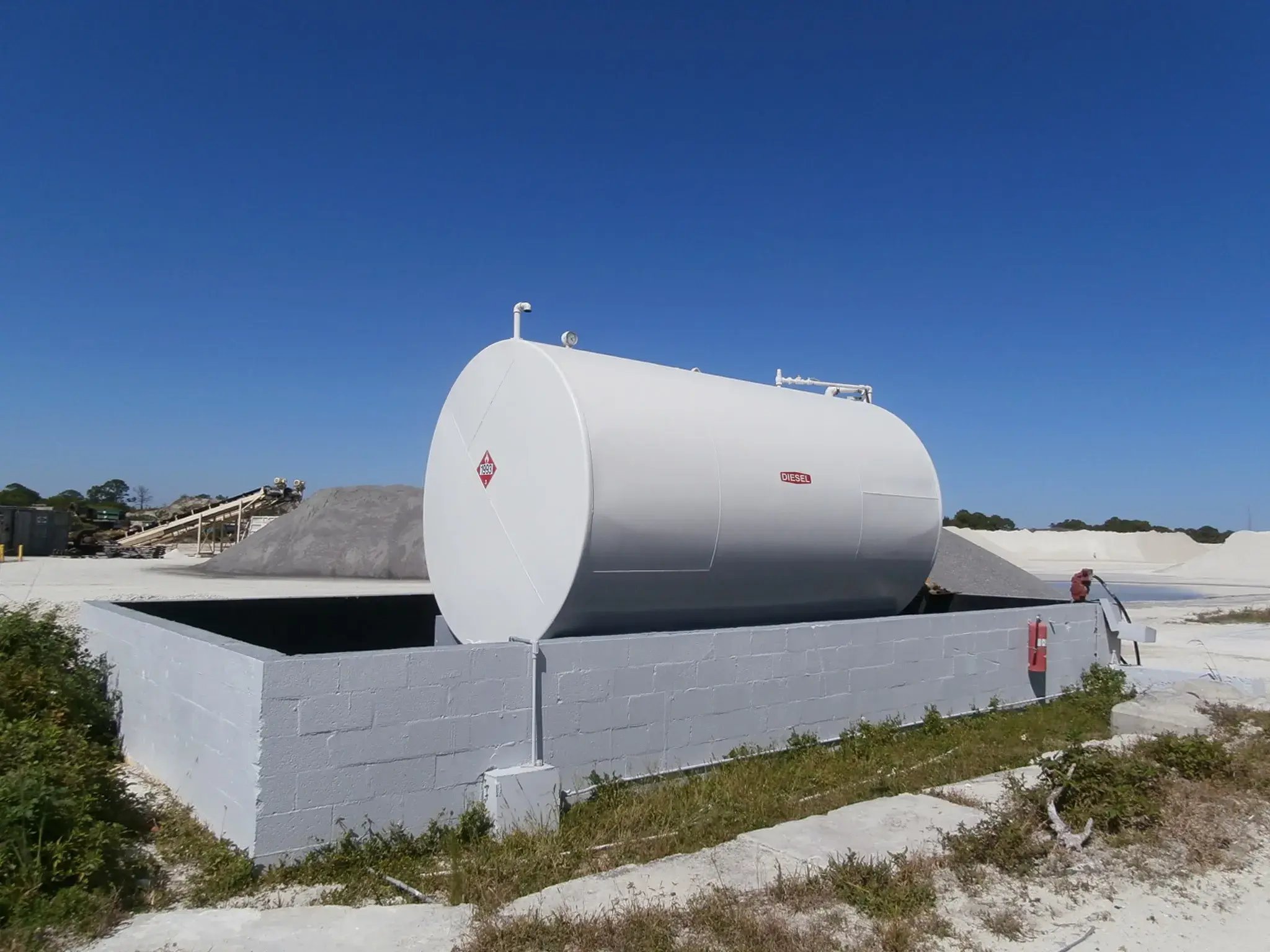
EPA's Oil Spill Rule Explained for Pennsylvania Businesses: Who Needs a Plan, What It Covers, and Who Signs Off
If your business keeps diesel, hydraulic oil, lube oil, or even used cooking oil in tanks, drums, or equipment on site, a federal oil spill rule may apply to you, and plenty of Pennsylvania businesses have never heard of it. The rule requires a written oil spill plan, formally called a Spill Prevention, Control, and Countermeasure Plan, or SPCC Plan. For many facilities it only comes up when an insurer, lender, customer, or inspector asks to see one.
This article explains what an SPCC Plan is, which facilities need one, what the plan has to cover, who certifies it, and how enforcement works in Pennsylvania, where EPA and the state each play a part. We also cover how often a plan needs attention and what one costs. If you'd rather talk it through with a person, you're welcome to reach out to RMA at any point, whether or not you ever hire us.
Table of Contents
TL;DR
An SPCC Plan is a written oil spill prevention plan that EPA requires under 40 CFR Part 112. A facility that could reasonably send oil to a waterway needs one if it stores more than 1,320 gallons of oil above ground in containers of 55 gallons or larger, or more than 42,000 gallons buried. The plan covers tanks, containment, inspections, training, and spill response. A qualified facility with 10,000 gallons or less can usually self-certify it, and larger facilities need a professional engineer. In Pennsylvania, EPA Region 3 enforces SPCC, and DEP's tank rules are a separate layer.
What Is an SPCC Plan, and Why Does EPA Require One?
An SPCC Plan is a written, facility-specific plan for preventing oil spills, containing them if they happen anyway, and responding quickly when they do. It comes from EPA's Oil Pollution Prevention regulation, 40 CFR Part 112, written under the Clean Water Act, and its goal is to keep oil out of rivers, creeks, and other waters of the United States. The rule covers non-transportation oil storage and use, from a plant's tank farm to a data center's generator fuel to a fleet's bulk diesel. Equipment and operations under Department of Transportation authority are handled separately.
The name describes the job. Spill prevention means the tanks, piping, procedures, inspections, and training that keep oil from getting out. Control means secondary containment, such as dikes, berms, and drip pans, that catches oil if a container fails. Countermeasure means discovering a spill, stopping it, cleaning it up, and calling the right people. The rule requires you to implement the plan, not just write it, so the inspections, training, and upkeep it describes have to be done. It also counts total storage capacity, not the oil on site on a given day, so a facility with modest daily use can still be covered.
Who Needs an SPCC Plan Under 40 CFR Part 112?
Two tests decide it, and a facility has to meet both. The first is location: because of where it sits, the facility could reasonably be expected to discharge oil in harmful quantities into navigable waters of the United States or onto adjoining shorelines. That call looks only at geography, such as distance to water, land contour, and drainage, and you can't count dikes, berms, or other manmade structures. A storm drain, ditch, or sloped lot leading to a creek is often enough, so location alone rarely rules a facility out.
The second test is capacity. A facility that meets the location test needs a plan if its total aboveground oil storage capacity is more than 1,320 gallons, or its completely buried capacity is more than 42,000 gallons. For the aboveground number, you count only containers of 55 gallons or larger and add up their full capacity. Capacity counts, not contents, so an empty 5,000-gallon tank still counts and a permanently closed one doesn't. Buried tanks already fully regulated under the federal underground storage tank rules, or an approved state program, are left out of the buried count.
| Counts toward the threshold |
Doesn't count |
| Aboveground tanks and drums of 55 gallons or more, full or empty |
Containers under 55 gallons |
| Oil-filled equipment such as transformers and hydraulic systems |
Permanently closed containers |
| Fuel trailers, skid tanks, and portable storage containers |
Motive power containers, such as a truck's own fuel tank |
| Animal fats and vegetable oils, including used cooking oil |
Propane and diesel exhaust fluid, which aren't oil under the rule |
| Bunkered, partially buried, and vault tanks, treated as aboveground |
Milk containers, hot-mix asphalt, and heating oil used only at a single-family home |
Add up your containers carefully. A 1,000-gallon diesel tank and a 500-gallon hydraulic oil tank already put a property over 1,320 gallons, and a dozen drums of lube oil, an oil-filled transformer, and a generator tank can cross the line unnoticed. If your total comes in under the threshold, you're probably not covered, though it's worth double checking the counting rules. Our article on figuring out if you need an SPCC Plan walks through the steps, and we cover 55-gallon drums and cooking oil on their own because they catch so many businesses off guard.
A new facility has to have its plan prepared and implemented before it starts operating. The permits and approvals for building the site, such as construction stormwater and erosion and sediment control, are a separate track that RMA doesn't prepare, and your engineer or contractor will usually steer that work. Once the site is running, the oil spill plan is one of the operational plans it needs, and that's the part we help with.
What Does an SPCC Plan Cover?
The rule lays out an outline in 40 CFR 112.7, and EPA inspectors read plans against it. Details change from facility to facility, but every plan walks through the same core pieces.
| Plan section |
What it contains |
| Facility diagram |
Site layout, every fixed container, where portable ones are kept, the oil and capacity of each, and transfer points and piping |
| Containers and piping |
Condition, integrity testing, and overfill protection |
| Secondary containment |
Dikes, berms, curbing, or drip pans sized for the largest container plus room for rain, and drainage control |
| Spill prevention procedures |
How loading, unloading, and transfers are done, and what would spill and where it would flow if major equipment failed |
| Inspections and records |
Written procedures, who inspects and how often, and signed records kept with the plan |
| Training and security |
Instruction for oil-handling staff, a person accountable for spill prevention, and how access to oil areas, valves, and pumps is controlled |
| Response |
How a spill is found, stopped, and cleaned up, how waste is disposed of, and contacts including the National Response Center |
Secondary containment is where plans get complicated, because the sizing depends on the largest container and on rainfall, and some sites can't build a dike at all. When containment isn't practicable, the rule allows an alternative, but the plan has to explain why, add a spill contingency plan, and have a professional engineer certify that determination. We cover the math in How Big Does My SPCC Oil Spill Containment Need to Be? Federal rules also require reporting an oil discharge that reaches a waterway or causes a visible sheen, covered in When Do You Have to Report an Oil Spill? The Sheen Rule Explained! Management has to approve the plan at a level that can commit the people and money to carry it out, and a complete copy stays on site if the facility is normally attended at least four hours a day, or at the nearest field office if not.
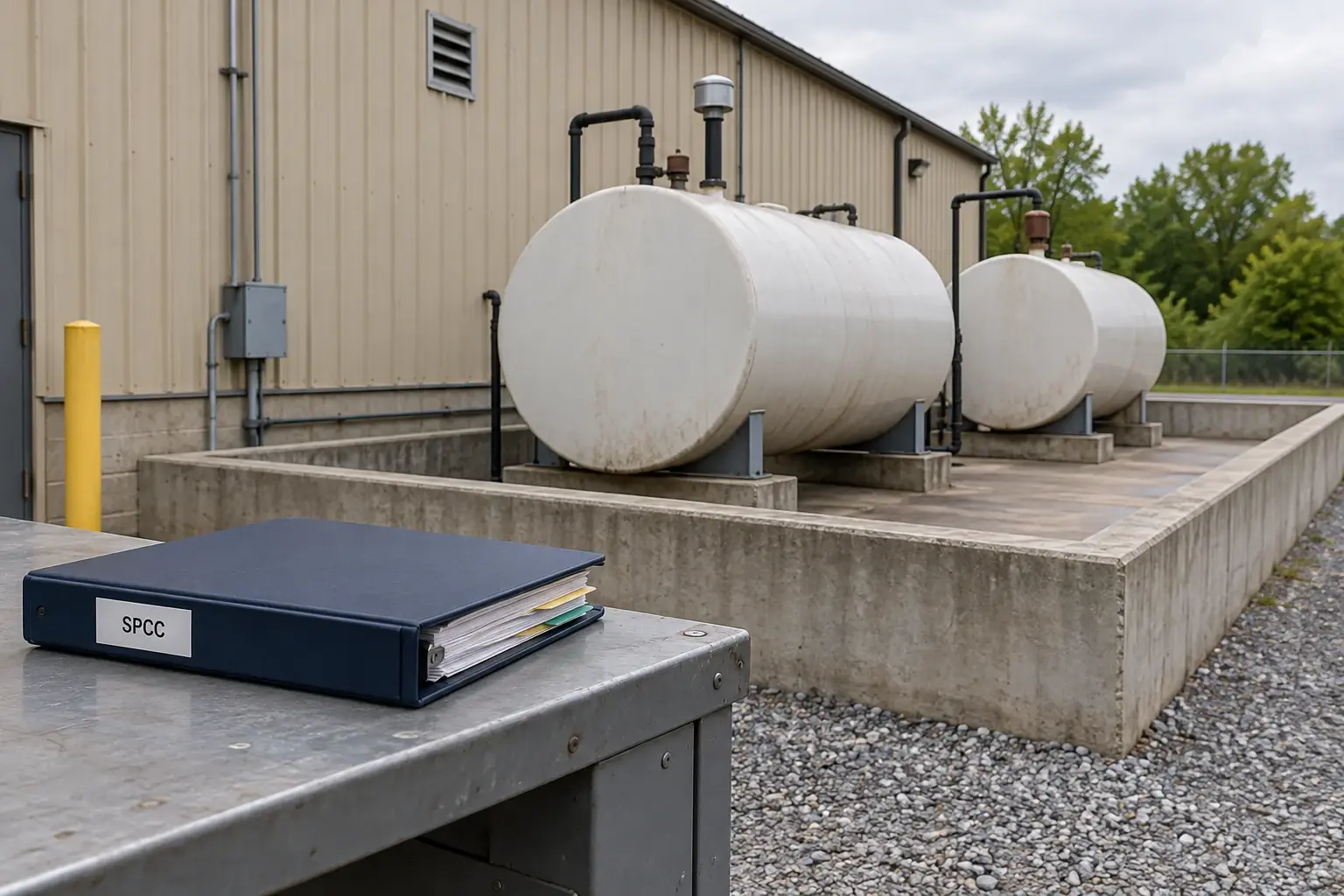
Who Certifies an SPCC Plan: You or a Professional Engineer?
Every plan is certified one of two ways. A licensed professional engineer (PE) reviews and certifies it, which is the default, or, if the facility qualifies, the owner or operator self-certifies. EPA calls the smaller, cleaner facilities that can self-certify qualified facilities, and the rule splits them into two tiers.
| Path |
Who qualifies |
Who certifies |
| Tier I qualified |
10,000 gallons or less total, no container over 5,000 gallons, clean spill history |
Owner or operator, who can use EPA's template |
| Tier II qualified |
10,000 gallons or less total, clean spill history, any container size |
Owner or operator, but a PE must certify alternative measures and any finding that containment is impracticable |
| Everyone else |
Over 10,000 gallons total, or a spill history that doesn't meet the test |
A licensed PE certifies the full plan |
A clean spill history means that in the three years before certification, the facility had no single spill to a waterway or shoreline over 1,000 gallons, and no two such spills over 42 gallons each within any twelve-month period. Self-certifying means signing a statement that you know Part 112, that you've visited and examined the facility, that the plan follows sound industry practice and the rule, that inspection and testing procedures are in place, that you'll implement the plan, and that management has approved it and committed the resources. A PE attests to similar things after visiting the site. Either signature leaves the facility responsible for doing the work the plan describes.
If your facility is a straightforward Tier I site, with a few tanks, solid containment, and a clean history, you can often prepare the plan yourself using EPA's template, and we say so when people ask. Help pays off at sites with a container over 5,000 gallons, containment that can't be sized or built, or a total close enough to 10,000 gallons to tip into PE territory. We explain the paths in Different Types of SPCC Plans EXPLAINED, with more on Tier I plans, Tier II plans, PE-certified plans, and how professional engineers fit into SPCC. A small number of larger facilities also need a Facility Response Plan under 40 CFR 112.20, a separate and heavier document, so if your storage is at the upper end, ask whether you're in that group.
Who Enforces SPCC Plans in Pennsylvania, EPA or DEP?
EPA enforces the SPCC rule in Pennsylvania through its Region 3 office in Philadelphia, which also covers Delaware, Maryland, Virginia, West Virginia, and the District of Columbia. Pennsylvania's Department of Environmental Protection (DEP) doesn't enforce the federal rule. EPA can review your plan during an on-site inspection and can bring penalty actions when a plan is missing, outdated, or not being followed.
What Does DEP's Storage Tank Program Add?
Pennsylvania has its own tank layer that sits beside SPCC instead of replacing it. DEP's Storage Tank Program administers the Storage Tank and Spill Prevention Act and 25 Pa. Code Chapter 245, which cover registration of regulated tanks, DEP certification for the people who install and inspect them, technical standards, and a Spill Prevention Response Plan for large aboveground storage tank facilities. Whether a particular tank is regulated by DEP depends on its size, type, and use, so check yours against DEP's storage tank program. The federal rule also says your SPCC Plan has to address any more stringent state requirements that apply, and EPA Region 3 has resolved cases where one complaint cited both SPCC violations and violations of the Pennsylvania Storage Tank and Spill Prevention Act.
On penalties, EPA can assess administrative penalties of up to $23,647 per violation or per day of violation depending on the penalty class, capped at $59,114 for Class I and $295,564 for Class II. In federal court, failing to comply with the SPCC regulations can carry up to $59,114 per day. Those are the inflation-adjusted figures in 40 CFR Part 19 for penalties assessed on or after January 8, 2025, and EPA adjusts them periodically. Actual penalties depend on the facts and are often resolved well below those ceilings. We cover the findings we see most in Top SPCC Plan Violations & Fines Explained! and each agency's role in Who Enforces SPCC Plans? If you've received an EPA information request or inspection notice, or you've had a spill, it's reasonable to talk with an environmental attorney before you respond.
How Often Does an SPCC Plan Need Reviews and Updates?
An SPCC Plan isn't a one-and-done document, but it doesn't get redone every year either. The rule runs on three clocks. You review and evaluate the plan at least every five years and document it with a signed statement saying whether you'll amend, and you amend within six months if a field-proven technology would significantly reduce the likelihood of a spill. Any change that materially affects the facility's potential for a discharge, such as adding or removing containers, replacing tanks or piping, altering containment, or switching products, triggers an amendment: six months to prepare it and up to six more to put it into effect. Technical amendments are certified the same way the original plan was. Our articles on five-year reviews and yearly updates go into the details.
Between reviews, the plan lives through routine work. Inspections follow written procedures, and signed records stay with the plan for three years. Oil-handling staff have to be trained on equipment operation, discharge procedures, pollution control rules, and the plan itself. Someone has to be accountable for discharge prevention, and the rule calls for discharge prevention briefings at least once a year. We explain the training side in Do I Need to Do Annual SPCC Training?, and our online training library has courses your team can take on their own schedule.
How Much Does an SPCC Plan Cost?
Costs vary with the facility, so here are the ranges we publish. A new SPCC Plan generally runs from $2,500 to $15,000. A simple Tier I update is about $1,500, and updating a more complex, PE-certified plan runs $7,500 and up. Price moves with total oil storage capacity, the number of containers, whether a PE has to certify the plan, whether secondary containment needs to be evaluated, how many sites are involved, and the condition of any existing plan.
We're not the cheapest option and we don't try to be. The low end of the market tends to be a template with your company name dropped in, and that kind of plan holds up until someone asks the facility to match it. We write about this in How Much Does an SPCC Plan Cost? and in Can ChatGPT or AI Write an SPCC Plan? For the record, our senior staff write our plans, and we don't use AI to produce client deliverables. If you'd like a number for having us handle yours, our pricing calculator is below.
How Does RMA Help Pennsylvania Facilities With SPCC Plans?
We're a family-run firm based in New Jersey, and we work with facilities across Pennsylvania and the rest of the country. For SPCC, that usually means working out whether you need a plan and which type fits, then writing it, updating it, or reviewing an existing plan against the rule. Senior staff do the work, and we tell you plainly when a simpler route makes sense. We can also train your oil-handling staff and help you set up an inspection routine so the plan gets followed instead of just filed.
If any of this sounds like your facility, or you're not sure, there's no pressure and no obligation. You can call us, email us, or fill out the form on our website, and a member of our team will help you sort out where you stand. Whenever it suits you, you can contact RMA and we'll talk it through.