The 1937 Law Behind Today's Runoff Rules, and What It Means for Pennsylvania Businesses
Most facility managers have heard of the Clean Water Act. Far fewer have heard of the Pennsylvania Clean Streams Law, even though it's older, it's what gives PA DEP most of its power over water, and it applies to businesses that have never thought of themselves as polluters. If you've ever filed for a stormwater permit, written a PPC Plan, or called DEP about a spill, you were already working inside it.
This article walks through where the law came from, how it gives DEP its authority, what waters it covers, and how its penalties compare with the federal ones. The comparison has a few surprises, and we'll be straight about them. We'll also cover what the law means for a business on an ordinary day. If you'd rather talk through your own site, you're welcome to reach out to RMA, though you can follow most of this without us.
Table of Contents
TL;DR
The Clean Streams Law is Pennsylvania's own water pollution statute, passed in 1937, and it's the foundation for DEP's stormwater, wastewater, and spill rules. It covers storm sewers, ditches, springs, and groundwater, not just rivers. Its civil penalty cap of $10,000 per day is lower than the federal Clean Water Act cap, but Pennsylvania can still cost you more because the law reaches more waters, counts every day as a separate violation, and adds cleanup and criminal exposure. A business doesn't need a permit to be covered, since the law applies the moment something polluting reaches a drain.
What Is the Pennsylvania Clean Streams Law?
The Clean Streams Law is Pennsylvania's main water pollution statute. The legislature passed it in 1937, and it's still the backbone of how the state regulates anything that might end up in a creek, a river, or the ground. Its core idea is simple. If you put something into the waters of Pennsylvania that pollutes them, that's against the law, and the state can stop you, make you clean it up, and fine you.
That sounds like what the federal Clean Water Act does, and in some ways it is. The difference is timing and reach. The federal act didn't arrive until 1972, so Pennsylvania had a working water pollution law for 35 years before Congress wrote one. The federal act is also limited to waters that qualify as federal waters, while the Clean Streams Law is written around waters of the Commonwealth, a broader term we'll get to below. Today the two laws operate side by side. Pennsylvania runs the federal NPDES permit program under authority from EPA, so a stormwater permit from DEP is issued under both at once.
How Did the Clean Streams Law Develop From 1937 to Today?
The 1937 law was a response to decades of raw sewage and industrial waste going straight into Pennsylvania's rivers. It tightened discharge limits and added penalties, but it had real gaps. It didn't require anyone to restore waterways that were already damaged, and it left coal mine discharges largely alone, which in a state with Pennsylvania's mining history was a big hole.
The legislature closed those gaps over time. A 1945 amendment brought coal mining under regulation for the first time. A 1965 amendment went further by requiring industry both to prevent pollution and to repair damage, and it tightened the mining rules. Amendments in 1970 gave the state's Sanitary Water Board full regulatory authority over industrial activities that affect water. The Sanitary Water Board eventually gave way to the Department of Environmental Resources, which became the Department of Environmental Protection in 1995.
One more piece sits above the statute. In 1971, Pennsylvania voters added Article I, Section 27 to the state constitution, which says people have a right to clean air and pure water and makes the Commonwealth a trustee of its natural resources. That gives agencies and courts a constitutional reason to read the Clean Streams Law broadly, and it's one reason DEP's authority is hard to wave away.
How Does the Clean Streams Law Give PA DEP Its Authority?
The statute does two things for DEP. It sets prohibitions, and it hands DEP the tools to enforce and fill in the details. Section 301 and Section 307 make it unlawful to discharge industrial waste to the waters of the Commonwealth without authorization, which in practice means a permit. Section 401 goes wider and makes it unlawful to put or let flow into the waters any substance that causes pollution. Section 402 lets DEP regulate activities that carry a danger of pollution even when nothing has been discharged yet.
DEP then writes the detail into regulations in Title 25 of the Pennsylvania Code. Chapter 92a covers NPDES permitting, Chapter 93 sets water quality standards, and Chapter 102 handles erosion, sediment control, and construction stormwater. Two short provisions in Chapter 91 come up all the time for businesses. Section 91.33 requires you to notify DEP right away when a spill or release threatens a stream or storm drain. Section 91.34 requires anyone who stores, uses, processes, or transports pollutants to take measures to keep those substances from reaching the waters of the Commonwealth, and it lets DEP require a written plan showing what you've done. That written plan is where the PPC Plan comes from, and we cover how it differs from a SWPPP in our PPC Plan and SWPPP comparison.
Enforcement runs on the same statute. DEP can inspect, issue orders, require corrective action, and assess civil penalties after a hearing, with appeals going to the Environmental Hearing Board. District attorneys and municipal solicitors can also go to court to abate a nuisance under Section 601. If you want to know what an inspection looks like in practice, what happens during a PA DEP stormwater inspection walks through it.
What Waters Does the Pennsylvania Clean Streams Law Cover?
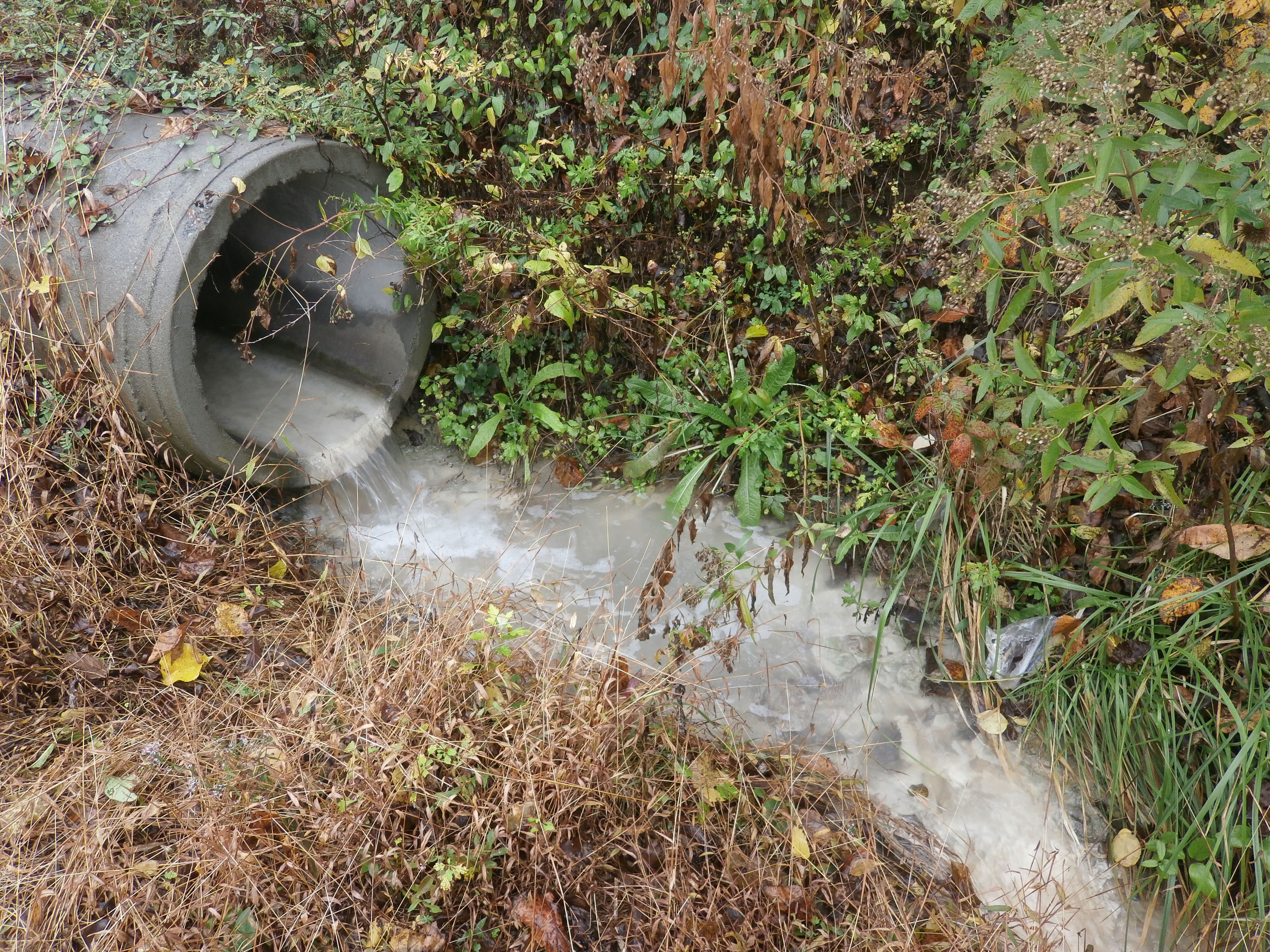
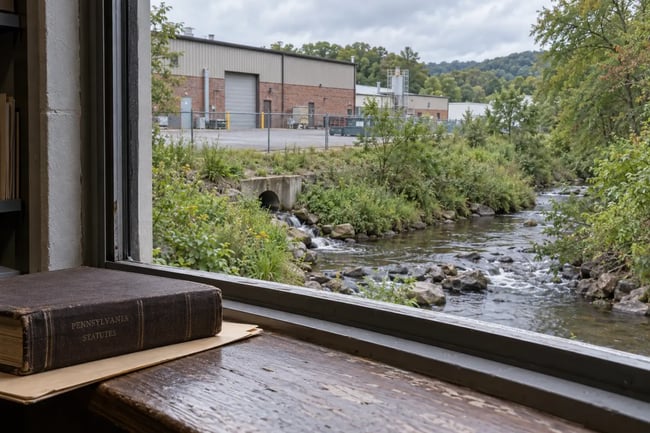
This is the part that surprises people. The Clean Streams Law defines waters of the Commonwealth as just about any water in the state, including rivers, streams, creeks, ditches, impoundments, ponds, springs, and underground water. The definition also names storm sewers. So when rain runs off your parking lot into a catch basin, the pipe it enters is itself covered by the law, before the water ever reaches a creek.
Since 2023, that wording has done a lot more work. In that year, the U.S. Supreme Court's decision in Sackett v. EPA narrowed which waters the federal Clean Water Act reaches, limiting it to relatively permanent waters and wetlands with a continuous surface connection to them. A dry ditch or an isolated pond that falls outside the federal definition can still be fully protected under the Pennsylvania law. A business that reads only the federal rules and decides a feature isn't regulated can be wrong about the state.
Groundwater is covered too. A leak from a tank, a floor drain, or a dry well that reaches the ground can be a Clean Streams Law problem even though no creek is anywhere nearby. For the stormwater side of this, our post on what you can discharge under a stormwater permit explains where the line sits, and our post on impaired waters covers what happens when the stream your drain feeds is already struggling.
How Do Clean Streams Law Penalties Compare With Federal Penalties?
What Are the Dollar Figures?
Here's the straight answer, since the common claim doesn't quite hold. The Clean Streams Law allows civil penalties of up to $10,000 per day for each violation. The federal Clean Water Act maximum, after the January 2025 inflation adjustment under 40 CFR Part 19, is $68,445 per day. On the headline number alone, the federal law is higher, not Pennsylvania's.
The criminal side is serious too. A negligent violation of the Clean Streams Law is a second-degree misdemeanor with fines of $2,500 to $25,000 and up to two years in prison, and a knowing violation is a third-degree felony with fines of $5,000 to $50,000 and up to seven years. Criminal cases are rare and usually involve repeated or deliberate conduct, but the statute is there.
Where Pennsylvania Can Cost More
The cases where a Pennsylvania case ends up costing more than a federal one rarely come down to the per-day cap. They come from a few other things. The first is reach. Because the state law covers storm sewers, ditches, and groundwater, DEP can bring a case over a discharge that EPA couldn't touch. The second is stacking. Penalties are counted per day and per violation, so a requirement missed for ninety days can be ninety violations, and the state and EPA can both pursue the same facts. The third is everything outside the fine. DEP can order you to clean up, fix the source, restore the damage, and monitor afterward, and those costs often run well past the penalty. For a facility that has already had a close call, the extra costs tend to be what changes minds. Our post on the hidden costs of non-compliance covers that side, and our violation cost calculator gives a rough picture for your own situation.
Both figures are ceilings. DEP and the courts weigh how serious the violation was, whether you knew, how fast you fixed it, and your history, and real penalties usually land well below the maximum. The ceiling still sets the stakes, and a long-running problem makes the days add up.
What Does the Clean Streams Law Mean for a Pennsylvania Business?
The biggest takeaway is that the law applies whether or not you hold a permit. A permit is how you get authorization to discharge certain things. It doesn't create the underlying rule, which is that nothing polluting reaches a drain, a ditch, or the ground. A business with no permit at all, such as a small shop with a fuel tank and a drain out back, is still covered the day something leaks.
The law also doesn't turn on intent for the basic violation. Section 401 prohibits discharges that cause pollution, and the question isn't whether you meant to cause it. Intent shows up later, in the penalty and in whether criminal charges are on the table. This catches people who assume an accident is a defense. A forgotten spill kit, a leaking valve, or a power wash that sends soapy water to a storm drain can each be a violation.
For most industrial sites, the practical result is a short list. If rain touches industrial materials or activities and then leaves your site, you may need coverage under PAG-03 and a PPC Plan, and who needs a stormwater permit goes through the triggers. You need to know your notification duties for spills, and when you have to report an oil spill explains the common case. You need practices that keep pollutants away from drains, and you need employees who know what those practices are. Our online training library covers the training side. If you're unsure which permit applies, we compare the choices in which NPDES permit you need.
A few everyday situations show how this plays out. A wash bay that drains to a storm inlet is a problem even if the soap is biodegradable. A loading dock where product gets tracked outside and rinsed off by rain can send solids and chemicals toward the same inlet. A fuel tank with a slow drip at the fitting can reach the ground long before anyone sees a stain. None of these needs a dramatic accident, and the fixes are usually small: a berm, a cover, a drain plug, a closed valve, a better routine. The reporting duty is where businesses get hurt, because a spill that was easy to clean up turns into a violation once nobody tells DEP.
The good news is that being covered by a broad law isn't the same as being overwhelmed by it. Many facilities need no permit at all, and for the ones that do, the PAG-03 application fee is $500 with a $500 annual fee, plus consultant help if you want it. We lay out the numbers in how much a PAG-03 permit costs in Pennsylvania, and we're open in our take on doing a PAG-03 yourself about when you can handle it without us.
How Can RMA Help With Clean Streams Law Compliance?
RMA is a family-run firm that's been doing this since 1992. We're based in New Jersey and work with facilities across Pennsylvania and the rest of the country. Senior staff do the work themselves, and we don't use AI to produce client deliverables. For Pennsylvania businesses, that usually means working out which parts of the law reach your site, getting PAG-03 coverage or a No Exposure Certification in place through our NPDES permitting service, and writing the PPC Plan DEP expects. Our online environmental assessment is a quick way to see which programs are likely to apply.
If you're not sure whether you need us, that's a perfectly good reason to get in touch, and we'll tell you plainly if you don't. You can call, send an email, or fill out the form on our website, and there's no obligation either way. Whenever you're ready, contact RMA and tell us what's going on at your facility.