From Storm Drain to the Passaic, Raritan, Hackensack, Delaware, or the Jersey Shore: How New Jersey Runoff Reaches Rivers and Bays, and Why NJDEP Regulates It
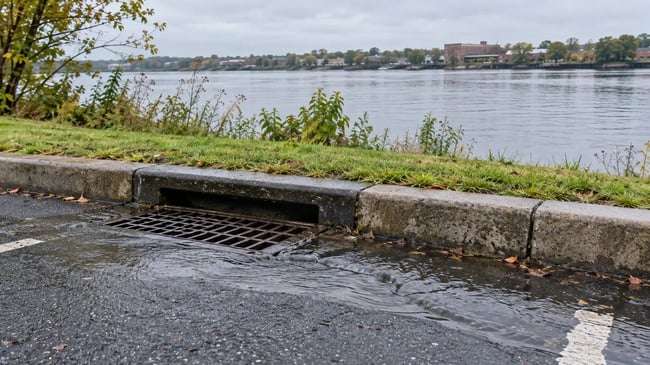
Most people who run a plant, a yard, or a warehouse in New Jersey have watched rain sheet across the pavement and disappear into a grate without giving it a second thought. It feels like the water is gone once it drops into the drain. It isn't. In most of New Jersey, the storm drain in your parking lot connects to a pipe that carries rainwater straight to the nearest stream, river, wetland, or bay, with no treatment plant along the way. Whatever that water picked up on your site, like oil drips, sediment, metal dust, or spilled product, goes with it. The main exception is a handful of older cities with combined sewers, where some street runoff goes to a sewage treatment plant instead.
Below, we follow that water from your drain to the river or bay it ends up in, explain how combined sewers and groundwater change the picture, connect it to why NJDEP regulates industrial stormwater, and show you how to check where your own site drains. If you'd like help sorting out what that means for your facility, feel free to reach out to RMA.
Table of Contents
TL;DR
In most of New Jersey, rain that runs off your parking lot into a storm drain isn't treated. It flows through pipes to the nearest stream and eventually into the Passaic, Hackensack, Raritan, or Delaware River, or into a coastal bay like Barnegat Bay. The exception is 21 older municipalities with combined sewers, where some runoff goes to a sewage treatment plant, except during heavy storms when those systems overflow. Because nothing cleans that water before it reaches a river, NJDEP requires many industrial facilities to keep pollutants out of their runoff in the first place, which is what a New Jersey industrial stormwater permit is for.
Where Does Parking Lot Stormwater Go in New Jersey?
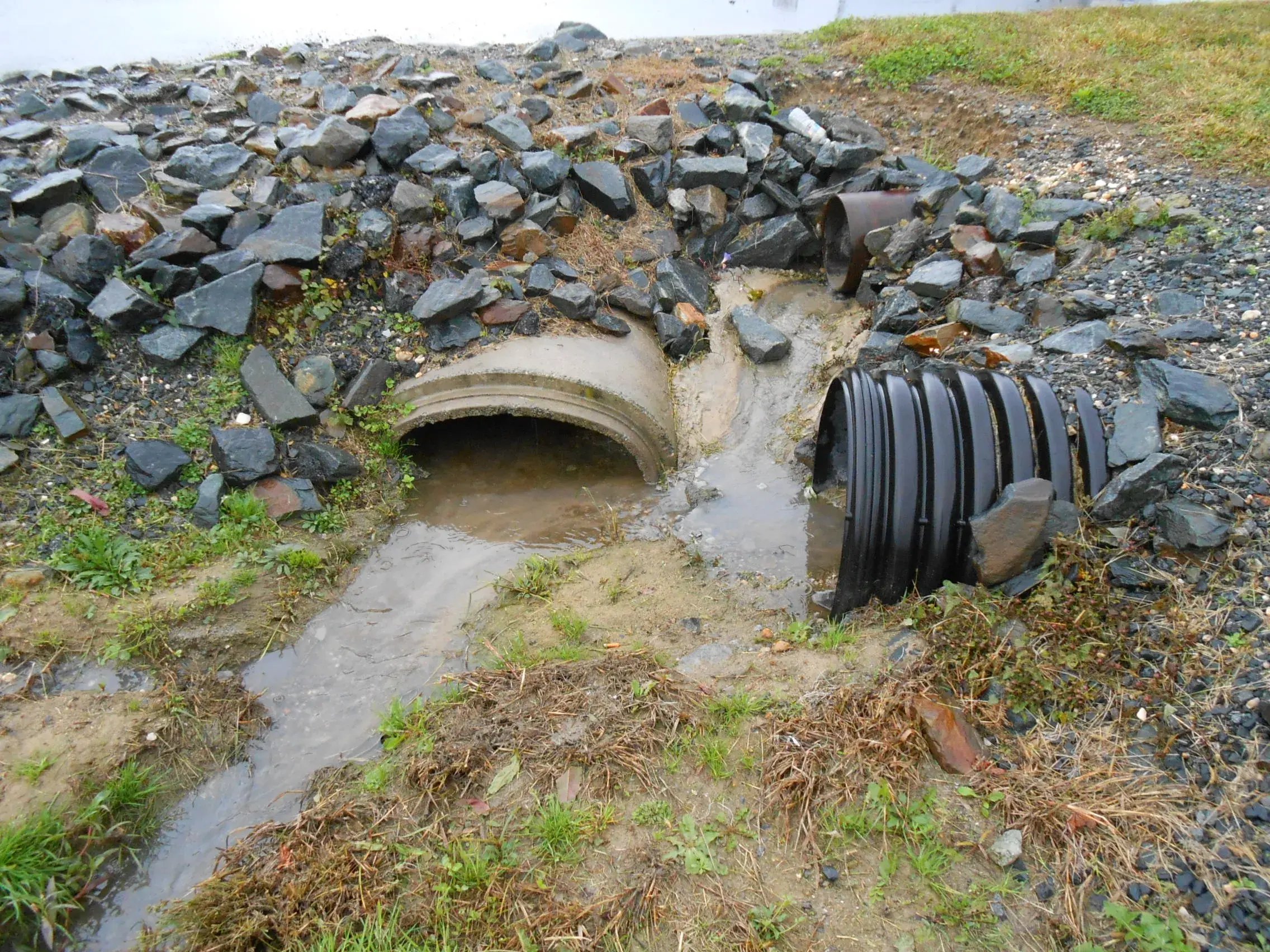
Here's the short version. Most of New Jersey has two separate pipe networks under the ground. The sanitary sewer carries water from toilets, sinks, floor drains, and many process lines to a sewage treatment plant, where it's cleaned before it's released. The storm sewer is a completely different set of pipes. It collects rain and snowmelt from streets, roofs, and parking lots and sends it to the nearest body of water, usually as fast as it can, because its main job is keeping roads and buildings from flooding.
That means the storm drain in your lot is really the start of a stream. Rain picks up whatever is sitting on your pavement, flows to the inlet, and leaves through a pipe that empties into a creek, which feeds a bigger river, which ends in a bay or the ocean. Nobody tests or cleans that water along the way. NJDEP divides the state into 20 watershed management areas grouped into five water regions, so every site has a "watershed address" that decides which river and bay it affects.
How a New Jersey Storm Drain System Works, From Inlet to Outfall
It helps to follow a single raindrop. The table below walks through the trip most stormwater takes from a commercial or industrial site in New Jersey to open water.
| Stage |
What It Is |
What Happens to Your Runoff |
| Sheet flow |
Rain moving across pavement, roofs, and gravel yards |
Picks up oil, fuel drips, sediment, metals, salt, trash, and anything stored or spilled outside |
| Inlet or catch basin |
The grate in your lot or at the curb |
Some heavy grit may settle in the sump, but dissolved pollutants and oil keep moving |
| Storm sewer pipe |
Underground pipe, first on your property, then often the town's, county's, or state highway's |
Carries water quickly downhill with no treatment |
| Basin or treatment device (sometimes) |
A detention basin, infiltration basin, or manufactured device built during site development |
Slows flow and can capture some sediment, if it's maintained |
| Outfall |
The end of the pipe, usually at a stream bank, ditch, or wetland |
Runoff enters surface water |
| Receiving water |
Stream, then river, then bay or ocean |
Whatever your site released is now part of the river |
One thing that surprises people is how many owners a single drainage path can have. The pipes on your property are yours. Once they connect to a pipe under the street, that pipe usually belongs to the municipality. A few hundred feet later, the water might pass through county road drainage or NJDOT highway drainage before reaching the outfall. The town's part of that network is called a municipal separate storm sewer system, or MS4, and NJDEP issues permits to municipalities (sorted into Tier A and Tier B) that require them to manage their storm sewer systems. Those permits cover the town's pipes and practices. They don't cover what happens on your facility, and sending your runoff into the town's system doesn't hand off your responsibility for what's in it.
Not every site even has a pipe. Plenty of yards and quarries drain by sheet flow straight into a ditch, a swale, or a creek. From a regulatory point of view, a gravel yard that drains across a grassy strip into a brook is in the same position as a paved lot with three inlets and a pipe.
New Jersey's Major Stormwater Destinations: Passaic, Raritan, Hackensack, Delaware, and the Shore
New Jersey is small, but its runoff heads in several very different directions. Some ends up in New York Harbor, some in Delaware Bay, and some in shallow back bays along the shore. Here's a broad look at where water from each part of the state ends up.
| NJDEP Water Region |
Major Rivers and Waters |
Where the Water Ends Up |
Typical Areas |
| Northeast |
Passaic, Pompton, Rockaway, Whippany, Saddle, Hackensack, Pascack |
Newark Bay and New York Harbor |
Bergen, Essex, Hudson, Passaic, and much of Morris County |
| Raritan |
North and South Branch Raritan, Millstone, South River, Lawrence Brook, Arthur Kill tributaries |
Raritan Bay and the Arthur Kill |
Somerset, Middlesex, Hunterdon, and parts of Union and Mercer |
| Northwest |
Upper and Central Delaware tributaries, Wallkill |
The Delaware River, or north to the Hudson by way of the Wallkill |
Sussex, Warren, and western Hunterdon |
| Lower Delaware |
Rancocas, Crosswicks, Assiscunk, Maurice, Salem, Cohansey |
The tidal Delaware River and Delaware Bay |
Burlington, Camden, Gloucester, Salem, and Cumberland |
| Atlantic Coastal |
Navesink, Shrewsbury, Manasquan, Toms, Metedeconk, Mullica, Great Egg Harbor |
Barnegat Bay, other back bays, and the Atlantic Ocean |
Monmouth, Ocean, Atlantic, and Cape May |
In the north, the Passaic River drains a basin of close to 950 square miles and winds through Paterson and Newark into Newark Bay. The Hackensack runs south through Bergen County and the Meadowlands to the same bay, and from there the water moves into New York Harbor. If your facility is in the industrial corridor between Paterson and Bayonne, your runoff is almost certainly headed this way. The Raritan basin, at roughly 1,100 square miles, is the largest river basin entirely within New Jersey, and most of central Jersey's warehouses, manufacturers, and materials yards drain to it and on to Raritan Bay.
The Delaware River takes runoff from the whole western side of the state, from Sussex and Warren counties down through Trenton, Camden, and Salem. The Delaware River Basin Commission (DRBC), an interstate agency, has its own water quality role there alongside NJDEP. Along the coast, rivers like the Toms and Metedeconk feed Barnegat Bay, a shallow bay that doesn't flush quickly. NJDEP has called stormwater runoff, and the nitrogen it carries, one of the biggest challenges for the bay's health.
The Combined Sewer Exception in Older New Jersey Cities
There's one big exception to the "straight to the river" rule. Some of New Jersey's oldest cities were built with combined sewers, a single pipe network that carries both sewage and stormwater to a treatment plant. NJDEP lists combined sewer overflow outfalls in 21 New Jersey municipalities, mostly in the Hudson and Newark Bay area, including places like Newark, Jersey City, Paterson, Elizabeth, Hoboken, Bayonne, and Perth Amboy, plus Camden, Gloucester City, and Trenton along the Delaware. Back in 2015, NJDEP counted a little over 200 of these overflow outfalls statewide.
On a dry day or during light rain, a combined system sends everything to the treatment plant. In heavy storms, the pipes can't handle the volume, so the system overflows by design, releasing rainwater mixed with untreated sewage into the river through a combined sewer overflow (CSO) outfall. NJDEP has required the operators of these systems to develop long-term plans to cut those overflows.
| Question |
Separate Storm Sewer (most of NJ) |
Combined Sewer (parts of 21 older municipalities) |
| Where does runoff go on a normal rainy day? |
Straight to a stream or river, untreated |
To a sewage treatment plant |
| What happens in a big storm? |
Same as always, more volume to the river |
Overflow of stormwater mixed with sewage to the river |
| Who sets the rules for what goes in? |
NJDEP, through NJPDES stormwater permits |
The local sewerage authority, and possibly NJDEP as well |
Even within these cities, not every block is on a combined system, and a single property can drain partly to a combined sewer and partly to a separate storm pipe or a waterway. So being in Newark or Camden doesn't, on its own, tell you whether you need a stormwater permit. Where your site drains is what counts. If your runoff goes to a combined sewer, the sewerage authority that runs it, like the Passaic Valley Sewerage Commission in the Newark area, may regulate what you send into it instead of, or alongside, an NJPDES stormwater permit. The right move is to confirm your drainage with the authority and with NJDEP before assuming either way.
Stormwater That Soaks In: Discharges to Groundwater in New Jersey
Some facilities tell us their water doesn't go anywhere because it just soaks into the ground. In southern New Jersey that's often true in the literal sense. The Coastal Plain and the Pinelands have deep, sandy soils, and a lot of sites there were built with infiltration basins, dry wells, or gravel areas that let runoff sink rather than flow off site.
That water hasn't disappeared, though. It's moving down into aquifers that supply drinking water to much of the state, including the Kirkwood-Cohansey system beneath the Pinelands. New Jersey treats discharges to groundwater (DGW) as their own regulated category under NJPDES, so a site whose runoff soaks in can still have obligations.
If your permit calls for stormwater samples and the water never leaves through a pipe, figuring out where to sample takes some thought. We cover that in where to sample stormwater if water doesn't leave your site.
Why New Jersey Regulates Industrial Stormwater Runoff
Once you know that runoff isn't treated, industrial stormwater permits make sense. An industrial yard has stockpiles, scrap, fueling areas, equipment maintenance, outdoor drums, and loading docks, and rain falls on all of it. The storm drain carries the result to the same river people fish and kayak in. Because nothing downstream cleans that water, the only place to control it is at the source.
That's the logic behind the federal Clean Water Act's industrial stormwater rules, which EPA put in place in 1990. New Jersey runs the program itself under the Water Pollution Control Act and N.J.A.C. 7:14A, through the New Jersey Pollutant Discharge Elimination System, or NJPDES. Facilities in covered industrial categories need coverage when stormwater exposed to industrial materials or activities leaves the site. If you're not sure whether that describes your operation, our guide to stormwater associated with industrial activity breaks the definition down.
New Jersey doesn't use a single industrial permit the way many states do. Instead, there are several options, and landing on the right one depends on your industry, what's exposed to rain, and where your water goes.
| NJPDES Option |
Who It's Generally For |
| Basic Industrial Stormwater General Permit (5G2) |
Covered industrial facilities that don't fall under one of the industry-specific permits |
| Industry-specific general permits |
Concrete Products Manufacturing (CPM), Hot Mix Asphalt (R4), Mining and Quarrying (R13), Sand and Gravel (RSG), Scrap Metal (SM and SM2), Vehicle Recycling (RVR), and Wood Waste Recycling and Leaf Composting (WRC) |
| Individual permit |
Facilities whose discharges don't fit a general permit, often larger or more complex sites |
| No exposure exclusion |
Covered facilities that keep industrial materials and activities completely out of the rain |
Most of these permits are built around the same idea: keep pollutants out of the rain. That usually means a written stormwater pollution prevention plan. You'll see it called an SPPP, an SP3, or just a stormwater plan, but we call it a SWPPP (usually pronounced "swip"), and our guide to what a SWPPP is walks through what goes in one. Alongside the plan come good housekeeping and other stormwater best management practices, routine inspections, employee training, and an annual inspection and certification. Some permits also require stormwater sampling, and the details vary from one permit to the next. We cover the specifics in NJPDES stormwater permit requirements you can understand and in our walkthrough of the 5G2 basic industrial stormwater permit.
Where your water goes can shape your obligations, too. A discharge to a stream that NJDEP has listed as impaired, or one covered by a pollution limit called a total maximum daily load, can bring extra scrutiny. So can a discharge to a Category One water, New Jersey's designation for waters that get special protection. Our article on TMDLs, impaired waters, and stormwater permits explains how that works.
And plenty of businesses don't need a permit at all. Warehouses, data centers, body shops, dealerships, and quick-lube shops often aren't in a covered category, or don't have industrial activity exposed to rain. If everything happens under a roof, the no exposure exclusion may be the right fit. Our guide on who needs a stormwater permit is a good place to start if you're unsure.
How to Find Out Where Your New Jersey Facility's Stormwater Goes
You don't need a consultant to figure out where your water goes. You need a rainy day, a site plan, and a couple of phone calls. Walk the property during a steady rain and watch where the water flows, which inlets it enters, and whether any of it leaves across a driveway, fence line, or low corner. Then pull your site plans or as-built drawings, which often show where your pipes tie into the street. If you don't have them, try the municipal engineer, since many towns have mapped their storm sewers and outfalls under their own stormwater permits.
| What You Find |
What It Usually Tells You |
| Inlets that tie into a pipe under the street |
Your runoff goes to the town's storm sewer, then to a nearby waterway (or, in some older cities, possibly to a combined sewer) |
| Water running off the edge of the yard into a ditch or swale |
Your site discharges to surface water without a pipe |
| A basin with no outlet pipe, or dry wells |
Your runoff is likely infiltrating to groundwater |
| Floor drains or trench drains inside buildings |
These should go to the sanitary sewer or a holding tank, not the storm sewer. Confirm it. |
NJDEP's online mapping tools can show which watershed management area you're in and what stream your outfall feeds. In the older cities, ask the local sewerage authority whether your street is on a combined or separate system. And check that last row closely. Floor drains and wash bays plumbed into the storm sewer are one of the most common problems we find, and wash water or process water is a separate issue a stormwater permit generally doesn't cover. Our article on the difference between stormwater and process water explains why that distinction matters so much. If your team needs to get up to speed on the basics, our online environmental training library covers stormwater along with other compliance topics.
How RMA Helps New Jersey Facilities With Stormwater Runoff Questions
We're a family-run firm based in New Jersey, and we've been helping facilities here work through NJDEP stormwater rules since 1992. When someone calls us with a stormwater question, we usually start right where this article does: figuring out where the water goes. From there we can help you sort out whether your facility needs NJPDES coverage at all, which permit category fits, or whether a no exposure exclusion makes more sense. For facilities that do need a permit, we help with the SWPPP, inspections, the annual certification, sampling where the permit requires it, and training your people to run the program themselves.
We'll also tell you if you don't need us. If your site drains to a combined sewer, has no industrial exposure, or just needs a little housekeeping, we'll say so. If you'd like to talk it through, give us a call, send an email, or fill out the form on our website, and there's no obligation. You can contact RMA here, and one of us will get back to you.