Why PE-Certified SPCC Plans Cost More in New Jersey, and What You're Paying For
If you've gotten quotes for a Spill Prevention, Control, and Countermeasure (SPCC) Plan, you've probably seen a wide spread, and the plans that need a Professional Engineer (PE) to certify them sit at the top of it. That's not padding. A PE certification means a licensed engineer is putting a professional license behind a statement that your plan is adequate, and the work needed to stand behind that statement costs real money.
This article explains what goes into a PE-certified plan, what RMA's published ranges look like, and what pushes a facility toward the high end. We also explain why the cheapest quote is usually the one to worry about. If you'd like a straight price for your own facility, you can reach out to RMA and we'll talk through it.
Table of Contents
TL;DR
PE-certified SPCC plans cost more because a licensed engineer has to review the facility, check the containment math, make judgment calls on alternatives to the standard requirements, recommend tank testing, and accept professional liability for the result. RMA's published range for SPCC plans is $2,500 to $15,000, and complex PE-certified updates start at $5,000. Where you land depends mostly on how much oil you store, how many containers and pieces of equipment are involved, how complicated the site is, and how much engineering judgment the plan requires.
When Does an SPCC Plan Need Professional Engineer Certification?
Smaller facilities that qualify under the federal rule can self-certify their own plans. In general, that means total aboveground oil storage of 10,000 gallons or less and a clean recent spill history, with a simpler Tier I path for facilities that have no single aboveground tank over 5,000 gallons. Larger or more complex facilities need a PE to review and certify the plan under 40 CFR 112.3(d), and a qualified facility that wants to use an alternative to a standard requirement also needs a PE to certify that deviation. Technical amendments to a PE-certified plan need PE certification too. We cover the tiers in our guide to the different types of SPCC plans and the engineer's role in our article on Professional Engineers and SPCC plan requirements.
The key is that a Professional Engineer reviews and approves the plan. Some consulting firms have a PE on staff and others work with a trusted outside PE. Either way, that review is a separate piece of work with its own cost, and it's the piece that doesn't exist on a self-certified plan.
What Work Does a Professional Engineer Add to an SPCC Plan?
The certification isn't a stamp on a finished document. The engineer attests that they're familiar with Part 112, that they or someone under their supervision examined the facility, and that the plan follows good engineering practice and is adequate. Each of those statements requires work behind it.
| Work Item |
What It Involves |
Why It Adds Cost |
| Containment calculations |
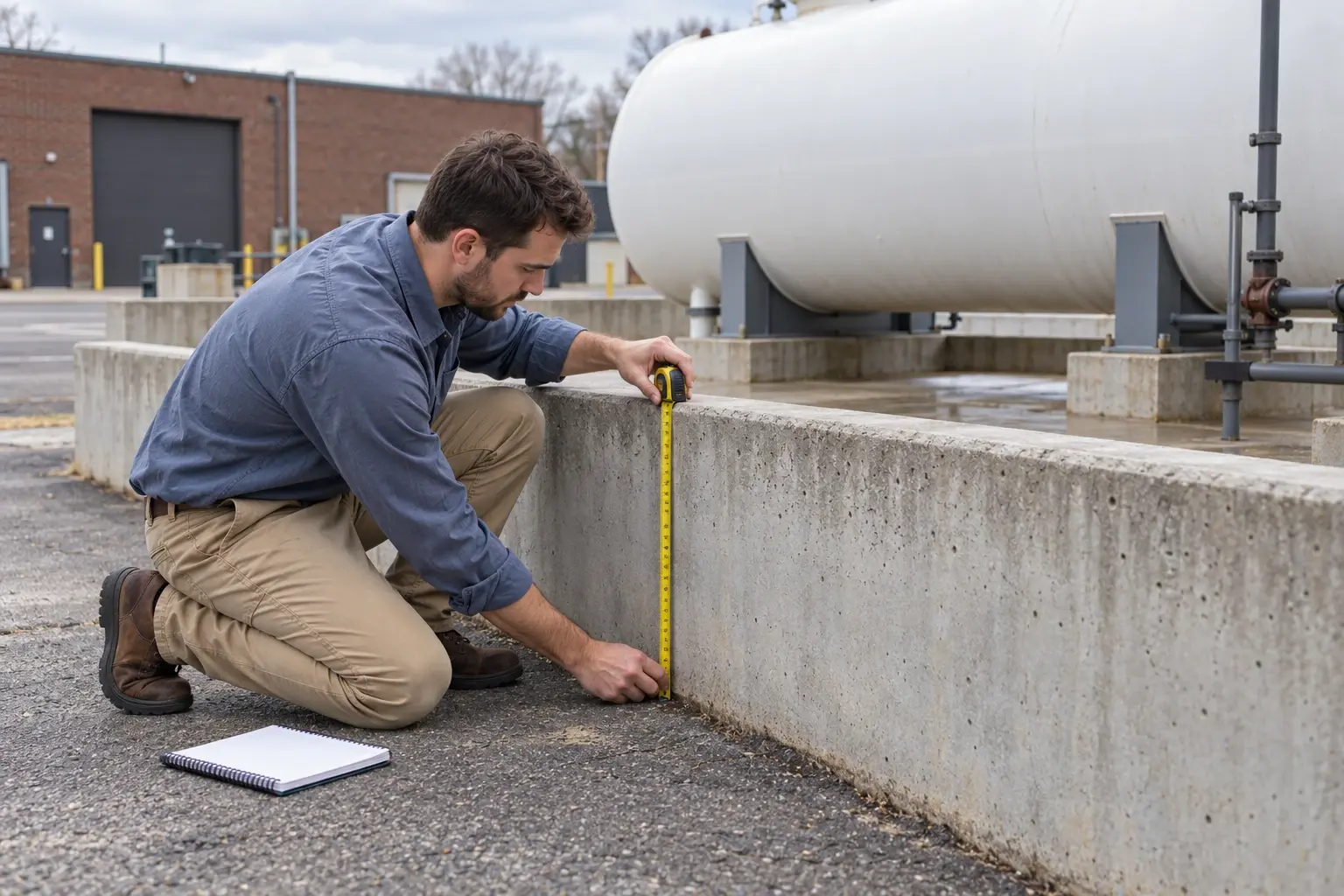
Checking that secondary containment holds the largest container plus freeboard for precipitation, adjusted for other tanks and displacement inside the dike. |
Measurements and math that can be wrong in expensive ways. See our guide to SPCC containment sizing. |
| Engineering judgment on alternatives |
Deciding whether an alternative provides equivalent environmental protection, or whether a standard measure is impracticable and what to do instead. |
Judgment the engineer has to defend, and it's the part that varies most from site to site. |
| Integrity testing recommendations |
Recommending inspection and testing of bulk containers to industry standards, with frequencies and who qualifies to perform them. |
Requires understanding tank construction, age, and condition. |
| Professional liability |
The engineer's license and insurance stand behind the certification. |
Engineers who do this carefully price in the review time and the risk. |
None of these steps are optional extras. They're what the certification is supposed to mean, and skipping any of them is how a plan ends up certified on paper and inadequate on the ground.
What Do PE-Certified SPCC Plans and Updates Cost?
These are the ranges RMA has published. Treat them as ballparks, since your own price depends on the factors in the next section.
| Service |
Published Range |
| New SPCC Plan (all types) |
$2,500 to $15,000 |
| Simple Tier I plan update |
About $1,500 |
| Complex PE-certified plan update |
$5,000 and up |
The gap between the Tier I update and the complex update is the PE work described above. A simple self-certified update is mostly document work, while a PE-certified update needs the engineer to revisit the facility and the calculations before certifying the changes. We go deeper on pricing in our article on what you should expect to pay for an SPCC plan, and you can get a number for your own facility with the pricing calculator below.
What Pushes an SPCC Plan Toward the High End of the Price Range?
The biggest driver is the amount of engineering the facility needs. Total storage capacity matters, but so does how many containers it's spread across. A site with a dozen tanks, drums, totes, and oil-filled equipment takes longer to inventory and document than one large tank. Secondary containment is the next major factor. A facility with simple dikes is straightforward, while one with shared containment, unusual geometry, or no containment at all needs calculations and a decision on what to do about it. The same goes for loading and unloading areas, complicated drainage, and sites with multiple buildings or a lot of piping.
Engineering judgment is the third driver. If standard requirements don't fit your site, the engineer has to evaluate alternatives and document the reasoning, and that takes more time and carries more liability than a plan where everything fits the template. The condition of your tanks matters as well. Older bulk containers with no inspection history make the integrity testing recommendations harder, and sometimes lead to follow-up work outside the plan itself. Finally, plan updates are cheaper when the original plan is accurate and complete. If we're fixing someone else's plan, we often start by finding out what's wrong with it. We explain when an update makes sense in our article on when to update your SPCC plan.
For New Jersey facilities, the engineering is the same as in any other state. What often adds work is the setting. Sites can be tight, close to water, and part of a larger state layer, and a facility that's a "major facility" under N.J.A.C. 7:1E also carries DPCC and DCR plans that need to line up with the SPCC Plan. Whether you're a major facility depends on your total storage and what you store, so check the rule against your own inventory.
Why Is the Cheapest PE-Certified SPCC Plan Usually a Bad Idea?
The cheapest quote is usually cheap because something in the table above got skipped. A plan that was certified without anyone examining the site, or without checking the containment math, can look finished and still fail an inspection. When it does, you're the one who answers to EPA Region 2, not the firm that sold you the plan, and the engineer's certification won't protect you from a plan that doesn't match your facility. Our article on top SPCC plan violations and fines shows how often the problems trace back to a plan nobody checked against the site.
We're not the cheapest, and we don't want to be. Our staff does the real work on your plan, and where a PE review is needed, we make sure it's a genuine review. A fair price for a PE-certified plan reflects the time it takes to get it right.
How Can RMA Help With PE-Certified SPCC Plans?
We can look at your facility, tell you whether your plan needs PE certification or can be self-certified, and give you a clear price with the factors behind it. If you already have a plan and just need to know whether it needs updating, we'll say so, and if a simple Tier I update is all you need, we'll tell you that too. We're a New Jersey-based firm, and we know how the state layer fits around the federal plan.
There's no pressure and no obligation. You can call us at 888-RMA-0230 or fill out the form on our website, and we'll start with a few questions about your site. When you're ready, contact RMA and tell us what you're trying to sort out.