How the 1988 Floreffe Oil Tank Collapse Shaped Pennsylvania's Storage Tank Law
If you store diesel, heating oil, or hydraulic oil at a Pennsylvania facility, you've probably noticed that two sets of rules seem to apply to your tanks. There's the federal oil spill prevention rule most people call SPCC, and there's a separate state program run by the Department of Environmental Protection (DEP). Plenty of facility managers assume the state layer is just bureaucratic duplication. It isn't, and the reason traces back to a single winter evening in 1988, when a tank outside Pittsburgh split open and sent diesel fuel into the Monongahela River.
We're going to walk through what happened at Floreffe, why the tank failed, how the spill reached drinking water for a large part of the region, and how Pennsylvania responded with the Storage Tank and Spill Prevention Act. Then we'll bring it back to what that history means for your facility today. If you'd rather talk through your own tanks and what applies to them, you can reach out to RMA at any point.
Table of Contents
TL;DR
On January 2, 1988, a reassembled Ashland Oil tank in Floreffe, Pennsylvania, split open on its first full fill and released about 3.8 million gallons of diesel. Roughly 750,000 gallons or more reached the Monongahela River and disrupted drinking water for an estimated one million people downstream. Pennsylvania passed the Storage Tank and Spill Prevention Act in 1989, which gave DEP its own tank program with registration, certified installers and inspectors, and spill planning. That's why Pennsylvania facilities answer to DEP's tank rules on top of the federal SPCC rule.
What Happened in the 1988 Floreffe Oil Tank Collapse?
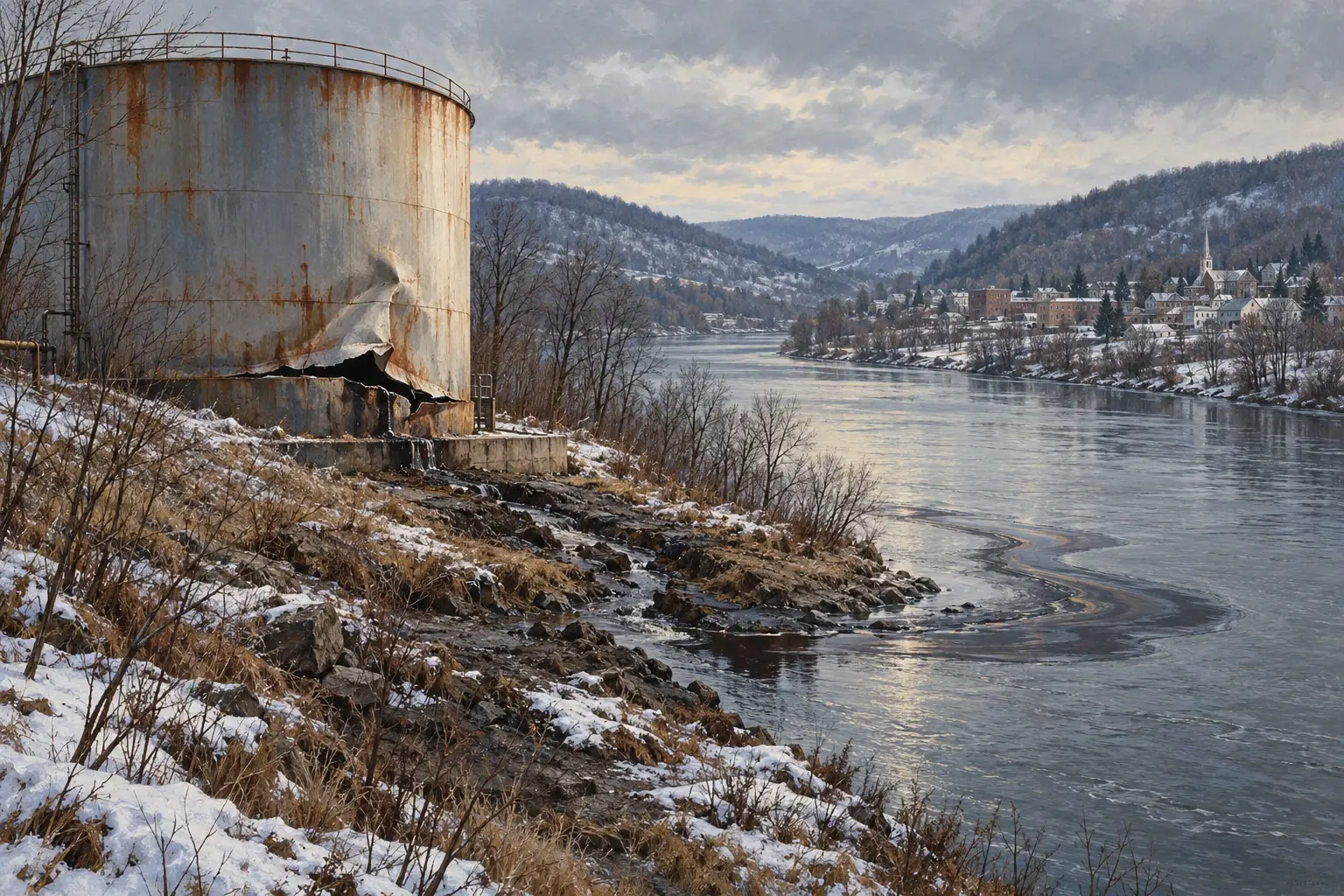
On the evening of January 2, 1988, a four-million-gallon storage tank at Ashland Oil's Floreffe terminal split apart. Floreffe sits on the Monongahela River about 25 miles south of Pittsburgh. The tank held roughly 3.8 million gallons of diesel fuel when it failed, and nearly all of that product left the tank in minutes. The steel shell split vertically, the contents rushed out, and the surge carried over the earthen dikes that were supposed to hold a failure like this one.
The tank wasn't an old, neglected fixture that had been leaking for years. It had been dismantled at another site near Cleveland, Ohio, moved, and rebuilt at Floreffe. The evening of the collapse was the first time it had been filled to capacity since that reconstruction. That detail is the center of the story, because the failure came from how the tank was built and tested, not from a slow leak anyone could have spotted on a walk-around.
For a sense of scale, most facility managers deal with tanks measured in hundreds or a few thousand gallons. The Floreffe tank held more than a thousand times the 1,320-gallon total that triggers a federal SPCC Plan. The principle that follows from Floreffe applies at every size: containment and inspection exist for the day a tank does something nobody planned for.
Why Did the Ashland Storage Tank Fail?
Investigators from the National Bureau of Standards, now known as NIST, concluded that the collapse came from a brittle fracture in the tank shell. The steel was World War II-era plate, and a flaw in it, described in news coverage as roughly dime-sized, gave a crack somewhere to start. When the tank was filled and the stress on the shell climbed, the crack ran along the steel instead of stopping. A Pennsylvania task force reviewed the collapse alongside the federal investigation, and the findings pointed the same direction.
Ashland admitted that it had violated industry standards when it rebuilt the tank. Brittle fracture is a known risk when older steel is reused, and industry standards for rebuilt tanks exist to catch it. Hydrostatic testing and careful evaluation of the steel are part of that picture. The lesson from the investigation wasn't that tanks fail without warning. It was that a tank can pass for sound until the moment it's loaded, and that decisions made during installation and modification decide whether it holds.
That's worth keeping in mind when you hear that Pennsylvania certifies the people who install, modify, and inspect regulated tanks. The state didn't invent that requirement out of habit. The worst inland oil spill of its era came from a tank that was moved and reassembled without the care the work required.
How Did the Diesel Spill Reach the Monongahela River and Drinking Water?
Containment is where the story gets harder to shrug off. The surge from the failed tank went over the containment dikes, across a parking lot on neighboring property, and into an uncapped storm drain. That drain emptied directly into the Monongahela. Estimates of the amount that reached the river vary by source, from about 700,000 gallons to as much as a million, with a figure around 750,000 gallons cited often. Within minutes the slick was moving downstream, passing over river locks and dams as it went.
The Monongahela is a source of drinking water for communities around Pittsburgh, and it flows into the Ohio River, which supplies water to many more. EPA's account of the incident says the oil temporarily contaminated drinking water sources for an estimated one million people across Pennsylvania, West Virginia, and Ohio. The spill also killed wildlife, damaged private property, and hurt local businesses. Cleanup crews used booms, vacuum trucks, and other equipment, and EPA reports that roughly 20 percent of the oil that entered the river was recovered. The rest dispersed into the water and along the shoreline.
The legal fallout was serious. A federal grand jury indicted Ashland in September 1988 for negligently discharging oil into the river in violation of the Clean Water Act, and in March 1989 news reports described a $2.25 million fine. A 1989 report from the U.S. General Accounting Office also reviewed the spill as an example of the risks of aboveground tanks sitting close to waterways. If your facility is near a stream, river, or storm drain, the Floreffe route from tank to river will sound familiar. Our article on when an oil spill has to be reported covers what the trigger looks like at ordinary facility scale.
How Did Floreffe Lead to the Pennsylvania Storage Tank and Spill Prevention Act?
The state's response came within about eighteen months. Pennsylvania's Storage Tank and Spill Prevention Act, Act 32 of 1989, was signed on July 6, 1989, and took effect on August 5, 1989. A review of the spill written from the state's environmental perspective described Floreffe as possibly the most severe spill in terms of potential impact on water supplies, and said it underscored the need for additional regulation of aboveground storage tanks. We can't point to a single sentence in the Act that says it was written because of Floreffe. The timing, the task force investigation, and the state's own post-spill review make the connection hard to miss.
The Act gave DEP a full storage tank program for aboveground and underground tanks. According to DEP, the program's responsibilities include tank registration and an annual registration fee, certification of the individuals and companies who handle and inspect tanks, permitting of tanks, technical and operational standards for tank systems, and procedures for reporting releases and carrying out corrective action. The statute also contains a Spill Prevention Response Plan article for aboveground tank facilities and provisions on siting new aboveground tank facilities. Those pieces map neatly onto what went wrong at Floreffe: who built the tank, how it was inspected, what stood between the tank and the river, and what the plan was when the worst happened.
Floreffe also pushed aboveground tank safety into national conversation, with federal agencies, Congress, and industry all examining how large tanks near waterways were built and managed. Pennsylvania just happened to be the state that had the disaster in its backyard, so it wrote its own rules.
How Do Pennsylvania Tank Rules Differ From Federal SPCC Rules?
The two systems overlap in purpose but they're separate programs, run by separate agencies, with different triggers. The federal SPCC rule is in 40 CFR Part 112 and is enforced in Pennsylvania by EPA Region 3. It's built around a written plan, inspections, secondary containment, and training for facilities that store oil above certain capacities. Pennsylvania's tank program sits in the Storage Tank and Spill Prevention Act and DEP's regulations in 25 Pa. Code Chapter 245, and it deals with the tanks themselves and the people working on them.
| Topic |
Federal SPCC (EPA) |
Pennsylvania Tank Program (DEP) |
| Legal basis |
40 CFR Part 112 |
Storage Tank and Spill Prevention Act and 25 Pa. Code Chapter 245 |
| Who enforces it in Pennsylvania |
EPA Region 3 |
DEP's storage tank program |
| Main focus |
Preventing oil from reaching waterways through a plan, containment, inspections, and training |
Regulating the tanks themselves: registration, permitting, standards, release reporting, and cleanup |
| Who does the work on tanks |
Facility owner or operator, with a PE needed for some plans |
DEP-certified companies and individuals for installation, modification, and inspection of regulated tanks |
| What triggers it |
Aboveground oil capacity over 1,320 gallons, counting only containers of 55 gallons or more, or buried capacity over 42,000 gallons |
Depends on the tank's size, type, and use, so it has to be checked against DEP's program |
A tank can be covered by one program, both, or neither, which is why a facility can have a current SPCC Plan and still have a DEP registration or certification question. The reverse happens too. Our articles on who enforces SPCC plans and the different types of SPCC plans cover the federal side in detail. For the state side, DEP's storage tank program pages are the authoritative source for what's regulated and what fees and certifications apply to your tanks.
What Does Floreffe Mean for Pennsylvania Oil Storage Facilities Today?
DEP's own program description says it regulates more than 17,000 aboveground storage tanks, along with roughly 21,000 underground tanks, at over 12,000 facilities across Pennsylvania. That's the program the 1989 Act built, and it's still running. For a facility manager, the practical takeaway is that oil storage here isn't a one-agency question. You may owe EPA a current SPCC Plan, owe DEP registration and inspections for certain tanks, and need certified professionals for tank work that DEP regulates.
The Floreffe failure points to the habits that keep a tank from becoming a news story. Look at what happens around the tank, because the oil that reached the river did it by finding a drain. Know where your storm drains and ditches lead and whether anything stands between a tank release and those paths. Treat any tank that's been moved, rebuilt, or modified as a different tank from the one you had before, and make sure the work was done by people qualified to do it. Keep your inspections and records current, since those are what an EPA or DEP inspector will ask to see first. Our guide to sizing SPCC oil spill containment explains how containment gets evaluated, and our article on SPCC five-year reviews covers keeping an existing plan current.
If you're building or expanding a facility, the construction side is a separate world. Building permits, fire permits, erosion and sediment control, and tank installation itself may involve DEP-certified installers and your engineer or contractor. RMA doesn't prepare construction-phase permits or approvals, and we won't pretend to. A new or expanded facility almost always needs operational pieces once it's running, such as an SPCC Plan or amendment, DEP tank registration questions, inspections, and employee training, and that's where we can help. We're also glad to point you toward the right construction professionals. Our online training library is one way to get your staff up to speed on spill response once the tanks are in service.
How Can RMA Help With Pennsylvania Oil Storage Compliance?
We're a family-run firm based in New Jersey, and we work with facilities across Pennsylvania. For oil storage, that usually means working out which rules apply to your tanks, writing or updating the SPCC Plan, evaluating secondary containment, training your people, and helping you sort out where DEP's tank program fits in. Our SPCC Plans typically run between $2,500 and $15,000 depending on capacity, the number of containers, and whether a PE certification is needed. Some people don't need us at all, since a smaller facility with a simple setup may qualify to handle a plan on its own, and we'll tell you so.
If a spill has already happened at your facility, make the required notifications first and handle the immediate safety and cleanup. Spills that involve violations, penalties, or liability questions can also call for an environmental attorney, and we're happy to work alongside one. When you're ready to talk about your tanks, call us, email us, or fill out the form on our website. There's no obligation and no pressure. You can contact RMA here and a member of our team will follow up.