How Stormwater Exposure Works at New Jersey Businesses, What Counts as Exposed, and Why It Decides Your Permit
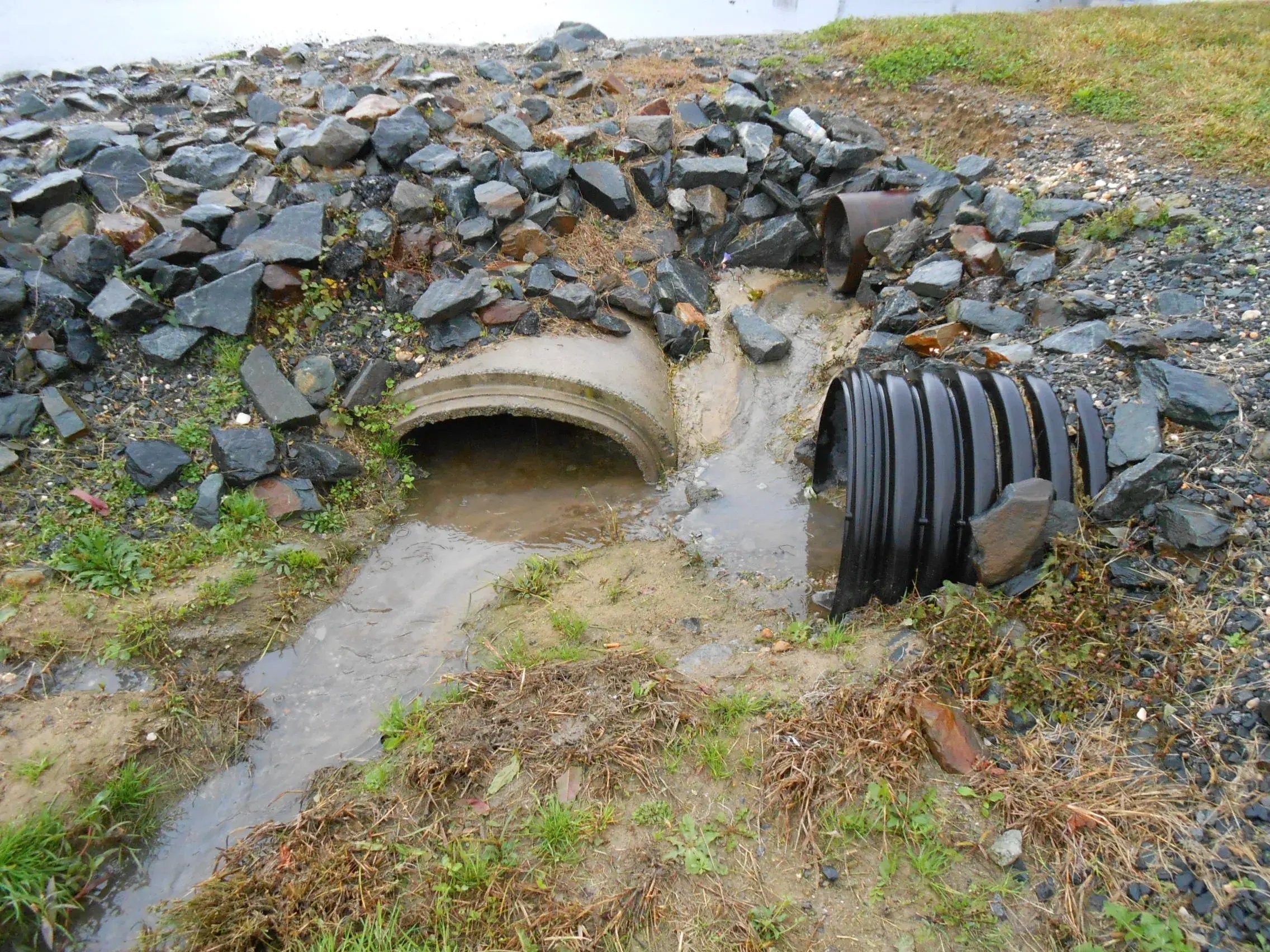
Most business owners in New Jersey think of rain as weather, not as a regulatory issue. It lands on the roof, crosses the lot, and drains away. The New Jersey Department of Environmental Protection (NJDEP) sees the same rain and asks what it touched on the way. Water that runs over an open dumpster, a stack of pallets, a leaking drum, or the underside of a forklift picks up whatever is on those things and carries it off your property, and for certain industrial businesses that runoff is a regulated discharge. The short answer to why NJDEP cares is that the rain does the polluting, and the more of your equipment and materials sit outside where rain can reach them, the more likely you are to need a permit, a plan, or at least a certification.
Below, we'll explain in plain words what "exposure" means, walk through everyday examples like dumpsters, pallets, drums, forklifts, scrap bins, and loading docks, show what usually counts and what doesn't, and explain why it all decides which New Jersey permit path a business ends up on. If you'd rather have someone look at your yard with you, you can always reach out to RMA and we'll help you sort it out.
Table of Contents
TL;DR
NJDEP cares about dumpsters, pallets, and forklifts because rain picks up oil, debris, and spilled product from them and carries it off your property. Anything sitting outside where rain can reach it is "exposed." If your business is in a covered industry, exposure decides your path: a Permanent No Exposure Certification if everything industrial is inside a permanent building, a basic or industry-specific general permit if it can't all go inside, or an individual permit if nothing else fits. Many businesses, like offices and plenty of warehouses, aren't in a covered industry at all.
What Does Stormwater Exposure Mean at a New Jersey Business?
Start with the rain itself. When it falls on your property, it hits the roof, the parking lot, the yard, and anything sitting outside, then it moves. It ends up in a storm drain, a ditch, a creek, or a basin where it soaks into the ground. Regulators call that moving water "stormwater," and in New Jersey the agency in charge of it is NJDEP, which does the job through the New Jersey Pollutant Discharge Elimination System, or NJPDES. NJPDES is the state's version of the federal NPDES permit program, and it covers water that soaks into the ground as well as water that runs into streams and storm sewers.
"Exposure" is the word NJDEP uses for how much of your stuff the rain can reach. The agency talks about "source materials," meaning any material or machinery connected to your industrial work that could add pollutants to runoff. Raw materials, finished products, waste, equipment, and anything leaking or spilled all qualify. If a source material sits outside where rain or snowmelt can touch it, it's exposed. If it's inside a building, it isn't. That one distinction ends up driving almost every decision about which New Jersey stormwater permit, if any, a business needs.
Why Would NJDEP Care About Dumpsters, Pallets, and Forklifts?
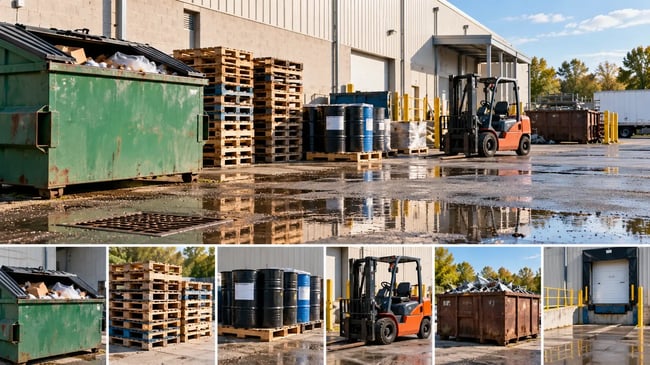
Because each one is a small, ordinary source of the things stormwater programs exist to keep out of streams and groundwater. EPA's industrial stormwater fact sheets name them directly. Wooden pallets shed debris and soak up whatever drips on them. Material handling equipment like forklifts leaks oil, hydraulic fluid, and fuel. Dumpsters holding manufacturing debris or wet waste give off liquid and loose trash when rain gets in. Drums, totes, and tanks leak at the fittings and spill during filling, especially when they sit outside.
None of these is dramatic on its own. A forklift drip is a few ounces. But rain doesn't care about quantity, and a yard where several of these sit uncovered for years adds up to a steady trickle of oil, metals, and debris heading for the nearest drain. NJDEP's approach is to deal with it at the source. Instead of testing the water after the fact and arguing about it, the permit system pushes businesses to get materials out of the rain in the first place, which is cheaper for everyone and works better.
Does Your Business Even Fall Under New Jersey's Industrial Stormwater Rules?
Before worrying about your dumpster, find out whether the rules apply to you at all. Having a parking lot doesn't put you in the program. The rules cover "stormwater discharges associated with industrial activity," and that phrase is defined by a list of business types, most of them identified by four-digit Standard Industrial Classification (SIC) codes that describe what a site does. Manufacturing, mining and quarrying, recycling and scrap, landfills and hazardous waste facilities, and power and treatment plants are the big groups. Our article on what stormwater associated with industrial activity means goes through the full list.
Plenty of businesses aren't on it. Offices, stores, restaurants, and most service businesses sit outside the industrial categories, so the dumpster behind your office isn't NJDEP's concern under this program. Many warehouses, data centers, auto body shops, car dealerships, and quick-lube shops don't need an industrial stormwater permit either, because their SIC code isn't listed or only a narrow piece of the operation is covered. Transportation businesses are covered only for maintenance, equipment cleaning, fueling, and deicing areas, so a truck terminal with a repair bay is a different story from one that only parks trucks. Your SIC code describes the main activity at that specific site, so check it before you file anything.
What Counts as Exposure? Everyday Examples at New Jersey Businesses
If your site is in a covered category, walk the yard and look at what rain can reach. Here's how the usual suspects tend to be treated.
| What's sitting outside |
What rain can pick up |
How it's usually treated |
| Open or leaking dumpster |
Liquid from wet waste, loose debris, residue |
Counts as exposure. A covered, leak proof dumpster used only for routine waste is one of the few things New Jersey's no exposure rule lets stay outside. |
| Stacked pallets |
Wood debris, dust, and anything that has dripped or spilled onto them |
Usually counts, especially if they hold product or are stained. The no exposure rule doesn't carve out pallets, so don't count on a pass. |
| Drums, totes, and tanks |
Oil, solvents, and chemicals from leaks and filling |
Counts. Open, rusted, or leaking containers are the worst case, and sealed drums aren't on New Jersey's short list of exceptions the way they are in some other states. |
| Forklift or loader parked outside |
Oil, hydraulic fluid, coolant, and fuel drips |
A well-maintained vehicle in normal condition can stay outside under the no exposure rule. A leaking one can't, and fueling, washing, or repairing it outside counts as exposed activity. |
| Scrap bins and roll-offs |
Metal fines, shavings, and oily residue |
Counts, especially if the scrap has touched oil or coolant. Scrap yards have their own general permits. |
| Outdoor loading dock |
Spilled product and residue from loading and unloading |
Outdoor loading and unloading appears on federal exposure checklists, so an open dock deserves a hard look. |
| Raw material or finished product stacks |
Dust and runoff from the material itself |
Counts. Bulk stockpiles are the most obvious exposure there is. |
The pattern across the table is simple. Anything that can leak, shed, or collect residue and sits where rain falls on it is a candidate. Anything closed, intact, and well maintained is much less of a problem, and anything that never leaves the building isn't one at all. When a call is close, it usually turns on small details, like whether a lid seals or whether a drum has a drip stain under it. Our guide to what no exposure means under a stormwater permit covers the general idea if you want the national picture.
What Can Stay Outside Under New Jersey's Permanent No Exposure Rule?
New Jersey's version of the no exposure exclusion is called the Permanent No Exposure Certification, and the rules behind it are in N.J.A.C. 7:14A-24.6. The word "permanent" matters. All industrial materials have to be stored, and all industrial activities have to happen, inside a permanent building or structure anchored to a foundation and fully roofed and walled. A tarp over a pile or a canopy open on the sides doesn't meet that definition.
The exceptions are narrow. Dumpsters or similar rigid containers used only for routine waste collection can stay outside if they're watertight, leak proof, and covered. Adequately maintained vehicles in normal operating condition that are used for material handling can stay outside too, and so can intact piping. Sealed drums, outdoor pallet stacks, and bins aren't on that list. Some other states' versions are more forgiving, so a "yes" you heard from a colleague in another state may not hold in New Jersey.
The certification covers the whole facility, so one clean building can't offset an exposed yard behind it. You resubmit it every five years, it doesn't transfer to a new operator, and NJDEP can inspect to confirm you qualify. If something becomes exposed later, the exclusion no longer applies and you'd need a permit. For a manufacturer with a loading dock, a leaky forklift, and a pallet yard, no exposure often isn't realistic, and the next question is which permit fits.
How Does Exposure Decide Which New Jersey Stormwater Permit Path You Land On?
For a covered business, what's outside and what you can do about it sorts you into one of four paths. New Jersey doesn't use one permit for everyone, and the permits rest on different assumptions about exposure.
| Path |
What it asks of your outdoor items |
Usually fits |
| Permanent No Exposure Certification |
Everything industrial inside a permanent, fully roofed and walled building, apart from the narrow exceptions |
Covered businesses that already keep it all indoors |
| Basic Industrial Stormwater General Permit (5G2) |
Get materials and activities out of the rain by moving or covering them, which NJDEP often calls "remove and cover," and follow the permit's plan, inspection, and certification requirements |
Covered businesses without their own industry permit that can fix their exposure |
| Industry-specific general permit: Concrete Products Manufacturing (CPM), Hot Mix Asphalt (R4), Mining and Quarrying (R13), Sand and Gravel (RSG), Scrap Metal (SM and SM2), Vehicle Recycling (RVR), Wood Waste Recycling and Leaf Composting (WRC) |
Written around industries where stockpiles and outdoor work are part of the job, with terms that differ by permit |
Concrete, asphalt, mining, sand and gravel, scrap, vehicle recycling, and wood and leaf recycling operations |
| Individual NJPDES permit |
NJDEP writes terms for your specific facility |
Sites that can't eliminate exposure and don't fit a general permit |
This is why your dumpster and pallets matter beyond tidiness. A manufacturer that moves its drums inside, puts a lid on the dumpster, and keeps the forklift in good repair may be able to certify no exposure and skip a permit. One that can cover most things but not everything probably lands on the 5G2, which expects exposure to be eliminated and then asks you to keep a Stormwater Pollution Prevention Plan (SWPPP). New Jersey's rules call that plan an SPPP, and some people call it an SP3 or just a stormwater plan, but we'll stick with SWPPP. Our article on what a SWPPP is walks through what goes in one, and our guide to the 5G2 Basic Industrial Stormwater Permit covers that path in detail.
Industries where outdoor material is the whole business don't get that option. A scrap yard can't move its scrap inside, which is why scrap metal has its own permits, covered in our SM2 scrap metal permit guide, and why concrete plants with aggregate stockpiles use a permit written for them, covered in our article on concrete plants and stormwater permits. If nothing fits, the individual NJPDES industrial permit article explains that last path. Our overview of general, individual, and no exposure permit options compares the paths side by side.
How Do You Check Your Site for Stormwater Exposure?
You can do a first pass yourself in an afternoon. Walk the property during or right after a real rain, because that's when you'll see where water pools and what it crosses on its way out. Look at every dumpster lid, every pallet stack, every drum, every parked piece of equipment, and every loading door. Look at the ground too. Stains and sheen under a forklift or at a drum fitting tell you more than any checklist, and old staining from years of operation can count against you even when nothing is leaking today.
Then follow the water. Runoff that reaches a stream, a ditch, a town storm sewer, or the ground through a basin is a discharge in the NJPDES program. Runoff that goes into a sanitary or combined sewer, where one pipe carries both sewage and rainwater to a treatment plant, may fall under your local sewerage authority's rules instead of, or alongside, an NJPDES stormwater permit. Several older New Jersey cities have combined sewers in at least part of town, but a single property can drain both ways, so don't let your zip code decide it for you. Find out where your own inlets and roof drains go, and confirm it with your authority or NJDEP before relying on it.
If you find exposure, ask whether the fix is cheap. Putting a lid on a dumpster, swapping an open container for a sealed one, or moving a few drums inside costs far less than living with a permit, and good housekeeping habits fall under stormwater best management practices. Write down what you found, including your SIC code, what you looked at, and where the water goes. Plenty of small facilities handle the basic permit on their own, and our article on whether you can get a stormwater permit yourself explains when that works and when it doesn't. Whatever path you land on, your employees will need training on it, and our online environmental training library is one way to cover that.
How RMA Helps With Stormwater Exposure at New Jersey Businesses
We're a family-run environmental consulting firm based in New Jersey, and we've been helping facilities with environmental compliance since 1992. We work with NJDEP's permit categories all the time. A senior member of our team will walk through your situation with you: whether your business is in a covered category at all, what counts as exposed on your site, whether no exposure is realistic, and which permit fits if it isn't. From there we can handle the Request for Authorization (the application you file with NJDEP for general permit coverage), write your SWPPP, and set up inspections and annual certification.
We'll also tell you when you don't need us. If your SIC code isn't covered, or the fix is a lid and a few drums moved inside, we'd rather say so than sell you something. There's no pressure and no obligation. You can call us, send an email, or fill out the form on our website, and when you're ready, just contact RMA and we'll talk through what you're looking at.