Supplier-Owned Diesel and Fuel Oil Tanks at Pennsylvania Sites Usually Still Belong in Your Oil Spill Plan. Here's How Responsibility Splits and How to Put It in Writing.
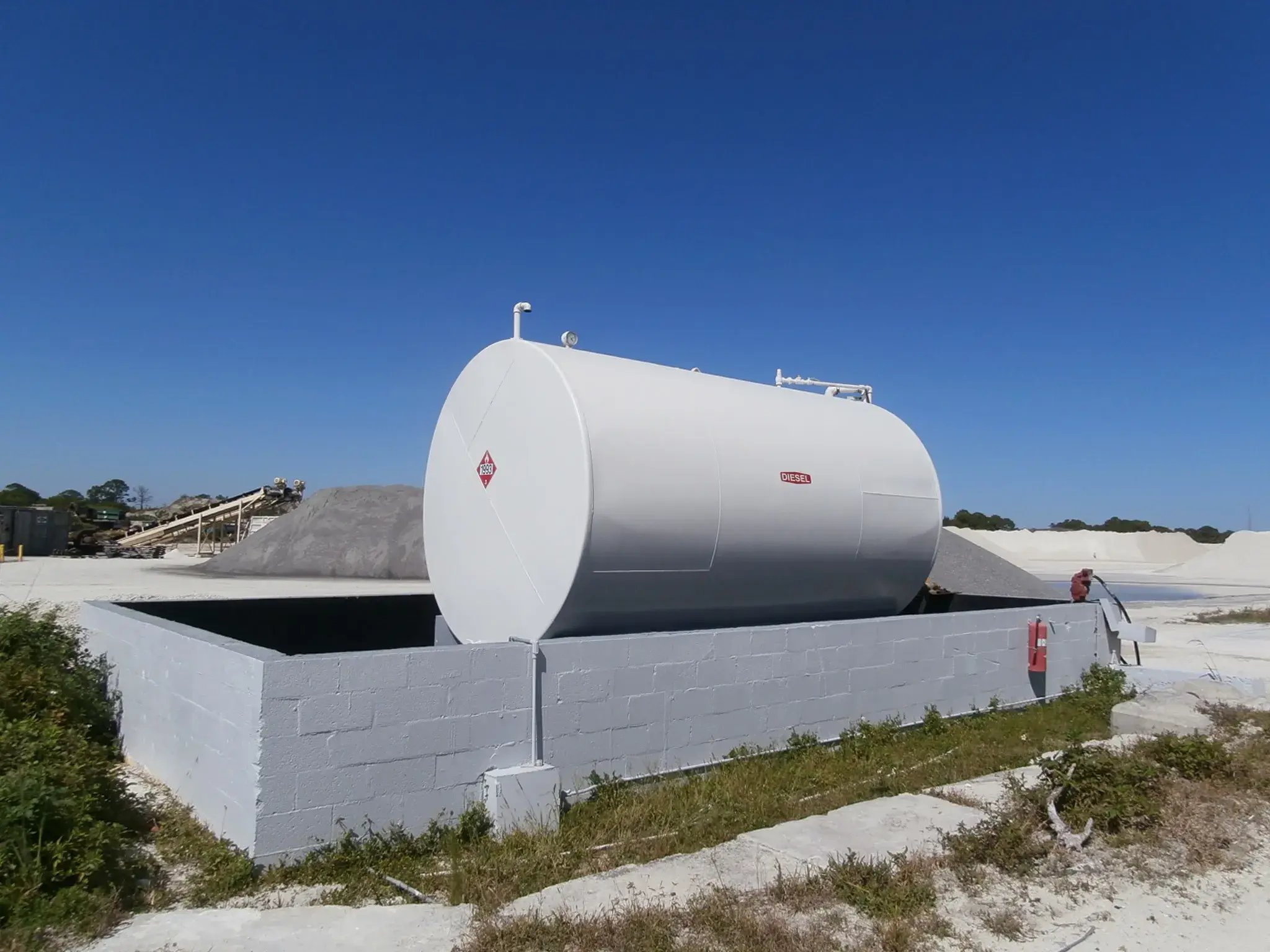
Plenty of Pennsylvania facilities have a diesel, gasoline, or fuel oil tank out back that they don't own. The fuel supplier dropped it off, keeps it filled, and maybe even services it, so it's easy to assume the supplier handles the compliance side too. Usually that's not how it works. The federal oil spill prevention rule puts the duty on the owner or operator of the facility where the oil is stored, and if your crews run the site and pull fuel from that tank, that's you. In most cases you still need to count the supplier's tank toward your storage total and cover it in your plan. The supplier often has obligations of its own, especially under Pennsylvania's tank program, but those don't take yours away.
Below, we'll cover why a tank you don't own still counts, how EPA and Pennsylvania DEP split duties between owners and operators, which tasks to sort out with your supplier and put in writing, who responds to a spill, and what it costs to bring those tanks into your plan. If you'd rather talk through your own setup, feel free to reach out to RMA and we'll help you figure out where you stand.
Table of Contents
TL;DR
If your fuel supplier owns a tank at your Pennsylvania site, you're usually still responsible for it under the federal oil spill prevention rule, because that rule applies to the owner or operator of the facility where the oil is stored, and you're the one running the site and using the fuel. The tank counts toward your storage threshold and belongs in your oil spill plan. Pennsylvania's tank program puts some duties on the tank owner, like DEP registration, so your supplier often has its own obligations too. The practical fix is a written agreement that spells out who handles inspections, integrity testing, overfill protection, deliveries, repairs, and spill response.
Who Is Responsible for SPCC Compliance When a Supplier Owns the Tank?
The federal rule we're talking about is the Spill Prevention, Control, and Countermeasure rule, found at 40 CFR Part 112. In plain terms, it requires certain facilities that store oil to have a written oil spill plan, called an SPCC Plan, that explains how they prevent spills, contain them, and respond if one happens. The rule applies to the "owner or operator" of a facility, and EPA defines that as any person owning or operating the facility. The rule is written around the facility, not around whoever holds title to each tank.
EPA has addressed this directly in its frequently asked questions for farms, which use supplier-filled tanks constantly. When asked whether the retailer that filled a tank is liable if the farm is out of compliance, EPA's answer was no, and that it looks to the tank's owner or operator. The same logic carries over to a quarry, a trucking yard, or a plant. If your people run the place and draw fuel from that tank, you're operating the facility where the oil is stored, and you'll usually be expected to account for it in your plan.
That doesn't mean the supplier is off the hook either. Owning the tank can bring its own obligations, particularly in Pennsylvania, and in some arrangements both companies carry duties at the same time. A regulator doesn't have to pick just one. In Pennsylvania, SPCC is enforced by EPA Region 3, and federal law allows civil penalties of more than $59,000 per day of violation for failing to follow the oil spill prevention regulations, based on the inflation-adjusted figures in 40 CFR Part 19.
Do Supplier-Owned Tanks Count Toward Your SPCC Threshold?
Usually, yes. The SPCC rule kicks in when a facility has more than 1,320 gallons of aboveground oil storage capacity (counting only containers of 55 gallons or more), or more than 42,000 gallons of completely buried capacity, and could reasonably be expected to discharge oil to waters of the United States. The count is based on capacity, not on how much oil is in the tank today, and it doesn't care who owns the container. A 1,000-gallon diesel tank your supplier lent you counts the same as one you bought.
This is how a lot of facilities end up over the line without realizing it. A supplier's 1,000-gallon diesel tank, plus a 275-gallon tote of hydraulic oil, plus a handful of 55-gallon drums of motor oil, puts you past 1,320 gallons. Empty tanks still count unless they've been permanently closed under the rule's specific requirements, and oil-filled equipment like hydraulic systems and transformers you own counts too. If you add everything up and you're comfortably under the threshold, you probably don't need a plan at all, and that's a fine answer. Our guide on the 4 steps to figure out if you need an SPCC Plan walks through the math.
Supplier-owned containers come in a lot of forms, and not all of them count the same way:
| Supplier-Owned Container |
Counts Toward Your SPCC Capacity? |
| Diesel, gasoline, or fuel oil tank on your property |
Generally yes, if it's 55 gallons or more |
| Lubricant or hydraulic oil bulk tank or tote on consignment |
Generally yes, if it's 55 gallons or more |
| Skid tank or fuel trailer parked on site |
Generally yes. These aren't motive power containers, so they don't get that exemption |
| Used cooking oil container from a rendering company |
Generally yes. Animal fats and vegetable oils count as oil under the rule |
| Propane tank |
No. Propane isn't oil under SPCC |
| DEF tote |
No. Diesel exhaust fluid isn't oil |
| The supplier's delivery truck while it's making a delivery |
The truck itself generally isn't part of your facility's capacity, but the area where it transfers fuel into your tank still needs to be addressed in your plan |
How Does EPA Decide Which Supplier Tanks Belong in Your SPCC Plan?
The SPCC rule's definition of a "facility" says its boundaries depend on site-specific factors, including who owns or operates the buildings, structures, and equipment on the site. EPA's guidance recognizes that a container on your property isn't always yours to plan for. The classic example is a pole-mounted transformer owned and operated by the electric utility. Your crews don't touch it, you don't control it, and EPA generally expects you to coordinate with the utility rather than put its equipment in your plan.
A supplier's fuel tank rarely looks like that utility transformer. Your employees dispense from it, park equipment next to it, check its gauge, and call for refills. That's operational control in every practical sense, so the tank usually belongs in your plan, on your facility diagram, and in your inspection routine.
There are genuine gray areas. A supplier that stores its own inventory on land it leases from you, behind its own fence, for distribution to other customers, may be operating its own facility. A tenant who owns and runs a tank on your property raises similar questions. EPA's advice for leased property is simple: make sure the lease states who's responsible for the tanks, and if it doesn't, talk to the other party and settle it. If you decide a container on your property isn't yours to cover, write down the reasoning so you can show an inspector how you got there.
How Do Pennsylvania's Tank Rules Split Duties Between Tank Owners and Operators?
Pennsylvania layers its own program on top of the federal rule. DEP's storage tank program runs under the Storage Tank and Spill Prevention Act and 25 Pa. Code Chapter 245, and the Act was passed in 1989, the year after the Ashland tank collapse in Floreffe spilled millions of gallons of diesel and sent much of it into the Monongahela River. Unlike SPCC, the state program draws a clear line between the two roles. An "owner" is anyone who owns or has an ownership interest in a storage tank. An "operator" is anyone who manages, supervises, controls, or has responsibility for the tank's operation. With a supplier-owned tank, the supplier is usually the owner and you're very often the operator.
Some duties land on the owner specifically. Tank owners register their tanks with DEP, generally within 30 days after installation or after acquiring an ownership interest, and the registration form asks for the owner, the operator, and the property owner. The Act makes it unlawful for an owner or operator to use an aboveground tank that isn't currently registered, and unlawful for anyone to fill an unregistered one. Whether a particular tank falls under the program depends on its size, contents, and use. The Act generally covers aboveground tanks over 250 gallons that store regulated substances like petroleum, with exclusions for things like heating oil burned on the premises, propane, and small noncommercial motor fuel tanks, so confirm your tank's status against DEP's storage tank program.
Other duties are shared or follow whoever is running the tank day to day, including monthly maintenance inspections, recordkeeping, and release reporting. When something goes wrong, DEP can order the owner, the operator, the landowner, or the occupier to take corrective action. Larger sites have one more layer. An aboveground storage tank facility with more than 21,000 gallons of capacity needs a Spill Prevention Response Plan (SPRP) filed with DEP, and Pennsylvania's Preparedness, Prevention, and Contingency (PPC) Plan requirements can also come into play. Most sites with a single supplier tank are well under the SPRP threshold.
| Requirement |
Program |
Who It Points To |
| SPCC Plan covering the tank |
Federal (EPA Region 3) |
Facility owner or operator, which is usually you |
| DEP tank registration |
Pennsylvania (DEP) |
Tank owner, which is often the supplier |
| Not using or filling an unregistered tank |
Pennsylvania (DEP) |
Owner, operator, and whoever delivers fuel |
| Release reporting and corrective action |
Federal and Pennsylvania |
Owner or operator, and DEP can also look to the landowner or occupier |
| Spill Prevention Response Plan |
Pennsylvania (DEP) |
Owner of an aboveground tank facility over 21,000 gallons |
Which Fuel Tank Responsibilities Should You Sort Out With Your Supplier?
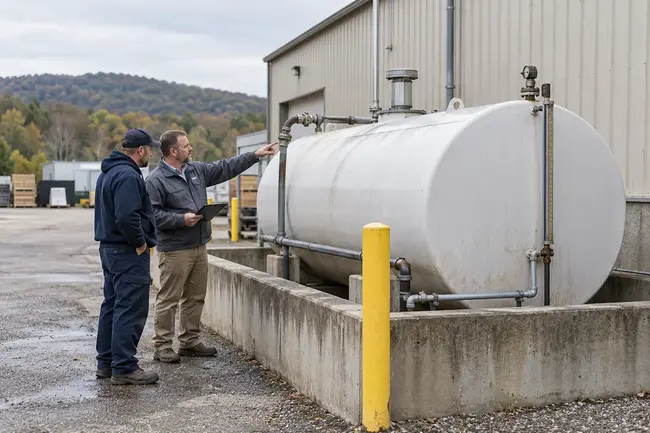
Once the tank is in your plan, the next question is who does the work. Your SPCC Plan has to describe how each requirement is met for every container, and some of that work may be better handled by your supplier. The rule cares that the work gets done and documented, not that your own employees did it. The trouble starts when both companies assume the other one has it covered. The "typical split" column below reflects common arrangements, but contracts vary widely, so treat it as a starting point for your conversation with the supplier.
| Task |
What the Rules Expect |
Typical Split (Varies by Contract) |
| Routine visual inspections |
Regular inspections of the tank, containment, and piping, with records kept |
Usually you, since you're on site every day |
| Integrity testing |
Testing or inspection on a schedule set by industry standards, such as STI SP001 for shop-built tanks |
Often the supplier as tank owner, with copies of results sent to you |
| Overfill protection |
A high-level alarm, pump cutoff, gauge, or similar device, kept in working order |
Supplier maintains the device. You confirm it works |
| Secondary containment |
Containment that holds the tank's full capacity plus room for rain, or an approved alternative like a double-walled tank |
Supplier if the tank is double-walled. You if it sits in a dike or berm you built |
| Delivery procedures |
Written procedures for transfers, such as checking available space and attending the fill |
Shared. The driver follows them, and your plan describes them |
| Employee training |
Training for oil-handling personnel and annual discharge prevention briefings |
You for your employees. The supplier for its drivers |
| Repairs, swaps, and removal |
Repairs to industry standards, and plan amendments when changes affect spill potential |
Supplier does the work. You update your plan |
Two of these deserve extra attention. Containment sizing is where supplier tanks most often fail inspections, because a tank swapped for a larger model can quietly outgrow the dike it sits in. Our article on how big SPCC containment needs to be covers the calculation. Inspections are the other one. Even if the supplier handles formal integrity testing, someone on your team should be walking the tank regularly, and our list of the top 10 things to check during SPCC monthly inspections is a good place to start.
What Should a Written Fuel Tank Agreement With Your Supplier Cover?
Many fuel supply contracts say very little about the tank. A common version says the equipment remains the supplier's property and the customer is responsible for its care, and that's about it. Pull your contract and read it. If it's silent on compliance, ask your supplier for an addendum or a signed letter that lays out who does what. Most reputable suppliers won't be surprised by the request.
A good written agreement should name who owns the tank and who registers it with DEP, and require the supplier to send you a copy of the current registration. It should set the integrity testing schedule, say who performs it, and require that you get copies of the reports for your SPCC records. It should cover who maintains overfill devices and gauges, what procedures delivery drivers follow at your site, and how much notice you'll get before the supplier swaps, moves, or removes a tank. Ask for that notice in writing, because a bigger tank can change your containment needs and trigger a plan amendment.
The agreement should also address spills. Spell out who calls whom, who supplies cleanup contractors, who pays, and how insurance and indemnification work if a release comes from the supplier's equipment or a driver's mistake. Liability and indemnity language is where an environmental attorney earns their fee, and we'd recommend having one review it. A contract can decide who does the work and who pays for it, but it can't stop EPA or DEP from holding you accountable as the facility operator. That's why your SPCC Plan should reference the agreement, and why you should keep copies of the supplier's records on site.
Who Responds When a Supplier-Owned Fuel Tank Spills in Pennsylvania?
Your people do, at least at first. If a spill creates a fire hazard or anyone is hurt, call 911 before anything else. Once it's safe, stop the source if you can, contain the oil, and keep it out of drains, ditches, and streams. Don't wait for the supplier to show up. Your SPCC Plan should list the supplier's emergency contact number right next to your own spill contractor's.
Reporting is also on whoever is there. Federally, any discharge that reaches water or causes a sheen on it has to be reported to the National Response Center at 1-800-424-8802, and our explainer on when you have to report an oil spill covers the sheen rule in more detail. Under Pennsylvania's Storage Tank and Spill Prevention Act, the tank owner or operator must notify the DEP regional office for your area immediately after a reportable release from a storage tank, and follow up in writing to DEP and the affected municipality within 15 days. Whether a specific spill meets the reporting threshold depends on what spilled, how much, and where it went, so when in doubt, call.
Who pays gets sorted out afterward, which is where your written agreement earns its keep. Spills can also lead to EPA or DEP enforcement, and inspectors who respond to a spill will look at your whole plan, not just the tank that leaked. If you're dealing with a spill, an information request, or a notice of violation, it's a good time to bring in an environmental attorney. For a sense of what's at stake, see our breakdown of top SPCC Plan violations and fines.
How Much Does It Cost to Add Supplier Tanks to Your SPCC Plan?
It depends on where you're starting. If a supplier's tank is what pushes your site over the threshold and you don't have a plan yet, you'll need one. RMA's SPCC Plans generally run from $2,500 to $15,000, depending on your total storage capacity, how many containers you have, and whether the plan qualifies for self-certification or needs a Professional Engineer's certification. A small site with one supplier diesel tank and a few drums often qualifies as a Tier I facility, which sits at the low end. Our article on how much an SPCC Plan costs walks through the factors.
If you already have a plan and the supplier adds, swaps, or moves a tank in a way that changes your potential for a discharge, the rule requires you to amend the plan within six months and put the changes in place within six months after that. A simple Tier I update typically runs about $1,500 with RMA, while a complex amendment requiring PE certification can run $7,500 or more. You can read more about when you should update your SPCC Plan and whether you can do it yourself. Containment upgrades, integrity testing, and tank work depend on the tank and your supplier contract, so get those quotes from the supplier or a qualified contractor. To estimate what our help with your plan would cost, use the calculator below.
How RMA Helps With Supplier-Owned Tanks and SPCC Plans in Pennsylvania
We're a family-run environmental consulting firm based in New Jersey, and we work with facilities across Pennsylvania on oil spill prevention. When supplier-owned tanks are part of the picture, we start by inventorying every container on your site, including the ones you don't own, to figure out whether you're over the SPCC threshold. If you are, we'll prepare a new plan or amend your existing one so the supplier tanks are covered properly, and we can put together a clear responsibility breakdown you can attach to your supplier agreement. We can also help your team with required training through our online environmental training library. If it turns out you're under the threshold, we'll tell you that too.
We're not attorneys, and we don't write supply contracts, but we can help you work out what the agreement needs to address so your lawyer and your supplier are working from the same list. There's no pressure and no obligation. Give us a call, send us an email, or fill out the form on our website, and reach out to RMA whenever you're ready to talk through your site.