An Overdue SPCC Plan Is One of the Most Common Inspection Findings. Here's How Much It Matters and How to Get Current Fast
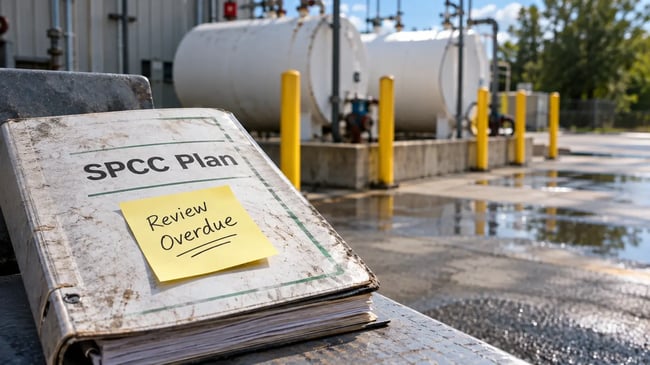
You open the binder to find your Spill Prevention, Control, and Countermeasure (SPCC) Plan, and the date on the cover is from 2018. Or the review log is blank. Or the tank list shows a 2,000-gallon diesel tank that was hauled off years ago and doesn't mention the generator you installed last spring. It's an uncomfortable moment, and it's a common one. Facilities across New Jersey fall behind on SPCC paperwork all the time, usually because the person who owned the plan moved on.
So how exposed are you? An overdue review is a real violation, but it's usually a paperwork violation, and it's one of the easiest to fix. Your exposure grows if the plan no longer matches your tanks, and it grows fast if you have a spill while the plan is stale. This article covers what the rule requires, why EPA finds this so often, how far out of date matters, what the penalties look like, and the fastest way to catch up. If you'd rather talk it through with someone, you can reach out to RMA at any point.
Table of Contents
TL;DR
Yes, an SPCC Plan that's past its five-year review is a violation of 40 CFR 112.5(b), but it's usually a fixable paperwork problem rather than an emergency. Your exposure depends less on the date on the cover than on whether the plan still matches your tanks, containers, and procedures, and it climbs quickly if there's a spill. EPA Region 2 enforces the rule in New Jersey, and the statutory penalties can reach tens of thousands of dollars, though paperwork-only findings have often settled for much less. The fastest fix is to walk the site, decide whether the plan needs a review or a rebuild, get a Professional Engineer to certify technical changes, and restart inspections and training.
What Does the SPCC Five-Year Review Require Under 40 CFR 112.5?
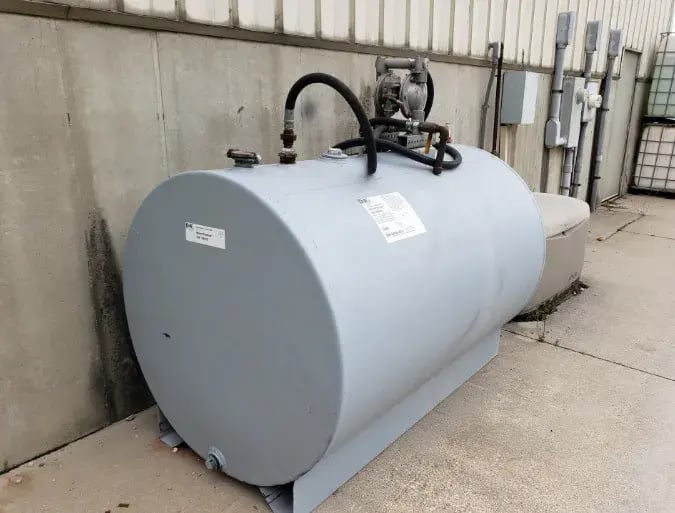
The SPCC rule is federal, found at 40 CFR Part 112. It applies to facilities that store more than 1,320 gallons of oil aboveground, counting containers of 55 gallons or more, or more than 42,000 gallons underground, and that could reasonably be expected to discharge oil to navigable waters or adjoining shorelines. Capacity is what counts, not how full the tanks are, and oil-filled equipment like transformers counts right along with fuel tanks. In New Jersey, EPA Region 2 enforces the rule. NJDEP doesn't administer it.
Section 112.5(b) sets the review requirement. You have to review and evaluate the plan at least once every five years, and you have to document that you did it with a signed statement in the plan saying whether you will amend it. If the review turns up a more effective prevention or control technology that's been field-proven and would significantly reduce the chance of a discharge, you amend the plan within six months and put the change in place within six months after that. The clock runs from your last documented review, so a review that happened but never got written down doesn't help you when an inspector asks for proof.
The review itself doesn't need an engineer. A Professional Engineer (PE) has to certify technical amendments under 112.5(c), unless you qualify to self-certify under the qualified facility provisions of 112.6, which generally means 10,000 gallons or less of aboveground storage and a limited spill history. A technical amendment is a separate obligation from the five-year review. Section 112.5(a) requires one within six months of any change in facility design, construction, operation, or maintenance that materially affects your discharge potential, no matter where you are in the five-year cycle. Our post on whether to update, renew, or redo a plan at its five-year review goes through the options, and our guide to when a Professional Engineer is required covers who can sign what.
Why Is an Overdue SPCC Plan Such a Common Inspection Finding?
EPA's own review of SPCC inspection findings, presented in a national webinar in 2021, listed plan content, certification, and reviews first among the most common deficiency areas, and it specifically called out plans that had never been reviewed and evaluated. The reason is simple. The five-year review is one of the easiest things for an inspector to check. They open the plan, find the review log, and look at the dates. If the log is blank or the last entry is old, the finding writes itself.
It also slips past facilities because nothing forces it. SPCC isn't a permit. You don't submit the plan to anyone, and there's no renewal notice or filing deadline. An SPCC Plan can sit in a binder until the person who knew about it changes jobs, and the review date goes by with no one noticing.
NJDEP doesn't enforce the SPCC rule, so an NJDEP or local inspector isn't going to cite you for an old plan. A facility with an overdue plan usually ends up in front of EPA after a spill, a complaint, or a referral. The five-year review is a standard line item on the form EPA inspectors use to record findings. For more on who shows up and why, see our post on who enforces SPCC Plans.
How Far Out of Date Is Too Far for an SPCC Plan?
Two clocks run on an SPCC Plan. The calendar drives the five-year review, and your site drives technical amendments any time your oil storage changes. A plan can be on schedule and still wrong, or overdue and still accurate. The table below shows how common situations stack up.
| Situation |
Rule involved |
Realistic exposure |
| Review a few months late, site unchanged |
112.5(b) five-year review |
A paperwork finding. Complete and document the review now and the gap is closed going forward. |
| Review years overdue, site mostly unchanged |
112.5(b), plus the records that support it |
The same finding, but inspectors tend to look harder at inspection and training records. |
| Tanks, drums, or equipment added, removed, or moved since the plan was written |
112.5(a) technical amendment, PE certification |
A separate violation that stands on its own, whatever the date on the cover says. |
| Plan can't be found, was never certified, or was never signed by management |
112.3(d) certification, management approval |
A full plan isn't effective without PE certification, so the facility can be treated as having no plan. |
| Any of the above, and a spill has happened |
SPCC rule, Clean Water Act, NJ Spill Act |
The plan and its records get read closely, and cleanup liability gets added to the picture. |
Inspectors read the age of the plan as a clue about the rest of your program. If the review is overdue, they'll reasonably wonder whether monthly inspections happened, whether anyone was trained, and whether anyone evaluated changes to the site. Inspection records have to be kept with the plan for three years, so pull those together before anyone asks for them.
What Penalties Can an Overdue SPCC Plan Lead To?
SPCC violations are enforced under Section 311 of the Clean Water Act. Under the federal inflation adjustments in 40 CFR Part 19 (the table we reviewed applies to penalties assessed on or after January 8, 2025, and EPA updates it periodically), EPA can assess a Class I administrative penalty of up to $23,647 per violation, capped at $59,114, or a Class II penalty of up to $23,647 per day, capped at $295,564. In federal court, the maximum for failing to comply with SPCC requirements is $59,114 per day of violation. Those are statutory ceilings, not what a paperwork finding typically costs.
In practice, a missing five-year review on its own has historically been resolved through expedited settlement, where EPA assigns a fixed amount to each paperwork finding and the facility pays and corrects the problems. The numbers climb when findings stack up, when the plan is missing or was never certified, when containment doesn't match what the plan describes, or when there's been a spill. We cover the usual findings in our post on top SPCC Plan violations and fines.
A spill also brings New Jersey's own law into play. The Spill Compensation and Control Act (the Spill Act) generally makes the party responsible for a discharge liable for cleanup and removal costs regardless of fault, and cleanups in New Jersey typically involve a Licensed Site Remediation Professional (LSRP). Those costs are separate from any SPCC penalty and can be far larger. We describe these programs in general terms here. If you're dealing with an actual discharge right now, make the required emergency and agency notifications first, and talk to an environmental attorney about your liability.
What If Your SPCC Plan Lists Tanks You No Longer Have?
The other way a plan goes stale has nothing to do with the calendar. Facilities add and remove oil storage constantly. A tank gets replaced, a contractor leaves a 330-gallon tote, a generator with a built-in fuel tank goes in, a transformer is swapped, or a diesel tank is pulled and the pad sits empty. Each of those can change what the plan has to say about containment, inspections, and drainage, and the changes that materially affect discharge potential require a technical amendment within six months, certified by a PE unless you're self-certifying as a qualified facility.
Removed tanks cut the other way. If your plan lists 5,000 gallons of storage and you're down to 800, you may have dropped below the 1,320-gallon threshold and no longer need an SPCC Plan at all. If that's you, we'd rather tell you so than sell you a new plan. Just document the capacity calculation and the date of the change. Count carefully, since drums of 55 gallons or more, totes, and oil-filled equipment all count toward the total. Our post on 55-gallon drums and SPCC Plans explains how.
New Jersey adds a layer for some facilities. Under N.J.A.C. 7:1E, a major facility is one with total storage capacity of 20,000 gallons or more of hazardous substances other than petroleum, or 200,000 gallons or more of all hazardous substances including petroleum products. Major facilities need a Discharge Prevention, Containment, and Countermeasure (DPCC) plan and a Discharge Cleanup and Removal (DCR) plan, which are submitted to NJDEP for approval and are separate from an SPCC Plan. NJDEP has been amending the rule, so check the current text against your own inventory. Lenders and insurers also tend to ask for a current plan, and we explain why insurers ask about SPCC Plans in a separate post. For the broader picture, see our overview of SPCC Plans in New Jersey.
What's the Fastest Way to Get a Current SPCC Plan?
The fastest route is a short sequence, and most of it is work you can start this week.
- Date the work accurately. Don't backdate a review or sign a log entry for a review that didn't happen. A review dated today, with a plain note that the prior one was missed, is fixable. A backdated one is a much bigger problem.
- Walk the site with the existing plan in hand. Compare every tank, drum, tote, and piece of oil-filled equipment on the ground to what the plan lists, then check containment, drainage, loading areas, contacts, and the facility diagram. Note capacities and take photos.
- Decide between a review and a rebuild. If the plan is yours, reasonably sound, and the site hasn't changed much, you can complete and document the review yourself, and an engineer only gets involved if something technical changed. If the plan is years old, was written by someone else, or no longer matches the site, rebuilding is usually faster than patching it. That's what we generally do, because we can only stand behind a plan we built from your site as it is today. Our post on what to do when a plan is over five years old digs into that decision, and so does our look at whether an old plan can be updated.
- Get the certification right. A full plan needs a Professional Engineer to review and certify it, and amended portions of an existing plan need certification too. Some consulting firms have an engineer in house and others work with a trusted outside engineer. What counts is that the engineer reviews the plan against the real site. If you qualify to self-certify, the person signing has to have visited and examined the facility.
- Restart the routine. Get management sign-off, keep a complete copy of the plan at the facility if it's attended at least four hours a day, restart monthly inspections, hold annual oil-handling training, and keep the records for three years. Our online training library covers the training piece if you need it quickly.
A simple facility can usually be done in a few weeks, and a complex site can take a couple of months, mostly because of site data collection and engineering review. We go through how long an SPCC Plan takes in more detail elsewhere.
On cost, our published range for a full SPCC Plan is $2,500 to $15,000. Where you land depends on total storage capacity, the number and type of containers, whether the plan needs Professional Engineer certification, and whether secondary containment needs to be evaluated or calculated. We break down SPCC Plan costs in a separate post, and the pricing calculator below shows what we'd charge to build a current plan for your facility.
How Does RMA Help With an Overdue SPCC Plan?
We're a family-run firm based in New Jersey, and we've been helping facilities with SPCC Plans since we started in 1992. When someone calls about an overdue plan, we start by finding out when the last review happened, what's changed on site, and whether the existing plan is something to build on or replace. Senior staff do that work, not junior people. Sometimes the answer is that you can handle the review yourself, and we'll tell you so. Other times the plan needs to be rebuilt, and we'll give you a straight price and a realistic timeline.
If you'd like a hand, you can call us, email us, or fill out the form on our website. There's no pressure and no obligation. Just contact RMA, and we'll talk through your situation and the options, whether that ends with us writing the plan or with you knowing exactly what to do on your own.