5G2 BMPs Explained: The Covers, Housekeeping, Maintenance, and Spill Controls NJDEP Expects to See at Your Facility
You've got a 5G2 authorization from the New Jersey Department of Environmental Protection (NJDEP), or you're about to apply for one, and somewhere in the permit and the plan forms you keep running into the phrase "best management practices." The permit says you need them, the stormwater pollution prevention plan (SWPPP, which NJDEP's forms call an SPPP, and which some people call an SP3 or just the stormwater plan) asks you to list them, and neither document tells you what they look like in a real warehouse or yard. The short answer is that under the 5G2, a best management practice (BMP) is anything you do that keeps your materials and activities away from rain and snowmelt: moving them indoors or under cover, keeping the site clean, maintaining what protects it, being ready for spills, and controlling activities like fueling, washing, and loading.
This article walks through the BMPs the 5G2 emphasizes, how to cover or relocate exposed materials, what good housekeeping, preventive maintenance, and spill prevention should include, which controls fit specific activities, how inspections and training keep everything working, and what NJDEP inspectors typically check when they visit. If you'd rather talk through your own site with someone, you can reach out to RMA whenever you're ready.
Table of Contents
TL;DR
Under New Jersey's 5G2 permit, best management practices are the habits and fixes that keep industrial materials and activities away from rain and snowmelt. The main ones are moving or covering exposed materials, keeping the site clean, maintaining the covers, containers, and procedures that protect it, being ready to stop and clean up spills, and controlling specific activities such as fueling, washing, and loading. You write them into your SWPPP, check them with monthly and annual inspections, train your people on them every year, and NJDEP inspectors compare what's on paper to what's on the ground.
What Are Best Management Practices Under the New Jersey 5G2 Permit?
NJDEP's permit defines best management practices as structural and non-structural controls, plus operation and maintenance procedures, that you apply before, during, and after polluting activities to keep pollutants out of receiving waters. That's a broad definition, and the 5G2 narrows it in practice. The 5G2 is the Basic Industrial Stormwater General Permit, issued under the New Jersey Pollutant Discharge Elimination System (NJPDES), and it's built for industrial facilities that can eliminate exposure of industrial materials and activities to stormwater. Our guide to the 5G2 Basic Industrial Stormwater Permit covers who qualifies. This article covers what you do once you're covered.
Because the goal is to eliminate exposure instead of treating dirty runoff, 5G2 BMPs lean heavily on prevention. The 5G2 doesn't require stormwater sampling, since a facility that has done its job shouldn't have pollutants in its runoff to measure. What the permit does require is a plan that says, for every material and activity at your site, what keeps it away from the weather. NJDEP's 5G2 SWPPP forms pair each source material or activity with a BMP and a scheduled completion date, so the BMP list sits at the center of your plan. The table below groups the practices the permit emphasizes.
| BMP Category |
What It Means at Your Site |
Typical Examples |
| Covering or relocating exposed materials |
Nothing industrial sits or happens in the rain |
Indoor storage, permanent roofs, sealed containers, closed dumpsters |
| Good housekeeping |
Outdoor areas stay clean and free of debris and leaks |
Sweeping, trash control, drip pans, quick cleanup |
| Preventive maintenance |
The things that protect you keep working |
Roof and cover repairs, container replacement, updated procedures |
| Spill prevention and response |
Liquids are contained, and people know what to do if one gets out |
Containment, spill kits, response procedures, trained staff |
| Controls for specific activities |
Higher-risk tasks have their own rules |
Fueling, washing, loading and unloading, equipment repair |
| Inspections and training |
You check the BMPs and your people know them |
Monthly walks, annual inspection, annual training |
How Do You Write BMPs Into the SWPPP?
The permit spells out what the plan contains: an inventory of source materials and industrial activities, a site map showing drainage and where materials and activities sit, a narrative assessment of how materials are handled, the BMPs themselves with a schedule for any you haven't finished, a maintenance plan, an inspection schedule, references to related plans like an SPCC plan, and training records. The plan is signed and dated, amended whenever operations change, and kept at your facility. You don't mail it to Trenton, but you do show it to NJDEP when asked. Our article on writing your own SWPPP covers what that takes for small sites. NJDEP's current 5G2 took effect in February 2018, and the department has circulated a draft renewal since then, so check NJDEP's 5G2 page for the version that applies to you.
How Do You Cover or Relocate Exposed Materials Under the 5G2?
Start with the inventory, because you can't cover what you haven't listed. NJDEP's term for the things that count is "source materials," and the permit's definition is wide: raw materials, intermediate and final products, wastes, by-products, industrial machinery, and fuels, lubricants, solvents, and detergents. A pallet of product by the back door counts. So does the used oil drum, the scrap bin, the bag of spill absorbent, and the parked piece of equipment that drips.
Once you know what's out there, each item gets one of three answers: move it indoors, put it under a permanent cover, or put it in a sealed container. Indoors is the cleanest fix. A permanent roof over a storage area works when there's no room inside. Containers work when they're closed and stay closed, and that includes dumpsters, which need to be covered when they're not in use. A tarp is a weaker answer than a roof or an enclosure, and whether a temporary cover satisfies the permit depends on how it's used, so ask before you build your plan around one.
The fix sometimes costs money, whether it's a storage shed, an enclosed dumpster, or a rearranged yard. If you build a structure, local building and zoning approvals may apply, and your contractor or engineer handles those, not us. If you can't cover or relocate everything, the 5G2 probably isn't your permit. Our article on individual NJPDES industrial permits covers what comes next, and our explainer on no exposure covers the opposite situation, where nothing is outside at all.
What Does Good Housekeeping Look Like at a 5G2 Facility?
Good housekeeping is the daily version of everything above. It means the parking lot, the loading area, the sides of the building, and the ground around the dumpsters stay free of trash, spilled product, leaking fluids, and stray debris. It's sweeping on a schedule, keeping lids closed, using drip pans under anything that might leak, wiping up a drip before it becomes a stain, and not letting pallets, scrap, or empty containers collect outside.
The right schedule depends on the site. At one facility we worked with, the monthly walk showed trash piling up near the dumpster. They swapped the open dumpster for a fully contained one and put cigarette butt buckets where employees took smoke breaks. Small changes like that come straight out of what the monthly inspection finds, which is how housekeeping BMPs are supposed to develop.
Look up as well as down. Leaking rooftop equipment can send pollutants to the ground through downspouts, and the permit expects your site map to show roof drainage where industrial activity happens on a roof. Our overview of stormwater BMPs gives more examples of the housekeeping practices that work for different kinds of facilities.
How Does Preventive Maintenance Work Under a 5G2 SWPPP?
Every BMP that's a physical thing eventually wears out, and the permit says so. Your SWPPP has to include a maintenance plan that provides for regular preventive maintenance and appropriate repairs, including replacement, of structural BMPs, and for updating non-structural BMPs such as standard operating procedures. In plain terms, someone is responsible for checking the roof over the storage area, the lids on containers, the drip pans, the drain covers, and any containment, and for fixing them before they fail.
A plan an inspector will respect names who does the checking, how often, and what happens when something's found. A cracked container lid gets replaced and the date gets written down. A leaking roof panel over the storage area gets a repair order, and the material moves while it waits. The permit also asks you to record problems and the corrective action you took, then reinspect to confirm the fix worked. Procedures need the same attention. If you add a product line or move a storage area, your written procedures and the SWPPP change with it, and old versions are kept for the retention period your permit sets.
What Spill Prevention and Response BMPs Does the 5G2 Expect?
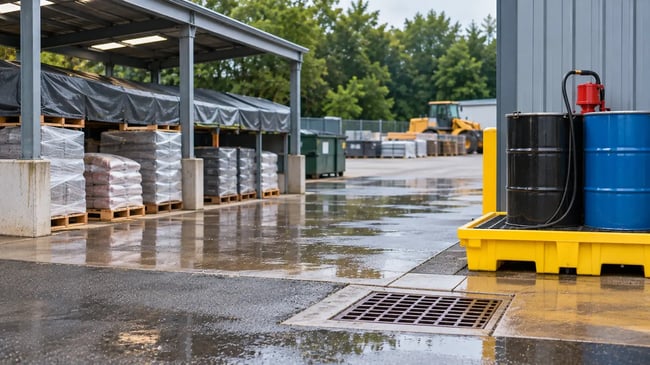
If a spill is an emergency or puts anyone at risk, call 911 first and deal with the paperwork afterward. For everything else, spill BMPs come in two halves: keeping liquids from getting out, and knowing what to do when they do. On the prevention side, that means containers that are closed and labeled, drums on containment instead of bare ground, drip pans under equipment, and liquids handled indoors or under cover. On the response side, it means spill kits stored near where liquids are used, written procedures that say who responds and who gets called, and employees who've been trained on them.
Your SWPPP also has to point to related spill plans if you have them. That includes a Spill Prevention, Control, and Countermeasure (SPCC) plan under federal rules and any discharge prevention plans required under New Jersey's N.J.A.C. 7:1E. If you store enough oil to need an SPCC plan, our explanation of the difference between an SPCC plan and a SWPPP shows how the two fit together. Know your reporting obligations too. NJDEP runs a spill hotline at 1-877-WARNDEP, and our article on when you have to report an oil spill explains the sheen rule.
One limit is worth stating plainly. The 5G2 covers stormwater, not process wastewater, non-contact cooling water, or sewage, and the permit doesn't treat a hazardous substance spill as a permitted discharge. If your inventory turns up a wastewater stream that reaches a storm drain or the ground, the answer is to stop it, send it somewhere that's authorized, or get the right permit. A SWPPP can't cover it up.
Which BMPs Apply to Fueling, Washing, Loading, and Other Specific Activities?
Some tasks create more risk than storage does, because they move liquids or materials around outdoors. The permit defines industrial activity broadly, covering manufacturing, processing, storing, loading and unloading, transporting, and the maintenance of equipment, and your SWPPP needs a control for each one that happens at your site. The table below shows the BMPs we see most often and what an inspector is likely to ask about each.
| Activity |
Typical BMP |
What an Inspector May Ask |
| Loading and unloading |
Do it inside or under cover, and sweep up spillage right away |
Does anything sit outside between the truck and the building? |
| Fueling |
A written procedure, drip pans, spill kit nearby, trained staff |
Who fuels, where, and what happens if something drips? |
| Vehicle and equipment washing |
Wash indoors with the water captured, or stop washing outside |
Where does the wash water go? |
| Equipment maintenance and repair |
Do the work indoors, and store fluids and parts under cover |
Are there stains, parts, or fluids outside? |
| Waste and recycling containers |
Closed lids, enclosed containers, no overflow |
Are lids closed and the area around them clean? |
| Dust or particulate-generating processes |
Enclose the process and clean up settled material |
Is there residue on the roof, the ground, or near drains? |
Washing deserves a closer look because it trips up more facilities than the others. The 5G2 authorizes stormwater, and wash water is a different animal. Wash water that reaches a storm drain or the ground generally needs its own permit, so facilities typically capture it and recycle it, haul it away for disposal, send it to a sewer where the local sewerage authority allows that, or stop the activity outdoors. Which one fits depends on your site and where your drains lead, so confirm before you commit. For fueling and maintenance the cleanest BMP is moving the task inside, and the next best is a covered, contained area with a procedure people follow.
How Do Monthly Inspections, Annual Inspections, and Training Keep 5G2 BMPs Working?
BMPs only count if someone checks them. The 5G2 asks for a monthly inspection of the areas at your facility exposed to stormwater or snowmelt runoff, and the person or team in charge of your stormwater program does it. It's a walk outside with a purpose. You're looking for trash buildup, uncovered materials or dumpsters, leaks or spills, the condition of the building exterior, and the places where stormwater leaves the site. Each finding gets written down with the fix and the date. Our guide to a stormwater visual inspection the right way will help you get consistent.
Once a year you do a more thorough inspection. This one confirms that your SWPPP is current, that the BMPs are in place, and that they're keeping industrial materials and activities away from stormwater. You'll review the plan, the monthly records, and the training records along the way. If you find that the facility isn't in compliance, the permit expects you to document what you're doing to fix it and how you'll keep it from happening again. NJDEP then wants a certification form stating that the plan was prepared and implemented and that the annual inspection took place. The due date follows the calendar quarter printed on your authorization, and the certification goes to NJDEP while the plan stays with you.
Training rounds out the program. Each year your facility trains employees on the BMPs in your SWPPP, so the people who handle materials and fix problems know what's expected of them. Good topics include spill response, housekeeping, and anything specific to your site. Keep a record of the date, topic, attendees, and trainer. Our articles on whether stormwater training is required and on taking 5G2 training online cover the details, and our online environmental training library can supply part of the content.
What Do NJDEP Inspectors Check at a 5G2 Facility?
NJDEP's Water Compliance and Enforcement staff inspect permitted facilities, and 5G2 facilities are generally among the easier visits. In our experience a visit is often about an hour. The inspector walks the outside of the building and grounds to confirm nothing is exposed to stormwater, then reviews your SWPPP and paperwork. Sometimes you'll get advance notice that they're coming, and sometimes they just show up, which the permit allows. Most facilities we work with have been inspected more than once over the years, though not every year. The table below shows what they look at and where facilities tend to come up short.
| What They Look At |
What They Want to See |
Common Gaps |
| Outdoor areas and building perimeter |
Nothing industrial exposed, and a clean site |
Pallets, scrap, drums, or equipment left outside |
| Dumpsters and waste containers |
Closed or enclosed, with a clean area around them |
Open lids, overflow, trash blowing around |
| Storm drains and discharge points |
Clear of stains, residue, and anything that doesn't belong |
Spills or wash water that reached a drain |
| The SWPPP itself |
Signed, dated, and matching the site as it is today |
Old maps, missing materials, unchanged after a layout change |
| Monthly inspection records |
One for every month, with problems and fixes noted |
Gaps in the log, or entries that all say the same thing |
| Annual inspection and certification |
A completed annual inspection and the certification on time |
Missed quarter, no record of the inspection |
| Training records |
Annual training with topics and attendees documented |
No sign-in sheet, or no training that year |
| Spill supplies and procedures |
Kits where liquids are handled and staff who know the steps |
Kits that are empty, missing, or locked away |
Most findings come from the gap between what the plan says and what the site looks like. The plan says dumpsters stay closed, and one's open. The plan says monthly inspections happen, and the log stops in March. When an inspector finds a problem, the usual outcome is a Notice of Violation with a deadline to correct it, and the permit has cited penalties under New Jersey's Water Pollution Control Act as high as $50,000 per day, per violation. A facility whose plan matches its site and whose records show it's been paying attention rarely gets near that. If you do receive a Notice of Violation or are facing penalties, an environmental attorney may be worth calling alongside your consultant. Our article on common NPDES permit problems covers the issues we run into most.
How Does RMA Help With 5G2 Best Management Practices?
We're a New Jersey firm, and we've worked with NJDEP's industrial stormwater permits for decades. For the 5G2, that usually means confirming the permit fits your site, walking your facility to build a source material inventory and BMP list that match what's really there, writing or updating the SWPPP, and training your team to run the monthly inspections and the annual review themselves. Our senior staff do that work directly, and we can support you after you're permitted with reminders, inspection prep, and plan updates if that's useful.
We'll also tell you when you don't need us. If your site is simple and someone on your team has an afternoon to walk it, the NJDEP forms may be all you need, and the articles linked above should get you most of the way. If you'd like a second set of eyes on your BMPs or a straight answer on whether the 5G2 fits, you're welcome to call us at 888-RMA-0230, email info@rmagreen.com, or fill out the form on our website. There's no pressure and no obligation, and you can contact RMA whenever the timing works for you.