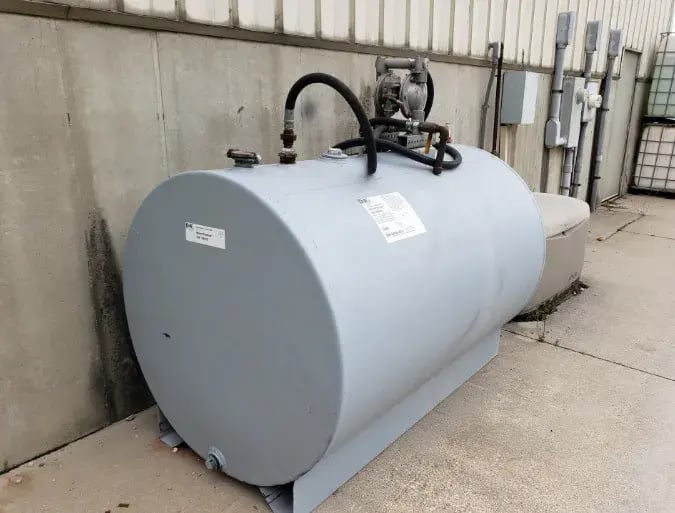
Driver, Supplier, or Facility? How Fuel Delivery Spill Responsibility Works in New Jersey
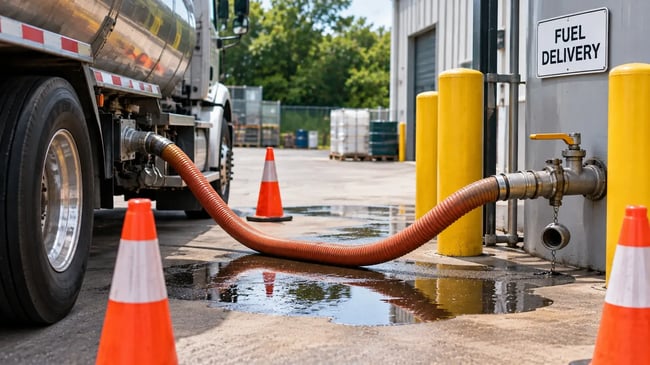
A delivery truck is connected to your diesel tank, everyone looks away for a minute, and fuel is running across the pavement toward a storm drain. In that scramble, the question that jumps to mind is whose fault it is, because cleanup bills, regulator attention, and your relationship with your fuel supplier all seem to hang on the answer. The short answer is that responsibility is shared and rarely tidy. The driver, the supplier, and your facility can all end up answering to the New Jersey Department of Environmental Protection (NJDEP) and EPA, your oil spill plan puts delivery procedures on you no matter what a contract says, and the contract mostly decides who pays whom after the fact.
In this article we walk through how New Jersey's spill law spreads responsibility around, what your federal oil spill plan (called an SPCC Plan) has to say about deliveries, what to do in the first few minutes, who has to report and to whom, and how contracts and written procedures can settle everyone's role before a hose ever gets connected. If you'd rather talk through your own delivery setup, you can reach out to RMA any time. We're not attorneys, so where an answer turns on a legal question, we'll say so.
Table of Contents
TL;DR
Responsibility for a fuel delivery spill is usually shared. Under New Jersey's Spill Act, anyone who caused a discharge or is in any way responsible for it can be held liable for cleanup costs whether or not they were at fault, and that can include the driver, the supplier, and your facility. Your SPCC Plan has to cover delivery procedures regardless of what your supplier contract says, and a spill generally calls for an immediate report to NJDEP. Written delivery procedures, overfill protection, and a clear supplier agreement are how you settle who does what before anything goes wrong.
Who Is Legally Responsible for a Fuel Delivery Spill?
New Jersey's main spill law is the Spill Compensation and Control Act, usually called the Spill Act. It covers petroleum along with other hazardous substances, and it's one of the broadest liability laws in the country. Under it, anyone who discharged a hazardous substance, or who is "in any way responsible" for it, can be strictly liable, jointly and severally, without regard to fault, for cleanup and removal costs. In plain words, strict means fault isn't the test, and joint and several means the state can go after any one responsible party for the whole bill and leave the parties to sort out their shares afterward.
In a delivery spill, that can reach the driver holding the hose, the supplier who employs the driver and owns the truck, and the facility that owns the tank. We're not attorneys, and how a court would divide the cost of a particular spill depends on the facts, so treat this as the general picture and not a legal conclusion.
| Party |
Typical Role in a Delivery |
Why They Can Be Pulled In |
| Driver |
Runs the truck, the pump, and the hose, and is usually first to see a problem |
Can be treated as the person who caused the discharge, and often makes the first phone call |
| Fuel supplier |
Employs the driver, owns the truck, and owns the product while it's in the truck |
Can be treated as the discharger or as a party in any way responsible, and usually carries its own insurance |
| Your facility |
Owns or operates the tank, the containment, and the spill plan |
Has SPCC Plan duties, Spill Act exposure, and reporting duties no matter who was holding the hose |
| Landlord or property owner |
Owns the land the fuel reached, if that isn't you |
Owning the property at the time of a discharge can be enough to draw attention under the Spill Act |
The federal side is easier to describe. The SPCC rule, which is 40 CFR Part 112, puts its duties on the owner or operator of the facility, not on the delivery company. EPA Region 2 enforces it in New Jersey, and we cover how that works in our guide to who enforces SPCC Plans. If an inspector shows up after a delivery spill, they'll ask to see your plan and your records, and "the supplier's driver did it" doesn't change what the plan was supposed to cover.
What Does an SPCC Plan Require for Fuel Deliveries?
SPCC stands for Spill Prevention, Control, and Countermeasure. A facility needs a plan if it stores more than 1,320 gallons of oil aboveground, counting every container of 55 gallons or more. The count is based on capacity, not on how full the containers are, and it includes oil-filled equipment and vegetable oils. Our overview of what an SPCC Plan is walks through it. Facilities under the threshold don't need an SPCC Plan, but the Spill Act still applies to them.
The rule requires the plan to describe discharge prevention measures, including procedures for routine handling of products such as loading, unloading, and facility transfers. It also asks for drainage controls, a description of how you'd discover, respond to, and clean up a discharge, and a contact list that includes the National Response Center, your cleanup contractor, and the agencies you'd call. A fuel delivery is a transfer, so your plan has to address it whether or not your supplier has procedures of its own.
Most facilities don't have a loading rack, which is a fixed structure such as a platform used to load or unload a tank truck. EPA's position is that the sized-containment and truck-departure rules for racks apply where a rack exists, and that transfer areas without a rack fall under the general secondary containment rule. Drainage from undiked areas where a tank truck discharge could happen still needs to flow somewhere that holds the oil, and the rule tells you to warn vehicles entering the facility so nobody backs into aboveground piping. We cover sizing in how big your SPCC containment needs to be.
People are part of the rule too. Oil-handling staff need training on discharge prevention and the contents of the plan, one person has to be designated as accountable for discharge prevention, and briefings have to happen at least once a year. New Jersey adds more for larger sites. A facility that counts as a "major facility" under N.J.A.C. 7:1E needs Discharge Prevention, Containment and Countermeasure (DPCC) and Discharge Cleanup and Removal (DCR) plans. Whether you're a major facility depends on your total storage capacity and what you store, so check the rule against your own inventory. Our page on SPCC Plans in New Jersey covers how the state layer fits on top of the federal rule.
What Should You Do in the First Minutes of a Fuel Delivery Spill?
Safety comes first, and your own plan and site hazards come before any generic list. With that said, a sequence like this works at most facilities.
- Stop the transfer. Hit the emergency shutoff, or have the driver stop the pump and close the valves.
- Get people clear, and call 911 if there's fire, injury, strong vapors, or fuel heading somewhere you can't block.
- Keep ignition sources away from the spill, including running engines, hot work, and smoking.
- Stop the spread. Close containment drain valves, cover or block storm drains, and use the sorbent socks, pads, or berms from your spill kit. Don't wash fuel into a drain with a hose.
- Ask the driver to stay until you've recorded what you need.
- Make your reporting calls, then call the cleanup contractor named in your plan.
While things are fresh, write down the time, the product, the truck number, the driver's name and company, the tank level before the delivery, how much was delivered, your best estimate of how much spilled, and where it went. Take photos. Stick to what you saw and measured, and leave guesses about fault to the people whose job it is to sort that out.
Who Has to Report a Fuel Delivery Spill in New Jersey?
New Jersey's Spill Act says any person who may be subject to liability for a discharge must immediately notify NJDEP, and owners and operators of major facilities must immediately report any unauthorized discharge. The NJDEP hotline is 1-877-WARNDEP (1-877-927-6337), staffed around the clock. The reporting rules at N.J.A.C. 7:1E-5.3 include some exemptions, but they're narrow and technical, so unless you've confirmed that one applies to your exact situation, make the call.
The federal rules run alongside the state's. Under 40 CFR Part 110, known as the sheen rule, a discharge of oil that reaches navigable waters or adjoining shorelines, or leaves a visible sheen on the water, has to be reported immediately to the National Response Center at 1-800-424-8802. A storm drain that leads to a stream can turn a pavement spill into a waterway spill quickly. We explain the trigger in when you have to report an oil spill. The SPCC rule also adds a written step. If a single discharge to navigable waters exceeds 1,000 gallons, or you have two discharges to navigable waters of more than 42 gallons each within 12 months, you have to send information to the EPA Regional Administrator (Region 2 for New Jersey) and to the state within 60 days.
| Who to Call |
Contact |
When |
| Emergency services |
911 |
Fire, injury, strong vapors, or any hazard to people |
| NJDEP hotline |
1-877-WARNDEP (1-877-927-6337) |
Immediately for a discharge in New Jersey, subject to limited exemptions |
| National Response Center |
1-800-424-8802 |
Immediately if oil reaches navigable waters or adjoining shorelines, including a visible sheen |
| EPA Region 2 and the state (written information) |
Written submission |
Within 60 days of a discharge over 1,000 gallons, or two over 42 gallons within 12 months |
| Your cleanup contractor, supplier, and insurer |
Per your plan and your agreements |
As soon as the immediate hazards are handled |
Whether a call from the driver or the supplier satisfies your own reporting duty is a legal question, and we'd rather not guess at it. The practical approach is to treat the call as yours. Confirm it was made, and write down the time, who took the call, and any case number you were given. Reporting isn't the same as admitting fault. Because reporting, liability, and enforcement questions can get complicated fast, an environmental attorney can be a good call for anything beyond a small spill. For cleanup, contamination of soil or groundwater typically involves a Licensed Site Remediation Professional (LSRP), which is a different specialty from SPCC work, and NJDEP may direct the response depending on the situation.
How Should Fuel Supplier Contracts Assign Spill Responsibility?
A supplier contract can't change what NJDEP or EPA expect from your facility, but it can decide who pays whom after the dust settles. Most facilities never read their delivery terms until after a spill. Check yours now, because the gaps tend to be in the practical details, not the legal boilerplate.
| Topic |
What to Look For |
| Attendance |
Who stays with the truck, and who from your side is present during the transfer |
| Tank room |
Who confirms the tank has space for the order, especially with scheduled or automatic top-offs |
| After-hours deliveries |
What happens when nobody is on site, and who has access to fill ports and containment |
| First response and notification |
Who responds first, who supplies materials, who makes which calls, and how quickly the supplier tells you about any incident |
| Indemnity and insurance |
Who covers cleanup costs and third-party claims, and whether you can get a certificate of insurance |
Indemnity language runs from balanced to heavily one-sided, and whether it holds up depends on the exact wording and New Jersey law, so have your attorney review it before you sign. General liability policies often limit pollution coverage, so talk to your broker too. Our article on SPCC Plans and insurance companies covers why insurers ask about your plan. Ask each supplier for a copy of its delivery and spill procedures and compare them with your plan. The driver follows the supplier's procedures and your plan describes yours, so where the two disagree, or where neither covers something like an unattended after-hours drop, is where spills usually start.
What Written Fuel Delivery Procedures Prevent Spills?
Written procedures turn "somebody should watch the tank" into a named person doing specific things. Name one person responsible for each delivery and a backup, and tie that to the accountable person your SPCC Plan already requires.
| Stage |
Facility Role |
Driver Role |
| Before connecting |
Check the tank level against capacity and work out room for the order, confirm containment drain valves are closed, stage the spill kit, and make sure the fill port is clearly labeled |
Confirm product and quantity, check that the product matches the tank, and inspect the hose and connections |
| During the transfer |
A trained staff member stays within sight of the tank and gauge and knows where the shutoff is |
Stays at the controls and watches the connections |
| After the transfer |
Verify the final level, check the fill area for drips, and sign the delivery ticket |
Disconnects, handles the hose drainage as the procedure says, and checks valves and outlets before leaving |
| If something goes wrong |
Stop the transfer, follow the plan, and make the calls |
Stops the pump, closes valves, and tells the facility immediately |
Training is what makes the table real. Anyone who might receive a delivery, including weekend and backup staff, should know the routine, where the shutoff and spill kit are, and who to call. Our guide to what SPCC training should include lists the topics, and our online training library is there if you'd rather not build your own. Keep records of your inspections and tests with the plan, since the rule calls for three years of them.
How Do Overfill Protection and Containment Reduce Fuel Delivery Spill Risk?
This section is about aboveground tanks. Underground tanks follow New Jersey's UST rules at N.J.A.C. 7:14B, which have their own requirements. For aboveground bulk storage containers, the SPCC rule requires at least one overfill prevention method. The choices are a high liquid level alarm with a signal at a constantly attended location, a high level pump cutoff, direct audible or code signal communication between the person watching the tank and the pumping station, or a fast response level gauge with a person present to monitor the filling. At smaller facilities, an audible air vent may be enough. Whatever you use, liquid level sensing devices have to be tested regularly, and a device nobody has tested in years doesn't count for much on delivery day.
Containment is the second layer. Bulk storage tank installations generally need secondary containment sized for the largest single container plus room for rain, and drain valves on diked areas have to be manual open-and-closed types, not flapper-type valves. Drip pans or curbing at fill connections catch the small leaks that happen at nearly every connection. Monthly walk-throughs catch most problems before a delivery does, and our list of the top 10 things to check during monthly SPCC inspections is a good place to start. If your plan is several years old, give its delivery section a fresh look too, since tanks and routines change without anyone editing the plan. Our article on what to do when your SPCC Plan is over five years old explains your options.
How Does RMA Help With Fuel Delivery Spill Prevention?
We're a family-run environmental consulting firm based in New Jersey, and our senior staff do the work themselves. Any SPCC Plan we write has to address how fuel gets delivered at your site. We help you check that your plan describes what happens on delivery day, write procedures your receiving staff can follow, train the people involved, and rebuild an outdated plan so we can stand behind it.
You may not need us. If you're under the SPCC threshold and what you need is a spill kit, a written delivery routine, and a supplier agreement your attorney has read, that's often manageable in-house. Contract language belongs with your attorney, and larger cleanups belong with a cleanup contractor and, where needed, an LSRP. If you'd like a second set of eyes on your plan or your delivery procedures, call us at 888-RMA-0230, email us, or fill out the form on our website. There's no pressure and no obligation, and you can contact RMA whenever it suits you.