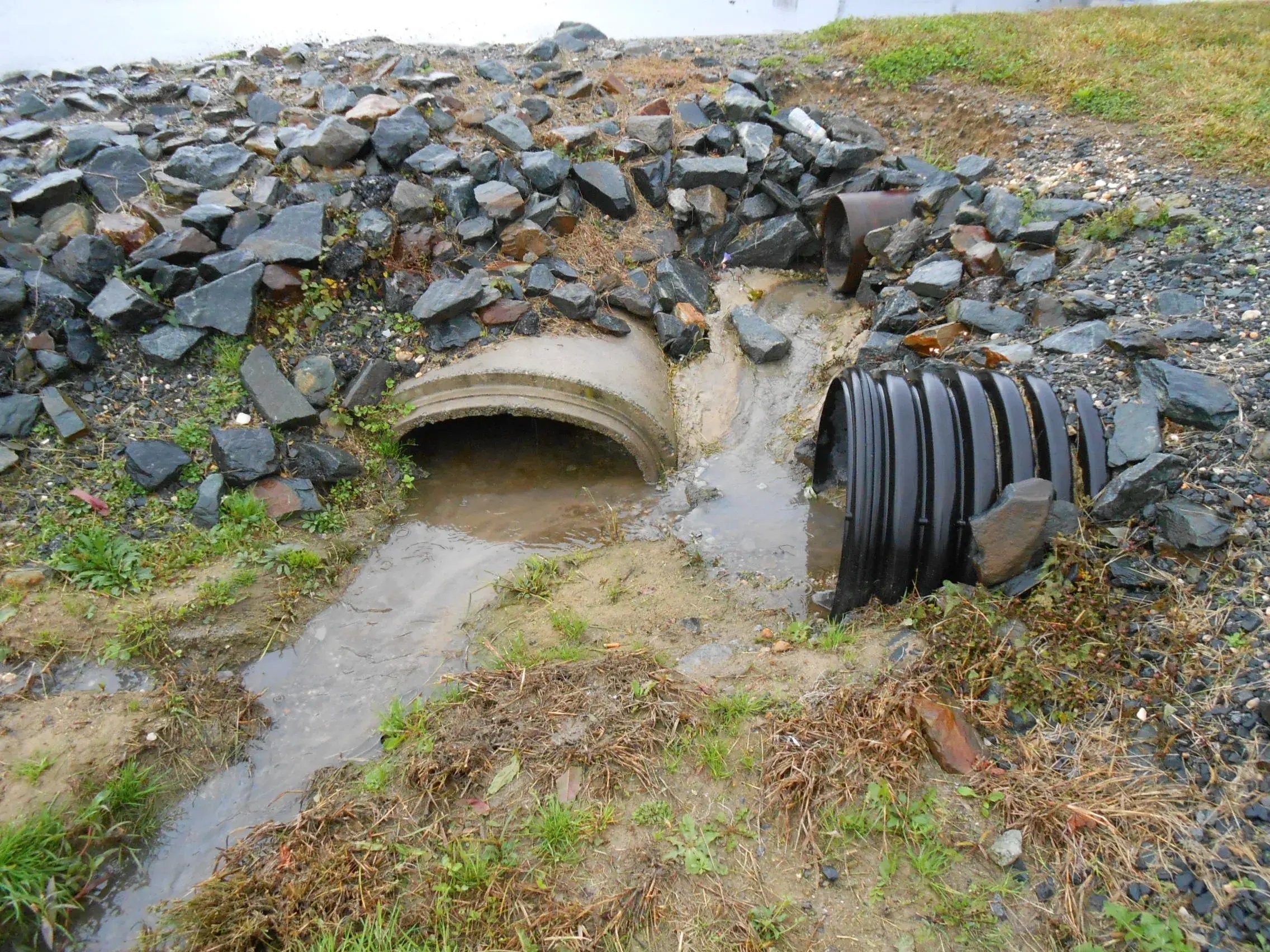
Too Small, Town Sewer, Utility Fee, Indoors, and the 5G2: What NJDEP's Industrial Stormwater Rules Really Say
Ask ten New Jersey facility managers whether their site needs a stormwater permit and you'll get ten different answers, and most of them start with a reason the rules don't apply. Stormwater permitting is about rain and snowmelt that touch your equipment, materials, or work areas and then run off your property. New Jersey regulates that runoff through NJPDES, the New Jersey Pollutant Discharge Elimination System, which the New Jersey Department of Environmental Protection (NJDEP) runs. Five beliefs come up constantly: we're too small, the town storm sewer makes it the town's problem, our stormwater fee covers us, we're indoors, and the 5G2 permit fits everyone. Each one is wrong or only partly right.
We'll cover what NJDEP looks at, take the five myths one at a time, and show how to work out which permit or exclusion fits your site. If your situation is still murky by the end, you can reach out to RMA and we'll look at it with you, even if the answer turns out to be that you don't need a permit at all.
Table of Contents
TL;DR
Whether a New Jersey facility needs an industrial stormwater permit depends on what it does and whether industrial materials or activities are exposed to rain, not on how big it is. Draining to a town storm sewer doesn't shift the responsibility to the town, and a local stormwater utility fee isn't an NJDEP permit. Being indoors only gets you out of permitting if everything is truly inside a permanent building and you file the right certification with NJDEP. The 5G2 is just one option alongside industry-specific general permits, individual permits, and the permanent no exposure exclusion.
What Does NJDEP Require for Industrial Stormwater Permits?
NJDEP treats stormwater as a discharge, meaning water that leaves your site after touching something industrial along the way. Federal rules sort industrial operations into 11 categories whose runoff needs permit coverage, and New Jersey applies those categories through its NJPDES regulations at N.J.A.C. 7:14A, using Standard Industrial Classification (SIC) codes and activity descriptions. The state program has run since 1993, and it covers discharges to groundwater as well as to streams, rivers, and lakes. Three questions decide where a facility lands: what does the site do, are industrial materials or activities exposed to rain and snowmelt, and where does the runoff go.
The paperwork that comes with a permit centers on a stormwater pollution prevention plan, which people call a SWPPP (pronounced "swip"), an SPPP, an SP3, or just a stormwater plan. We'll use SWPPP from here on. Here's how the five myths compare with what the rules say.
| The Myth |
What's True |
| We're too small. |
Coverage depends on your activity and exposure, not your size. |
| We drain to a town storm sewer, so it's the town's problem. |
The facility that discharges industrial stormwater stays responsible for it. |
| We pay a stormwater fee, so we're covered. |
A local utility fee pays for the local system. It doesn't authorize your discharge under NJPDES. |
| We're indoors, so we need nothing. |
Only a qualifying permanent no exposure certification takes a regulated facility out of permitting. |
| The 5G2 fits everyone. |
New Jersey also has industry-specific general permits and individual permits. |
Each of these has a reason people believe it, so we'll take them one at a time.
Myth 1: Is Our Business Too Small for a New Jersey Stormwater Permit?
No size threshold exists. The 11 federal categories sort facilities by what they do, such as manufacturing, recycling, mining, and transportation operations with vehicle maintenance, fueling, or equipment cleaning areas, and none of them sets a minimum headcount, acreage, or revenue. A five-person scrap yard with open piles can need coverage, while a much larger plant that does all of its work inside a permanent building may qualify for an exclusion. Size changes how much work the permit is, because a small site usually has fewer drainage areas to inspect and fewer places where water leaves the property. It doesn't change whether the rules apply.
NJDEP can also require permit coverage for a discharge that contributes to a water quality problem, such as one that falls under a total maximum daily load (TMDL) for the receiving water, even when the facility doesn't fit neatly into a category. Going the other direction, plenty of small businesses never need a stormwater permit because their activity isn't in a regulated category or their materials stay indoors. You reach that conclusion by checking your activity and your exposure, not by pointing to your headcount. Our guide to who needs a stormwater permit walks through the general logic behind that check.
Myth 2: Does Draining to a Town Storm Sewer Make It the Town's Problem?
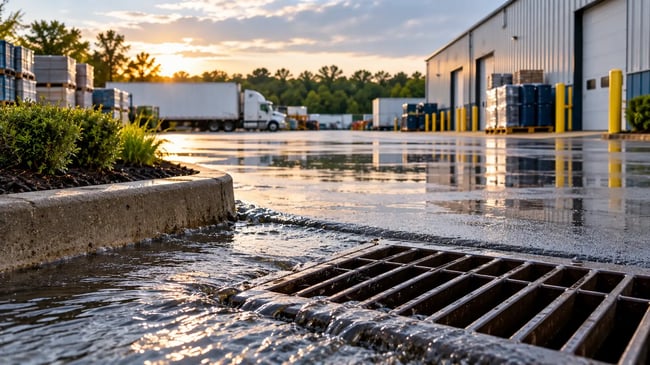
A storm drain at the edge of your lot moves your runoff into the town's system, but the responsibility doesn't move with it. The municipality holds its own NJPDES permit for its municipal separate storm sewer system (MS4), the network of storm drains, pipes, and ditches the town operates, under the Tier A or Tier B municipal stormwater general permit. That permit covers how the town runs its system. New Jersey's rules carry forward the federal requirement that industrial stormwater discharged through a municipal system is still regulated as industrial stormwater, so the facility that produces it stays on the hook. Many town ordinances also prohibit anything other than stormwater from entering the storm sewer, such as process wastewater or non-contact cooling water, unless a NJPDES permit authorizes it.
Where your water goes still matters, and it can change the answer. Stormwater that goes to a combined or sanitary sewer isn't covered by New Jersey's industrial stormwater permit rules, and the local sewerage authority's own requirements may apply instead. Some older urban areas have combined sewers, but you can't tell from a town name alone which kind of system your site connects to. Sites that drain to the ground, a dry well, or an infiltration basin aren't exempt either, since NJDEP regulates discharges to groundwater too. If your facility sits in an industrial park with a privately owned storm sewer, NJDEP can issue one permit with each tenant as a co-permittee or authorize each discharger separately, so a landlord's pipe doesn't remove your obligation. Confirm where your site drains with your municipality, your sewerage authority, or a consultant before you assume anything.
Myth 3: Does Paying a Stormwater Utility Fee Cover Our NJDEP Stormwater Permit?
Two different things share the word "stormwater" here. A stormwater utility is a local government service, made possible by the Clean Stormwater and Flood Reduction Act signed in 2019, that lets counties, municipalities, and certain authorities charge fees based on how much runoff each property sends into the public system. Each community decides whether to set one up, so some New Jersey businesses pay a utility fee and many don't. The money goes toward maintaining and improving the local stormwater system, and the law requires partial fee credits for properties that meet certain on-site stormwater standards.
An NJPDES permit is a separate thing. It's state authorization from NJDEP for your discharge, and it comes with conditions that fall on your facility, such as a SWPPP, inspections, and, depending on the permit, sampling and reporting. Paying the local fee doesn't satisfy any of that. When the utility law was being debated, the New Jersey Business and Industry Association pointed out that facilities already holding NJDEP stormwater permits would still be assessed the local fee, which tells you how separate the two are. A fee credit for on-site controls can lower your bill, but a credit isn't coverage. Our overview of NPDES stormwater permits explains what the permit itself involves.
Myth 4: Do We Need Nothing for Stormwater If Everything Is Indoors?
This one is the closest to true, which makes it the trickiest to correct. New Jersey does have an exclusion for what the rules call "permanent no exposure," found at N.J.A.C. 7:14A-24.6. To qualify, all industrial materials must be stored and all industrial activities performed inside a permanent building or structure that sits on a permanent foundation and is completely roofed and walled. Industrial materials and activities include machinery, raw materials, products, byproducts, and waste, along with storing, loading, unloading, and moving any of them. A tarp over a pile, a three-sided shed, or truck loading in an open yard doesn't meet that standard. The rules carve out a few exceptions: watertight, covered dumpsters used for routine waste, well-maintained vehicles used in material handling, and pipe that doesn't leak.
Qualifying also takes paperwork. The operator signs NJDEP's Permanent No Exposure Certification and resubmits it every five years, and NJDEP can inspect the facility to verify it. The exclusion applies to the whole facility rather than to individual outfalls or drainage areas, and it doesn't transfer, so a new operator has to file a new certification. If your town's MS4 operator asks for a copy, you have to provide it. If exposure comes back, say because a new product line puts material in the yard, the exclusion ends and discharging without a permit becomes an enforcement problem, so you'd want to get permit authorization before the change. NJDEP can also deny the exclusion if a facility's discharge could contribute to a water quality violation. Some facilities never needed a permit to begin with because their activity isn't in a regulated category, and if that's you, there's nothing to certify. Our post on what no exposure means under an NPDES stormwater permit covers the concept more broadly.
Myth 5: Does the 5G2 Basic Industrial Stormwater Permit Fit Every New Jersey Facility?
The 5G2 is the Basic Industrial Stormwater General Permit, and it's the name most facility managers hear first. It's one of several options. NJDEP also issues general permits written for specific industries, plus individual permits for facilities that don't qualify for a general permit, and it can require a facility to move to a different permit than the one it applied for. Which one applies depends on your primary activity, so the table below matches each permit to the kind of operation it was written for.
| Permit or Exclusion |
Code |
Designed For |
| Basic Industrial Stormwater General Permit |
5G2 |
Many regulated industrial facilities whose activity doesn't have its own industry-specific permit |
| Concrete Products Manufacturing |
CPM |
Concrete products manufacturing facilities |
| Hot Mix Asphalt |
R4 |
Hot mix asphalt producers |
| Mining and Quarrying |
R13 |
Mining and quarrying operations |
| Sand and Gravel |
RSG |
Sand and gravel operations |
| Scrap Metal Recycling |
SM2 |
Scrap metal recycling facilities |
| Vehicle Recycling |
RVR |
Vehicle recycling facilities |
| Wood Waste Recycling and Leaf Composting |
WRC |
Wood waste recyclers and leaf composting sites |
| Individual Industrial Stormwater Permit |
Individual |
Facilities that don't qualify for a general permit, or that NJDEP decides need site-specific conditions |
| Permanent No Exposure |
Exclusion |
Facilities with all industrial materials and activities inside permanent buildings |
Filing under the 5G2 when an industry-specific permit was written for your operation, or the other way around, is an easy mistake to make. SWPPP content, inspections, monitoring, and reporting can all differ from one permit to the next, so the wrong permit means building the wrong program. Our guides to the 5G2 permit, individual NJPDES industrial permits, the SM2 scrap metal permit, and concrete plants and stormwater permits cover several of these in more depth, and our post on which NPDES permit you need compares general, individual, and no exposure options side by side.
How Do You Figure Out Which New Jersey Stormwater Permit You Need?
You can work through it yourself in four steps, and plenty of facilities do.
- Identify your primary activity and its SIC and NAICS codes, then check whether it falls into one of the 11 regulated categories. If it doesn't, you may not need a stormwater permit at all.
- Walk the site and list everything that sits outdoors: material piles, containers, equipment, loading areas, fueling, vehicle maintenance, and anything else rain touches.
- Trace where the water goes: surface water, groundwater, a municipal storm sewer, a private system, or a combined or sanitary sewer.
- Match what you found to a permit or exclusion, then confirm it before you file anything.
If you're building or expanding a facility, a separate layer of requirements applies during construction. That includes construction stormwater coverage under the 5G3 general permit, soil erosion and sediment control certification through your local Soil Conservation District, and municipal site plan approvals. We don't prepare those, and your engineer, contractor, or a soil erosion specialist usually handles them. Once the facility is running, it almost always needs operational coverage, meaning the right industrial permit or a no exposure certification, along with a SWPPP and inspections. That's where we come in, and we can also help you work out what the construction phase needs and point you toward the right construction professionals.
If your answers point to a straightforward 5G2, you may not need a consultant. Our post on whether you can get a stormwater permit yourself covers when it's reasonable to go it alone.
How Does RMA Help With New Jersey Stormwater Permits?
We're a family-run environmental consulting firm based in New Jersey, and senior staff do the work on your file rather than handing it down. We can help you work out which permit or exclusion fits your site, build a SWPPP that matches your operation, and train your team to run it, including how to take stormwater samples correctly. We don't take the samples ourselves, because storm-event sampling windows are short and you know your site best. After you're permitted, we offer annual support such as reminders, help interpreting results, SWPPP updates, and inspection prep, as hands-on or hands-off as you want. Your staff can also build skills through our online environmental training library.
We're not the right fit for everyone. If you need engineering design or a treatment system built, or you're shopping purely on lowest price or fastest turnaround, another firm may serve you better, and we'll tell you that up front. Pricing depends on factors like the permit category, sampling, the size and complexity of your site, and whether you already have a SWPPP, and our NPDES pricing calculator gives you a starting number. If you'd like a second set of eyes on your situation, you can call us, email us, or fill out the form on our website when you contact RMA. There's no pressure and no obligation, and if you don't need us, we'll say so.