How the Federal SPCC Rule, New Jersey's Spill Act, and a Few Common Blind Spots Apply to Township and Borough Garages, Fuel Tanks, Drums, and Used Oil
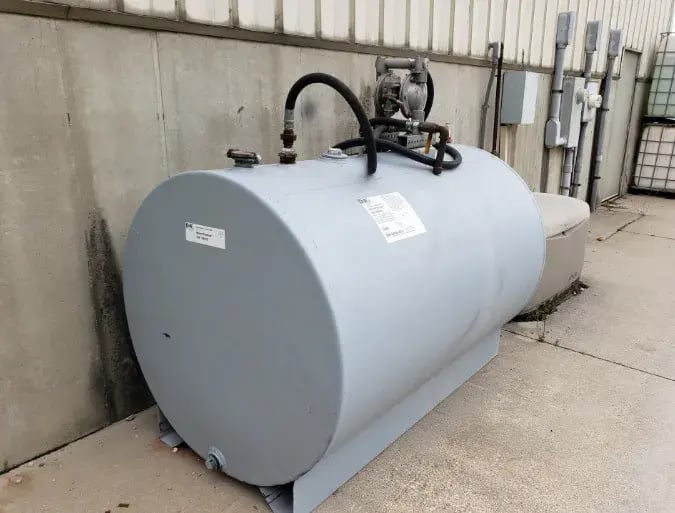
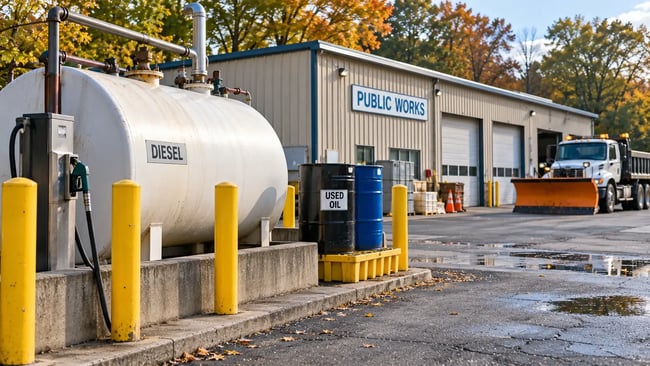
Walk through almost any township or borough public works yard and you'll find the same things: a diesel tank for the plow trucks, a gasoline tank for the pickups, a used oil tank by the garage, a rack of 55-gallon drums of hydraulic oil, and a heating oil tank behind the building. Added up, that's often more oil than anyone at town hall has ever tallied, and federal rules say a site with enough of it needs a written oil spill plan. The short answer is yes, many New Jersey municipal yards need one, and every municipality has spill reporting duties whether or not it needs a plan.
This article covers the federal oil spill plan rule, called the Spill Prevention, Control, and Countermeasure rule or SPCC, and how to tell whether your yard crosses the line. We'll also cover where New Jersey adds its own rules, the gaps we see most often in municipal yards, and how towns with several sites keep everything organized. If you'd rather talk it through with someone, you can reach out to RMA at any point.
Table of Contents
TL;DR
Yes. If a township or borough site stores more than 1,320 gallons of oil aboveground, counting every container of 55 gallons or more, and a spill could reasonably reach a stream, storm drain, or other water, it needs a written oil spill plan, known as an SPCC plan. Each yard, plant, and garage is judged on its own, so a town often ends up with several plans, several sites under the line, or both. Whether or not a plan is required, New Jersey law says to report a discharge to the NJDEP hotline immediately. Old tanks, forgotten drums, and used oil are where most municipal yards run into trouble.
Do New Jersey Municipalities Need an Oil Spill Plan Under the SPCC Rule?
The federal SPCC rule, found in 40 CFR Part 112, doesn't care whether the owner is a private company or a township. EPA's own guidance says facilities owned and operated by state and local governments are subject to it, and EPA Region 2 enforces it in New Jersey. A site needs a plan when three things are true: it isn't a transportation-related facility, it has more than 1,320 gallons of aboveground oil storage capacity in total, and it could reasonably be expected to discharge oil to navigable waters or adjoining shorelines.
The third test trips people up. The rule decides it using geography and location only, and it tells you to ignore manmade features like dikes, berms, and buildings. In practice, a public works yard with a storm drain, a ditch, or a swale that eventually reaches a creek or river usually meets the test, and in New Jersey that describes most yards. Capacity is the other detail to get right. The rule counts the size of the container, not how much oil is in it, so a 2,000-gallon tank holding 300 gallons still counts as 2,000.
Skipping the plan is a violation by itself, before any spill happens. Federal penalties for oil spill violations are adjusted for inflation each year under 40 CFR Part 19. At the last adjustment we confirmed, administrative penalties ran roughly $23,000 and up per violation, and court penalties ran roughly $59,000 per day. Our guide to the top SPCC violations and fines covers what inspectors tend to cite first.
Which Oil Containers at a Public Works Yard Count Toward the SPCC Threshold?
Most towns have never added up the oil on a yard, and the total is usually higher than expected because small items stack up. The rule counts oil in tanks, drums, totes, and oil-filled equipment, and it only counts containers with a capacity of 55 gallons or more. Here's how the usual yard inventory sorts out.
| Oil source at the yard |
Counts toward 1,320 gallons? |
| Aboveground diesel or gasoline tanks |
Yes, full tank capacity |
| 55-gallon drums of new or used oil |
Yes, 55 gallons each |
| Used oil tanks and totes |
Yes |
| Hydraulic oil totes and oil-filled equipment of 55 gallons or more |
Yes |
| Aboveground heating oil tanks |
Yes |
| Mobile fuel trailers and skid tanks |
Yes |
| Generator fuel tanks, including belly and day tanks |
Yes |
| Fuel tanks on plow trucks, loaders, and other vehicles |
No, motive power containers are exempt |
| Any container under 55 gallons |
No |
| Permanently closed containers |
No |
| Buried tanks covered by the New Jersey UST program |
No, handled under the state tank rules |
One tank alone can settle the question. A single 4,000-gallon diesel tank puts a yard over the line, and so do two 1,000-gallon tanks plus a handful of drums. The vehicle exemption has a catch, though. The truck's own tank is exempt, but the fueling area where diesel moves from a dispenser into that truck is still part of the plan.
If every site in your town comes in under 1,320 gallons, you don't need a plan, and you don't need us to tell you that. Do the math yourself, write it down, and keep it on file so you can show an inspector how you got there. If a site is over, the next question is who has to certify the plan. A site with 10,000 gallons or less in total and a clean discharge history over the past three years (no single discharge over 1,000 gallons and no two discharges over 42 gallons within a year) can qualify to self-certify, and a site with no container over 5,000 gallons can use the simplest version of that. Everything else needs a licensed Professional Engineer to review and certify the plan, so ask any consultant exactly how that step gets handled. Our posts on the different types of SPCC plans and Professional Engineer requirements walk through each path.
How Do the Spill Act and DPCC Plans Apply to Municipal Oil Storage?
New Jersey's Spill Compensation and Control Act, usually called the Spill Act, sits on top of the federal rule. It has no storage threshold. It applies to a discharge of petroleum or another hazardous substance at any facility of any size, and the implementing rules at N.J.A.C. 7:1E require the person responsible to notify NJDEP immediately at the hotline, 1-877-WARNDEP (1-877-927-6337). Limited exceptions exist, so the safe habit for a public works crew is to call when oil reaches soil, a storm drain, or water and let NJDEP decide whether it's reportable. If a sheen reaches a waterway, federal rules also call for a report to the National Response Center at 1-800-424-8802. Our explainer on when you have to report an oil spill covers the federal side.
Spill Act liability is strict, and it can reach the owner or operator of the property regardless of fault, so a municipality can't treat a spill at the yard as someone else's problem. Cleanup after the emergency response usually runs through a Licensed Site Remediation Professional, or LSRP, who oversees the work under NJDEP's rules. This is a topic where your municipal attorney should be in the loop, and we'd rather you hear that from us than skip it.
The heavier state layer is for what the rules call major facilities. A facility is a major facility under N.J.A.C. 7:1E when its total storage capacity reaches 200,000 gallons of hazardous substances including petroleum, or 20,000 gallons of hazardous substances other than petroleum. Major facilities must prepare and submit a Discharge Prevention, Containment and Countermeasure plan and a Discharge Cleanup and Removal plan, known together as DPCC and DCR plans. Most public works yards sit far below those numbers. Water treatment plants are the exception to watch, because large inventories of treatment chemicals that appear on NJDEP's hazardous substance list can count toward the total. Containers of five gallons or less and out-of-service tanks aren't counted, and NJDEP has been revising these rules, so check the current text of N.J.A.C. 7:1E against your own chemical inventory. Tank installations also have to satisfy the Uniform Fire Code, which local fire officials enforce, and that's a separate track from SPCC.
What Are the Most Common SPCC Gaps at Municipal Public Works Yards?
Municipal yards get built up over decades. A tank goes in during one administration, a generator arrives after a storm, a new superintendent starts stacking drums in the old salt shed, and nobody circles back to the plan. These are the problems we see most.
| Gap |
What it looks like in the yard |
What fixes it |
| Old fuel tanks |
Single-wall tanks with no containment, rust or weeping at the seams, no overfill protection, no record of ever being inspected |
Containment, a documented inspection program, overfill and gauging checks, or replacement |
| Drums |
Drums on bare ground or pallets, open bungs, mixed new and used oil, no containment |
Indoor or covered storage, containment, closed lids, labeling |
| Used oil |
Unlabeled tanks, rainwater in the collection tank, overflow during pickups |
Labeling, covered containment, a pickup routine, and a spill kit nearby |
| Fueling area |
Trucks fueled beside a storm drain with no drain protection or spill kit |
Spill response materials at the dispenser, drain covers, and written fueling procedures |
| Tanks added after the plan |
An emergency generator, a mobile refueler, or a new tote that never made it into the plan |
Amend the plan when the site changes, and re-tally capacity |
| Old or missing plans |
No plan at all, or one written years ago for a layout that no longer exists |
A five-year review at minimum, and a rebuild when the site has changed a lot |
| No records or training |
No inspection logs, and staff who couldn't say where the spill kit is |
Routine inspections with a signed log, plus an annual spill prevention briefing |
Secondary containment trips up more towns than any other item. For bulk storage containers, the rule calls for containment sized to hold the full capacity of the largest container plus enough freeboard for rainfall, and our post on how big SPCC oil spill containment needs to be shows how that math works. Drums and used oil have their own pitfalls, which we cover in whether 55-gallon drums count and the used oil rules.
Paperwork is the cheapest gap to close and the one inspectors check first. A plan has to be reviewed at least every five years and amended when a change materially affects the chance of a discharge, and the routine inspections need a written record. Our guides on what to do with a plan that's over five years old and monthly SPCC inspections are good starting points for a crew that's behind.
How Do Underground Fuel Tanks and Tank Replacements Fit Into Municipal SPCC Compliance?
Many older yards have a buried fuel tank next to the garage. Underground tanks that fall under New Jersey's UST program, N.J.A.C. 7:14B, are regulated separately for leak detection, registration, and closure, and the SPCC rule doesn't count them toward your capacity. That exemption only covers tanks subject to the full UST requirements. Heating oil tanks at nonresidential sites with a combined capacity of 2,000 gallons or less fall outside the regulated program, and an underground tank that sits outside the state program may still need to be addressed in your plan, so don't assume buried means exempt. Work on those smaller heating oil tanks also requires certified contractors under the state rules.
Replacing or removing a tank is construction work, and it brings its own approvals. Installing, repairing, or closing a regulated underground tank requires NJDEP-certified UST contractors and the appropriate construction permits, and aboveground tank installations involve local construction and fire officials. We don't prepare construction-phase permits or approvals, so a project like that belongs with your engineer and a certified tank contractor. We can help you figure out what the construction phase involves and point you toward the right people. What we do handle is everything the yard needs once the new tank is running: the plan or amendment, the inspection routine, spill procedures, and staff training. If a tank leak turns into a cleanup, an LSRP will typically lead that process.
How Do Municipalities Manage SPCC Plans for Several Facilities?
A town's oil isn't all in one place. The public works yard is the big one, but the water plant, sewer pump stations, firehouses, the police building, and the municipal complex all have generators or heating oil tanks. The SPCC rule lets the owner or operator decide where a facility's boundaries fall, and EPA's 2008 amendments confirmed that non-contiguous buildings and parcels can be treated as separate facilities. The limit is that you can't carve up a site just to dodge the rule, so splitting side-by-side tanks that serve the same purpose into separate facilities won't hold up. For a municipality, that usually means each site gets its own capacity calculation, and each site over the line gets its own plan.
| Municipal site |
Typical oil sources |
What to watch |
| Public works yard |
Diesel, gasoline, used oil, drums, hydraulic oil, heating oil |
The site most likely to need a full plan, with a fueling area and several containers |
| Water treatment plant and wells |
Standby generator tanks, transformers, lubricating and hydraulic oil |
Treatment chemicals can count toward New Jersey's major facility totals |
| Sewer plant and pump stations |
Generator tanks, oil-filled equipment |
The wastewater treatment exemption is narrow and doesn't cover a generator fuel tank |
| Fire, EMS, and police buildings |
Generator tanks, heating oil tanks |
Often under the threshold, but a generator plus a heating oil tank can add up |
| Municipal buildings and community centers |
Heating oil tanks |
Document the capacity math even when it's under the line |
Water and sewer plants carry notification duties in their own permits that can sit alongside the Spill Act, so read those permit conditions as well. Once you have the sites sorted, the towns that run this smoothly tend to do the same handful of things. They keep one inventory of every oil container across all sites, with capacities. They write down the facility boundaries they chose and why. They use a common plan format with a site-specific diagram, inspection log, and contact sheet for each location. They name a responsible person at every site and post the NJDEP hotline number where crews will see it. They also stagger the five-year reviews so the work spreads across budget years, and they re-tally capacity whenever someone adds a tank, tote, or generator. If two towns share a yard through a shared services agreement, decide in writing who the operator is.
Several sites don't have to mean several times the effort. A remote approach can keep a multi-site rollout efficient, and our post on handling SPCC plans for multi-facility operations explains when that makes sense. Training is part of the same picture, and our online training library and our guide to annual SPCC training cover how to keep crews current.
What Does a Municipal SPCC Plan Cost?
SPCC plans from RMA generally run from $2,500 to $15,000, and the number moves with the site. The drivers are total storage capacity, the number and type of containers, whether Professional Engineer certification is needed, and whether the secondary containment needs to be evaluated. A pump station with one generator tank is a very different job than a yard with six tanks and a fueling island, so pricing follows each site rather than the town as a whole. For a town with several sites, the yard usually drives most of the cost, and the smaller sites tend to be simpler. Our post on SPCC plan costs goes deeper on what affects the price. If you'd like a ballpark for your own sites, our SPCC pricing calculator below gives you one in a couple of minutes.
How Does RMA Help New Jersey Municipalities With Oil Spill Plans?
We're a family-run firm based in New Jersey, so NJDEP's rules and the way the Spill Act plays out for local governments are familiar ground. For a municipality, we can walk through each site with you, add up the oil, tell you honestly which sites need a plan and which don't, and build plans that fit how your crews work. Senior staff do the work, and we don't use AI to produce plans. If you already have a plan that's old or doesn't match the yard anymore, we'll tell you whether it makes sense to rebuild it. We can also help with the inspection routine and training that keep a plan working after it's written.
There's no pressure and no obligation to start. If you want to talk through a yard, a firehouse, or a whole town's worth of sites, you can call us, send an email, or fill out the form on our website. You're welcome to get in touch with RMA whenever it's convenient, and we'll give you a straight answer about what your sites need.