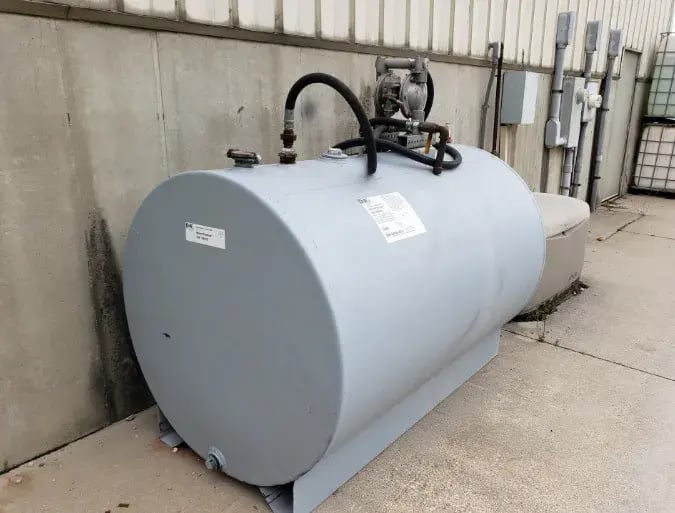
Generators, Heating Oil Tanks, Bus Fueling, and Shop Drums Can Add Up to an SPCC Plan Requirement for School Districts and Colleges
Most facilities directors know their buildings have fuel on site. Fewer have added it all up. There's a generator tank behind the high school, heating oil tanks in the older buildings, a fueling station at the bus yard, drums of motor oil and hydraulic fluid in the maintenance shop, and used cooking oil outside the cafeteria. Each one looks small on its own, but federal and New Jersey spill rules look at the total, and school districts and universities cross the line routinely once someone does the math.
This article explains when a New Jersey school or university needs an oil spill plan (the federal version is called an SPCC plan, short for Spill Prevention, Control, and Countermeasure), how the oil storage gets counted across a campus or a district, where we see gaps, and how New Jersey's own tank and spill rules layer on top. If you'd rather talk through your sites with a person, you can always reach out to RMA, and we'll tell you straight whether you need us at all.
Table of Contents
TL;DR
A New Jersey school or university needs a federal SPCC oil spill plan when it stores more than 1,320 gallons of oil aboveground, counting every container of 55 gallons or more by its full capacity. Generators, heating oil tanks, bus fueling tanks, shop drums, and oil-filled equipment all count, and the total is figured per facility, so a single contiguous campus usually adds up fast. Many districts end up with a plan at some buildings and not others. New Jersey adds its own tank program, immediate spill reporting to NJDEP, and larger discharge plans for facilities with very large storage. If your total is clearly under the threshold, you don't need a plan.
Do Schools and Universities Need an SPCC Oil Spill Plan?
Public school districts, charter schools, private schools, community colleges, and universities are all treated like any other facility under the federal oil spill prevention rule. The rule is 40 CFR Part 112, and in New Jersey it's enforced by EPA Region 2. A facility needs an SPCC plan when it meets three conditions: it stores, uses, or handles oil, a spill could reasonably be expected to reach navigable waters or adjoining shorelines, and its total aboveground oil storage capacity is greater than 1,320 gallons. Only containers of 55 gallons or more are counted, and the count is based on how much a container can hold, not how much is in it today. A tank that's half empty still counts at full size.
A spill that could reach a stream, a ditch, or a storm drain that leads to one generally meets that test, so a school with a parking lot drain or a retention basin that discharges to a brook is usually within reach. If you want the full federal basics first, our guides on what an SPCC plan is and SPCC plans in New Jersey cover the ground. Our piece on who enforces SPCC plans covers who to expect at the door.
The short answer for most districts and campuses is that some sites need a plan and some don't, and the only way to know is an inventory. A small elementary school with one 275-gallon heating oil tank and a few quart containers is well under the line. A high school with a 1,000-gallon heating oil tank and a 500-gallon generator tank is over it. We'd rather you find that out from a spreadsheet than from an inspector.
How Does SPCC Count Oil Storage Across a Campus or School District?
The threshold applies per facility, so the definition of a facility does the heavy lifting. Under the rule, a facility is the buildings, property, parcels, and equipment where oil is stored or used, and its boundaries depend on site-specific factors such as who owns or operates the buildings and how the site is run. The rule also says that contiguous or non-contiguous buildings, properties, parcels, and structures under the same owner or operator may be considered separate facilities. In practice, the owner or operator makes a reasoned call about where the lines fall, and the plan documents that call.
For a university, that usually means a single contiguous campus is one facility, and every qualifying tank and drum on it gets added together, whether it's behind the athletic center, in the central heating plant, or under a residence hall. A hundred-gallon drum here and a 500-gallon tank there reach 1,320 gallons quickly. For a school district, each school on its own parcel can often be treated as its own facility, so a district might have a dozen separate totals rather than one. Where it gets less clear is shared infrastructure. A central bus garage that fuels vehicles from several schools, or a district maintenance yard that stores bulk oil for all of them, is its own facility with its own total, and it often turns out to be the biggest one in the district.
There's no single right answer for every layout, and EPA's guidance includes diagrams for how complexes can be aggregated or separated. We'd suggest settling the boundaries early, writing down the reasoning, and keeping it consistent from plan to plan. Inconsistent boundaries are one of the first things that make a multi-site program hard to defend.
What School Oil Storage Counts Toward the 1,320-Gallon SPCC Threshold?
Oil, for SPCC purposes, covers more than petroleum fuel. It includes petroleum fuels, lubricants, hydraulic fluid, and used oil, and it also covers vegetable oils and animal fats. Propane doesn't count because it isn't an oil. The table below walks through what we typically find at schools and colleges.
| Typical School Source |
Counts Toward SPCC? |
Notes |
| Emergency generator with a sub-base or day tank |
Yes, if the container is 55 gallons or more |
Counted at the container's full capacity, and generators are often added after the plan was written. |
| Aboveground heating oil tank |
Yes |
Schools aren't single-family homes, so the residential heating oil exemption doesn't apply. |
| Aboveground bus or fleet fueling tank |
Yes |
Usually the largest single container at a district yard. |
| Drums of motor oil, hydraulic fluid, or used oil in maintenance shops |
Yes, for 55-gallon drums and larger |
Our guide on 55-gallon drums and SPCC plans covers the details. |
| Oil-filled equipment such as transformers, hydraulic elevators, and compressors |
Yes, the oil capacity counts |
Often missed because it isn't thought of as storage. |
| Cafeteria cooking oil or used cooking oil in bulk containers |
Yes, vegetable oils count |
Only containers of 55 gallons or more are counted. |
| Fuel tanks on buses, mowers, and maintenance vehicles |
No |
Motive power containers are exempt. The fueling tank that fills them is not. |
| Underground tanks |
Depends |
Tanks covered by the federal underground tank program are left out. Buried tanks that aren't covered are measured against a separate 42,000 gallon buried threshold. |
The reach-the-water test has a rule of its own: you can't count on manmade structures like berms, curbs, or sewer systems to stop a spill, so a facility with a storm drain nearby doesn't get to rule itself out because the drain has a grate on it. If you want a deeper look at how containment gets sized once a plan is required, we cover it in how big SPCC oil spill containment needs to be.
How Do School Districts Manage SPCC Plans Across Multiple Sites?
Districts that handle this well tend to treat it as a portfolio rather than a pile of individual plans. The first step is a one-time inventory of every building and yard: each container of 55 gallons or more, its capacity, what it holds, and whether it sits indoors or outdoors. Plenty of districts discover at this point that three or four sites cross the threshold and the rest don't, and that the sites needing plans are the ones with generators, bulk heating oil, or the transportation yard. Sites below 1,320 gallons don't need a plan, though it's worth rechecking whenever a generator is added or a tank is replaced with a larger one.
For the sites that do need plans, a consistent format saves a lot of effort. When every plan follows the same structure, with the same inspection forms, the same training records, and the same spill response language, a business office or facilities department can keep up with them. Smaller sites with 10,000 gallons or less of total storage and a clean spill history may be able to self-certify, while larger or more complex sites need a Professional Engineer to review and approve the plan. Our article on professional engineers and SPCC plan requirements explains where that line sits. Plans for different sites also have different review dates, so a shared calendar for the five-year review of each one prevents a plan from quietly expiring.
Many districts find that remote plan development fits multi-site work well, since much of the information comes from site descriptions, photos, and a facilities contact rather than a full walkthrough of every building. We lay out the approach in handling SPCC plans for multi-facility operations remotely. Some sites, especially a large bus garage or a campus central plant, are still better served by a visit, and we'll say so when that's the case.
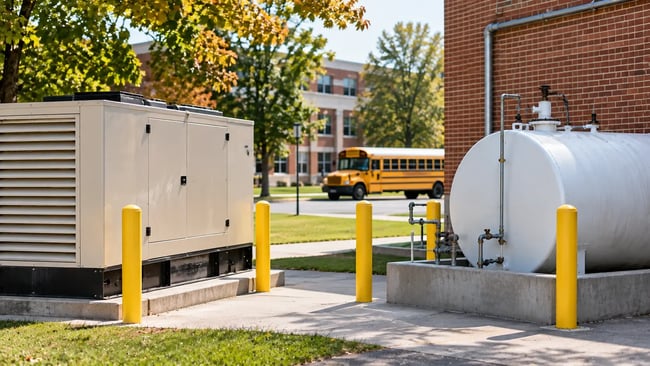
What Are the Most Common SPCC Plan Gaps at Schools and Universities?
The same handful of problems show up across school and campus facilities. They rarely come from neglect. They come from the way schools are run, with budgets approved building by building, facilities staff who turn over, and equipment added by contractors without anyone thinking about spill rules.
The most frequent one is a plan that covers one building and not the others. A district writes a plan for the high school years ago and never revisits the middle school that later got a generator. Close behind is a plan that's older than five years with no documented review. The rule requires a review at least every five years, and any physical change to the facility that affects spill risk, like a new tank, a moved fueling station, or a replaced generator, triggers an amendment sooner. If yours is old, our article on what to do when your SPCC plan is over five years old walks through the options.
Other gaps are more about day-to-day practice. Inspection records are missing, or the inspections happen but nobody signs and dates them. The staff who handle fuel, such as bus fuelers, custodians, and shop mechanics, haven't had the annual spill prevention briefing the rule calls for. Drums sit in a shop or on a loading dock with no secondary containment. The plan lists tanks that were replaced, or leaves out ones that were added. And the plan itself lives in a binder at the district office while the site that needs it has nothing on file. For a practical look at routine checks, see our list of what to check during SPCC plan inspections, and for the training piece, our online environmental training library is available for staff who need it.
How Do New Jersey's Tank Rules Apply to School Heating Oil and Fuel Tanks?
Federal SPCC is only part of the picture. New Jersey also regulates underground storage tanks under the Underground Storage of Hazardous Substances Act, with the rules in N.J.A.C. 7:14B, and NJDEP runs that program. Which tanks fall under it depends on what's stored and how much, and heating oil has its own exemptions.
For heating oil, NJDEP exempts underground tanks used to store heating oil for on-site consumption at non-residential sites when the total capacity on the site is 2,000 gallons or less, and it exempts underground heating oil tanks at residential sites regardless of size. A school building is non-residential in the ordinary sense, though NJDEP defines what counts as residential in the rule, so a dormitory or staff housing is worth checking against N.J.A.C. 7:14B before you assume an exemption. Above 2,000 gallons of underground heating oil at a non-residential site, the tank system is regulated, which brings registration, release detection, and NJDEP approvals for things like closure. Because the 2,000 gallon figure is the aggregate for the site, several smaller tanks in one building complex can add up to it.
Underground motor fuel tanks at a bus yard or a maintenance garage are a different category and are generally regulated. Tanks that feed emergency generators get some relief from certain release detection requirements, but that doesn't take them out of the program entirely, so check N.J.A.C. 7:14B-1.4 for your tank before relying on it. Even an exempt, unregulated heating oil tank isn't a free-for-all: New Jersey requires individuals and firms who do services on unregulated heating oil tanks, like installation, testing, and removal, to be certified under N.J.A.C. 7:14B-16, and regulated tanks require NJDEP-certified contractors. Aboveground tanks aren't part of the underground tank program, but they still fall under the federal SPCC count and often under fire code and construction code requirements enforced locally.
If you're installing, replacing, or removing a tank, that work involves construction and fire permits and certified contractors, and it's outside what we do. RMA doesn't prepare construction-phase permits or approvals, and for that piece you'll work with your engineer, contractor, or NJDEP-certified tank firm. What we do help with is the part that follows: updating or building the SPCC plan around the new or changed tank, and keeping the operational side current once it's in service. We can also help you figure out what the construction phase is likely to involve and point you toward the right professionals.
What Do the Spill Act and NJDEP Discharge Rules Mean for Schools?
New Jersey's Spill Compensation and Control Act, usually called the Spill Act, applies to far more than oil. It covers petroleum and other hazardous substances, and its discharge rules are in N.J.A.C. 7:1E. Two pieces matter to most schools.
The first is spill reporting. A person responsible for a discharge who knows or reasonably should know about it must notify NJDEP immediately through the hotline at 1-877-WARNDEP (1-877-927-6337). That applies to every facility, including ones that don't need a spill plan. The rule has narrow exemptions, so we wouldn't assume a small spill falls under one. Federal reporting is separate: a spill that creates a sheen on water, or that reaches a waterway, also goes to the National Response Center at 1-800-424-8802. Our article on when you have to report an oil spill breaks down the federal side. If a spill is large, active, or near a waterway, the first step is safety and calling for emergency help, and the reports follow.
The second piece is the major facility threshold. New Jersey requires a larger set of plans, called the DPCC and DCR plans (Discharge Prevention, Containment and Countermeasure, and Discharge Cleanup and Removal), for major facilities. A major facility is one with a total storage capacity of 20,000 gallons or more of non-petroleum hazardous substances, or 200,000 gallons or more of all hazardous substances including petroleum. Most schools are far below that, but a large university with a central plant, big tanks, and chemical storage across many science buildings is worth evaluating. Out-of-service tanks and containers of five gallons or less are left out of the storage count under the rule. Which substances count and how storage capacity is calculated depends on N.J.A.C. 7:1E, so check it against your own inventory or ask us.
Cleanup liability is where the Spill Act gets serious for any owner. In general terms, it imposes strict liability on the party responsible for a discharge, meaning fault isn't the test, and that liability can be joint and several, so one party can be pressed for the full cleanup cost. When a spill requires remediation, a Licensed Site Remediation Professional, or LSRP, typically oversees the cleanup in New Jersey. We're not attorneys, and if a spill or an enforcement issue is on the table, an environmental attorney is the right person to advise on liability.
What Does an SPCC Plan Cost for a School District or University?
SPCC plans from RMA generally run from about $2,500 to $15,000 per plan, and where a school lands in that range depends on a few things. The biggest are total storage capacity, the number and type of containers, whether a Professional Engineer's review and approval is needed, and whether secondary containment has to be evaluated or sized. A single-building school with a generator and a heating oil tank sits at the low end. A university campus with a heating plant, several generators, and a fueling area sits much higher. For districts, the number of sites that need a plan is the main driver of the total, and a fair amount can be handled remotely, which helps with cost.
If an old plan is out of date or was written by someone else, we usually rebuild it so we can stand behind it, rather than patching it. Our article on SPCC plan costs goes into the pricing in more detail, and the calculator below is built to give you a number for your own facility, which is a more useful figure than any general range.
How Can RMA Help With School and University SPCC Plans?
We're based in New Jersey and have been doing this since 1992, so NJDEP and the state's rules are familiar ground for us. For a school district or college, we'd typically start by helping you inventory your sites and figure out which ones cross the threshold, because plenty of buildings don't, and we'll tell you so. From there we can build plans for the sites that need them, in a consistent format your staff can manage, with a Professional Engineer's review and approval where one is needed. We can also set up inspection routines and training, and help you sort out how federal SPCC fits with New Jersey's tank and spill rules. If you're comparing options, our guide to everything about SPCC plans is a good place to start.
If you have questions, or just want a second opinion on whether a site needs a plan, there's no pressure and no obligation. You can call us, send an email, or fill out the form on our website, and you can also contact RMA directly. We'd rather give you a straight answer than sell you something you don't need.