A Plain-English Guide to When Rain on Your Property Needs a Permit, and Which New Jersey Stormwater Permit Fits Your Business
Most business owners never think about the rain that falls on their property. It hits the roof, runs across the yard, and disappears down a drain. But if your business does certain kinds of industrial work, New Jersey treats that runoff as a regulated discharge. Here's the short answer. If your business falls into one of the industrial categories the rules cover, and rain or snowmelt can touch your materials, equipment, or vehicles outside, you need either a stormwater permit or a certification that nothing at your site is exposed. If your business isn't in one of those categories, or everything happens inside a closed building, there's a good chance you don't need a permit at all.
The tricky part is that New Jersey doesn't have just one stormwater permit. It has a basic permit that covers most facilities, several permits written for specific industries, individual permits for complicated sites, and an exclusion for businesses where nothing is exposed. Below, we'll start from zero: what stormwater is, which businesses the rules cover, why exposure decides so much, what each New Jersey option looks like, and how to work out which situation you're in. Or you can always reach out to RMA and we'll help you sort it out.
Table of Contents
TL;DR
A New Jersey business needs a stormwater permit when it does a type of industrial work the rules list (most manufacturing, recycling and scrap, mining, and some transportation and waste operations) and rain or snow can touch its materials, equipment, or vehicles outside. Offices, stores, most warehouses, and many service businesses usually don't need one. Businesses that do need coverage choose from a basic general permit, several permits written for specific industries like concrete, asphalt, scrap, and mining, or an individual permit, while businesses that keep everything inside a closed building can file a no exposure certification instead. To figure out where you land, check your industry code, walk your site looking for anything rain can reach, and trace where your runoff goes.
What Is Stormwater at a New Jersey Business?
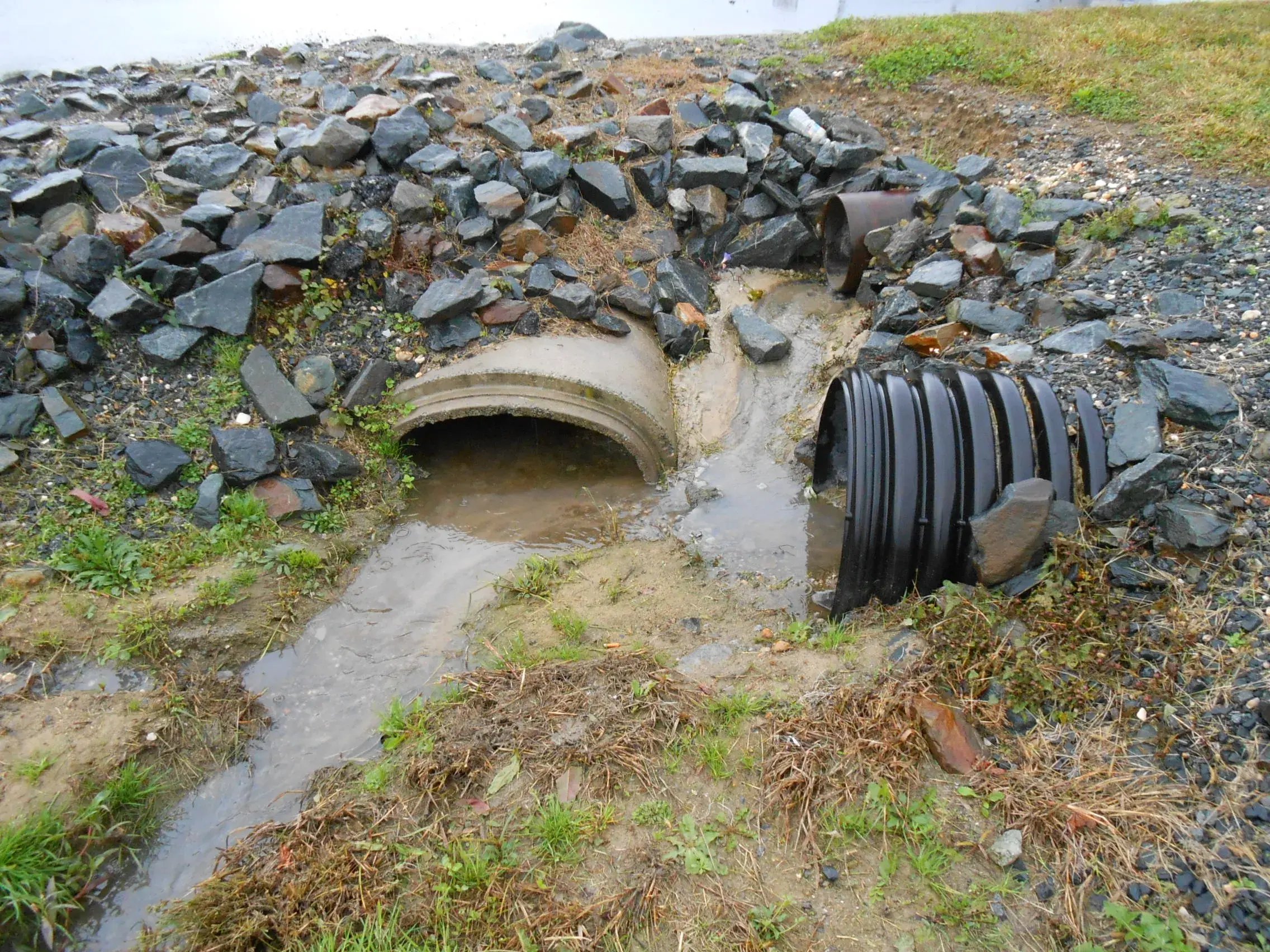
Picture your property during a heavy rain. Water lands on the roof, the parking lot, the yard, and anything sitting outside. As it moves across the site, it picks up whatever it touches: dust from a stockpile, oil drips under a loader, residue from a dumpster with the lid open, spilled product near a loading door. Then it leaves, into a storm drain in the street, a ditch along the property line, a creek behind the building, or a basin where it soaks into the ground. Regulators call that runoff "stormwater," and when it comes off a site where industrial work happens, "industrial stormwater."
Stormwater is different from water you use on purpose. Truck washwater, production water, and cooling water are process wastewater, and they're handled under separate rules. Read our guide to the difference between stormwater and process water if your site has both.
In New Jersey, the agency that regulates industrial stormwater is the New Jersey Department of Environmental Protection (NJDEP). It does this through the New Jersey Pollutant Discharge Elimination System, or NJPDES, which is the state's version of the federal NPDES permit program. NJPDES is built on the state's Water Pollution Control Act, with the detailed rules at N.J.A.C. 7:14A. Unlike many states, New Jersey covers stormwater that soaks into the ground as well as stormwater that flows into streams and storm sewers, so a site with no pipe leaving the property and a basin out back can still be in the program.
Which New Jersey Businesses Fall Under the Stormwater Permit Rules?
Having a parking lot doesn't put you in the stormwater program. The rules apply to "stormwater discharge associated with industrial activity," and that phrase is defined by a list of business types that New Jersey shares with the federal rules. Most categories are identified by Standard Industrial Classification (SIC) codes, which are four-digit codes describing what a business does. The rest are described in words, like "landfills." Our article on what stormwater associated with industrial activity means walks through the full list, but here's the general picture.
| Type of Business |
Common Examples |
What to Know |
| Manufacturing |
Food plants, metal fabricators, chemical and plastics makers, concrete plants |
Most codes covered; some lighter manufacturing only when exposed |
| Mining and quarrying |
Quarries, sand and gravel pits |
Have their own New Jersey permits |
| Recycling and salvage |
Scrap yards, auto salvage, recycling centers |
Several have industry-specific permits |
| Waste facilities |
Landfills, hazardous waste treatment and storage |
Covered alongside their waste permits |
| Transportation |
Truck terminals, bus depots, rail yards |
Only maintenance, equipment cleaning, fueling, and deicing areas |
| Utilities and treatment |
Power plants, larger wastewater treatment plants |
Covered |
It's just as useful to know who usually isn't on the list. Offices, retail stores, restaurants, and most service businesses aren't in any industrial category. Warehouses that store packaged goods indoors, data centers, auto body shops, car dealerships, and quick-lube shops often don't need an industrial stormwater permit either, because their SIC code isn't listed or only a narrow piece of their operation is. Adding a fleet maintenance bay or an outdoor fueling area can change that answer.
Why Your SIC Code Decides the New Jersey Stormwater Question
Your SIC code describes the main activity at that specific site, not what your company does overall or what's on a tax form. Getting the code wrong is one of the easiest ways to file for a permit you don't need or skip one you do. NJDEP can also send a written request to a business it believes is regulated, asking it to apply, certify no exposure, or explain why it needs neither.
Does Rain Have to Touch Something to Trigger a New Jersey Stormwater Permit?
Being in an industrial category is half the question. The other half is exposure. NJDEP's approach is about keeping rain and snow away from "source materials," meaning materials or machinery tied to your industrial work that could add pollutants to runoff. Raw materials, finished products, waste, fuel, and equipment all count.
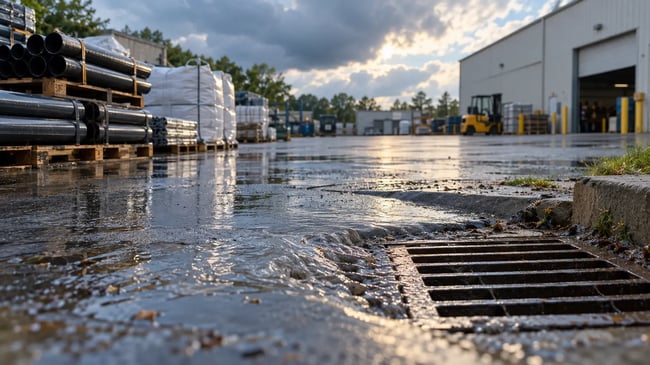
Stockpiles of aggregate, mulch, or scrap in the yard are obvious exposure. Less obvious are the forklift parked outside overnight, the open-top roll-off, drums waiting at the dock, the fuel dispenser out back, the truck wash area, and stained ground from years of old operations. Loading and unloading counts too, because moving materials is part of the industrial activity even when they're stored indoors. If rain can land on any of it and then leave the property, the site has exposure.
Where Your Site Drains Changes the New Jersey Stormwater Answer
The last piece is where the water goes. Runoff that reaches a stream, a ditch, or a town's storm sewer is a discharge to surface water and squarely in the NJPDES program. Runoff that soaks into the ground through a basin is a discharge to groundwater, which New Jersey regulates too. Runoff that goes into a sanitary sewer or a combined sewer (one pipe carrying both sewage and rainwater to a treatment plant) is different. Under N.J.A.C. 7:14A-24.2(f), stormwater going into a combined or sanitary sewer isn't covered by the industrial stormwater rules, and the local sewerage authority's rules apply instead.
Several of New Jersey's older cities still have combined sewers in at least part of town. Even in those cities, many neighborhoods drain to separate storm sewers, and a single property can drain both ways. So don't assume your city decides it for you. Find out where your own inlets and roof drains go.
What Are New Jersey's Industrial Stormwater Permit Options?
Many states rely mostly on one big permit covering dozens of industries. New Jersey splits things up. According to NJDEP, most regulated facilities fall under one basic general permit, and certain industries have their own industry-specific general permits. A general permit is a master permit NJDEP writes once, and businesses sign up for coverage under it. An individual permit is written for one facility. Here's how the options line up.
| Option |
Who It's Built For |
| Basic Industrial Stormwater General Permit (5G2) |
Most regulated facilities in industries without their own permit |
| Concrete Products Manufacturing (CPM) |
Ready mix plants and block, brick, and concrete product makers |
| Hot Mix Asphalt (R4) |
Asphalt plants |
| Mining and Quarrying (R13) |
Mines and quarries, which are no longer eligible for the 5G2 |
| Sand and Gravel (RSG) |
Sand and gravel operations whose stormwater goes only to groundwater |
| Scrap Metal (SM and SM2) |
Scrap metal yards |
| Vehicle Recycling (RVR) |
Auto salvage and vehicle recyclers |
| Wood Waste Recycling and Leaf Composting (WRC) |
Wood recyclers and leaf composting sites |
| Individual NJPDES permit |
Sites that can't eliminate exposure and don't fit a general permit |
| Permanent No Exposure Certification |
Regulated businesses with everything inside a permanent building (an exclusion, not a permit) |
Picking the right one matters because the permits rest on different assumptions. The 5G2 expects you to eliminate exposure by getting materials and activities out of the rain, which NJDEP often sums up as "remove and cover." That works for a manufacturer with a few drums and a dumpster outside. It doesn't work for a concrete plant with aggregate stockpiles or a scrap yard with acres of material, which is why those industries have their own permits, and why NJDEP says industry-specific permits may include monitoring, benchmarks, or effluent limits. The wrong permit means rules that don't fit your site and, usually, a new filing to fix it.
Our guides to the 5G2 Basic Industrial Stormwater Permit, the SM2 scrap metal permit, and concrete plants and stormwater permits go deeper on specific categories. If your site doesn't fit any of them, our article on when you need an individual NJPDES industrial permit covers that path.
What Comes With a New Jersey Stormwater Permit
Coverage under a general permit starts with a Request for Authorization (RFA), the application you file with NJDEP through its online permitting system. The core of the permit is your Stormwater Pollution Prevention Plan. New Jersey calls it an SPPP, not the SWPPP you'll see in federal guidance. It describes your site, where water flows, what's exposed, and how you keep pollutants out of runoff. From there, expect a regular cycle of site inspections, employee training, and certifying to NJDEP that you're following the plan, plus any sampling your specific permit requires. NJDEP also charges a permit fee. Our plain-English guide to NJPDES stormwater permit requirements covers the obligations in more detail, and our article on how long it takes to get a New Jersey stormwater permit covers timing.
What Is New Jersey's Permanent No Exposure Certification?
If your business is in an industrial category but nothing at your site is exposed, you may not need a permit at all. New Jersey's version of this option is the Permanent No Exposure Certification, and its rules are in N.J.A.C. 7:14A-24.6. The word "permanent" carries a lot of weight. All industrial materials have to be stored, and all industrial activities have to happen, inside a permanent building or structure anchored to a foundation and fully roofed and walled. A tarp over a pile or a shelter open on the sides doesn't meet that definition as written.
A few things can stay outside: dumpsters used only for routine waste collection, if they're watertight, leak-proof, covered, and clean on the outside; material-handling vehicles kept in normal operating condition; and pipe that isn't deteriorated or leaking (pumps and valves don't count as pipe). The certification is facility-wide, so one clean area can't be excluded while another has exposure. You resubmit it every five years, it doesn't transfer to a new operator, and NJDEP can inspect to confirm you qualify. If conditions change and something becomes exposed, the exclusion no longer applies, and the rule expects you to apply for a permit before the change happens. If you already have a permit and want to switch, the permit and all its requirements stay in effect until NJDEP inspects and formally ends it.
Our article on what no exposure means under a stormwater permit covers the general concept, and our guide to general, individual, and no exposure options compares the paths side by side.
How Do You Figure Out If Your New Jersey Business Needs a Stormwater Permit?
You can work through most of this yourself with a few questions, taken in order. Each one either settles the matter or narrows down where you land.
| Step |
Question |
What It Tells You |
| 1 |
What's the SIC code for the main activity at this site? |
Whether you're in an industrial category |
| 2 |
Is it on the list, and for transportation, do you have maintenance, washing, fueling, or deicing areas? |
If no, you likely don't need a permit |
| 3 |
Can rain or snow touch anything industrial outdoors? |
If no, you may qualify for no exposure |
| 4 |
Does runoff reach a stream, storm sewer, the ground, or a sanitary or combined sewer? |
Whether NJPDES or your sewerage authority applies |
| 5 |
Does your industry have its own permit, and can you eliminate exposure? |
Industry-specific permit, 5G2, or individual permit |
For step three, walk the site during a real rain. You'll see where water pools and what it crosses on the way out. If you find exposure, ask whether it's easy to fix. Moving a few drums inside or swapping an open container for a covered one costs a lot less than living with a permit.
If you bought or leased an existing site, check whether it already has coverage before filing anything. NJDEP's public data tools can show existing permits by facility, and the seller or landlord may have an SPPP and authorization that need to be transferred or replaced. Whatever answer you reach, write down how you got there, including your SIC code, what you looked at, and where your water goes.
Building or expanding adds a separate construction requirement while the work is happening. Projects that disturb an acre or more generally need coverage under New Jersey's Construction Activity Stormwater General Permit (5G3), which runs through the local Soil Conservation Districts along with soil erosion and sediment control certification. Your engineer, contractor, or a soil erosion specialist handles that, and RMA doesn't prepare construction permits. We can help you think through what the construction phase needs and who to talk to, then handle the operational permit or no exposure certification your facility will likely need once it's running.
Plenty of small facilities get through the basic 5G2 process on their own. Our article on whether you can get a stormwater permit yourself lays out when that works and when it tends to go sideways, and our online environmental training library can help with employee training if you go that route.
How RMA Helps New Jersey Businesses With Stormwater Permits
We're a family-run firm based in New Jersey, and we've been helping facilities with environmental compliance since 1992. We work with NJDEP's stormwater program constantly, so we know the permit categories, the paperwork, and where businesses usually get tripped up. A senior member of our team will help you figure out whether you need a permit at all, which New Jersey permit fits if you do, and whether no exposure is realistic. From there, we can handle the RFA, write your SPPP, set up inspections and annual certification, help with sampling if your permit requires it.
If it turns out you don't need a permit, or you can handle it yourself, we'll tell you that. There's no pressure and no obligation. Call us, send an email, or fill out the form on our website, and we'll talk through your situation. When you're ready, just contact RMA and we'll help you find the right next step.