Used Oil Tanks and Drums at Shops, Fleets, and Manufacturers Count Toward Federal Oil Spill Plan Rules, and Pennsylvania's Waste Oil Rules Apply on Top
If you run a shop, a fleet yard, or a manufacturing plant in Pennsylvania, there's probably a drum or a tank of used oil sitting near the service bay or the maintenance room, waiting on the next pickup. You may also have heard that federal oil spill rules kick in once a facility stores enough oil, and wondered whether oil that's already been used and is headed out the door gets counted. It does. Used oil counts toward the federal oil spill prevention rule, known as SPCC (Spill Prevention, Control, and Countermeasure), the same way new oil does.
This article walks through how used oil gets counted, what containment and inspections the oil spill plan side expects, and how Pennsylvania's separate used oil management rules fit on top. We keep the waste side brief on purpose, since it's its own program with its own requirements. If you'd rather have someone check your numbers against your actual tanks and drums, you can always reach out to RMA.
Table of Contents
TL;DR
Yes, used oil counts. The federal oil spill rule (SPCC) treats used oil as oil, so used oil drums of 55 gallons or more, totes, and tanks count toward the 1,320-gallon aboveground threshold at their full capacity, whether they're full or empty. Once a facility is over that line, the used oil belongs in the spill plan, with containment sized for it and regular inspections. Pennsylvania's waste oil rules for storage condition, labeling, and hauling are a separate program that applies at the same time.
Does Used Oil Count Toward SPCC Storage Capacity?
The SPCC rule is written around oil, and its definition of oil is broad. It covers oil of any kind and in any form, including petroleum, fuel oil, sludge, oil refuse, and oil mixed with wastes other than dredged spoil. Nothing in that definition carves out oil that's been used. A drum of spent motor oil is still oil, and it can still reach a storm drain or a stream the same way a drum of new oil can.
The used oil management rules say the same thing from the other direction. The federal standard for used oil generators, 40 CFR 279.22, states that generators are subject to all applicable SPCC requirements in addition to the used oil storage rules. So "it's waste, not product" isn't a way out. A lot of shop managers assume the two programs are alternatives, and they aren't. One asks how you store and ship the oil as a waste material. The other asks how you keep any of it from reaching water.
In Pennsylvania, EPA Region 3 enforces SPCC, and the agency can ask for your plan during an inspection. If you want the background on who shows up and why, our article on who enforces SPCC plans covers it. Used cooking oil is a related case, since animal fats and vegetable oils count too, and we cover that one separately in our piece on SPCC plans for cooking oil.
How Do You Count Used Oil Tanks and Drums Toward the 1,320-Gallon SPCC Threshold?
A facility needs an SPCC plan when its total aboveground oil storage capacity is more than 1,320 gallons, or when its completely buried capacity is more than 42,000 gallons. Only containers with a capacity of 55 gallons or more go into the aboveground total. Capacity is what counts, not what's in the container on the day someone checks, so a half-full used oil tank gets counted at its full rated size, and an empty drum still counts as 55 gallons. Containers that are permanently closed, as the rule defines that term, are left out.
Here's how it plays out at a typical fleet shop. Say the shop has a 500-gallon diesel tank, two 55-gallon drums of new motor oil, and a 275-gallon tote of new hydraulic oil. That's 885 gallons. Now add the used oil: a 275-gallon used oil tote and two 55-gallon drums of used oil, which adds another 385 gallons. The facility is at 1,270 gallons and still under the line. Put one more 55-gallon drum of used oil in the corner and it's at 1,325 gallons, which is over. Nothing about the operation changed in any way a person would notice, but the facility now needs a plan.
| Used Oil Container |
Counts Toward the SPCC Threshold? |
| 55-gallon drum (full, partly full, or empty) |
Yes, counted at 55 gallons |
| Five-gallon pails and other containers under 55 gallons |
No, not counted individually |
| Tote or IBC holding used oil |
Yes, counted at its full capacity |
| Aboveground used oil tank |
Yes, counted at its full capacity |
| Container that's permanently closed under the rule |
No |
| Completely buried used oil tank |
Tracked against the separate 42,000-gallon buried threshold, and tanks covered by the federal underground tank rules are excluded |
Smaller facilities often qualify for a simpler, self-certified plan instead of one stamped by a Professional Engineer, and we explain that split in our guide to the different types of SPCC plans. If you're not sure where your total lands, the four-step check for whether you need an SPCC plan walks through the counting, and our article on 55-gallon drums and SPCC covers the drum question in more detail.
What Secondary Containment Does Used Oil Storage Need Under SPCC?
Once used oil is part of your plan, it gets the same containment treatment as every other oil on site. For bulk storage tanks, the rule calls for a secondary means of containment that holds the entire capacity of the largest single container, plus enough freeboard to hold precipitation. For mobile or portable containers like drums and totes, the standard is a dike or catchment basin sized for the largest single container, again with freeboard for rain where the containers sit outside. In plain terms, if your biggest used oil tank is 300 gallons, the containment around it needs to hold those 300 gallons and then some, and it has to be tight enough to keep oil in until someone cleans it up.
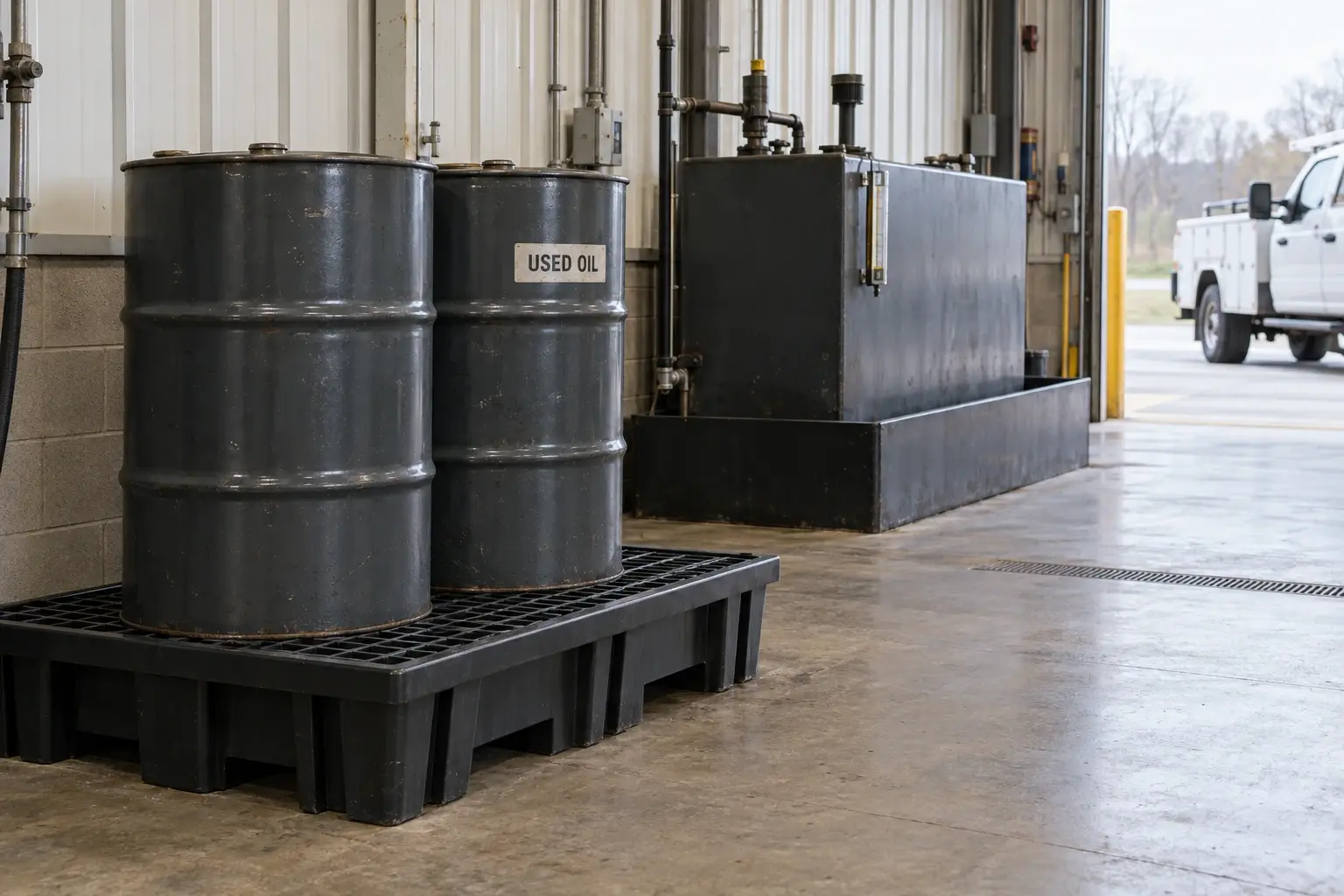
For used oil, that usually looks like a diked or curbed area around an aboveground tank, or spill containment pallets under drums and totes. Indoors, a curbed room or a sealed floor with no open drain nearby can do the job. Outdoors, rain is the complication. Water collects in a dike, and the rule lets you drain uncontaminated rainwater only if you inspect it first, keep the drain valve closed otherwise, and keep a record. Flapper-type drain valves aren't allowed on diked areas, so a dike with a drain plug that's left open is a violation waiting for a rainstorm.
If a particular containment measure really isn't practicable at your site, the plan has to say why, and it has to substitute periodic integrity testing and a written spill contingency plan, with a Professional Engineer involved in the certification. That's the exception, not the starting point. For the sizing math on dikes and pallets, our article on how big SPCC oil spill containment needs to be goes through worked examples.
What SPCC Inspections, Training, and Records Apply to Used Oil Storage?
The rule expects each aboveground container to be tested or inspected for integrity on a regular schedule and again after material repairs. It leaves the frequency and the type of inspection to industry standards, based on the container's size, design, and construction, so a shop-built steel tank and a plastic tote don't get the same treatment. Between formal inspections, someone should be looking at the outside of each container, its supports and foundation, and the containment area for signs of deterioration, leaks, and pooled oil. A visible leak has to be corrected promptly, and any oil that's collected in a dike has to be removed promptly.
The paperwork is simpler than most people expect. Inspections follow written procedures, and the records are signed by the inspector or supervisor and kept with the plan for three years. Records you already keep in the normal course of business can count, so a monthly walk-around checklist works if it's signed and filed. We list what a good monthly walk-around covers in our article on SPCC plan monthly inspections.
Training covers the people who handle the oil. That means the technician who pours drained oil into the used oil tank, the person who empties drip pans, and whoever meets the hauler when the pump-out truck arrives. Oil-handling staff need training on preventing discharges and on the contents of the plan, one person at the facility has to be accountable for discharge prevention, and the facility has to hold a discharge prevention briefing at least once a year. A pump-out is a transfer, and transfers are where a plan's loading and unloading procedures earn their keep, so used oil pickups should be written into the plan, not treated as someone else's job. Our article on annual SPCC training explains what the briefing has to cover, and our online environmental training library is one way to get staff through it. The plan itself also needs a review every five years, which we cover in our piece on SPCC plan five-year reviews.
How Do Pennsylvania's Used Oil Management Rules Fit In With SPCC?
Used oil is also a regulated waste, and that's a separate program from SPCC. The federal rules sit in 40 CFR Part 279, and Pennsylvania's version is Chapter 298 of Title 25 of the Pennsylvania Code, which the state calls the management of waste oil. Pennsylvania uses the term "waste oil" where the federal rules say "used oil," and we break down the vocabulary in our article on used oil versus waste oil.
At the federal level, a used oil generator has to keep used oil in tanks or containers, keep those containers and aboveground tanks in good condition with no visible leaks, label them, and clean up any release by stopping it, containing it, and managing the cleanup material properly. Those storage conditions overlap with what an SPCC inspection looks for, which is one reason the two programs are easier to run together. Pennsylvania's chapter has its own wording and its own requirements for labeling and for the haulers and processors your oil goes to, so check your containers against the state rules instead of assuming the federal label language is the whole answer. Used oil that gets mixed with a hazardous waste can also end up regulated as hazardous waste, which is a different set of rules entirely.
There's one more Pennsylvania layer on the tank side. DEP's Storage Tank Program, under 25 Pa. Code Chapter 245, generally regulates aboveground tanks over 250 gallons, with exclusions for certain tanks, and DEP's own tank listings include used motor oil and waste oil among the contents tracked. Whether a particular used oil tank needs DEP registration, and whether work on it has to be done by a DEP-certified installer or inspector, depends on its size, type, and use, so confirm yours against the Storage Tank Program before you buy or move one. For the waste-management side in more depth, start with our guide to the top things to know about used oil regulations, our guide to waste labels, and the waste and hazardous waste resources page.
What Used Oil SPCC Mistakes Do Pennsylvania Shops and Fleets Make?
The most common one is counting only the oil you buy. People add up the diesel tank, the new oil drums, and the hydraulic oil, land under 1,320 gallons, and never count the used oil tote by the back door. The fix is to walk the whole site, list every container of 55 gallons or more, and include the used oil, the waste oil, and anything else that's some form of oil.
The second is a plan that was right when it was written and isn't anymore. The rule requires an amendment when a change in design, construction, operation, or maintenance materially affects the potential for a discharge, and its examples include commissioning containers, moving containers, and changes of product or service. Adding a used oil tank or switching to a bigger tote fits that description. The amendment has to be prepared within six months, and it has to be implemented within six months after that. Technical amendments usually need Professional Engineer certification, with some exceptions for qualified smaller facilities.
The third is a physical one. Used oil drums end up on bare concrete near a floor drain, or outdoors on a pallet with no containment, because nobody thinks of them as part of the oil storage. The fourth is a paperwork gap, where the inspections happen but nobody signs the log. Neither is hard to fix, but both are easy to spot during an inspection, and both are the kind of thing an inspector looks at first.
How Can RMA Help With Used Oil and SPCC Plans in Pennsylvania?
We're based in New Jersey and work with facilities across Pennsylvania. For a shop, a fleet, or a plant, we can help you count your capacity correctly, tell you whether you need a plan at all, and then either write the plan or update the one you have so it covers your used oil. Our senior staff do the work, and we don't use AI to produce deliverables. We can also help you sort out which used oil and waste oil requirements apply to your site and point you toward the right DEP contacts for tank questions.
We'll also tell you when you don't need us. If your total comes in under 1,320 gallons, you may not need a plan, and if you're a smaller facility that qualifies for a self-certified plan, you may be able to handle it yourself with EPA's template. If you'd like a second set of eyes on your count, there's no pressure and no obligation. You can call us, email us, or fill out the form on our website, or just contact RMA directly, and we'll take it from there.


