Honest Ways Small New Jersey Businesses Can Lower SPCC Plan Costs, and the Shortcuts That End Up Costing More
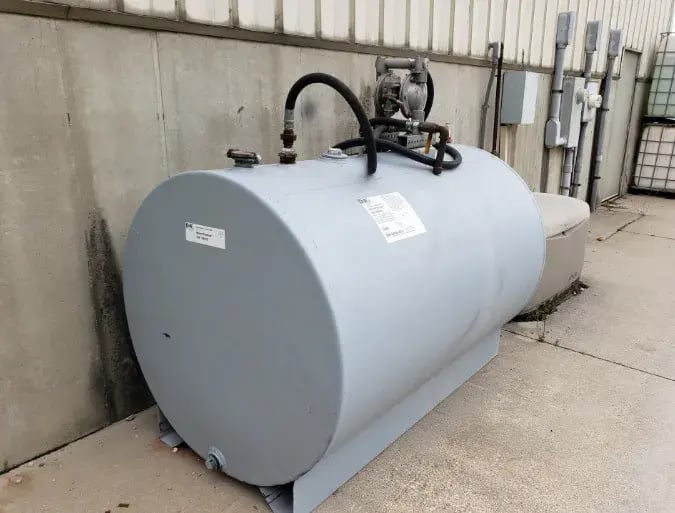
If your business stores fuel, hydraulic oil, lubricants, or used oil, there's a decent chance you need an oil spill plan, which the federal rules call a Spill Prevention, Control, and Countermeasure Plan, or SPCC Plan. For a small business sitting near the storage threshold, the question usually isn't whether to comply. It's how to comply without paying for more than the facility needs. That's a fair question, and a handful of legitimate moves can bring the bill down noticeably. A few popular shortcuts, on the other hand, tend to cost far more later.
The short answer is that the biggest savings come from storing less oil, followed by remote plan development, a local consultant, in-house inspections and training, bundled work, and a flexible deadline. We'll walk through each one, and we'll also cover where cutting corners backfires, mainly self-certifying a plan without doing the real work behind it. Some of this you can handle yourself, and we'll say so when it applies. If you'd rather talk it through, you can reach out to RMA and we'll tell you plainly what your facility needs.
Table of Contents
TL;DR
Small businesses can lower SPCC plan costs by storing less oil, using a remote plan or a local consultant, handling inspections and training in-house, bundling related services or locations, and giving the consultant a flexible timeline. Dropping below the federal storage thresholds can mean a simpler plan or no plan at all, but only if the reduction is real. Writing and self-certifying your own plan is allowed for smaller facilities, but it's the shortcut most likely to backfire, because the plan has to match your site and you're responsible for a spill either way.
Where Do Small Businesses Really Save Money on SPCC Plans?
Most of the savings come from a handful of places, and several of them stack. Storing less oil can change the kind of plan you need. Remote development, a local firm, and a flexible deadline cut the time and travel a consultant bills for. Your own staff can take over routine work once the plan exists, and bundling related work usually lowers the per-item price. The table below shows where each one fits and where it can go wrong.
| Way to Save |
Fits Best When |
Where It Backfires |
| Store less oil |
You have a tank or drums you don't need |
Capacity counts, not contents, so the reduction has to be real |
| Remote plan |
The site is simple and your team can supply good photos and records |
Complex sites need someone on the ground |
| Local, experienced firm |
Almost any facility |
Picking the cheapest quote instead of the most experienced firm |
| Self-certify |
A qualified facility with a simple layout and someone with time to do it properly |
The plan doesn't match the site, and a spill exposes it |
| Staff handle inspections and training |
The plan is already in place |
Nobody owns it and the records stop |
| Bundle services or locations |
You need other permits or have several similar sites |
Rarely a downside, as long as each piece gets real attention |
| Flexible timeline |
You're not facing a deadline or an inspection |
Waiting until after a spill or a visit removes the option |
For a sense of scale, our published range for SPCC plans runs from about $2,500 to $15,000, depending on how much oil you store, how many containers you have, and whether a Professional Engineer (PE) has to certify the plan. Our SPCC plan cost guide breaks that range down, and the SPCC pricing calculator below gives you a ballpark for having us handle yours. If your aboveground oil storage is under the federal threshold, you may not need a plan at all, and you don't need us either. For the rest of your program, see our piece on environmental compliance on a small business budget.
Can Reducing Oil Storage Lower Your SPCC Plan Requirements?
Yes, and it's the single biggest lever. The federal SPCC rule applies to facilities that store more than 1,320 gallons of oil aboveground in total, counting every container of 55 gallons or larger, and that could reasonably be expected to reach a waterway. The rule goes by capacity, not by what's in the container today, so a 5,000-gallon tank that's half full still counts as 5,000 gallons. In New Jersey, EPA Region 2 enforces the rule, and our guide on who enforces SPCC plans explains how that works.
Once you're over the threshold, a few storage numbers decide which type of plan you need, and that decides most of the cost. The table lays it out.
| Plan Type |
Storage Limits |
Who Certifies |
EPA Template |
| Tier I qualified facility |
10,000 gallons or less in total, no single container over 5,000 gallons, clean spill history |
Owner or operator |
Optional |
| Tier II qualified facility |
10,000 gallons or less in total, clean spill history |
Owner or operator, with a PE for any alternative measures |
Not allowed |
| PE-certified plan |
Over 10,000 gallons in total, or a facility that doesn't qualify |
Licensed Professional Engineer |
Not applicable |
A clean spill history is part of the test for both qualified tiers. That means no single discharge over 1,000 gallons, and no two discharges over 42 gallons each within any 12-month period, during the three years before you certify. A facility that fails that test needs a PE-certified plan no matter how little oil it stores. Our guide on the different types of SPCC plans goes deeper on each one.
Say your site has 12,000 gallons of total capacity, including one 5,000-gallon tank you barely use. That puts you over the 10,000-gallon line and into PE-certified territory. Remove that tank for good and you're at 7,000 gallons with no container over 5,000, which can put you in Tier I, where you may be able to write the plan yourself using EPA's template. It's worth asking what each large tank does for your operation before you plan around it.
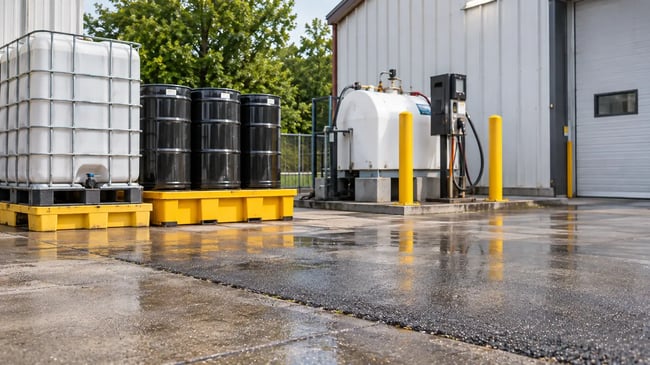
Consolidating drums works the same way, with a catch. Containers of 55 gallons or more count toward your total, so a rack of drums adds up quickly, and our article on whether 55-gallon drums are included in SPCC plans covers the details. Swapping twelve drums for one tank doesn't lower total capacity much, and it creates a large container with its own containment needs. The savings come from less total capacity, not from rearranging the same oil. Also confirm that a tank really counts as gone under the rule before you count on it. A tank you've hauled off the property is gone. One you've emptied and left sitting in place may still count toward your total, so check how the rule treats permanently closed containers before you rely on that reduction.
Dropping below the federal threshold doesn't end your responsibilities. New Jersey's Spill Act still makes the party responsible for a discharge answerable for cleanup, and the reporting duty still applies. We cover the state side in our guide to SPCC plans in New Jersey.
Does a Remote SPCC Plan Cost Less?
Often, yes. We can develop some SPCC plans entirely remotely, which means no travel time, no mileage, and no overnight stay billed to you. For a straightforward facility, such as a few tanks, a clear site layout, and good photos and records from your team, a remote plan can come in below the cost of a full site visit.
The catch is that it depends on the scale and complexity of your operation. Past a certain level of complexity, we wouldn't do a plan remotely, because a plan built from photos and a phone call can miss things that someone standing in the yard would catch. If your site is simple, it's worth asking about. Our guides on how remote SPCC development works, whether your facility is a good fit for remote development, and what a remote SPCC plan costs walk through the details.
Why Does Hiring a Local SPCC Consultant Save Money?
Consultants bill for time, and travel is time. A firm that has to fly someone in, book a hotel, and spend a day on the road is going to pass those costs along. A firm based near your facility doesn't have those costs, so more of what you pay goes into the plan itself. We're based in New Jersey, so for many New Jersey facilities there's no flight or overnight stay to build into the price.
Experience matters here as much as distance. A firm that has written a lot of SPCC plans knows the rule and the common site layouts, so it moves faster and makes fewer return trips for missing information. Fewer hours billed is the saving. We'll be upfront that we're not the cheapest option and we don't want to be. A rock-bottom quote often reflects a junior person learning the rule on your dime or a plan that gets less attention than it needs, and our article on the hidden risks of hiring the cheapest environmental consultant explains why. If you've never hired one, what it's like to hire an SPCC plan consultant shows what the process looks like.
Is a Self-Certified SPCC Plan Worth the Risk?
Self-certifying is the cheapest route, and the rule allows it for qualified facilities. It's also the shortcut most likely to backfire, so here's what you're signing when you do it.
When you self-certify, you're stating in writing that you know the rule, that you visited and examined the facility, that the plan follows accepted industry practices, and that you'll fully implement it. You're also stating that management has approved it and committed the resources to carry it out. A Professional Engineer still has to certify any alternative measures, such as a decision that standard secondary containment isn't practical.
The trouble starts when the plan on paper doesn't match the facility. EPA's Tier I template is a reasonable starting point, but in our experience it's thin for real sites. The rule requires secondary containment for the entire capacity of the largest container plus room for precipitation, and the template leaves the sizing math to you. It also leaves you to describe your own overfill prevention and build an inspection routine that fits your equipment. Those are the spots where owners tend to guess, and they're the spots an inspector looks at. Our guide on how big your SPCC containment needs to be shows how quickly that math gets involved.
Now consider a spill where the plan doesn't hold up. If the plan wasn't prepared in line with the rule, or you didn't carry out what it says, that's a violation on top of the spill itself, and a signed certification you didn't back with a real site review leaves you little to point to. The plan also doesn't cap your responsibility for the discharge, since cleanup costs and state liability fall on you either way. EPA's own guidance also notes that some states restrict self-certification, so confirm what applies to your facility before you start.
None of that means self-certifying is always wrong. If you have a handful of containers, a simple site, a clean spill history, and someone on staff with the time to read the rule and walk the property, a Tier I plan is doable, and we'd rather tell you that than have you pay for help you don't need. Treat the template as the minimum, keep the plan current, and read our guide on when to update your SPCC plan and whether you can do it yourself. Tier II is harder, because it can't use the template and the plan has to meet the full rule. We'd also steer you away from letting an AI tool write it. We tested that, and you can read what we found when we asked ChatGPT to write an SPCC plan. If your plan needs a PE, our overview of professional engineers and SPCC plan requirements explains when and why.
How Can Your Own Staff Handle SPCC Inspections and Training?
Once a plan exists, a lot of the ongoing work is routine, and your team can do it for less than an outside firm would charge. Regular inspections of tanks, containment, and oil-filled equipment are the main piece, and your plan spells out what to look at and how often. Our list of the top 10 things to do during your SPCC monthly inspections gives your inspector a place to start.
Training is the other piece. The rule expects employees who handle oil to know the plan, understand how to prevent discharges, and know what to do if one happens. You can outline that yourself using our guide on what SPCC training should include, or buy a course from our online environmental training library instead of paying for custom or on-site sessions.
Two things keep this from going sideways. Put one person in charge and give them the time, because inspections that live on nobody's to-do list stop happening. And keep the records, since an inspection you did but didn't write down is hard to prove later. Outside help still earns its fee on the higher-risk jobs, like the five-year plan review and any change to your tanks or containment that triggers an amendment.
Does Bundling Services or Locations Lower SPCC Plan Prices?
Usually, yes. A facility that needs an SPCC plan often needs other work too, such as stormwater permitting or Tier II chemical reporting. When one firm learns your site once and handles several items, there's less repeated discovery, fewer site visits, and a smoother schedule, and most firms, us included, charge less per service when the work comes together than when each item is bought separately.
The same logic applies if you run more than one location. Getting several plans done at the same time is often cheaper per plan, especially when the facilities are similar. Similar sites are also the best candidates for remote development, which stacks two savings on top of each other. Our article on handling SPCC plans for multi-facility operations remotely explains how that works.
Can a Flexible Timeline Lower Your SPCC Plan Cost?
It can. A consultant who can slot your plan in around other work doesn't have to reshuffle a schedule or work evenings, and rush jobs tend to cost more for exactly that reason. If you're flying under the radar, with no inspection, lender request, or other deadline pressing on you, give your consultant room. Our guide on how long it takes to get an SPCC plan gives typical timelines so you can plan ahead.
That flexibility disappears fast in a few situations. A new facility is expected to have its plan in place before it begins operations. A facility that has just had a spill or an inspector's visit is suddenly on a clock. And a plan that has reached its five-year review date has a deadline built in. The last one is predictable, so put it on the calendar early rather than paying a rush premium. Our article on what to do when your SPCC plan is over 5 years old walks through the options.
What Does Skipping a Real SPCC Plan Cost When Something Goes Wrong?
Saving a few thousand dollars looks different next to the cost of a violation. Under EPA's 2025 inflation adjustment, a Class I administrative penalty for violating the SPCC rule can reach $23,647 per day of violation, up to a cap of $59,114, and larger administrative and judicial penalties exist above that. EPA adjusts these amounts every year, so check 40 CFR 19.4 for the current figures. Our guide on the top SPCC plan violations and fines and our violation cost calculator help you put numbers on your own situation.
When a spill is involved, fines are often the smaller part of the bill. New Jersey's Spill Compensation and Control Act, known as the Spill Act, generally makes the party responsible for a discharge liable for cleanup and removal costs, and courts and the state have described that liability as strict, joint, and several. In plain terms, you can end up paying for the whole cleanup. Anyone responsible for a discharge of petroleum or another hazardous substance is expected to notify the NJDEP hotline at 1-877-WARNDEP (1-877-927-6337). Don't assume a small spill is too small to report. We explain the federal side in our article on when you have to report an oil spill, and the state's reporting rules are in N.J.A.C. 7:1E. If a spill is happening right now, make the situation safe first and call 911 if there's a fire or an injury risk, then call the hotline.
A small number of New Jersey facilities also fall under Discharge Prevention, Containment and Countermeasure (DPCC) and Discharge Cleanup and Removal (DCR) plan requirements for major facilities under N.J.A.C. 7:1E. Whether your facility counts depends on its total storage capacity and what it stores, so check the rule against your own inventory, or ask us. The broader picture of what non-compliance really costs is in our piece on the hidden costs of environmental non-compliance. We're consultants, not attorneys, so if you're facing a violation or a significant discharge, an environmental attorney is a sensible call to make.
How Does RMA Help Small Businesses With SPCC Plans?
We help small businesses figure out what they need and then do it at the lowest cost that still holds up. That starts with the question of whether you need a plan at all, and if you're under the threshold, we'll say so. If you do need one, we'll tell you which type fits, whether your facility is a candidate for a remote plan, and whether the self-certified route is realistic for you. Senior staff do the work, and you won't find AI producing your deliverables. Our guide to saving on environmental compliance covers free tools you can use before you ever call us.
If you'd like to talk it through, there's no pressure and no obligation. You can call us at 888-RMA-0230, send us an email, or fill out the form on our contact page, and one of our team will get back to you with straight answers about what your facility needs and what it should cost.