A Facility Walkthrough for Finding Exposed Materials, Pollutant Sources, and Existing Controls, Then Getting Them Documented in Your New Jersey Stormwater Plan
If your New Jersey facility needs a stormwater pollution prevention plan, the first real task isn't writing. It's walking your property and seeing it the way rainwater does. The plan goes by a few names: SWPPP (we say "swip"), SPPP, SP3, or just a stormwater plan. NJDEP's permits call it the SPPP, and we'll use SWPPP here. The short answer to how you find and document your pollution sources is to walk the whole site with a site plan in hand, look at everything that can touch rain or snowmelt, write down each material and activity you find, note what's already protecting it, and turn all of that into a map, an inventory, and a list of fixes.
This article lays out how we'd run that walkthrough: who to bring, what to look for in each area of the site, how to spot discharges that shouldn't be heading to a storm drain, what a good site map shows, and how to record your existing controls and the gaps. If you'd rather have a second set of eyes on your site, you can reach out to RMA any time, and we'll tell you straight whether you need us at all.
Table of Contents
TL;DR
To find the stormwater pollution sources for your New Jersey SWPPP, walk your entire facility with a site plan, once in dry weather and once in or right after rain. Look at loading areas, outdoor storage, liquids, fueling and maintenance, waste containers, dust, washing, and roofs, and ask whether rain could carry anything away from each one. Record every material and activity, mark where water flows and leaves the site, note what controls already exist and whether they work, and list a fix with a completion date for every gap. That gives you the site map, source material inventory, and corrective action list your plan is built on.
What Is a New Jersey SWPPP, and Why Does the Facility Walkthrough Come First?
New Jersey's Department of Environmental Protection (NJDEP) regulates industrial stormwater through the New Jersey Pollutant Discharge Elimination System, or NJPDES, which is the state's permit program for discharges to water. Most facilities that need coverage fall under the Basic Industrial Stormwater General Permit, known as the 5G2, or one of the industry-specific general permits for things like concrete products, hot mix asphalt, mining, scrap metal, and vehicle recycling. A smaller group holds individual permits. If you're not sure which one is yours, our guide on which NPDES permit you need walks through the options, and our article on NJPDES stormwater permit requirements covers what New Jersey facilities face.
Whichever permit applies, NJDEP's stated aim for the plan is to prevent stormwater contamination by eliminating exposure of industrial materials, machinery, waste products, and other source materials to rain and snowmelt. "Source material" is NJDEP's term for any material or machinery tied to your operations that could be a source of pollutants. The plan includes a site map, an inventory of source materials, and a named stormwater pollution prevention team, and NJDEP's own guidance describes the starting point as walking through your facility and finding the places where those materials are exposed to the weather. The exact contents vary by permit, so your own authorization has the final word. For the basics of the plan itself, see our explainer on what a SWPPP is.
The walkthrough also answers a question some facilities never think to ask. If you can keep every industrial material and activity indoors or otherwise out of the weather, New Jersey has a "Permanent No Exposure" option under N.J.A.C. 7:14A-24.6 that may take the place of a permit and a plan. Our article on what no exposure means covers the details. A careful walk is the fastest way to see how far your site is from that line.
How Do You Prepare for a SWPPP Facility Walkthrough?
Start with people. The plan format NJDEP uses calls for a stormwater pollution prevention team with one named facility contact, and the best walkthroughs include whoever signs your permit paperwork plus someone from operations, someone from maintenance, and someone from shipping and receiving. The yard supervisor knows which corner of the lot turns into overflow storage in a busy week. The person who signs the paperwork usually doesn't, and the plan has to describe the site as it really runs.
Gather your paper before you go: the permit authorization, any existing plan, a current site plan or aerial image, your chemical and fuel inventories, and any SPCC plan, Tier II report, or other environmental plans you keep. Those inventories give you a head start on the list of materials, though they tend to miss outdoor items like bagged product, scrap piles, spare parts, and old drums behind a building. Treat them as a starting list, not the finished one.
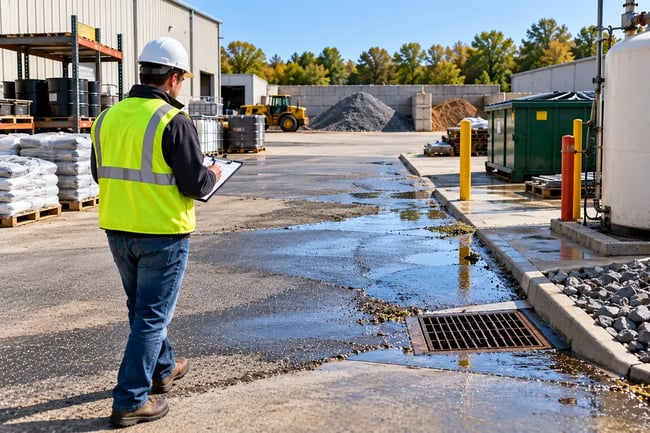
Plan two passes. A dry-weather walk lets you catalog materials and activities without distraction. A second walk during or right after a rain shows where water travels, which pavement it crosses, which pile it runs through, and where it leaves the property. If you can only do one, make it the rain walk, even though it's the less comfortable one. Bring a camera, a clipboard or tablet, and a printed site plan to mark up. Take dated photos of everything. They become part of your records and make every future update faster.
How Do You Find Exposed Materials and Stormwater Pollutant Sources on Your Site?
Walk the property line first, then work inward, and look at one area at a time. For each spot, ask what's here, what's it made of, and what happens when rain hits it. NJDEP's source material guidance gives a simple screening test you can run on anything you find. Ask whether the material is a liquid that stormwater can easily carry, whether it erodes or blows around, whether it dissolves in water, whether it breaks down or corrodes in a way that adds pollutants, and whether it would change the color or odor of runoff. A yes to any one of them makes it a source material that needs a control. Use your eyes and your nose. If you can picture rain running over something and carrying a piece of it away, write it down.
The table below covers the areas we check on nearly every industrial site in New Jersey, along with what we look for and the usual ways to take the exposure away.
| Area of the Site |
What to Look For |
Common Ways to Eliminate Exposure |
| Loading and unloading |
Dry bulk or liquids transferred outdoors, drips and spills at hoses and hoppers, product tracked off the dock |
Cover or enclose the dock, drip pans, spill kits, sweeping routines, drain covers during transfers |
| Outdoor storage of raw materials and products |
Piles of aggregate, powders, pellets, bagged product, scrap, uncovered pallets, anything stained or rusting |
Roof or tarp, move inside, bunkers or berms, remove material you no longer need |
| Liquid storage |
Drums, totes, aboveground tanks, waste oil, antifreeze, open or unlabeled containers |
Move inside or under a roof, secondary containment, covered drum storage, regular checks |
| Fueling, vehicle, and equipment maintenance |
Fuel islands, leaking equipment, parts washing, parked equipment with drips, stained pavement |
Roof over fueling, indoor maintenance, drip pans, absorbents, designated work areas |
| Waste containers |
Open dumpsters and roll-offs, scrap bins, overflowing or leaking containers, residue on the outside |
Lids and watertight covers, regular hauling, keep the area swept |
| Dust and particulate sources |
Dust collectors, crushing, cutting, mixing, residue settling on roofs, ground, and vehicles |
Capture at the source, enclosures, sweeping, a set cleaning schedule |
| Wash areas |
Vehicle, truck, or equipment washing, rinse water running toward a drain |
Capture and reuse, move indoors, approved sewer connection, stop the activity |
| Roofs, vents, and building exteriors |
Stained downspouts, vents depositing residue, corroded metal that flakes |
Repairs and coatings, redirect roof drainage, clean up residue |
Which Materials Count as Source Materials Under NJDEP Guidance?
Not everything outside is a source material, and knowing where NJDEP draws the line saves you from listing your whole yard. NJDEP's guidance has long treated clean, durable finished products meant for outdoor use, like precast concrete products, structural steel, and clean wooden pallets, as generally not source materials, as long as they carry no coating, film, or residue. Stone that's washed before delivery gets similar treatment. Drums go the other way. The guidance counts drums that hold or have held material as source materials, even factory-sealed ones, unless they're empty, thoroughly cleaned, and free of residue. Dumpsters that take industrial waste count unless they're covered and watertight, and even then they belong in the plan. Vehicles and machinery count wherever their fluids are exposed. Small, temporary stockpiles kept for things like emergency repairs get some leniency, but the limits are specific, so check NJDEP's current guidance for your permit before leaning on that. When you're unsure, list it and cover it.
How Do You Spot Non-Stormwater Discharges and Process Water Problems?
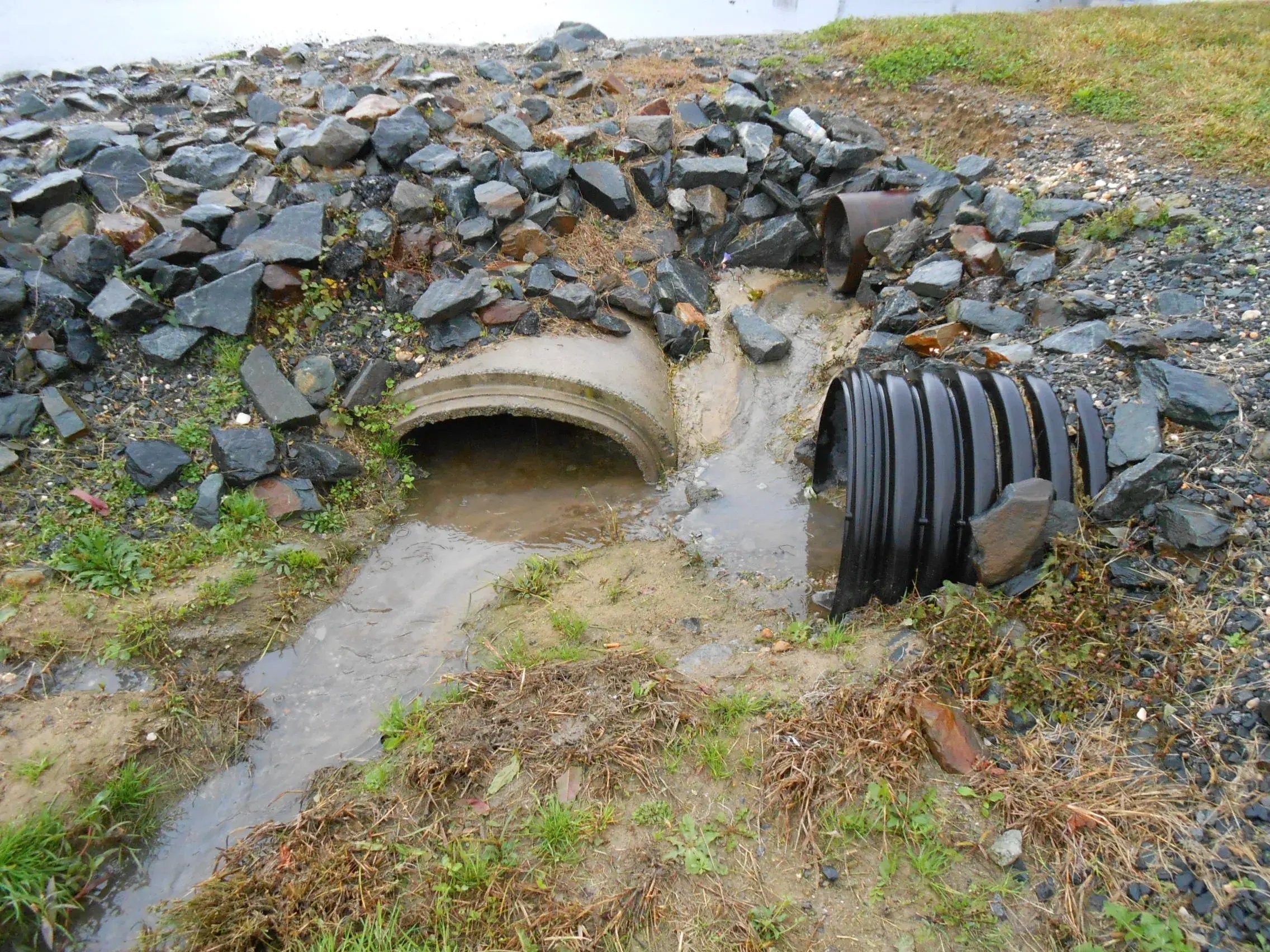
The walkthrough isn't only about things sitting outside. It's also about water that has no business reaching a storm drain. Look for floor drains and trench drains that connect to the storm system instead of the sanitary sewer, hoses and wash stations that drain across the yard, cooling water outlets, leaking process equipment, and any pipe discharging when it hasn't rained. Dry-weather flow from an outfall is a red flag. If you aren't sure where a drain goes, dye testing or a drawing review with your building plans can settle it.
That affects your plan because NJDEP's guidance says the Basic Industrial Stormwater General Permit doesn't authorize discharges of process wastewater, non-contact cooling water, or domestic sewage, and that those may need a separate NJPDES permit. If your wash water or process water is reaching the ground or a storm sewer, the fix usually comes before the paperwork: capture and reuse it, haul it for proper disposal, connect to a sanitary sewer with the local sewerage authority's approval, or stop the activity. Our article on the difference between stormwater and process water explains where the line sits. Whatever you find, list it in the plan's inventory along with where it goes and any permit that covers it.
What Should a New Jersey SWPPP Site Map Show?
The site map turns your walkthrough notes into something an inspector, a new employee, or you next year can read in a minute. NJDEP's guidance says existing engineered drawings are fine to use and hand-drawn maps are acceptable if everything is clearly labeled, and that the map should be drawn to scale where possible. The goal is a picture of where pollutants sit, where they could meet stormwater, and where that water leaves your property.
| Map Feature |
What to Show |
| Buildings and structures |
Every building, shed, canopy, and permanent structure, labeled by use |
| Paved areas |
Roads, parking, and access areas, so water paths across pavement are visible |
| Roof drainage |
Where downspouts and roof runoff go |
| Drainage patterns and conveyances |
Flow arrows, inlets, pipes, swales, ditches, and sheet flow across the surface |
| Discharge points |
Every location where stormwater leaves the site, whether to surface water, a storm sewer, or the ground |
| Source materials and activities |
Where materials are used, stored, or sit, and where industrial activity happens |
| Outdoor industrial areas |
Outdoor handling, treatment, storage, or disposal, loading and unloading, outdoor processing or cleaning, and dust-generating processes |
| Waste areas |
Hazardous waste storage and any on-site waste management or disposal |
| Non-stormwater entry points |
Any place sanitary sewage, cooling water, or process wastewater enters a storm sewer |
A few habits make the map far more useful. Number each source area on the map and use the same numbers in your inventory, so a reader can flip between them. Use one color for flow arrows and another for materials. Mark existing controls like covers, berms, and drain inserts right on the drawing. A map nobody can follow doesn't help during an inspection, and a map that doesn't match the yard gets you in trouble faster than having no map at all.
How Do You Document Existing Stormwater Controls and BMPs?
Once you know what's exposed, look at what's already in place. Best management practices, or BMPs, are the controls that keep materials and rain apart, and they come in two kinds. Structural BMPs are things you can point to: roofs, covers, berms, secondary containment, drain inserts, oil/water separators, swales, and settling basins. Non-structural BMPs are habits and procedures: sweeping schedules, spill response steps, written procedures for fueling and deliveries, inspections, and employee training. Our explainer on what stormwater BMPs are goes through more examples.
For every source area you found, write down what control exists, what shape it's in, and whether it keeps the material out of the rain. A ripped tarp is a control on paper and an exposure in practice. A berm that's full of water, a spill kit that's empty, and a dumpster lid that never closes all count as gaps. Take a photo of each, and note who's responsible for the area.
Then close the gaps on paper. NJDEP's approach leans on removing and covering, so for each gap, write the corrective action and a scheduled completion date: move the drums inside, build a roof over the transfer point, replace the cover, add a drip pan, change the procedure. Do the cheap ones now. Putting a lid on a container or relocating a pallet takes an afternoon, and it shortens the list of items an inspector could find. Larger projects like a new storage building or a wash water reclaim system need a budget and a schedule, and the schedule belongs in the plan. If a fix would need engineering design, say so plainly and bring in an engineer, because that's a different kind of work than the plan itself.
How Do You Record Your Findings and Keep the SWPPP Current?
NJDEP's SPPP forms give a good template for where each finding goes. The inventory lists every industrial activity, each source material with how it's used, stored, and handled (including quantities), every non-stormwater discharge with any permit that covers it, and the other NJDEP permits the facility holds. The site map comes from the walk. The BMP section carries your corrective actions and dates. A maintenance section explains how you'll keep structural controls working and update procedures. The table below shows the records that keep the plan alive after the first walkthrough.
| Record |
What It Shows |
When to Update |
| Site map |
Layout, drainage, discharge points, source areas |
Whenever the layout or storage areas change |
| Source material inventory |
Activities, materials, quantities, non-stormwater discharges |
Whenever materials or activities change |
| BMP list with completion dates |
Each fix and when it was finished |
As each corrective action is completed |
| Monthly inspection log |
Date, problems found, steps taken to fix them |
Monthly |
| Annual inspection and certification |
Whether the plan is current, implemented, and working |
Annually, on the schedule in your permit authorization |
| Employee training record |
Date, topic, and who attended |
Annually |
The monthly walk is the same walk you just did, in shorter form, and it's what keeps the plan accurate. NJDEP's general permit calls for recorded monthly maintenance inspections and an annual inspection with a certification form. NJDEP's forms say not to send in the plan itself with the certification, but to keep the plan and a copy of the form on site. Your authorization sets the due dates, so check it rather than assuming a calendar date. Our guide on doing a stormwater visual inspection the right way gives a simple routine for those monthly checks. Training is part of the picture too. NJDEP's forms include an annual stormwater training record, and our online environmental training library is one way to cover your team.
Finally, tie your stormwater plan to the other plans you already keep. NJDEP's forms ask you to cite where your SPCC plan, any Toxic Release Inventory reports, any New Jersey discharge prevention plans under N.J.A.C. 7:1E, and similar documents live. The tanks and drums you found on the walk may also trigger SPCC requirements, which kick in federally at more than 1,320 gallons of aboveground oil storage in total. We cover how the two plans fit together in the difference between an SPCC plan and a SWPPP.
Should You Do Your SWPPP Walkthrough Yourself or Get Help?
Plenty of facilities can do this themselves, and we'd rather you know that than pay for something you don't need. If your operations are simple, your site is small, you know your permit category, and your team has the time, the steps above will get you most of the way. Our article on writing your own SWPPP covers what that looks like in practice.
Outside help earns its keep in a few situations: you aren't sure which permit category fits, the site has a lot of outdoor activity or several overlapping plans, a past inspection or violation has you worried, or nobody on staff has the hours to do it right. What a walkthrough and plan cost depends on the permit category, the size and complexity of the site, how many outdoor activities and materials there are, and whether you already have a plan to update or you're starting from nothing. You can run the numbers on RMA's help with the pricing calculator below.
How Can RMA Help With Your New Jersey SWPPP Walkthrough?
RMA is based in New Jersey and has worked with NJDEP permits for decades, and senior staff do the work on your site, not a junior handoff. We can walk your facility with you, review a walkthrough you've done yourself, build or update your SWPPP, and train your team to run the monthly and annual routines on their own. After you're permitted, we also offer annual support, from reminders and plan updates to inspection prep and questions as they come up, as hands-on or as hands-off as you like.
We're also upfront about fit. We don't do engineering design or treatment system construction, and we're not the right choice for someone shopping purely on the lowest price or the fastest turnaround. We're a small firm, we're sometimes pricier than other consultants, and our timelines depend on workload, which we'll tell you at the start. If you'd like to talk it through, you can call us at 888-RMA-0230, or fill out the form on our website and reach out to RMA. There's no pressure and no obligation, and if a simpler route works better for you, we'll say so.