Your Renewal Application Is Due 180 Days Before Expiration. Here's What Happens If DEP Runs Late, What Happens If You Do, and How to Use Renewal to Fix Your Permit
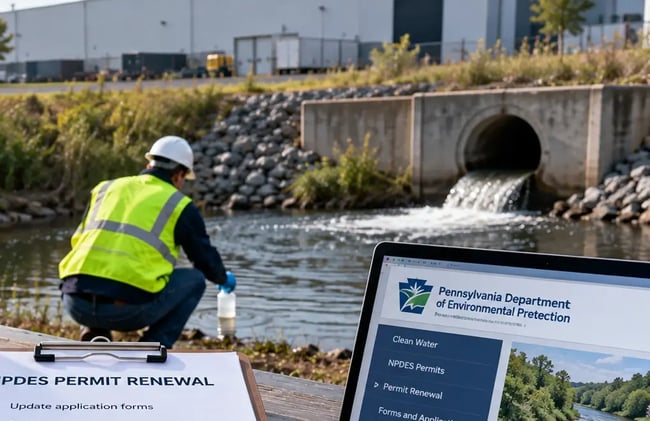
If your Pennsylvania facility discharges industrial stormwater under an individual NPDES permit, that permit has an end date. NPDES stands for National Pollutant Discharge Elimination System, the Clean Water Act program that Pennsylvania's Department of Environmental Protection (DEP) runs in the state, and an individual permit is the one written specifically for your site rather than the general permit many industrial facilities use. Pennsylvania limits these permits to a term of no more than five years, and DEP expects your renewal application at least 180 days before the expiration date. File a complete application by then and your current permit stays in force even if DEP hasn't finished its review when the old one expires. Miss the deadline, or file something incomplete, and you can end up discharging stormwater without a valid permit.
This article covers how renewal works, how to count back to your real due date, why the six months before that date go faster than anyone expects, and what DEP's own procedures say happens when an application is late or incomplete. We'll also look at how renewal gives you a chance to fix problems with your current permit, including whether your facility might now qualify to move to PAG-03, Pennsylvania's general permit for industrial stormwater. If you'd rather hand the paperwork and the DEP back-and-forth to someone who does it regularly, you can reach out to RMA at any point.
Table of Contents
TL;DR
Individual NPDES stormwater permits in Pennsylvania last up to five years, and DEP wants a complete renewal application at least 180 days before the permit expires. If your application is on time and complete, the permit's terms carry over automatically while DEP finishes its review, and you keep following every condition until a new permit is issued. If you're late, DEP's procedures call for violation notices and possible penalties, and an expired permit means you're treated as applying for a brand new one. Renewal is also your best chance to fix monitoring or outfall problems and ask whether PAG-03 now fits.
How Does Pennsylvania Individual NPDES Stormwater Permit Renewal Work?
Under 25 Pa. Code Chapter 92a, the state's NPDES regulations, every NPDES permit has a fixed term that can't run past five years. When that term is almost up, you file a renewal application with the Clean Water Program at your DEP regional office. DEP reviews it for completeness first, then does a technical review of your operations, outfalls, discharges, and monitoring history. For individual permits, DEP typically publishes notice of the renewal application and its tentative decision in the Pennsylvania Bulletin, and the notices we've seen give the public 30 days to comment before a final permit is issued.
If you aren't sure an individual permit is the right kind of coverage for your site in the first place, our guide on which NPDES permit you need lays out the differences between individual permits, general permits, and No Exposure Certifications. Because DEP writes the conditions for your facility, renewal is more than a form you sign again. DEP rebuilds the permit using current rules and the data you've collected over the past term.
When Is Your Pennsylvania Individual NPDES Permit Renewal Application Due?
The renewal application is due at least 180 days before the expiration date printed on your permit. DEP's own procedure for handling late renewals defines a timely application as one submitted at least 180 days before the permit expires, or by a later due date that DEP approved in advance but still before expiration. DEP decides whether you were on time by the postmark date rather than the date it received the package, which matters if you're mailing anything. Here's what the calendar looks like for a permit that expires December 31, 2027, used as an example.
| When |
What Happens |
| By the end of 2026 (at least a year out) |
DEP's procedure is to send an automated reminder letter to the permit contact it has on file, at least a year before expiration. |
| Early 2027 |
Your working window. Gather monitoring data, check outfalls and drainage, and decide what you want changed. |
| July 4, 2027 |
The 180-day mark. Your complete application is due. |
| December 31, 2027 |
Permit expires. DEP can't approve a submission date after this, no matter the circumstances. |
DEP's procedure does leave some room for extensions. If you or your consultant contact DEP on or before the due date, the request goes to a Permits Chief, who generally grants permission to submit later and generally won't go beyond 90 days, and never past the expiration date. After the due date has passed, staff will generally deny an extension request and tell you a Notice of Violation is coming. Ask early or don't count on it. The expiration date and renewal due date also appear on the paper discharge monitoring reports DEP issues and in inspection reports, and our article on what happens during a PA DEP stormwater inspection covers what those visits look like.
The reminder letter is a courtesy. It goes to whoever DEP has listed in its eFACTS database (the online system DEP uses to track facilities and permits), and that person may have left the company years ago. Look at the expiration date on your permit today, subtract 180 days, and put the result on the calendar of someone who will still be there.
Why Should You Start Your Pennsylvania NPDES Permit Renewal Early?
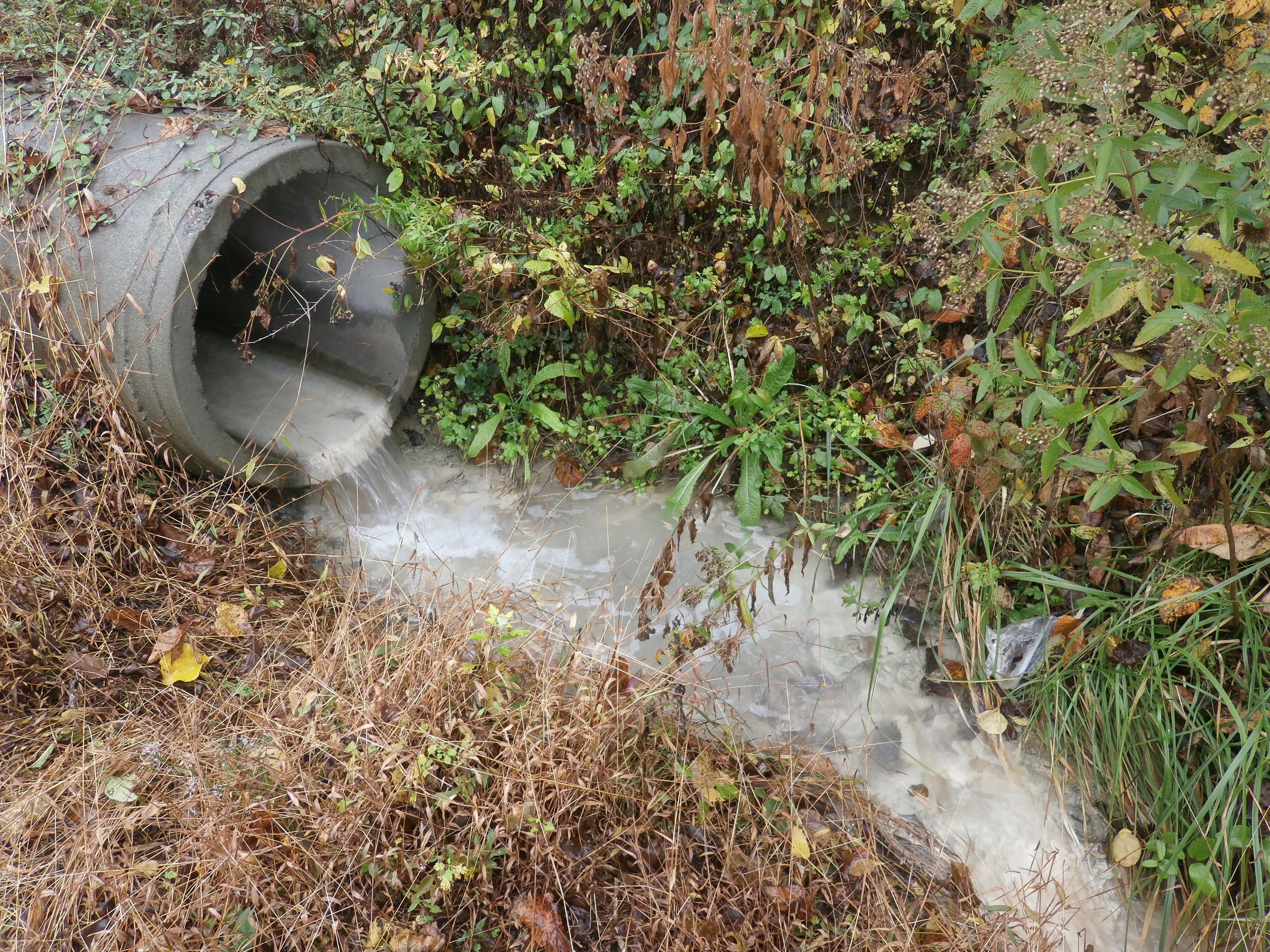
Six months sounds generous until you list what has to happen inside it. DEP's renewal package asks for current information about your operations, your outfalls (the points where stormwater leaves your site), and your discharges, and it leans on the monitoring results you've reported over the past term. That means pulling your electronic discharge monitoring report (eDMR) history, checking it against what your permit required, and confirming every outfall on the permit still exists. If a sampling gap or a changed drainage pattern turns up, you want to find it in January, not the week before the deadline, because fixing it may take lab time, a site walk, or an updated map.
Completeness is the other reason to get ahead. DEP's regulations say it may not process an application that is incomplete or otherwise deficient (25 Pa. Code § 92a.25). DEP's procedure is to send a deficiency letter that gives you 30 days to supply what's missing. Its template says that if you answer within those 30 days, DEP treats the permit as administratively continued. If you don't, and DEP can't reissue the permit before it expires, the template warns that the permit's terms are not automatically continued and you're at risk of operating without one. A timely but incomplete application, in other words, doesn't carry the same protection as a timely and complete one. Our post on common NPDES permit problems and how we fix them covers other problems that surface when someone finally looks closely at a permit file.
What Happens If Your NPDES Permit Expires Before DEP Acts on the Renewal?
Under 25 Pa. Code § 92a.7, the terms and conditions of an expiring permit are automatically continued when two things are true. You submitted a timely application for reissuance, and DEP couldn't reissue or deny the permit before the expiration date through no fault of yours. A permit continued this way stays effective and enforceable until DEP takes final action on your pending application. Once your complete application is in, DEP's procedure is to send an administrative extension letter confirming the continuation, so keep that letter with your permit records in case anyone ever asks.
Continuation is not a pause. Everything in your existing permit still applies, including sampling, visual inspections, recordkeeping, and reporting through Pennsylvania's eDMR system. Your discharge monitoring reports still have to go in on schedule, and the benchmarks and limits in the old permit still count against you. If you want a refresher on what those reports are, we cover them in what discharge monitoring reports are.
If DEP's review stalls because you didn't answer a deficiency letter or a technical question, that delay is on you, and continuation can be at risk. Treat DEP's requests for information as deadlines.
What Happens If You Submit a Pennsylvania NPDES Renewal Late?
What happens next depends on when the application shows up relative to the expiration date. DEP's procedure describes different paths, and it reserves discretion to deviate from them, so read this table as the general pattern and not a promise.
| Situation |
What DEP's Procedure Generally Calls For |
| Application arrives after the 180-day mark but before the permit expires |
DEP may issue a Notice of Violation and can follow it with a proposed consent assessment of civil penalty. DEP may still process the application. |
| No application, and the permit expires while you're still discharging |
A Notice of Violation, then generally a proposed consent order and agreement or an order, with a civil penalty and a deadline to submit a new permit application and fee. |
| Application is incomplete and the permit expires before it's fixed |
DEP's letters tell the permittee it's discharging without a permit. A fixed application is reviewed as a new permit application, and you owe the fee difference between a new and a reissued permit. |
The penalty exposure is real. DEP's own enforcement letter templates cite civil penalties of up to $10,000 per day under Section 605 of the Clean Streams Law for discharging without a permit, along with federal enforcement and citizen suits under the Clean Water Act. If you've already missed the 180-day mark, file as soon as you can. An application that reaches DEP before the permit expires leads to a much better set of options than one that arrives after. And if you've received a Notice of Violation or a proposed consent order, an environmental attorney may be appropriate before you respond, since what you sign becomes part of your compliance record.
How Can You Use Your NPDES Renewal to Fix Problems or Request Changes?
Renewal is the one regular moment when DEP reopens your whole permit, which makes it the best time to raise anything that bothers you. DEP decides what goes in the final permit, but a request backed by data and a clear technical reason has a far better chance than a complaint after the permit is issued. And since DEP builds the renewed permit from current rules and your recent results, limits and monitoring requirements can come out tighter or looser than before.
| If This Describes Your Site |
Raise This at Renewal |
| Samples keep coming in high at one or more outfalls |
The corrective actions you've taken and the results since. Showing improvement helps more than explaining it away. |
| A required parameter or sampling frequency doesn't fit your operations |
A request to adjust it, with your monitoring history as the technical support. |
| Drainage or activities have changed, or an outfall no longer discharges |
Updated outfall information, maps, and activities so the permit matches what's on the ground. |
| Your site may now fit a simpler type of coverage |
A conversation with DEP about PAG-03 or a No Exposure Certification before you file anything. |
If high results are your main headache, our article on what to do if your stormwater sampling results are high walks through how to find the cause and fix it before DEP reads your data again.
Could You Move From an Individual Permit to PAG-03 When It's Time to Renew?
Sometimes, and it's worth asking. PAG-03 is DEP's general permit for stormwater associated with industrial activity. Instead of a permit written for your site, you submit a Notice of Intent (NOI) for coverage under a standard set of conditions, and your plan is a PPC Plan, short for Preparedness, Prevention and Contingency Plan. Facilities that held individual permits for years because of an old eligibility issue or a past sampling problem sometimes find the picture has changed. Our guides to Pennsylvania's PAG-03 permit and to SWPPPs versus PPC Plans cover what that route involves.
Eligibility is the sticking point. A facility that discharges to High Quality or Exceptional Value waters can't use PAG-03, and DEP has required individual permits for facilities whose receiving stream turned out to carry one of those designations. A site that has or needs an individual permit for non-stormwater discharges generally can't use PAG-03 for its stormwater either, because the stormwater is folded into that individual permit. DEP can also decide that a particular facility needs an individual permit to protect water quality, and a poor compliance history can stand in the way.
Timing matters here as much as eligibility. PAG-03's own terms say a facility that holds an individual permit and applies for PAG-03 coverage can keep discharging under the individual permit while DEP reviews the NOI. Our article on how long PAG-03 coverage takes in Pennsylvania gives you a feel for the timeline. Unless DEP tells you otherwise in writing, treat your individual permit's renewal deadline as live until PAG-03 coverage is in your hands. If your operations are entirely indoors, a No Exposure Certification may be a third option, though it isn't available for discharges to High Quality or Exceptional Value waters.
If your renewal comes alongside building or expanding on the site, the construction side is a separate track. Construction stormwater coverage, erosion and sediment control plans, and township or county approvals have their own requirements, and RMA doesn't prepare those. Your engineer or contractor usually handles them. Where we help is the operational side once the facility is running, including the permit your renewal covers.
How Can RMA Help With Your Individual NPDES Stormwater Permit Renewal?
We work with Pennsylvania facilities on individual NPDES permits all the time. That can mean reviewing your permit and monitoring history, working out what to ask DEP for, preparing the renewal application and supporting documents, and staying involved when DEP comes back with questions. If it turns out PAG-03 or a No Exposure Certification is a realistic option for your site, we'll tell you that too, even when it means a smaller project for us. And if your team handles most of this well on its own, we'll say so. A library of online environmental training courses can help the people carrying out the permit day to day.
There's no pressure and no obligation. You can call, email, or fill out the form on our website, tell us when your permit expires, and we'll let you know whether it makes sense to work together. If you'd like to talk it through, get in touch with our team whenever you're ready.